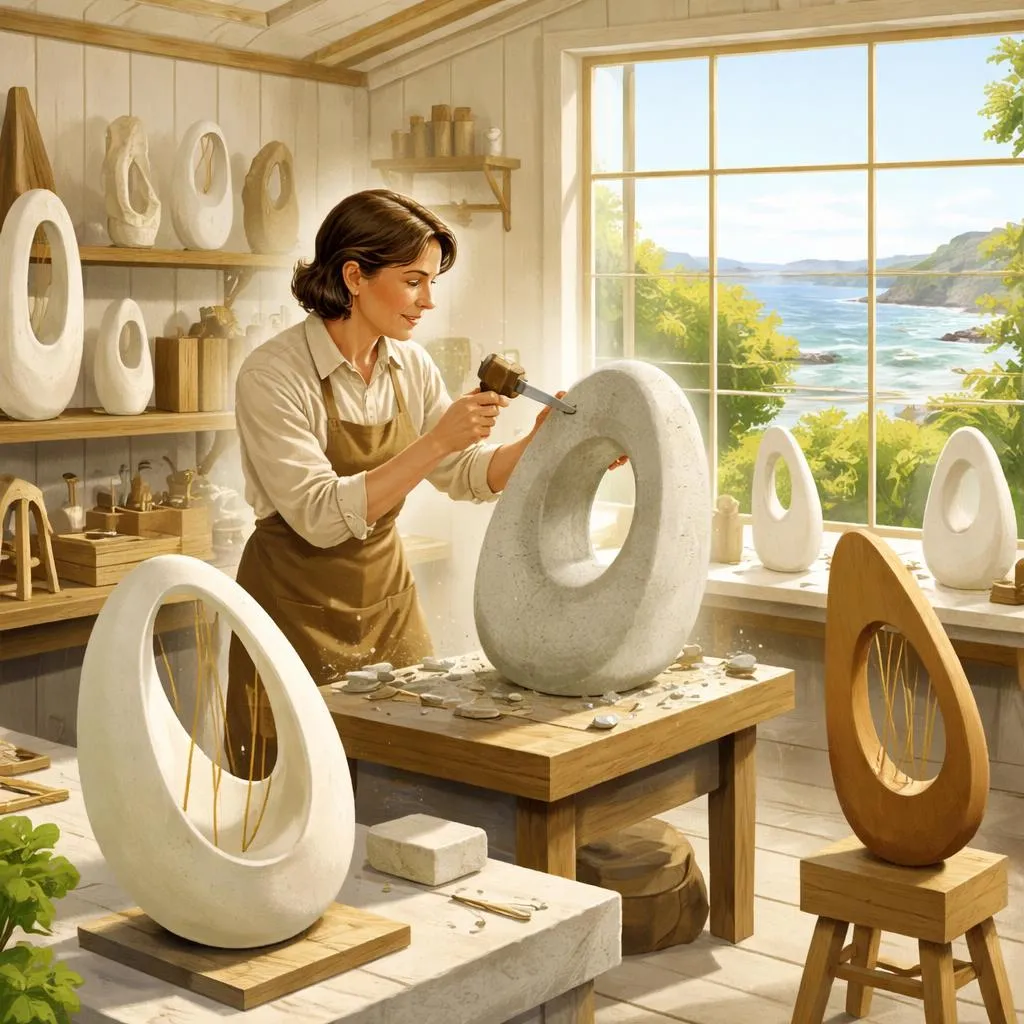

Have you ever seen a sculpture made of two hollowed stones standing upright with a string stretched between them? The string vibrates. The sculpture feels alive. That is a Barbara Hepworth sculpture. This Celebrity Story: Barbara Hepworth will introduce you to one of the most important sculptors of the 20th century. She was a woman in a world of men. She carved stone and wood with her own hands. She did not let assistants do the work. She put holes in her sculptures. She called them "pierced forms." The holes let you see through the sculpture to the landscape beyond. She lived in Cornwall, a beautiful coastal region of England. She placed her sculptures in her garden. The sky and sea became part of her art.
Let us meet the sculptor who opened up solid form. Barbara Hepworth believed that sculpture should be touched and walked around.
Who Is This Celebrity?
Barbara Hepworth was a British sculptor. She lived from 1903 to 1975. She was one of the leading abstract sculptors of her generation. She worked in stone, wood, and bronze. She is best known for her pierced forms. She carved holes into her sculptures. The holes became as important as the solid parts.
Why is she famous? She was one of the first women to achieve international fame as a sculptor. She carved directly into her materials. She did not make clay models first. Her work is smooth, organic, and beautiful. She often painted her wooden sculptures with bright colors. She also made sculptures with strings stretched across openings. The strings suggest tension and movement. Her studio and garden in St Ives, Cornwall, is now a museum. Thousands of people visit each year.
Early Life and Childhood
Barbara Hepworth was born in Wakefield, Yorkshire, England. Her father was a civil engineer. He was a county surveyor. He encouraged Barbara to work hard. He did not believe women were weaker than men. He treated her equally.
As a child, she won a scholarship to the Wakefield Girls' High School. She was a good student. She loved art. She decided to become a sculptor when she was 15 years old. She saw photographs of ancient Egyptian sculptures. She was fascinated. She knew her path.
Her father was supportive. He drove her to the train station. She left for art school. She was only 17.
She studied at the Leeds School of Art. There she met Henry Moore. They became friends. They both wanted to become sculptors. They influenced each other.
She then studied at the Royal College of Art in London. She graduated in 1924. She won a scholarship to travel to Italy. She studied Renaissance sculpture. She learned to carve in stone.
Education and Learning Journey
Barbara Hepworth studied at the Leeds School of Art and the Royal College of Art. She learned traditional techniques. She learned to model in clay. She learned to carve stone and wood.
Her most important education came from travel. She went to Italy. She saw the work of Michelangelo and other Renaissance sculptors. She was impressed by their skill. But she did not want to copy them. She wanted to find her own voice.
She also traveled to Paris. She saw the work of modern sculptors like Constantin Brancu?i and Jean Arp. They simplified forms to their essence. They carved directly into materials. Hepworth was inspired.
She began to carve directly into stone. She did not make preparatory models. She let the stone guide her. She said, "I am a sculptor. I carve with my hands."
She married a sculptor named John Skeaping. They worked together. They carved animals and simple figures. But the marriage did not last.
In 1931, she fell in love with another artist, Ben Nicholson. He was also married. Their affair caused a scandal. She left her husband. She married Ben in 1938. They moved to Cornwall at the start of World War II. Cornwall was safer than London.
How Did They Become Successful?
Barbara Hepworth became successful in the 1930s. She exhibited with a group of modern artists called Unit One. Critics noticed her work.
Her big breakthrough came in the 1950s. After World War II, her career took off. She was commissioned to create a large sculpture for the Festival of Britain in 1951. The sculpture was called "Contrapuntal Forms." It was a great success.
In 1959, she won the Grand Prize at the S?o Paulo Biennial in Brazil. That is a major international art competition. She was the first woman to win.
Her fame continued to grow. She received many public commissions. She made a sculpture for the United Nations building in New York. She made a sculpture for the university in Oxford. She made a sculpture for a hospital in London.
She also created a memorial sculpture for her friend Dag Hammarskj?ld. Hammarskj?ld was the Secretary-General of the United Nations. He died in a plane crash. Hepworth's sculpture, "Single Form," stands outside the UN building in New York. It is huge.
She continued to work until her death in 1975. She died in a fire in her studio. She was 72 years old. She had been working until the last day.
Big Ideas and Achievements
Barbara Hepworth's biggest idea was that sculpture should be open. Before her, sculpture was mostly solid. She carved holes. She let the space become part of the form. She said, "I use holes to let the space flow through."
Her greatest achievement is her series of "Pierced Forms." She started making them in the 1930s. She carved holes through stone and wood. The holes let you see the landscape beyond. The sculpture becomes a frame for nature.
Another huge achievement is her sculptures with strings. She would carve an opening. Then she would stretch strings across it. The strings create a web of tension. The strings also suggest musical instruments. They look like harps.
She also achieved great success as a public artist. Her sculptures are in parks and plazas around the world. "Single Form" in New York is one of her largest. "The Family of Man" in England is another.
She also made many drawings. Her drawings show surgeons in operating rooms. She was fascinated by the way surgeons used their hands. She said surgeons and sculptors both heal.
She was also a mother. She had four children. One of her children died in a plane crash. That tragedy affected her deeply. She poured her grief into her art.
Challenges and Difficult Times
Barbara Hepworth faced many challenges. First, she was a woman in a male-dominated field. She had to fight for respect. She did not let men push her aside.
Second, she had to balance motherhood and art. She had three children. She sculpted while they napped. She taught them to respect her work.
Third, her son Paul died in a plane crash in 1953. He was an artist. He was only 25. Hepworth was devastated. She never fully recovered. She poured her grief into her sculpture "Group with Stones." That work is full of pain and love.
Fourth, World War II was difficult. She lived in Cornwall. She had no money. She carved with found materials. She used stone from the beach.
Fifth, she had health problems. She had severe arthritis. Carving stone was painful. She kept working.
Fun Facts About the Celebrity
Barbara Hepworth carved with her hands, not with tools. She said she needed to feel the stone.
Another fun fact: She and Henry Moore were close friends. They helped each other. They also competed with each other. It was a friendly rivalry.
She painted her wooden sculptures. She used bright colors: red, blue, yellow, and white. The colors made the forms sing.
She loved music. She listened to classical music while she worked. She said the rhythm of music helped her carve.
One more fact: She had a pet cat named Python. The cat lived in her studio. The cat would sit on her sculptures.
Why Is This Celebrity Important Today?
Barbara Hepworth is important because she opened up sculpture. She let the space flow through. She showed that a hole can be as powerful as a solid.
She is also important because she was a successful woman in a male field. She paved the way for future generations of women artists. She proved that women could carve stone as well as men.
Her studio and garden in St Ives, Cornwall, is now the Barbara Hepworth Museum. You can see her sculptures in the garden. The sky and sea are part of the art.
Parents can use her story to teach children about persistence. Hepworth faced many obstacles. She kept working. She kept carving.
What Can Kids Learn from This Story?
Kids can learn beautiful lessons from Barbara Hepworth. First, open up your art. Hepworth put holes in her sculptures. The holes let you see through. When you draw, leave some spaces empty. The empty spaces matter too.
Second, feel the material. Hepworth carved with her hands. She touched the stone. When you make art, touch it. Feel the paper. Feel the clay. Your hands are your tools.
Third, balance work and family. Hepworth was a mother and an artist. She did both. You can have many roles. You can be an artist and an athlete. You can be a student and a friend.
Finally, be strong. Hepworth was a woman in a man's world. She did not give up. If you face prejudice, keep going. Prove them wrong.
Quick Quiz or Practice Time
Let us see what you learned from this Celebrity Story: Barbara Hepworth. Answer these questions with a parent or by yourself.
What did Hepworth call the holes she carved in her sculptures?
Which famous British sculptor was Hepworth's friend?
Where did Hepworth live and work in Cornwall?
What did Hepworth stretch across some of her sculptures?
What tragedy happened to Hepworth's son?
Here is a fun activity. Get a piece of clay or play-doh. Make a solid shape. Then carve a hole through it. Put your finger through the hole. Look through the hole at the room. You have made a pierced form like Barbara Hepworth.
Another activity. Look up Barbara Hepworth's "Single Form" online with your parent. It stands outside the United Nations in New York. Then draw a sculpture that you would put in a park. Make it abstract. Make it smooth. You are designing like Hepworth.
Barbara Hepworth was a pioneer. She carved stone with her hands. She put holes in her sculptures. She let the space flow through. She stretched strings across openings. She painted her wood with bright colors. She placed her work in her garden. The sky and sea became part of her art. She was a mother. She was a wife. She was a friend to Henry Moore. She won the Grand Prize in S?o Paulo. She made a memorial for the United Nations. She died in a fire in her studio. Her garden is now a museum. Her sculptures are in parks around the world. Her story teaches us to open up. To let the space in. To be strong. To keep carving. That is the real lesson of this celebrity story.