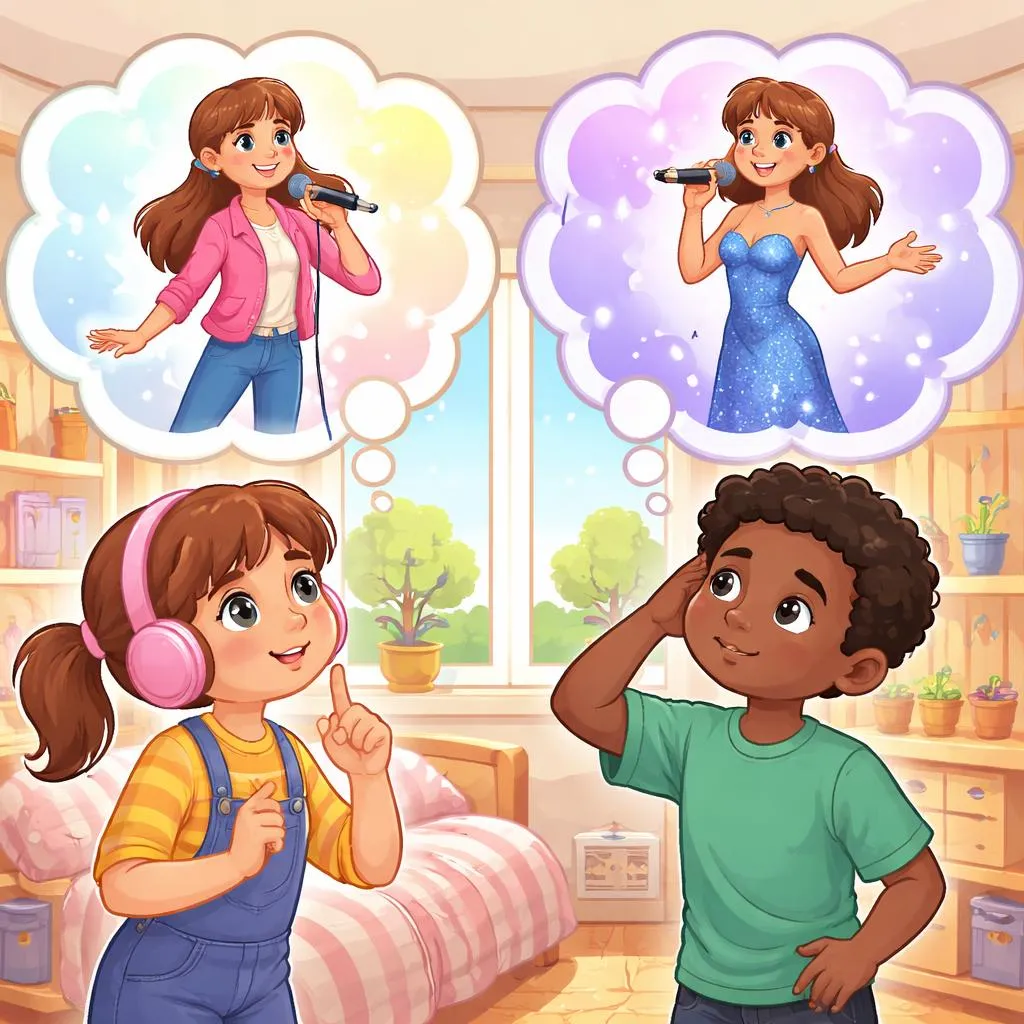

What Do These Expressions Mean? “A singer” and “a vocalist” both mean a person who uses their voice to make music. They tell a child that this person sings songs, with or without instruments. Children hear these words when listening to music, watching concerts, or singing in choir. Both describe voice artists.
“A singer” is the common, everyday word for a person who sings. A child says it when asking “Is she a singer?” It is short and natural.
“A vocalist” means the same thing, but it is more formal. It is often used in jazz, classical, or professional contexts. A child might hear it on a radio station or in a music class. It sounds grown-up.
These expressions seem similar. Both mean “a person who sings.” Both describe the same job. But one is for everyday talk while one is for formal or professional use.
What's the Difference? One is the standard, everyday word. One is a more formal or professional term. “Singer” is what you say to your family and friends. It is simple and direct. Children learn it first.
“Vocalist” is used in formal music contexts, like jazz, classical, or on album credits. You might see “lead vocalist” on a CD. A child saying “vocalist” sounds very grown-up. It is correct but unusual.
Think of a child listening to pop music. “I love that singer” is right. “I love that vocalist” would sound formal. One is natural. One is fancy.
One is for all conversations. The other is for professional or written contexts. “Singer” for talking. “Vocalist” for album notes. Use the first for speaking. Use the second for understanding.
Also, “vocalist” is sometimes used to emphasize skill or training. A “vocalist” might have studied voice. A “singer” can be anyone who sings.
When Do We Use Each One? Use “singer” for everyday conversation. Use it for pop stars, choir members, or anyone who sings. Use it as the standard word. It fits daily life.
Examples at home: “My favorite singer is Taylor Swift.” “The singer has a beautiful voice.” “I want to be a singer when I grow up.”
Use “vocalist” rarely. Use it in formal music talk, on album credits, or in professional contexts. Use it to teach the word. Children almost never need to say this word.
Examples for formality: “The lead vocalist of the band is amazing.” (professional) “She is a classically trained vocalist.” (formal) “The album credits listed the vocalists.” (written)
Most children should just say “singer.” It is clear, natural, and friendly. “Vocalist” is good to understand for reading music credits. But for speaking, “singer” is best.
Example Sentences for Kids A singer: “A singer uses their voice.” “The singer sang a lullaby.” “I am a singer in the school choir.”
A vocalist: “The vocalist sang a jazz song.” (formal) “The band’s lead vocalist wrote the lyrics.” (professional) “A vocalist is another word for singer.” (learning)
Notice “singer” is normal speech. “Vocalist” is more formal and professional. Children learn both. One for life. One for music class.
Parents can use “singer” every day. Save “vocalist” for vocabulary lessons. “The album says ‘lead vocalist.’ That means the main singer.” Learning happens in small moments.
Common Mistakes to Avoid Some children say “vocalist” for every singer. That sounds too formal. Stick with “singer” for everyday talk. Save “vocalist” for music class.
Wrong: “My favorite vocalist is on the radio.” Right: “My favorite singer is on the radio.”
Another mistake: thinking a vocalist is not a singer. A vocalist is a singer, just a more formal word. Teach the connection.
Wrong: “A vocalist is different from a singer.” Right: “A vocalist is a formal word for a singer.”
Some learners think “vocalist” is only for choirs or opera. It can be for any genre, but it is formal. For pop music, “singer” is fine.
Also avoid using “vocalist” for a person who sings occasionally. A child humming is a singer, not a vocalist. Vocalist implies professionalism.
Easy Memory Tips Think of “singer” as a microphone on a stage. Everyday. Friendly. For general talk.
Think of “vocalist” as a music award. Formal. Professional. For official contexts.
Another trick: remember the formality. “Singer” = talking. “Vocalist” = writing or professional. Talking gets “singer.” Professional gets “vocalist.”
Parents can say: “Singer for a tune. Vocalist for a music room in June.”
Practice at home. Pop star: “singer.” Jazz album credit: “vocalist.”
Quick Practice Time Let us try a small exercise. Choose the better phrase for each situation.
A child tells a friend about their favorite YouTube music star. a) “She is a great vocalist.” b) “She is a great singer.”
A child reads the liner notes of a jazz album. a) “The singer is Sarah.” b) “The vocalist is Sarah.”
Answers: 1 – b. A child talking to a friend fits the everyday “singer.” 2 – a or b. “Vocalist” is more formal and fits album notes.
Fill in the blank: “When I talk about the person who sings in my favorite band, I say ______.” (“Singer” is the natural, everyday, standard choice.)
One more: “When I read the credits on a classical music CD, it says ______.” (“Vocalist” fits the formal, professional, written description.)
Singing brings joy. “Singer” is for talking. “Vocalist” is for formal music. Teach your child both. A child who learns both can speak of their favorite music and read the credits too.