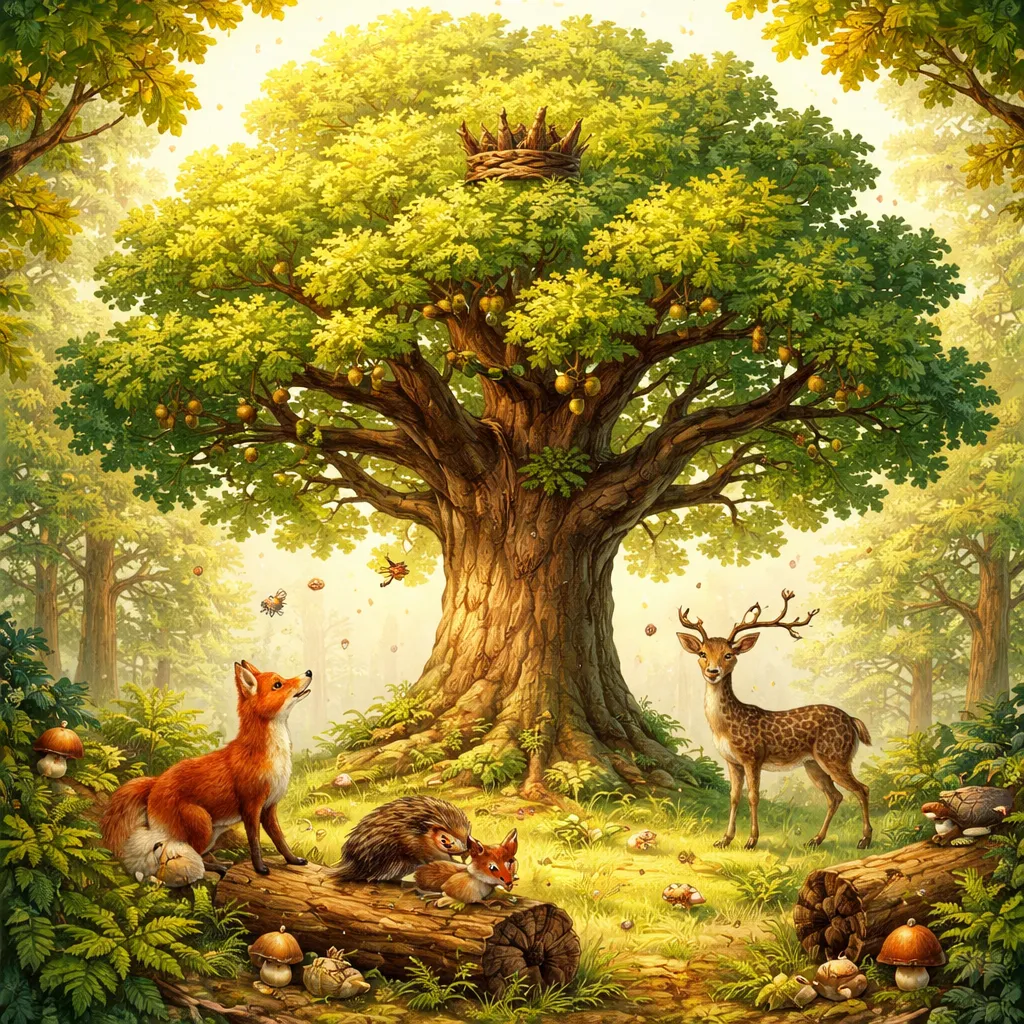

Have you ever seen a tree so big and strong, it looks like it could tell stories a thousand years old? Its trunk is wide and twisted, its branches reach out like mighty arms, and its leaves have wavy edges like a castle’s battlements. In autumn, it drops hard, brown nuts wearing little hats. Squirrels scramble to collect and hide them. This tree stands for strength, wisdom, and shelter in stories from all over the world. Let’s meet the mighty ruler of the woodland, the noble Oak plant.
Let’s Learn the Word! – Open the Treasure Box of Language
Formal Name and Pronunciation
This forest king is called an Oak. You can say it like this: /oʊk/ (oh-k). It’s a short, strong, round-sounding word, just like the tree itself. It rhymes with “cloak” and “joke.” Oak. Say it with a deep, respectful voice!
The Etymology Tale
The word “Oak” is ancient. It comes from the Old English word “āc,” which simply meant oak tree. This word is so old, it is related to words in other very old languages like Latin (“aesculus”) and Greek. For thousands of years, across many lands, people have had a special name for this most important tree. Its name echoes with history.
Nicknames and Friendly Aliases
Oaks have grand and friendly names. People often call it the “Mighty Oak” because of its great strength. A famous type is the “English Oak” or “Pedunculate Oak.” The “White Oak” and “Red Oak” are common in North America. Because it lives so long, it is often called the “Monarch of the Forest” or the “Ancient One.” A single, very old oak is sometimes just called a “Grandfather Tree.”
Building Your Word Web: Core Parts
Let’s learn the words for an Oak’s powerful body. The Acorn is the famous nut, the oak’s seed. It sits in a little cup called a Cupule that looks like a tiny, rough hat. The Leaf is broad, with rounded or pointy Lobes and Sinuses (the bays or dips between the lobes). The Trunk is massive, gnarled, and covered in thick, rough, deeply grooved Bark. The Canopy is the tree’s huge, spreading crown of branches and leaves, creating a giant umbrella of shade. A Gall is a strange, round growth on leaves or twigs, like a wooden marble, made when a tiny wasp lays an egg. The Taproot is the main, deep root that goes straight down, an anchor for the giant.
Action and State Words
Oaks are steady and generous. They stand firm for centuries. They shed their leaves in autumn and drop thousands of acorns. They provide shelter and food for countless creatures. They endure storms, droughts, and time. An oak tree is majestic, sturdy, long-lived, and venerable (worthy of great respect).
Ecosystem Friends Vocabulary
The oak is a whole universe. More life depends on the oak than on any other native tree! Squirrels, jays, woodpeckers, mice, and deer all eat acorns. Over 500 species of caterpillars (which become moths and butterflies) eat the leaves. Owls, raccoons, and foxes make homes in its hollows. Countless insects, lichens, and mosses live on its bark. It is the ultimate animal apartment building and supermarket.
Cultural Imprint in Language
A famous proverb says: “Great oaks from little acorns grow.” This means big, important things start from small, humble beginnings—just like you! The poet Alfred, Lord Tennyson, wrote in “The Oak”: “Live thy Life, Young and old, Like yon oak, Bright in spring, Living gold.” He describes the oak as bright green in youth and golden in old age, a model for a full life. We describe a very strong person as being “as strong as an oak.” An “oak leaf cluster” is a symbol for military bravery.
Ready for Discovery
We know its mighty name. Are you ready to uncover the secrets of this forest king? Let’s go on a detective mission to discover the Oak plant’s ancient wisdom.
Discover the Plant’s Secrets! – A Nature Detective’s Notebook
The Plant Passport
Oaks belong to the Beech family, Fagaceae. Their grand group name is Quercus. An oak is like a giant, kind, old giant with a thick, wrinkled body and arms spread wide to hug the forest. Its leaves are famous for their lobed shape, green in summer, turning beautiful shades of brown, red, or russet in fall. Its flowers are tiny, dangling catkins in spring. Its fruit is the mighty acorn. It grows very slowly but lives for hundreds, even over a thousand years. It is a deciduous tree, though some oaks keep their brown leaves all winter.
Survival Smarts
The oak’s genius is in its two-part strategy. First, it makes tannins. These are bitter chemicals in its leaves and acorns that make them taste bad to many animals, protecting the tree. Second, it makes a mast crop. This means every few years, instead of a few acorns, it makes thousands and thousands all at once! The animals can’t eat them all, so some always survive to grow. Its deep taproot anchors it against storms and finds water deep underground during droughts.
Its Role and Gifts
The oak is the cornerstone of its ecosystem. It is a “keystone species,” meaning the whole habitat depends on it. Its acorns are a crucial winter food for wildlife. Its leaves feed more kinds of caterpillars than any other tree, which feed baby birds. Its dead wood hosts fungi and insects that recycle nutrients. As an environmental engineer, its vast canopy rains leaves that create rich soil. Its roots prevent erosion. A single old oak can absorb tons of carbon dioxide, cleaning our air for centuries.
Stories and Symbols
Globally, the oak is a supreme symbol of strength, endurance, justice, and wisdom. Ancient Greeks, Romans, Celts, and Norse all revered it as sacred to their chief gods (Zeus, Jupiter, Dagda, Thor). The “Charter Oak” in America hid important documents. Kings were crowned under oaks. Its incredibly strong, durable wood built ships, cathedrals, barrels for wine, and fine furniture. It is the wood of legend and history.
Fun “Wow!” Facts
Get ready for a mighty surprise! A single, large old oak tree can be home to over 500 different species of insects, birds, mammals, mosses, and fungi. It’s a bustling city! And here is a time-travel fact: some oak trees alive today in England are over 1,000 years old. They were already hundreds of years old when William Shakespeare was writing his plays!
From Legend to Your Sapling
The Oak plant’s story is epic. Would you like to help write its next chapter? You can plant a legacy that may outlive us all. Let’s learn how to plant an oak.
Let’s Grow It Together! – A Little Guardian’s Action Guide
Good for Home Growing?
You must plan for the future! A mighty oak needs a huge space in a big garden or a community park. It is not for a pot forever. But you can start an acorn in a deep pot and care for it as a sapling for a few years before finding it a “forever home” in open ground. It is a project of incredible patience and hope.
Little Gardener’s Toolkit
You will need a healthy, plump acorn collected in autumn (float test it in water—use the sinkers!). Get a tall, deep pot (called a “tree pot”) to accommodate the long taproot. Use well-draining potting soil. Have a watering can and a label ready. A cold place, like a garage or fridge, is needed for a step called stratification.
Step-by-Step Growing Guide
Planting Your Future Giant
First, mimic winter. Place your acorn in a bag of damp sand or peat moss in the fridge for 6-8 weeks. This is stratification; it tells the seed it’s spring! In late winter, plant it about an inch deep in the deep pot, pointy end down. Water it well. Place the pot in a sunny spot outdoors.
Care Calendar
Keep the soil moist but not soggy. The tiny oak will first send down a long taproot, so be patient before you see a green shoot. It loves full sun. For the first few years in a pot, you can give it a little liquid fertilizer for trees in the spring. The most important thing is giving it space for its roots.
Watch and Be Friends
This is the slowest, most rewarding watch. Celebrate the first tiny green leaf! Notice how the first leaves may not look like typical oak leaves—they will change. Measure its height once a year on its “birthday.” Draw the shape of the true leaves when they appear. Talk to your little giant about the future.
Problem Diagnosis
If leaves look pale or yellow, it might need more sunlight or a little fertilizer. If you see holes in the leaves from caterpillars, celebrate! Your tree is already doing its job in the ecosystem. Only worry if the whole plant is struggling. Usually, oaks are very tough.
Your Rewards and Gifts
Your gift is planting a legacy. You are starting a life that may last a millennium. Caring for an oak teaches you profound patience, responsibility, and hope. You learn to think not in days, but in decades and centuries. You become a guardian of the future forest, a partner in an ancient story.
Creative Fun
Start a Century Journal. Make the first entry with a drawing of your acorn. Promise to add to it each year. Make acorn and cap people with glue and googly eyes. Do a beautiful, detailed rubbing of a large oak leaf’s veins. Research a legend about a famous oak tree and tell its story. Draw a picture of what your tree might look like in 100 years.
Planting a Legacy
By planting an oak, you are not just planting a tree. You are planting a cathedral of life, a symbol of strength, and a gift to the future. You are doing something truly great.
Conclusion and Forever Curiosity
What a majestic journey! You started by learning the word “Oak,” you discovered its secrets as the kingly keystone of the entire forest, and you learned how to plant a tiny acorn that holds a giant’s future. You now know the Oak is not just a big tree; it is a living ecosystem, a symbol of endurance, a piece of living history, and a promise to the future. Remember, “great oaks from little acorns grow.” Your curiosity is that little acorn. Keep nurturing it. Keep looking at every big tree and wondering about its story. Your adventure to learn about the Oak plant teaches us that the greatest strengths are patience, generosity, and deep roots. Go out and find your own acorn of wonder