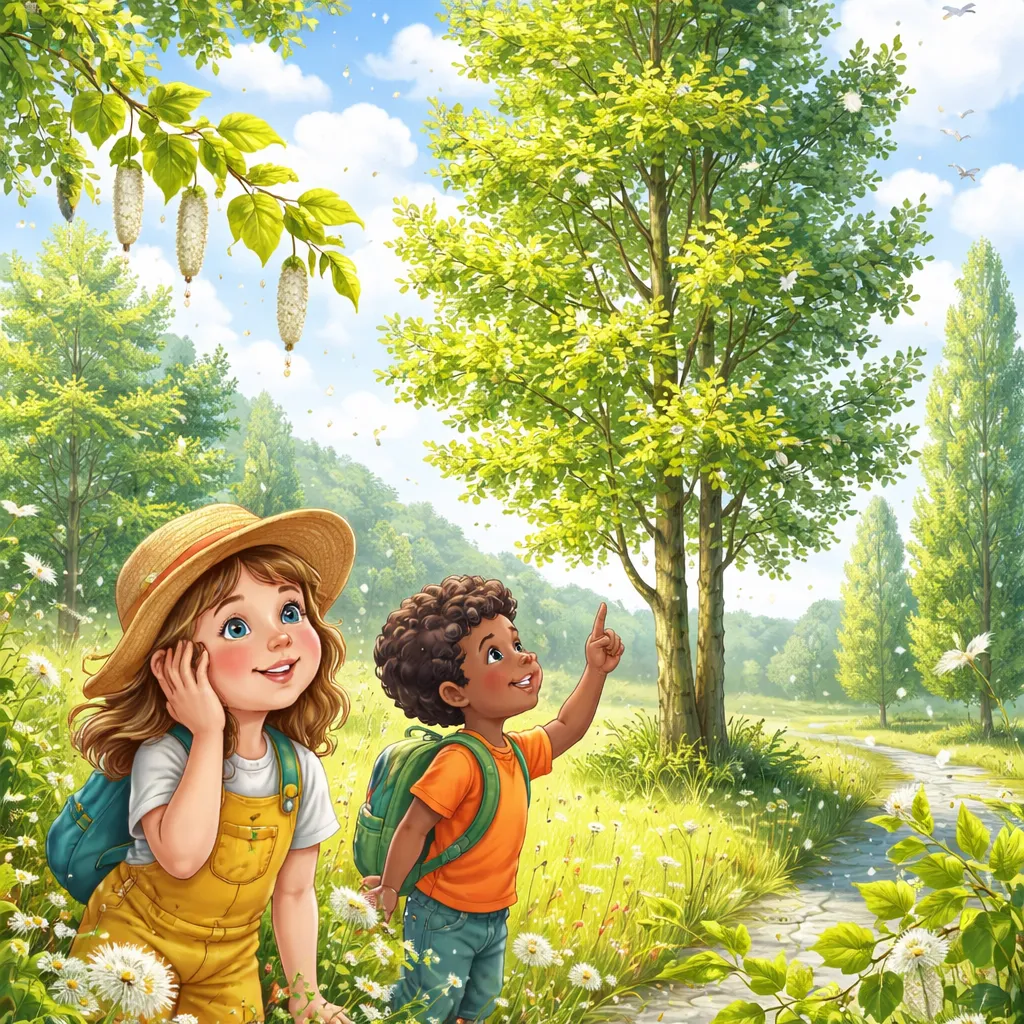

Have you ever walked by a row of tall, skinny trees and heard a quiet, rustling sound? The leaves seem to shimmer and shake, even when the wind is just a gentle breeze. It sounds like the trees are having a secret conversation, all whispering to each other. Their leaves flash bright green on one side and silvery-white on the other, like thousands of little mirrors blinking in the sun. This tall, friendly chatterbox of a tree is a wonderful friend to know. Let’s begin our adventure to learn about the Poplar plant.
Let’s Learn the Word! – Open the Treasure Box of Language
Formal Name and Pronunciation This talkative tree is called a Poplar. You can say it like this: /ˈpɒp.lər/ (POP-lar). The “Pop” sounds like the start of “popcorn,” and the “lar” rhymes with “car.” Poplar! It’s a quick, snappy word, just like the sound its leaves make.
The Etymology Tale The word has a long history! It comes from an old Latin word for the tree, “populus.” The Romans gave it this name. Long ago, people often planted these tall, fast-growing trees in public places where many “people” gathered. So, the tree’s name is connected to the word for a crowd or community, because it loves to grow in groups and be where people are.
Nicknames and Friendly Aliases Poplars have fun names that describe their best tricks. The “Quaking Aspen” or “Trembling Aspen” is a famous type whose leaves flutter and tremble non-stop. The “White Poplar” has beautiful white, fuzzy undersides to its leaves. People also call them “Cottonwoods” because their seeds are surrounded by fluffy, white cotton-like fluff that flies in the air. Another name is the “Lombardy Poplar,” which is tall and skinny like a green rocket ship.
Building Your Word Web: Core Parts Let’s learn the words for a Poplar’s body. The Leaf is usually shaped like a little heart or a triangle with a pointy tip. It has a long, flat stem, or Petiole, that makes it flutter easily. The Trunk is often very straight and tall, with pale bark. The Bark on young trees is smooth and pale green or gray, but gets rough and dark as it ages. Catkins are the long, fluffy flower clusters that hang down in spring, like fuzzy caterpillars. Seeds are tiny and attached to white, cottony fluff that helps them fly. The Crown is the top shape of the tree, often narrow and tall. A Clone is a special word for a whole group of poplars connected by one huge root system.
Action and State Words Poplars are always on the move! Their leaves constantly quiver, tremble, and rustle in the slightest breeze. They grow incredibly fast, shooting up towards the sky. In spring, they release their fluffy seeds, which float and dance on the wind. They form large, friendly groups called groves. They are tall, fast-growing, and social trees.
Ecosystem Friends Vocabulary The poplar grove is a busy neighborhood. Woodpeckers make holes in the soft wood for their nests. Caterpillars of many beautiful butterflies and moths love to eat the leaves. Beavers use poplar branches to build their dams and lodges, and they eat the tasty inner bark. Birds like finches eat the buds in spring. Deer and rabbits sometimes nibble on the young shoots.
Cultural Imprint in Language There is a famous saying: “The higher the tree, the stronger the wind.” Tall poplars face strong winds, teaching us that achieving great things can come with big challenges. The poet William Wordsworth wrote about the “poplar’s lonely spire,” painting a picture of a single, tall poplar standing like a church spire against the sky, both grand and alone. In some stories, the whispering leaves are said to be the tree sharing ancient secrets.
Ready for Discovery Now we know its name and the words for its world. Are you ready to listen closely and discover the secrets behind the whisper? Let’s find out what makes the Poplar plant so special.
Discover the Plant’s Secrets! – A Nature Detective’s Notebook
The Plant Passport Poplars are part of the Willow family, called Salicaceae. Their group name is Populus. A poplar often looks like a tall, straight pillar or a green flame reaching for the clouds. Its leaves are its magic—bright green on top, often silvery-white underneath, and shaped like hearts or triangles. In spring, it grows long, dangling catkins. Later, it makes seeds wrapped in fluffy, white “cotton” that flies everywhere. It is a deciduous tree, losing its leaves in winter, but it is one of the first to get a fresh, green coat in spring.
Survival Smarts The poplar’s superpower is super-speed! It is one of the fastest-growing trees in the world. It can grow several feet in just one year. This helps it quickly reach sunlight in open areas. Another amazing trick is how it spreads. One tree can send up new shoots from its roots, creating a whole circle or forest of trees that are all connected underground. This is a clone. The famous quaking leaves have flat stems, so even a tiny breeze makes them flutter, which helps cool the leaf and might scare away bugs.
Its Role and Gifts Poplars are fantastic community trees. Their leaves feed many, many caterpillars, which then become butterflies and moths. Their trunks provide homes for woodpeckers and other birds. They are superstar environmental helpers. People plant them in long lines called windbreaks to slow down strong winds and protect soil. Their thirsty roots can help dry out wet ground. They are also great at cleaning dirty water and soil.
Stories and Symbols In many stories, the constantly talking leaves make the poplar a symbol of communication, community, and also of eloquence (beautiful speaking). In Greek mythology, the poplar was a sacred tree to Hercules. Because it grows so straight and fast, its wood has been used for centuries to make things like matches, popsicle sticks, paper, and the frames for cheap furniture. It is the tree of everyday, useful things.
Fun “Wow!” Facts Get ready for a poplar surprise! An entire giant forest of Quaking Aspen trees in Utah, USA, called “Pando,” is actually one single living thing! All 47,000 trees are connected by one giant root system, making it one of the oldest and heaviest living things on Earth. And here’s another: the fluffy “cotton” from Cottonwood trees is so light, the seeds can fly for miles and miles on the wind, looking like summer snow!
From Whisper to Sapling These secrets are wonderful. Now, would you like to grow your own whispering friend? You can help a poplar start its life. Let’s learn how to be a poplar planter.
Let’s Grow It Together! – A Little Guardian’s Action Guide
Good for Home Growing? You must choose the right spot! Most poplars grow very big and have wide, spreading roots. They are not good for small gardens or pots for long. But, you can grow a small variety in a very large container on a big patio for a few years, or plant a special columnar type (like a Lombardy Poplar) if you have a tall, narrow space in a big yard. The best way is to plant one in a community garden or a schoolyard where it has plenty of space to become a giant.
Little Gardener’s Toolkit You will need a poplar sapling from a garden center or a long, straight cutting from a branch. Get the biggest pot you can find with drainage holes, or find a sunny spot in open ground. Use regular garden soil. Have a watering can and a stick for support ready. A small bag of all-purpose fertilizer is helpful too.
Step-by-Step Growing Guide
Planting Your Whispering Friend The best time to plant is in early spring. If you have a sapling, dig a hole twice as wide as the root ball. Place the tree in, fill the hole with soil, and pat it down gently. If using a cutting, push it about one-third of its length into deep, damp soil. Water it deeply right after planting to help it settle. Use a stick to support it so it grows straight.
Care Calendar Your poplar loves water, especially when it’s young. Water it deeply once a week if it doesn’t rain. It loves full, bright sunshine all day long. In the spring, you can give it a little bit of slow-release plant food sprinkled around its base to help it grow big and strong. Always follow the instructions on the package.
Watch and Be Friends This is a fast-growing friend! Measure its height every month—you will see amazing changes. Listen to the sound of its leaves rustling. Draw the shape of the leaves. Watch for catkins in spring and the “cotton” flying in early summer. Feel the different sides of a leaf—smooth green on top, sometimes fuzzy white underneath.
Problem Patrol If leaves get spots or turn yellow early, it might be a sign of a common poplar fungus. Just pick up and throw away the sick leaves. Sometimes, aphids (tiny bugs) like the new leaves. Spray them off with a strong jet of water from your hose. Poplars are tough and usually grow through problems quickly.
Your Rewards and Gifts Your gift is watching a giant grow from a small stick! You will see incredible growth in just one season. Caring for a poplar teaches you about speed, strength, and community. You learn that some living things grow fast and help others around them. You will feel proud knowing you planted a future home for birds and a whisperer for the wind.
Creative Fun Keep a “Speed-Growth” Diary. Take a photo with you next to your tree every season to see how fast you both grow. Make leaf art! Do a leaf rubbing to see the beautiful vein patterns. Collect the fluffy seed cotton in spring and glue it onto paper to make a fluffy cloud picture. Write a short poem about what the leaves are whispering, or draw a comic of a bird family moving into your tree.
Growing a Future Giant By planting and caring for a poplar, you are not just growing a tree. You are planting a living windbreak, a future animal apartment, and a gentle whisperer for the next generation. You are a helper of giants.
Conclusion and Forever Curiosity What a journey of discovery! You started by learning the word “Poplar,” you uncovered its secrets as a fast-growing, whispering giant of the tree world, and you learned how to help one begin its tall life. You now know the Poplar is not just a rustling tree; it is a symbol of community, a champion of growth, a protector of the soil, and a home for so many creatures. Remember, its strength is in its speed and its connections. Your curiosity connects you to all these wonders. Keep listening to the whispers of the leaves, keep watching for the flying summer cotton, and keep wondering about the quiet, giant world of trees. Your adventure to learn about the Poplar plant shows us that even the most common tree holds extraordinary stories.