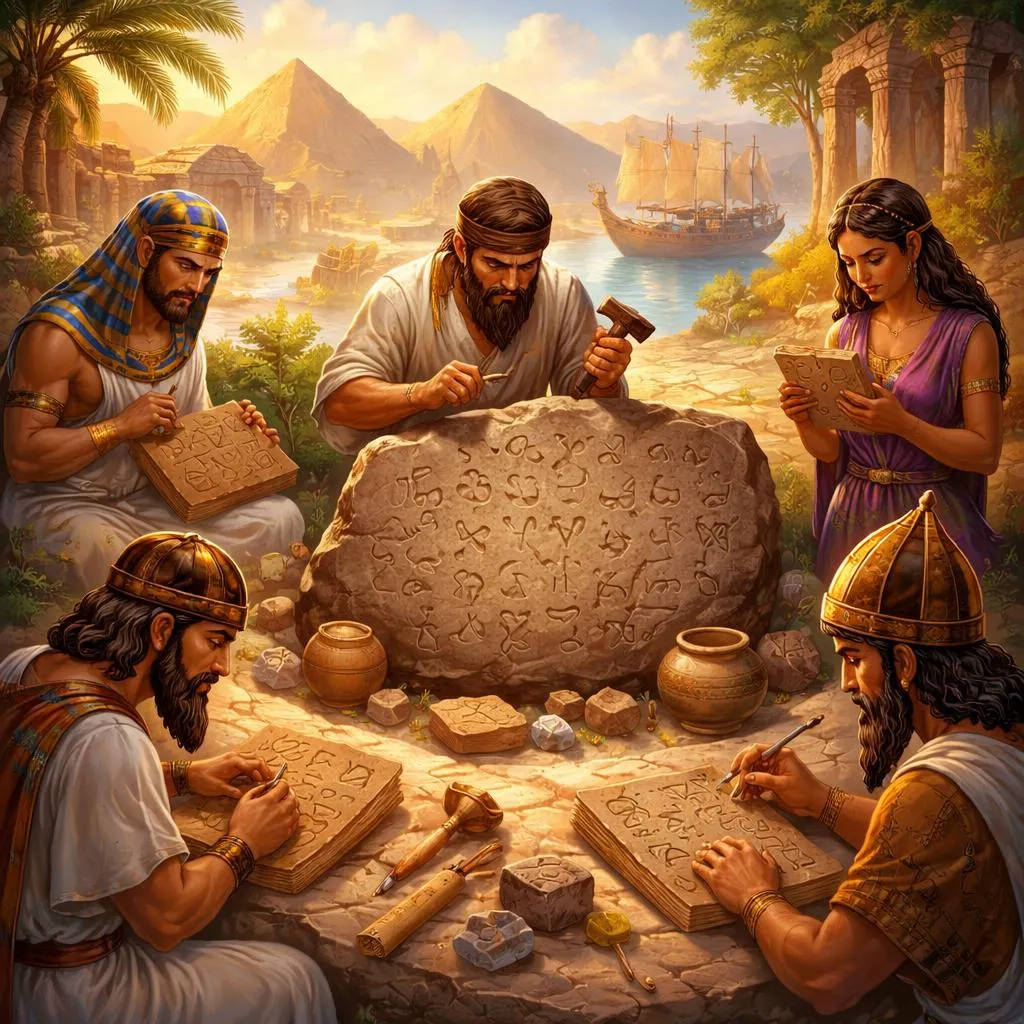

The alphabet was not made by one single person. It developed slowly over thousands of years. Different ancient civilizations contributed to its creation.
An alphabet is a writing system in which symbols represent sounds. Each symbol usually stands for a consonant or a vowel.
Early Writing Systems
Before alphabets existed, people used picture-based systems.
In Egypt, people used hieroglyphs. These were picture symbols carved into stone or written on papyrus. Hieroglyphs represented objects, ideas, and sometimes sounds.
In Iraq, ancient Mesopotamians developed cuneiform. This system used wedge-shaped marks pressed into clay tablets.
These early systems were complex and required learning hundreds of symbols.
The First Alphabet
Many historians believe the first true alphabet was created by Semitic-speaking people in the region of the eastern Mediterranean around 1800–1500 BCE.
This early alphabet is often linked to the Phoenicians.
The Phoenicia civilization, located in what is now modern-day Lebanon and surrounding areas, developed a simplified writing system with about 22 consonant symbols.
This Phoenician alphabet was much easier to learn than earlier writing systems. It represented sounds rather than whole words or ideas.
The Greek Alphabet
The alphabet spread through trade and cultural contact.
The Greece adopted the Phoenician system around the 8th century BCE. The Greeks made an important change: they added letters for vowel sounds.
This improvement made the alphabet more flexible and precise.
The Greek alphabet later influenced many other writing systems.
The Latin Alphabet
The alphabet used in English today is called the Latin alphabet.
It developed from the Greek alphabet through the Etruscans and the Romans.
The Roman Empire spread the Latin alphabet across Europe. As the empire expanded, Latin writing became widely used.
Over time, different languages adapted the Latin alphabet to fit their own sounds.
English eventually adopted this system.
Other Alphabets
Many other alphabets developed separately or were influenced by earlier ones.
The Cyrillic alphabet was developed in the 9th century for Slavic languages.
The Arabic alphabet developed in the Middle East.
The Hebrew alphabet also has ancient roots connected to early Semitic scripts.
Each alphabet reflects cultural history and linguistic needs.
Why the Alphabet Was Important
The invention of the alphabet made writing simpler and more accessible. Instead of memorizing hundreds of symbols, learners only needed to remember a few dozen letters.
This change increased literacy and helped spread knowledge, religion, trade, and literature.
The alphabet is one of the most important inventions in human history. It was not created by one individual, but by many civilizations over centuries of development.
How the Alphabet Spread
After the Phoenician alphabet was created in the eastern Mediterranean, trade played a major role in spreading it. Phoenician merchants traveled widely across the Mediterranean Sea, carrying goods as well as writing practices.
As different cultures adopted the alphabet, they modified it to suit their own languages. This process of adaptation led to the development of new alphabets.
For example, when the Greeks adopted the Phoenician system, they added vowels. Later, the Romans adapted the Greek-based system, which eventually became the Latin alphabet used in English and many other languages today.
Because of the expansion of the Roman Empire, the Latin alphabet spread throughout Europe. When European nations later explored and colonized other regions, the alphabet traveled even farther.
Alphabets and Abjads
Not all alphabet-like systems work in exactly the same way. Linguists distinguish between different types of writing systems.
A true alphabet represents both consonants and vowels clearly with separate letters.
An abjad mainly represents consonants. Vowels may be optional or marked with small symbols.
The Phoenician system was an abjad because it mainly recorded consonants. The Greek alphabet is considered one of the first “true” alphabets because it included clear vowel letters.
Understanding this difference helps explain how writing systems evolved over time.
The Development of Letter Shapes
The shapes of letters changed over centuries. Early letters were often carved into stone or written with simple tools. Straight lines were easier to carve than curves.
Later, when people began writing with pens and ink, letter shapes became more rounded and varied.
For example, the letter “A” in the Latin alphabet originally came from an earlier symbol that looked like an ox head turned upside down. Over time, the shape was simplified and standardized.
Many modern letters have surprising ancient origins when traced back thousands of years.
Uppercase and Lowercase Letters
Originally, alphabets did not have separate uppercase and lowercase forms. Roman inscriptions were written in capital letters only.
Lowercase letters developed later during the Middle Ages, when scribes writing quickly by hand created more flowing and connected letter forms.
Today, most alphabets that descend from Latin include both uppercase and lowercase letters. This system helps organize sentences and highlight proper nouns.
Printing and Standardization
The invention of the printing press in the 15th century helped standardize alphabet forms.
In Europe, printed books made spelling and letter shapes more consistent. Before printing, handwriting styles varied greatly from region to region.
Printed materials encouraged uniform spelling rules and more stable alphabet systems.
As education systems expanded, alphabets became even more standardized.
Alphabets Around the World
While many modern alphabets trace back to Phoenician roots, not all writing systems are alphabets.
For example:
Chinese uses a logographic system, where symbols represent words or ideas.
Japanese combines syllabic scripts with Chinese characters.
These systems developed independently from the Mediterranean alphabet tradition.
This shows that human societies have invented multiple ways to represent language visually.
Why the Alphabet Was Revolutionary
The alphabet dramatically reduced the number of symbols needed to write. Instead of memorizing hundreds or thousands of characters, learners only needed to understand a small set of letters that could combine to form unlimited words.
This efficiency supported education, religion, trade, science, and law. Written communication became easier to learn and transmit across generations.
Because alphabets are flexible, they can adapt to new words and sounds. This adaptability explains why alphabet-based systems remain dominant in many parts of the world today.
The Alphabet Today
Today, the Latin alphabet is used in countries across Europe, the Americas, parts of Africa, and parts of Asia. Other alphabets, such as Cyrillic and Greek, continue to serve millions of speakers.
Although technology has changed how people write—through keyboards, smartphones, and digital communication—the basic alphabetic principle remains the same: symbols represent sounds.
The alphabet was not invented by a single individual. It is the result of centuries of human creativity, adaptation, and cultural exchange.