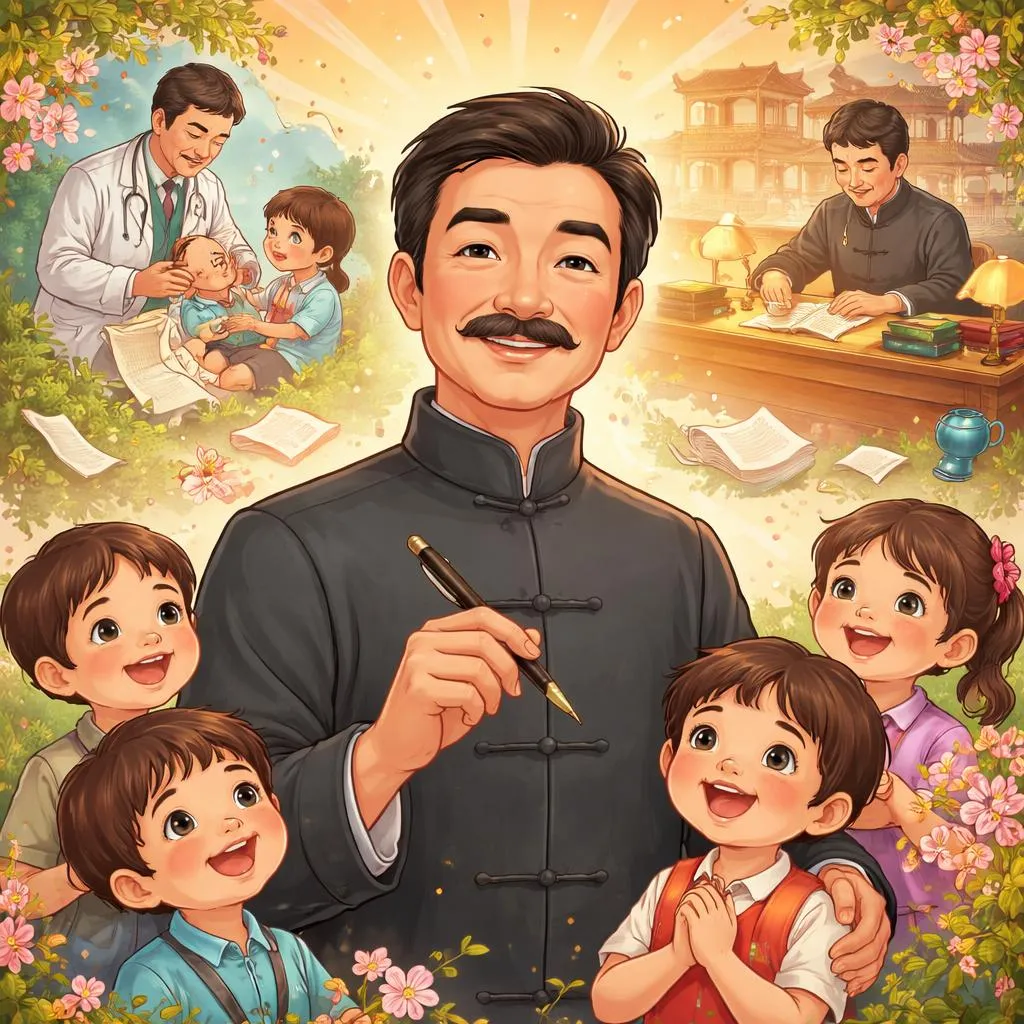

Who Is This Celebrity?
Lu Xun was a writer from China. He is considered the greatest Chinese author of the 20th century. He wrote short stories and essays that criticized unfair social traditions.
This celebrity story follows a man who started as a doctor. Lu Xun wanted to heal bodies. Then he realized that healing minds was more important. He became a writer instead.
Kids who love reading and writing will find his story inspiring. Lu Xun showed that words can change a country. A short story can make people think. An essay can start a movement.
His real name was Zhou Shuren. Lu Xun was a pen name. Millions of Chinese students have read his work in school.
Early Life and Childhood
Lu Xun was born in 1881. He was born in Shaoxing, a city in eastern China. His family belonged to the scholar class.
Young Lu Xun grew up in a large house with a garden. He loved playing in the garden. He watched insects and birds. He climbed trees.
His grandfather was a government official. His father studied for the civil service exams. The family expected Lu Xun to become a scholar too.
When Lu Xun was 12 years old, his grandfather got into trouble with the government. The family had to pay a huge fine. They lost most of their money.
His father became very sick. Traditional doctors gave expensive medicines. The family grew poorer and poorer.
Lu Xun ran errands for his father. He pawned family belongings to buy medicine. He watched his father suffer and die.
These experiences shaped Lu Xun's view of the world. He saw how traditional Chinese medicine failed his father. He saw how the government could ruin a family.
He decided to become a doctor. He wanted to help sick people. He wanted to learn modern Western medicine.
Education and Learning Journey
Lu Xun left his hometown to study in Nanjing. He attended a mining school. He learned about the modern world.
He read books translated from English and Japanese. He learned about science, history, and politics. He realized that China was falling behind other countries.
In 1902, Lu Xun traveled to Japan. He studied at a medical school in Sendai. He was one of the first Chinese students to study abroad.
In Japan, Lu Xun saw a slide show that changed his life. The slides showed the Russo-Japanese War. One slide showed a Chinese man being executed by Japanese soldiers.
Other Chinese students watched the execution. They did not try to help. They just watched. They did not seem to care.
Lu Xun realized that China's real problem was not weak bodies. It was weak minds. His people did not think for themselves. They followed traditions without questioning.
He decided to quit medical school. He would become a writer instead. He would use stories to wake up his people.
His family was shocked. His friends thought he was crazy. Lu Xun did not care. He moved to Tokyo and began writing.
He also learned German and Russian. He translated foreign stories into Chinese. He introduced Chinese readers to writers from around the world.
How Did They Become Successful?
Lu Xun became successful through powerful writing. In 1918, he published his first short story. It was called "A Madman's Diary."
The story was about a man who thought everyone wanted to eat him. The man realized that Chinese tradition was "eating" people. It was destroying their minds and spirits.
The story shocked readers. No one had ever written anything like it. Lu Xun became famous overnight.
He wrote more stories. "The True Story of Ah Q" is his most famous work. Ah Q is a poor man who pretends every loss is a victory.
When people beat him, he said they were beating his ancestor. When he lost his job, he said he was too good for it. Ah Q represented China's refusal to face reality.
Lu Xun also wrote essays. He attacked old traditions like foot binding and arranged marriages. He argued that China needed to change.
He taught at universities in Beijing and other cities. Young students adored him. They called him "the father of modern Chinese literature."
Lu Xun never joined a political party. He criticized both the old government and the new revolutionaries. He wanted to stay independent.
He also supported young writers. He edited magazines and published their work. He mentored a whole generation of Chinese authors.
Big Ideas and Achievements
Lu Xun achieved many things that changed Chinese culture. His biggest idea was simple. Writers must tell the truth. They must wake people up.
He created modern Chinese literature. Before Lu Xun, most Chinese stories were about emperors and heroes. Lu Xun wrote about ordinary people. Poor people. Lost people. Broken people.
He also developed a new writing style. He wrote in everyday Chinese that ordinary people could understand. Before Lu Xun, most serious writing used an old, formal style.
He published more than 20 books of stories, essays, and poems. His collected works fill many volumes.
Lu Xun also translated foreign literature into Chinese. He introduced Chinese readers to writers like Gogol, Chekhov, and Nietzsche.
He supported leftist politics but refused to join the Communist Party. He believed writers should criticize everyone, including their friends.
In 1930, the government put Lu Xun on a wanted list. He had to hide in a secret location. He kept writing anyway.
His health declined in his final years. He had lung problems from smoking too much. He died in 1936 at age 55.
The Communist Party later called him the greatest writer of modern China. His work became required reading in schools.
Challenges and Difficult Times
Lu Xun faced many challenges. His family lost their wealth when he was a child. He watched his father die a slow, painful death.
In Japan, he faced discrimination. Japanese people sometimes looked down on Chinese students. He felt humiliated.
His decision to quit medical school shocked his family. They had sacrificed so much for his education. He felt guilty but kept going.
Lu Xun's writing made him many enemies. Traditional scholars hated his criticism of old customs. Government officials hated his calls for change.
He received death threats. The government banned some of his books. He had to hide from the police.
Lu Xun also argued with other writers. Some said he was too negative. They wanted to write about hope and progress. Lu Xun said they were lying.
He fell in love with one of his students, Xu Guangping. She was much younger than him. Their relationship scandalized traditional society.
Lu Xun also struggled financially. He often gave money to young writers. He sometimes had trouble paying his own bills.
He smoked constantly. He drank tea all day. He worked late into the night. His health suffered. He died relatively young.
Fun Facts About the Celebrity
Lu Xun has many fun facts that kids enjoy. He loved to eat sweets. His favorite was a type of Chinese candy made from rice.
He kept a diary for 24 years. He wrote in it almost every day. The diaries fill 12 volumes.
Lu Xun designed his own book covers. He was also a talented calligrapher. His handwriting is famous in China.
He had a pet mouse as a child. He wrote about the mouse in his diary. He was very sad when it died.
Lu Xun never wore traditional Chinese robes. He always wore Western-style suits. This was his way of rejecting old customs.
He loved to watch movies. He went to the cinema almost every week. He especially liked Western adventure films.
Lu Xun's real name Zhou Shuren means "surrounding tree." His pen name Lu Xun means "quick and fast." He wanted a name that sounded energetic.
Why Is This Celebrity Important Today?
Lu Xun remains very important today. His stories are still read in Chinese schools. Every Chinese student knows his work.
His characters have entered Chinese culture. People still call stubborn, self-deceiving people "Ah Q."
Lu Xun's call for independent thinking influences Chinese writers today. They read his essays and learn to question authority.
His house in Beijing is now a museum. Visitors can see his desk, his books, and his personal items.
Lu Xun also influenced writers around the world. Authors in Korea, Japan, and Vietnam read his work. They learned how to use literature for social change.
His ideas about the role of the writer remain relevant. Should writers entertain or criticize? Lu Xun chose criticism.
The Lu Xun Literary Prize is one of China's highest honors. Winning writers receive great respect.
Even in translation, Lu Xun's stories move readers. People in America, Europe, and Africa read "The True Story of Ah Q." They see their own societies in his words.
What Can Kids Learn from This Story?
Kids can learn many lessons from Lu Xun. The first lesson is about finding your purpose. Lu Xun started as a doctor. He ended as a writer. He changed paths when he found a better way to help.
The second lesson is about speaking truth. Lu Xun criticized everyone, even his friends. He believed that writers must tell the truth, no matter what.
The third lesson is about reading widely. Lu Xun learned from Chinese, Japanese, Russian, and German writers. Read books from everywhere.
The fourth lesson is about helping others. Lu Xun mentored young writers. He used his fame to help them publish. Success means lifting others.
The fifth lesson is about independence. Lu Xun never joined a political party. He wanted to think for himself. Do not let groups tell you what to believe.
The final lesson is about ordinary people. Lu Xun wrote about poor farmers and lost workers. He believed everyone has a story worth telling.
Quick Quiz or Practice Time
Let us see what you remember about Lu Xun. Ask a parent to help with these questions.
Question 1: What job did Lu Xun first study for in Japan?
Question 2: What was the name of Lu Xun's first famous short story?
Question 3: What is the name of Lu Xun's most famous character?
Question 4: What style of clothes did Lu Xun prefer to wear?
Question 5: How old was Lu Xun when he died?
Activity Time: Draw Lu Xun sitting at his desk writing. Draw books and papers around him. Add a pipe on his desk.
Another Activity: Write a short story about someone in your neighborhood. It can be a shopkeeper, a bus driver, or a mail carrier. Make the character feel real. Remember Lu Xun wrote about ordinary people.
Talk about a tradition in your family or culture. Ask yourself: does this tradition make sense? Does it help people? Write down your thoughts.
Lu Xun wanted to heal bodies. Then he realized that weak minds made weak bodies. He picked up a pen instead of a scalpel. He wrote stories that shocked China awake. He criticized old customs that hurt people. He demanded that people think for themselves. He died young. His words never died. His stories are still read. His essays are still studied. His characters still walk the streets of Chinese literature. His story tells every child that words have power. Write the truth. Tell the truth. Live the truth. That is how you change the world.