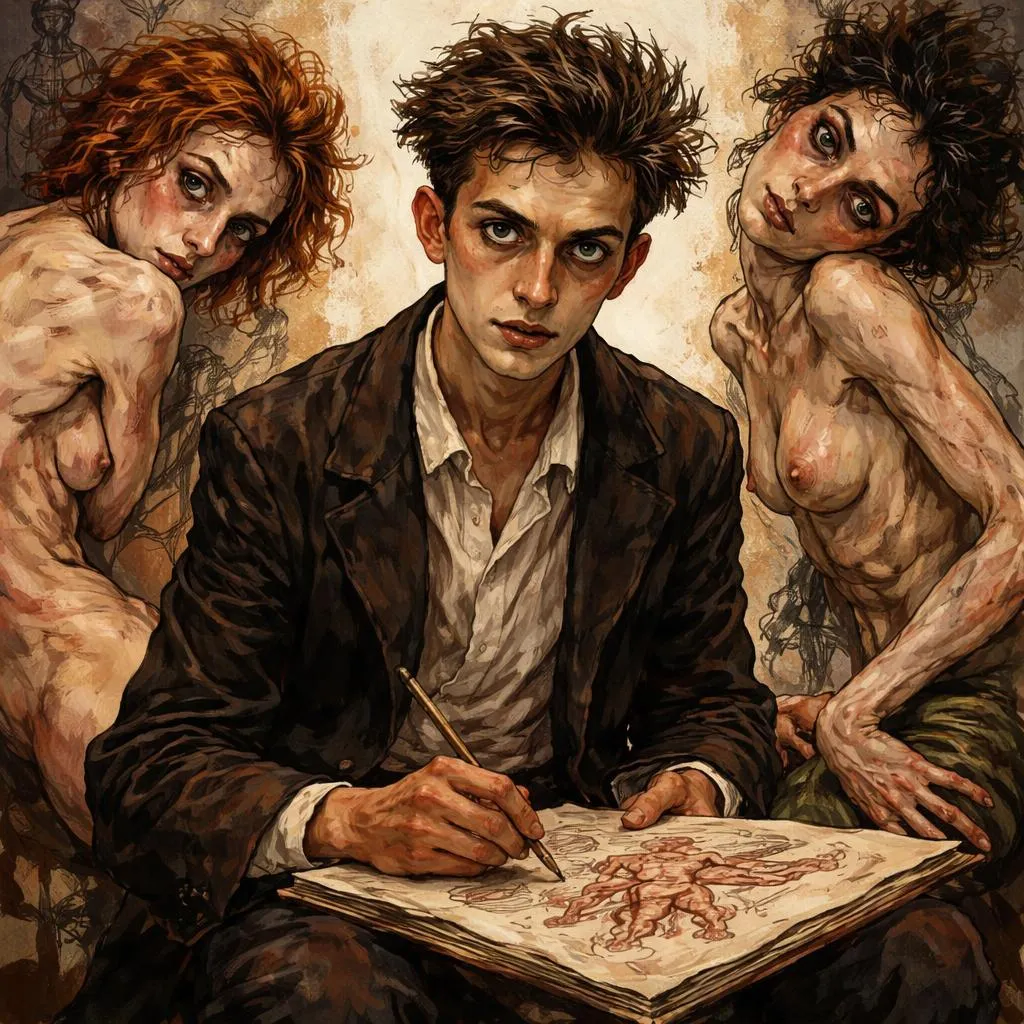

Have you ever seen a drawing of a person that looks thin, angular, and uncomfortable? The body is twisted. The fingers are long and bony. The eyes stare at you. You cannot look away. That is an Egon Schiele drawing. This Celebrity Story: Egon Schiele will introduce you to an artist who painted raw emotion. He did not make people look pretty. He made them look real. He painted their loneliness, their pain, and their desire. He lived only 28 years. He died in the Spanish flu pandemic. In that short time, he created thousands of drawings and paintings. His work is intense. It is not always comfortable to look at. But it is powerful.
Let us meet the master of line. Egon Schiele drew with a nervous, jagged line. His figures seem to vibrate.
Who Is This Celebrity?
Egon Schiele was an Austrian painter. He lived from 1890 to 1918. He was a protégé of Gustav Klimt. Klimt saw his talent and mentored him. But Schiele quickly developed his own style. His style was harsher, more angular, and more confronting than Klimt's.
Why is he famous? He drew and painted the human body with brutal honesty. He did not hide flaws. He exaggerated them. His figures are thin, bony, and often contorted. They look anxious. They look sexual. They look sad. He also painted many self-portraits. He looked at himself with the same harsh eye. He was not handsome. He drew himself as twisted and strange. He became famous after his death. Today, his work is in every major museum. He is considered one of the greatest draftsmen of the 20th century.
Early Life and Childhood
Egon Schiele was born in Tulln, Austria. That is a small town on the Danube River. His father worked for the Austrian railway. He was a station master. His mother was from Bohemia.
He was a strange child. He was obsessed with trains. He drew trains constantly. He was also obsessed with drawing. He drew on every piece of paper he could find.
His father was strict. He wanted Egon to have a practical career. He did not understand art. When Egon was 14, his father began to suffer from mental illness. He had syphilis. The disease made him crazy. He died when Egon was 15.
Egon was devastated. His father's death haunted him for the rest of his life. Many of his paintings are about death and loss.
After his father's death, Egon's uncle became his guardian. The uncle wanted Egon to become a railway official like his father. But Egon wanted to be an artist. He was stubborn. He went to art school.
Education and Learning Journey
Egon Schiele studied at the Academy of Fine Arts in Vienna. He was only 16 years old. He was the youngest student in his class.
He was a prodigy. He could draw beautifully. His teachers were traditional. They wanted him to paint realistic scenes of history and mythology. He was bored.
He discovered Gustav Klimt. Klimt was the most famous artist in Vienna. Schiele admired his work. He went to see Klimt. Klimt saw his drawings. He was impressed. He became Schiele's mentor. He bought Schiele's drawings. He introduced him to other artists.
Schiele started to develop his own style. He rejected the beauty of Klimt. He wanted something more raw. He drew the human body without idealization. He drew himself nude. He drew his sister nude. He drew young models nude. This was scandalous.
He left the Academy in 1909. He started his own group of artists. He was 19 years old. He was confident and arrogant.
How Did They Become Successful?
Egon Schiele became successful quickly. He was in his early 20s. He had exhibitions in Vienna and other cities. His work was shocking. People were offended. But they also paid attention.
In 1911, he moved to a small town. He painted a young woman named Wally Neuzil. She was his model and his lover. The townspeople were scandalized. They accused him of corrupting young people. He was arrested and jailed for 24 days. The judge actually burned one of his drawings in front of him. Schiele was traumatized.
But the scandal made him more famous. He moved back to Vienna. He continued to paint. He married a woman named Edith Harms. She was from a respectable family. Her family disapproved of Schiele. They married anyway.
In 1915, World War I broke out. Schiele was drafted into the army. He was not a good soldier. He was too skinny. He was too obsessed with art. He was assigned to guard Russian prisoners. He continued to draw. He drew his fellow soldiers. He drew the prisoners. He drew himself.
His career was interrupted by the war. But he never stopped working.
Big Ideas and Achievements
Egon Schiele's biggest idea was that art should be honest, not beautiful. He rejected the prettiness of Klimt. He wanted to show the human body as it really is: awkward, bony, and vulnerable.
His greatest achievement is his body of self-portraits. He drew himself hundreds of times. He showed himself naked. He showed himself grimacing. He showed himself making strange gestures. He was not afraid to look foolish or ugly. Those self-portraits are some of the most honest images ever made.
Another huge achievement is his drawings. He was a master of line. His lines are thin, jagged, and nervous. They twist and turn. They seem to have a life of their own. He influenced generations of draftsmen.
He also painted landscapes. His landscapes have the same jagged energy as his figures. The trees are twisted. The hills are angular. Even nature looks anxious in his hands.
He died young. But he produced over 3,000 works on paper. That is an enormous output for such a short career.
Challenges and Difficult Times
Egon Schiele faced terrible challenges. First, his father died when he was 15. He was traumatized by the madness and death of his father.
Second, he was haunted by a fear of death. Many of his paintings show death hovering over life. He drew himself lying next to a skeleton.
Third, he was arrested and jailed for his art. His drawings were burned. He felt humiliated.
Fourth, World War I was a nightmare. He was a soldier. He saw death and suffering. He continued to draw. His war drawings are haunting.
Fifth, the Spanish flu pandemic hit in 1918. Schiele and his wife Edith were both infected. Edith died first. She was six months pregnant. Schiele was devastated. He died three days later. He was 28 years old. He drew Edith's face on her deathbed. That drawing is one of his most heartbreaking works.
Fun Facts About the Celebrity
Egon Schiele kept a journal. He wrote his thoughts about art and life. The journal is full of intense, dramatic statements.
Another fun fact: He was obsessed with his own hands. He drew them over and over. His hands look long, thin, and almost skeletal.
He loved children. He drew his nieces and nephews. He was gentle with them.
He was not handsome. He was tall, thin, and awkward. He used his own ugliness in his art.
One more fact: His work was banned by the Nazis. They called it "degenerate." After his death, his reputation grew slowly. Now he is a giant.
Why Is This Celebrity Important Today?
Egon Schiele is important because he showed that art can be brutally honest. He did not flatter. He did not decorate. He told the truth about the body and about death.
He is also important because of his drawing. His line is one of the most distinctive in art history. Art students still study his technique.
His influence is seen in contemporary art. Artists who draw the body in a raw, unidealized way are following Schiele.
Parents should be cautious with Schiele. His art is intense. It deals with sexuality and death. It is best for older children.
But his story teaches children about honesty. About not hiding who you are. About facing difficult feelings.
What Can Kids Learn from This Story?
Kids can learn powerful lessons from Egon Schiele. First, be honest. Schiele did not pretend to be happy or pretty. He drew what he felt. Your art can be honest too. Draw your sadness. Draw your fears. Art can help you understand your feelings.
Second, do not be afraid of the dark. Schiele faced death and loss. He painted them. He did not look away. Bad things happen. Art can help us process them.
Third, work hard. Schiele produced thousands of drawings. He worked every day. He never stopped. Talent is not enough. You need discipline.
Finally, a short life can be a full life. Schiele lived only 28 years. But he left behind a huge body of work. He did not waste time.
Quick Quiz or Practice Time
Let us see what you learned from this Celebrity Story: Egon Schiele. Answer these questions with a parent or by yourself.
Who was Schiele's famous mentor?
What disease killed Schiele?
What happened to some of Schiele's drawings in court?
How old was Schiele when he died?
What did Schiele draw on his wife's deathbed?
Here is a fun activity for older children. Look up Egon Schiele's self-portraits online with your parent. Notice the lines. They are thin and jagged. Then draw your own self-portrait. Do not try to make it pretty. Draw your real face. Draw your real feelings.
Another activity. Practice drawing hands. Schiele drew hands obsessively. Look at your own hand. Draw it. Draw it again. Notice the bones. Notice the lines. Hands are hard to draw. Keep practicing.
Egon Schiele lived a short, intense life. He was 28 years old. He drew himself hundreds of times. He drew his bony body. He drew his strange face. He drew his wife dying. He drew his own death. He did not flinch. He told the truth. His truth was uncomfortable. But it was real. His work hangs in museums. Art students study his lines. He is a hero to those who believe that art should not lie. His story teaches us to be honest. To face our fears. To draw our pain. That is the real lesson of this celebrity story. Note: For younger children, parents should preview Schiele's work. Some of it is very intense. Choose his landscapes and clothed portraits first.