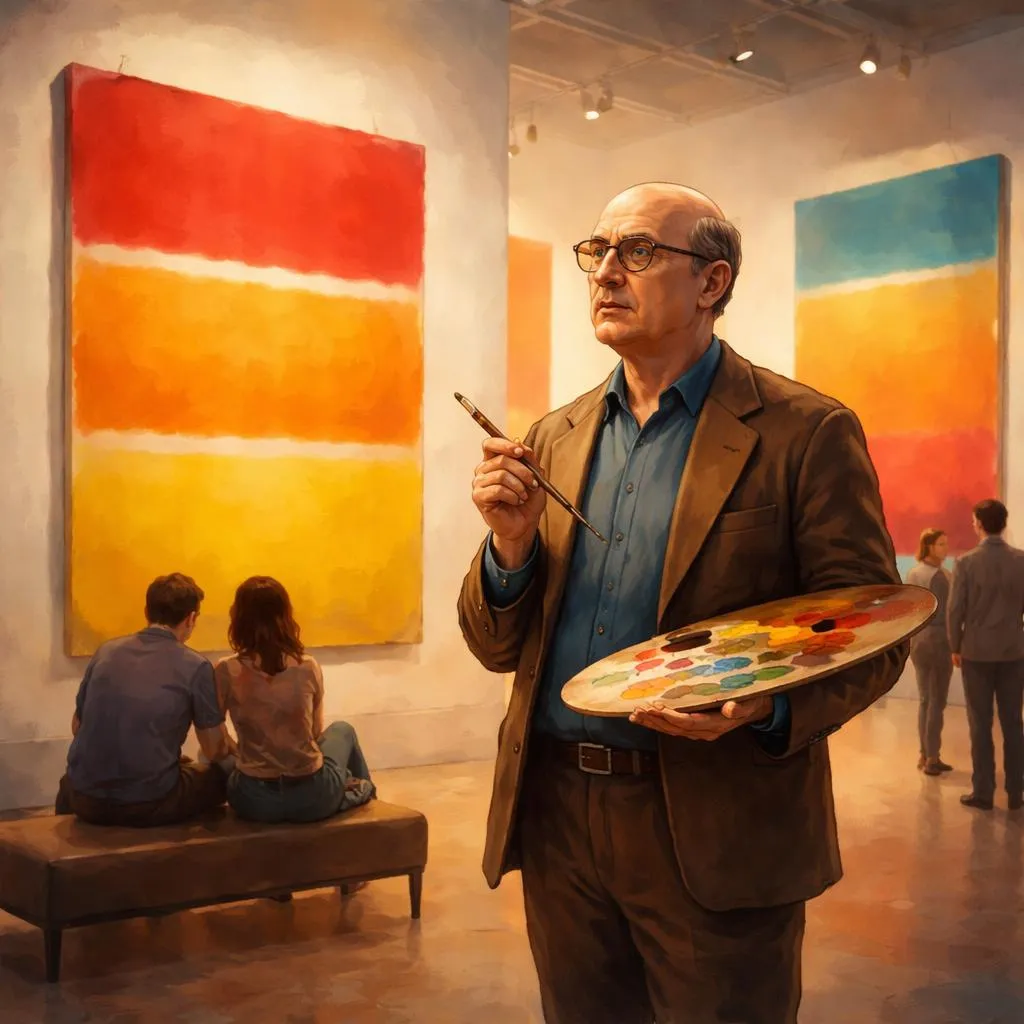

Have you ever looked at a painting and felt something deep inside? Not because the painting showed a happy face or a sad scene. Just because of the colors. Mark Rothko painted like that. He painted giant rectangles of color. Soft reds. Deep blues. Warm oranges. The rectangles float on the canvas. They seem to glow. This Celebrity Story: Mark Rothko will introduce you to an artist who wanted to make you feel. Not think. Feel. He believed that art could speak directly to your emotions without showing any objects. His paintings hang in special rooms designed just for them. People sit in front of them for hours. They cry. They meditate. They feel.
Let us meet the painter of color. Mark Rothko gave up painting people and places. He painted only rectangles. And those rectangles changed art forever.
Who Is This Celebrity?
Mark Rothko was an American painter. He lived from 1903 to 1970. He was born in Russia. His family moved to the United States when he was 10 years old. He became a leader of the Abstract Expressionist movement. That was a group of artists who painted abstract art after World War II.
Why is he famous? He invented a unique style of painting. He painted large canvases with soft-edged rectangles of color. The rectangles seem to float. The colors blend into each other. He called these paintings "multiforms." His most famous works are the "Rothko Chapel" paintings. Those are 14 dark paintings in a small chapel in Houston, Texas. People go there to sit and think. His art is about sadness, joy, mystery, and the big questions of life. He did not want you to understand his paintings. He wanted you to feel them.
Early Life and Childhood
Mark Rothko was born in Dvinsk, Russia. That is now part of Latvia. His birth name was Marcus Rothkowitz. His father was a pharmacist. His mother was a homemaker. He was the youngest of four children.
Life in Russia was hard for Jewish families. There was discrimination and violence. Rothko's father decided to move to America. He went first. The children followed later. Rothko arrived in the United States in 1913. He was 10 years old. He did not speak English.
His father died a few months after the family arrived. Rothko was heartbroken. He worked odd jobs as a child. He delivered groceries. He sold newspapers. He helped support his family.
He discovered art in school. He loved to draw. He was not a great student. But he loved books and ideas. He started studying at Yale University in 1921. He wanted to become a lawyer or an engineer. He left Yale after two years. He did not finish. He moved to New York City to become an artist.
Education and Learning Journey
Mark Rothko moved to New York in 1923. He enrolled in the Art Students League. That is the same school where Jackson Pollock studied. He learned traditional painting. He painted realistic scenes of city life.
His early work was figurative. That means he painted people and places. He painted subway stations. He painted portraits. He painted street scenes. The paintings were dark and moody.
He also taught art to children. He taught at a Jewish community center. He loved teaching. He said children understood art better than adults. Children did not ask "What is it?" They just felt it.
In the 1940s, he started experimenting. He painted surrealist images. Surrealism was about dreams and the unconscious. He painted strange, mythical creatures. He was searching for something.
Then in the late 1940s, he had a breakthrough. He stopped painting objects. He started painting soft, blurry shapes. The shapes evolved into rectangles. He found his style. He would paint nothing but rectangles for the rest of his life.
How Did They Become Successful?
Mark Rothko became successful slowly. He was in his 40s when he found his style. At first, critics did not understand his rectangles. They called them empty and boring.
But other artists saw the power. A famous art collector named Peggy Guggenheim gave him a show in 1945. Then the Museum of Modern Art bought one of his paintings. That was a big deal.
In the 1950s, he became famous. His paintings sold for high prices. He had solo exhibitions in top galleries. He represented the United States at the Venice Biennale in 1958. That is a huge international art exhibition.
He also started painting on a huge scale. His canvases were larger than a person. He wanted the painting to surround you. He wanted you to feel like you were inside the color.
In 1958, he received his most important commission. A restaurant in New York asked him to paint murals for their dining room. He painted a series of dark red and black paintings. But he later pulled out of the project. He said the restaurant was not the right place for his art. Those paintings became the Rothko Chapel.
Big Ideas and Achievements
Mark Rothko's biggest idea was that color could express human emotion. He said, "I am not interested in the relationship of color or form or anything else. I am interested only in expressing basic human emotions: tragedy, ecstasy, doom."
His greatest achievement is the Rothko Chapel in Houston, Texas. The chapel is a small, octagonal building. It is not a church. It is a place for people of any religion to sit and think. Inside are 14 of Rothko's paintings. They are huge. They are dark: maroon, black, deep purple. They seem to absorb light. People sit in the chapel for hours. They meditate. They cry. They feel. It is one of the most powerful art spaces in the world.
Another huge achievement is the series of paintings he made for the Harvard University dining hall. He painted huge murals in bright colors. Over time, the colors faded. But the paintings were so important that Harvard spent years restoring them digitally.
He also influenced countless artists. His idea that color can carry emotion changed painting. Modern artists who work with color all learned from Rothko.
Challenges and Difficult Times
Mark Rothko faced terrible challenges. First, he grew up poor and fatherless. He had to work as a child. That shaped him.
Second, he struggled with depression. His paintings became darker over time. The bright colors of the 1950s gave way to dark reds, blacks, and purples. His mood darkened too.
Third, he was a perfectionist. He would paint a canvas, then paint over it. He would destroy paintings he did not like. He was never satisfied.
Fourth, his marriage failed. He and his wife separated. He felt lonely.
Fifth, his health failed. He had an aneurysm in his heart. Doctors told him to rest. He could not rest. He kept painting.
On February 25, 1970, he took his own life. He was 66 years old. He left behind a note. He said he was depressed and in pain. The art world mourned. The Rothko Chapel opened the next year. It became his memorial.
Fun Facts About the Celebrity
Mark Rothko hated when people called his paintings "beautiful." He thought "beautiful" was an empty word. He wanted his paintings to be powerful, not pretty.
Another fun fact: He changed his name from Marcus Rothkowitz to Mark Rothko in 1940. He wanted to sound more American.
He loved classical music. He listened to Mozart and Bach while he painted. He said music taught him about structure and emotion.
He was very tall. He was over six feet tall. His paintings are also very tall. He said he wanted the paintings to be the same scale as a person.
One more fact: His paintings are so sensitive to light that museums keep them in dim rooms. Bright light would damage the colors.
Why Is This Celebrity Important Today?
Mark Rothko is important because he proved that abstract art can be deeply emotional. His paintings are not decoration. They are about life and death and everything in between.
He is also important because he created spaces for contemplation. The Rothko Chapel is a place where anyone can go to be quiet. In our noisy world, that is precious.
His paintings are worth millions. But he did not paint for money. He painted because he had to express what was inside him.
Parents can use his story to teach children about feelings. Rothko's paintings are about sadness and joy. He did not hide his feelings. He put them on canvas.
What Can Kids Learn from This Story?
Kids can learn deep lessons from Mark Rothko. First, feelings are not bad. Rothko painted sadness and darkness. He did not pretend to be happy. It is okay to feel sad. It is okay to paint sad pictures.
Second, art does not need to show things. Rothko painted rectangles. Nothing else. But his art makes people cry. You can make art that is just colors and shapes. It is still art.
Third, be serious about what you love. Rothko took his work very seriously. He thought art could change lives. Take your art seriously too. It matters.
Finally, ask for help if you are sad. Rothko struggled with depression. He did not get enough help. If you feel very sad for a long time, tell an adult. You do not have to suffer alone.
Quick Quiz or Practice Time
Let us see what you learned from this Celebrity Story: Mark Rothko. Answer these questions with a parent or by yourself.
What shapes did Mark Rothko paint in his most famous works?
What is the name of the chapel in Houston that houses Rothko's paintings?
What country was Rothko born in?
What did Rothko say he wanted to express with his art?
How did Rothko die?
Here is a fun activity. Get three pieces of paper. Paint or color each one with a different emotion. Use red for anger. Blue for sadness. Yellow for joy. Do not draw any shapes. Just cover the paper with color. Then show your paintings to your family. Ask them what they feel. You are painting like Rothko.
Another activity. Visit a museum's website with your parent. Look up Mark Rothko's paintings. Look at one painting for two minutes. Do not talk. Just look. Then close your eyes. What do you remember? Talk about how the colors made you feel.
Mark Rothko lived a life of color and darkness. He came from Russia as a poor immigrant. He studied art in New York. He painted people and places. Then he found his voice. He painted rectangles. Soft, floating rectangles of color. He painted joy in bright oranges and reds. He painted sadness in deep maroon and black. He built a chapel of dark paintings where people go to feel. He died by his own hand. His art lives on. Every time you look at a Rothko, you feel something. That was his gift. He taught us that a rectangle can be a window into the soul. That is the real lesson of this celebrity story.