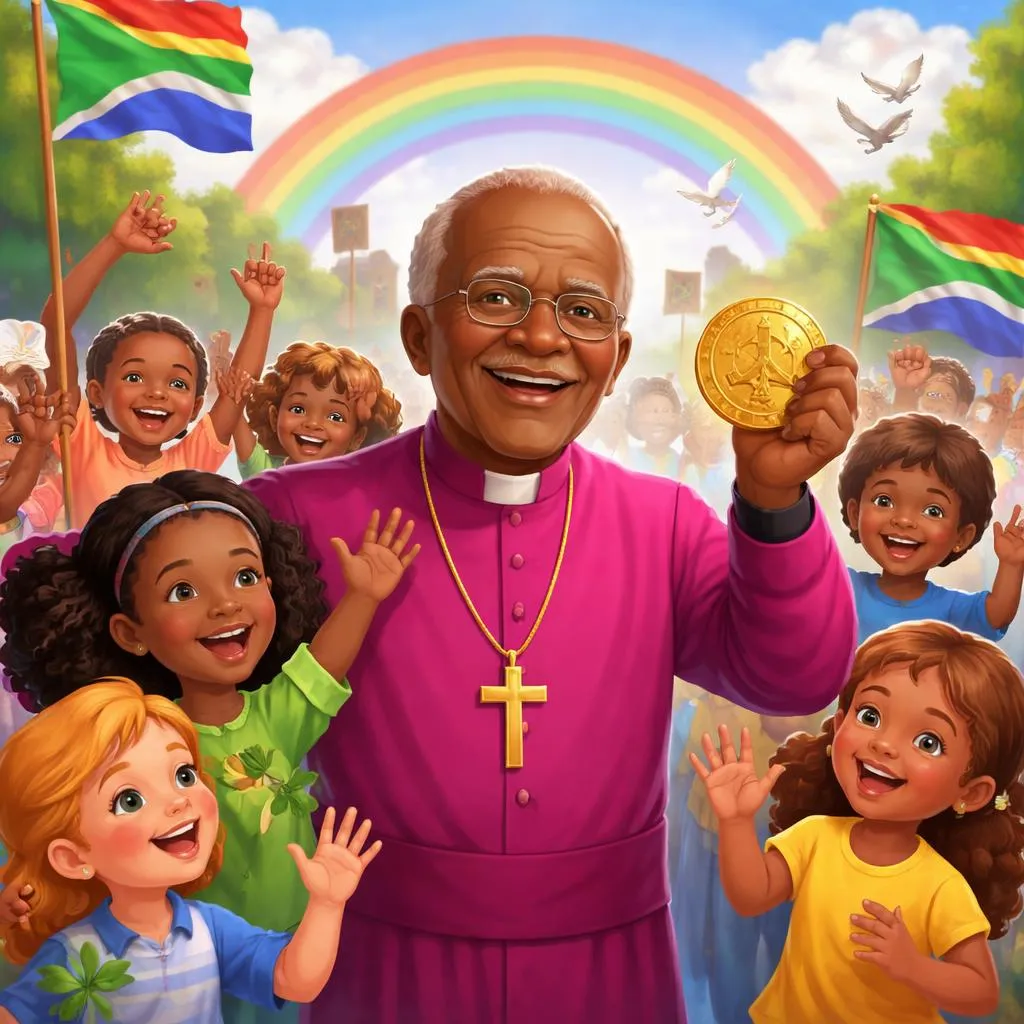

Who Is This Celebrity?
Desmond Tutu was a religious leader from South Africa. He won the Nobel Peace Prize for fighting against apartheid. Apartheid was a system that treated Black people unfairly.
This celebrity story follows a man who used laughter and love as weapons. Desmond Tutu did not fight with guns or fists. He fought with words and prayers. He danced while he marched.
Kids who believe in fairness will find his story inspiring. Desmond showed that you can be serious about justice and still have joy. He proved that forgiveness is stronger than hate.
He became the first Black leader of the Anglican Church in South Africa. He later led a commission that helped his country heal after apartheid.
Early Life and Childhood
Desmond Tutu was born in 1931. He was born in Klerksdorp, South Africa. His father was a teacher. His mother was a cook and cleaner.
Young Desmond became very sick with polio when he was a child. Polio is a disease that can paralyze people. His right hand became weak from the illness.
He still learned to write with that hand. He never let his disability stop him.
Desmond lived in a country where white people had all the power. Black people could not vote. They could not live in nice neighborhoods. They could not attend good schools.
He did not understand why his skin color mattered. He asked his mother. She did not have a good answer.
Desmond loved to read. He read comic books and adventure stories. He also loved to play soccer with his friends.
His family was Christian. They went to church every Sunday. Young Desmond enjoyed the singing and the stories.
He thought about becoming a doctor. But his family could not afford medical school. He decided to become a teacher instead.
Education and Learning Journey
Desmond Tutu attended a teachers college. He graduated and began teaching high school. He taught for three years.
But he became angry. The government had created a terrible education system for Black children. The schools were poor. The books were old. The government wanted Black people to stay uneducated.
Desmond decided he could not participate in this system. He quit teaching.
He then decided to become a priest. The church would allow him to serve Black people without following unfair government rules.
He studied at a religious college in South Africa. Then he went to London, England. He earned a master's degree from King's College.
In London, Desmond experienced freedom for the first time. No one treated him badly because of his skin color. He could sit anywhere on the bus. He could eat in any restaurant.
He returned to South Africa determined to end apartheid. He taught at a religious university. He became the dean of a cathedral.
His speeches became famous. He spoke against apartheid from the pulpit. The government watched him closely.
In 1976, police killed hundreds of Black students who were protesting. Desmond spoke out loudly. The government took away his passport. He could not leave the country.
How Did They Become Successful?
Desmond Tutu became successful through fearless truth-telling. He refused to be silent when he saw injustice. He used his position as a church leader to protect protesters.
In 1984, Desmond won the Nobel Peace Prize. The world recognized his work against apartheid. He became famous overnight.
He used his fame to pressure other countries. He asked them to stop doing business with South Africa. Many countries stopped buying South African goods.
The government finally had to listen. In 1990, they released Nelson Mandela from prison. Mandela had been locked up for 27 years.
Desmond and Nelson Mandela became close friends. They worked together to end apartheid peacefully.
In 1994, South Africa held its first free election. All people could vote, no matter their skin color. Nelson Mandela became president.
Mandela asked Desmond to lead a special commission. This commission would investigate the crimes of apartheid. It was called the Truth and Reconciliation Commission.
Desmond led this commission for three years. He listened to victims describe terrible pain. He listened to criminals confess their crimes.
He offered forgiveness to those who told the truth. This helped South Africa avoid a bloody civil war.
Big Ideas and Achievements
Desmond Tutu achieved many things that changed South Africa. His biggest idea was simple. There is no future without forgiveness.
He created the concept of "ubuntu." This African word means that people only become people through other people. We all belong to each other.
Desmond believed that punishing every criminal would tear the country apart. He believed that truth and forgiveness could heal the nation.
The Truth and Reconciliation Commission heard 21,000 testimonies. Desmond chaired each session with compassion and tears.
His work inspired other countries. Rwanda, Liberia, and other nations created similar commissions after their own conflicts.
Desmond wrote many books. His book "No Future Without Forgiveness" explains his philosophy. People around the world read his words.
He continued to speak out against injustice. He criticized poverty, AIDS, and homophobia. He never stopped fighting for the powerless.
Desmond also fought for Palestinian rights. He said that injustice anywhere threatens justice everywhere.
He received the Nobel Peace Prize. He also received the Presidential Medal of Freedom from President Obama. He received the Gandhi Peace Prize from India.
Challenges and Difficult Times
Desmond Tutu faced many challenges. The South African government hated him. Police arrested him many times. They confiscated his passport.
He received death threats. White supremacists wanted to kill him. He kept speaking anyway.
Desmond also faced criticism from Black radicals. Some said he was too forgiving. They wanted revenge against white people.
He answered them with love. He said that revenge only creates more violence. He said that forgiveness breaks the cycle.
His own church sometimes opposed him. Some church leaders thought he should stay out of politics. Desmond refused.
In his 70s, Desmond was diagnosed with prostate cancer. He underwent treatment for many years. He kept working despite the pain.
His wife Leah supported him through everything. They were married for 60 years. She was his closest advisor and friend.
Desmond died in 2021 at age 90. The world mourned. World leaders called him a moral giant.
Fun Facts About the Celebrity
Desmond Tutu has many fun facts that kids enjoy. He was known for his laugh. He laughed loudly and often. People said his laugh could fill a room.
He loved to dance. He danced at church, at protests, and at award ceremonies. He said dancing was a form of prayer.
Desmond had a favorite saying. He called himself "the archbishop with the goofy laugh." He did not take himself too seriously.
He loved cricket. He followed the South African cricket team closely. He cheered for them even when they lost.
Desmond kept a small stone on his desk. The stone came from Robben Island, where Mandela was imprisoned. It reminded him of the cost of freedom.
He collected colorful socks. He wore bright socks with his religious robes. He said socks made him happy.
Desmond named one of his daughters Mpho. That means "gift" in the Tswana language. He said every child is a gift.
Why Is This Celebrity Important Today?
Desmond Tutu remains very important today. His philosophy of ubuntu influences leaders around the world. Schools teach children about this African idea.
The Truth and Reconciliation Commission became a model for other countries. Nations that suffer from violence look to Desmond's example.
He showed that religious leaders can fight for justice. Many priests and ministers follow his path today.
Desmond spoke about climate change before it was popular. He called it a moral issue. He said rich countries must help poor countries.
He also spoke about LGBTQ rights. This made some religious people angry. Desmond did not care. He believed all people are children of God.
His books are still in print. New generations read "No Future Without Forgiveness." They learn that peace requires truth.
Desmond's face appears on posters and murals. Young activists study his speeches. His laughter echoes in the fight for justice.
What Can Kids Learn from This Story?
Kids can learn many lessons from Desmond Tutu. The first lesson is about joy. Desmond fought against terrible evil. He never lost his laugh. Joy is strength.
The second lesson is about forgiveness. Desmond forgave the people who hurt his people. He said forgiveness frees the forgiver.
The third lesson is about speaking truth. Desmond did not stay quiet. He told the government they were wrong. You can speak truth too.
The fourth lesson is about believing in ubuntu. We all need each other. No one succeeds alone. Help others and you help yourself.
The fifth lesson is about not giving up. Apartheid lasted 50 years. Desmond fought for 40 of those years. Change takes time.
The final lesson is about loving everyone. Desmond loved people who hated him. That is the hardest love. It is also the strongest.
Quick Quiz or Practice Time
Let us see what you remember about Desmond Tutu. Ask a parent to help with these questions.
Question 1: What disease did Desmond Tutu have as a child?
Question 2: What prize did Desmond win in 1984?
Question 3: What was the name of the commission Desmond led after apartheid?
Question 4: What African word means "people become people through other people"?
Question 5: How old was Desmond when he died?
Activity Time: Draw Desmond Tutu laughing and dancing. Draw a crowd of people of all colors dancing with him. Add the word "ubuntu" above his head.
Another Activity: Forgive someone this week. It could be a small thing. A friend who was mean. A sibling who took your toy. Say "I forgive you" out loud. Notice how you feel.
Talk about something unfair you have seen. Write down one peaceful way to respond. Remember Desmond used words and love, not violence.
Desmond Tutu grew up in a country that told him he was less than human. He knew they were wrong. He became a priest. He spoke truth to power. He won the Nobel Peace Prize. He helped end apartheid. Then he helped his country forgive. He danced while he did it. He laughed while he cried. His story tells every child that you can fight for justice and keep your joy. You can tell the truth and make peace. You can love people who hate you. That is what Desmond did. That is what you can do too. Start with a laugh. Start with a dance. Start today.