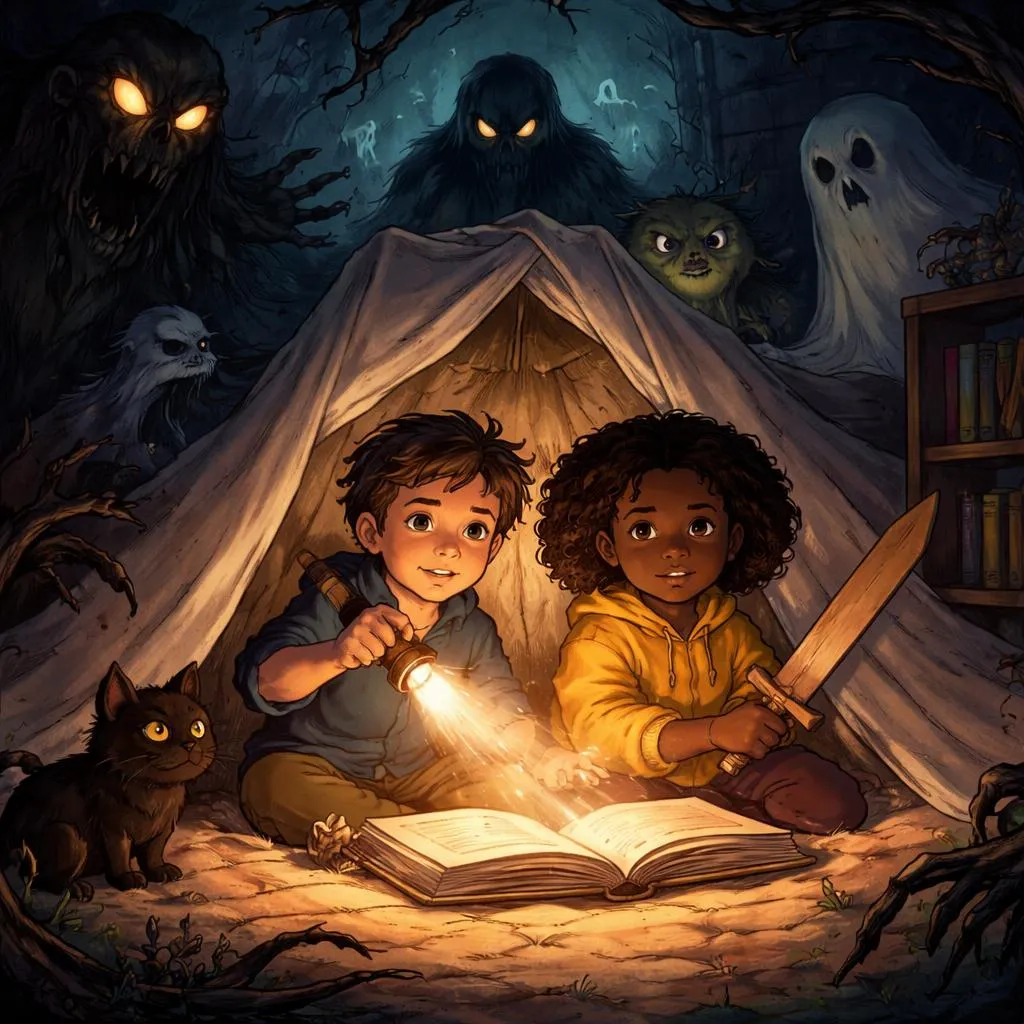

A creaking door. A shadow on the wall. A whisper in the dark. Children love being scared just a little. Children's book scary stories hold a special place in young hearts. They make hearts pound and eyes widen. But they do more than thrill. They help children understand fear and discover their own bravery.
Let us explore together why scary stories matter and how to share them with children in ways that build courage, not nightmares.
<h2>What is the story?</h2> Children's book scary stories come in many forms. Some are old folktales passed down for generations. In one such story from Europe, a little girl walks through the woods to visit her grandmother. A wolf watches from the trees. He gets to the grandmother's house first. He swallows the grandmother whole. He puts on her clothes and climbs into her bed.When the little girl arrives, she notices something strange. Grandmother, what big ears you have, she says. The better to hear you with, the wolf replies. Grandmother, what big eyes you have. The better to see you with. Grandmother, what big teeth you have. The better to eat you with!
The wolf jumps up. The girl runs. A woodcutter hears her screams. He kills the wolf and saves the girl and her grandmother. Little Red Riding Hood learns to be careful in the woods.
Other scary stories come from modern writers. In one picture book, a dark falls over a little bunny's room. Shapes appear in the shadows. The bunny's heart pounds. But then his mother comes. She turns on the light. The shadows disappear. She shows him that his coat makes a monster shape on the wall. The bunny learns that things are not always what they seem.
Some stories are just silly-scary. A book about a monster under the bed turns out to be a tiny creature scared of the child above. The monster and child become friends. The scariness becomes laughter.
<h2>The message of the story</h2> Children's book scary stories carry important messages about fear. They show that fear is normal. Everyone feels scared sometimes. Even big brave characters feel fear. The difference is what they do with it.These stories also teach that things are not always as scary as they seem. The shadow that looked like a monster turns out to be a robe. The noise at night turns out to be the wind. Children learn to question their fears.
Scary stories show heroes facing fear and winning. Little Red Riding Hood gets eaten but then rescued. The three little pigs outsmart the wolf. The bunny learns about shadows. Children see that fear can be faced and overcome.
The stories also teach safety. Don't talk to strangers. Stay on the path. Lock your doors. The scariness delivers the message in a way children remember.
We can ask our children, What scares you? What helps you feel brave? What would you tell a friend who was scared?
<h2>Vocabulary learning</h2> Children's book scary stories introduce rich vocabulary for feelings and frightening things.Words like terrified, frightened, spooked, and alarmed name different kinds of fear. Children learn to describe how they feel more precisely.
Scary stories introduce words for frightening creatures. Monster, wolf, ghost, witch, goblin, and troll populate these tales. Each word carries its own kind of scariness.
Setting words create atmosphere. Dark, shadow, moonlight, creaking, howling, and whispering paint pictures with words. Children learn how language creates mood.
Words for bravery appear too. Courage, brave, fearless, heroic, and daring show the other side of fear. Children learn that these qualities exist alongside fear.
After reading, we can use these words naturally. When your child feels scared at night, you might say, You seem frightened. Let's check those shadows together. When they do something hard, you might say, That was brave!
<h2>Phonics points</h2> The words in children's book scary stories give us wonderful phonics practice.Scary has two syllables. Scar-y. The SC at the beginning makes a SK sound. Sk-scary. The AR makes the sound like in car. The Y at the end makes a long E sound. Scar-y.
Monster has two syllables. Mon-ster. The M closes lips. The O is short. The N is nasal. The ST blend requires pushing S and T together. Mon-ster.
Shadow has two syllables. Shad-ow. The SH requires pushing air through teeth. The A is short. The D touches roof of mouth. The OW makes an O sound like in grow. Shad-ow.
Wolf has one syllable. W-ol-f. The W requires rounded lips. The OL makes a sound like in old. The F requires teeth on lip. Wolf.
We can play with these sounds by finding other words with the same patterns. Scary and scarf both start with Scar. Monster and mop both start with Mo. Shadow and shallow both start with Sha.
<h2>Grammar patterns</h2> Children's book scary stories use language patterns that build suspense and excitement.Short sentences create tension. The door creaked. The wind howled. The shadow moved. Short sentences feel like heartbeats speeding up.
Questions make readers wonder. What was that noise? Who is behind the door? Will the monster get him? Questions keep pages turning.
Sound words bring stories alive. Creak, howl, thump, whisper, crash. These onomatopoeic words show how language can imitate sounds.
Repetition builds pattern and prediction. Little pig, little pig, let me come in. Not by the hair on my chinny chin chin. Then I'll huff and I'll puff and I'll blow your house in. Children love joining in.
After reading, we can notice these patterns. The story said the door creaked. What other words sound like what they mean? Buzz, splash, boom!
<h2>Learning activities</h2> Children's book scary stories inspire wonderful activities that help children process fear creatively.Create a shadow puppet show. Use a flashlight and your hands to make shadows on the wall. Make rabbit shadows, bird shadows, even monster shadows. Talk about how shadows look scary but are just shapes.
Draw your fear. Give your child paper and crayons. Ask them to draw something that scares them. Then talk about the drawing. Sometimes putting fear on paper makes it smaller.
Make a courage collage. Cut out pictures of brave things from magazines. People helping others. Firefighters climbing ladders. Children trying new things. Talk about what courage looks like.
Build a safe fort. Use blankets and pillows to create a cozy space. Take a scary book inside and read it with a flashlight. The fort feels safe even while the story feels scary.
<h2>Printable materials</h2> Many wonderful printable materials exist for children's book scary stories.Look for coloring pages of friendly monsters, brave heroes, and not-too-scene scenes from scary stories. Children can color while you talk about the stories.
Find printable shadow puppets. Cut out shapes of animals and people. Attach to sticks. Create your own shadow stories together.
Some websites offer printable fear charts. Draw or write fears in one column. In another column, draw or write ways to face each fear. This builds problem-solving.
You might also find printable courage certificates. Award them when your child faces something hard. I faced my fear and was brave! Date and sign.
<h2>Educational games</h2> Games based on scary stories help children process fear through play.Play a game of shadow charades. Make shadows on the wall with your hands. Others guess what you are making. This takes the scariness out of shadows and makes them fun.
Create a monster matching game. Draw different friendly monsters on cards. Make pairs. Turn them over and find matches. The monsters become familiar and less scary.
Play a game of fear and courage. Name a situation. Walking in the dark. Hearing a noise. Meeting a new person. Your child says whether it feels scary and what a brave person might do.
For younger children, play a simple sorting game sorting pictures into scary and not scary. Talk about why each belongs where.
These games show that scary stories offer wonderful opportunities for emotional learning through play. Children process fears while having fun together.
<h2>Choosing the right scary stories</h2> Not all children's book scary stories work for all children. Some things to consider when choosing.Age matters. Younger children need gentle scariness where everything turns out fine. The monster becomes a friend. The scary thing is explained. Older children can handle more suspense.
Know your child. Some children love being scared. Others find any scariness overwhelming. Choose stories that match your child's temperament.
Look for resolution. The best scary stories end well. The monster is defeated. The fear is explained. The child is safe. This reassures while it thrills.
Read together first. Do not hand a scary book to a child alone. Read it together. Talk about it. Let your child know you are there.
Respect limits. If a story is too scary, stop. Put it away. Try again another time or choose something different. Reading should never traumatize.
<h2>The gift of scared but safe</h2> Children's book scary stories offer a special gift. They let children feel scared in a safe place. The child sits on a parent's lap, wrapped in blankets, while a story makes their heart pound. They experience fear and safety at the same time.This teaches something important. Fear can be felt and survived. The scary story ends. The light comes on. The child is still safe, still loved. Next time real fear comes, they remember. They have survived fear before. They can survive again.
Scary stories also create connection. Children snuggle closer during scary parts. They look up at parents for reassurance. Parents squeeze back. The story becomes a shared experience of moving through fear together.
<h2>What we learn from scary stories</h2> Scary stories teach us that courage is not the absence of fear. Courage is feeling afraid and doing the right thing anyway. The little pigs felt afraid, but they kept building. Little Red Riding Hood felt afraid, but she ran for help. The bunny felt afraid, but he called for his mother.Scary stories also teach us that fear passes. The sun comes up. The morning comes. The scary night ends. Children learn that feelings change.
Most of all, scary stories teach children that they are not alone in their fears. Everyone gets scared. Even big people. Even brave people. Fear is part of being human.
When we share children's book scary stories with our children, we give them tools for life. We give them words for their feelings. We give them examples of courage. We give them practice feeling scared while feeling safe.
So find a gently scary book. Settle in together. Let the shadows creep across the page. Let the heart pound just a little. Then turn the page, find the happy ending, and snuggle close. The fear passes. The love remains.