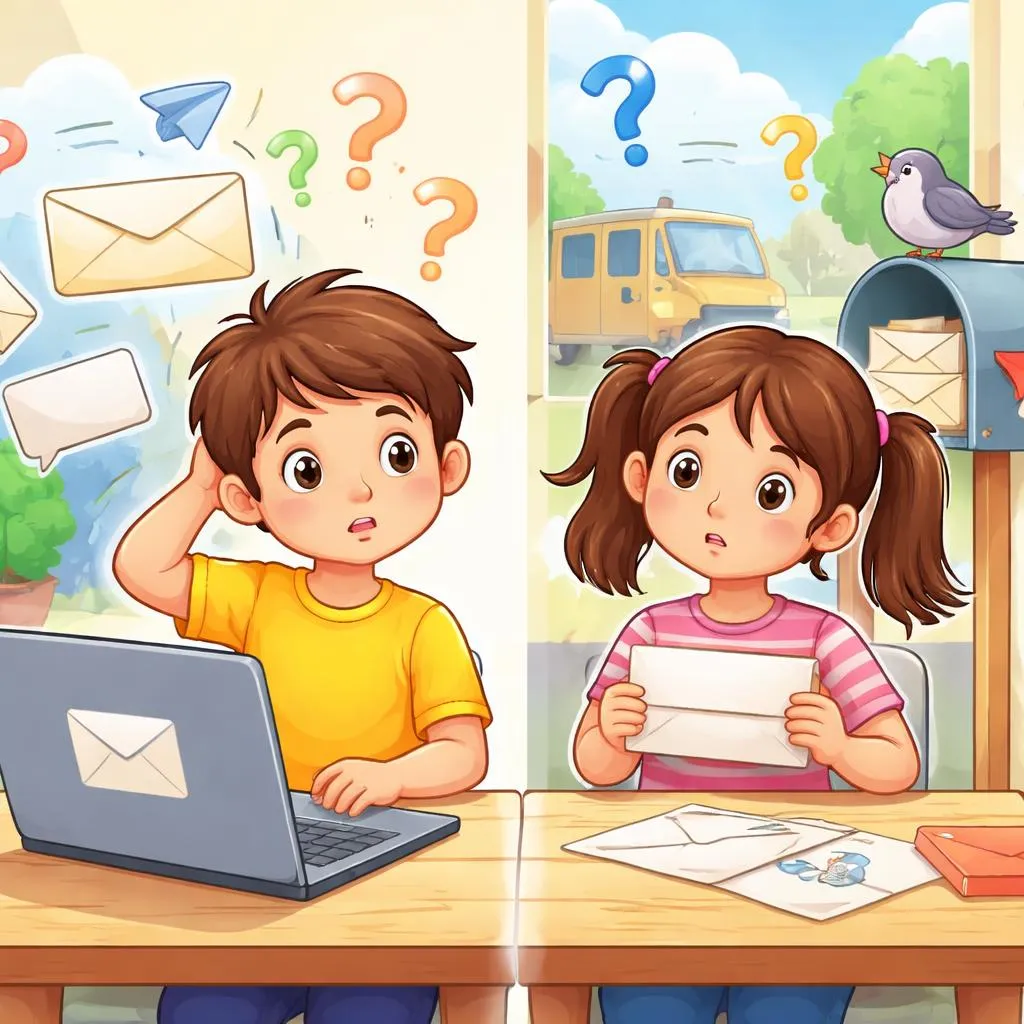

Children hear many English expressions every day. Some sound almost the same but work in slightly different ways. The phrases “email to” and “mail to” often create confusion because both involve sending something to another person.
A child may hear, “Please email it to me,” at school. Later, the same child may hear, “Mail it to your grandma,” at home. Both expressions involve delivery, but the method changes. Understanding this small difference helps young learners use English more naturally.
These expressions also appear often in books, apps, homework instructions, and conversations. Learning them early can improve speaking and writing skills. Kids also become more confident when they understand how modern and traditional communication differ.
What Do These Expressions Mean?
The expression “email to” means sending a digital message through the internet. People use computers, tablets, or phones for this action. The message arrives quickly, often within seconds.
For children, a simple way to understand it is this: an email is like a fast electronic letter. It travels through the internet instead of through streets and buildings.
The expression “mail to” usually means sending a physical item through the postal system. People may send letters, cards, packages, or documents by mail.
A child-friendly explanation is easy: mail travels inside trucks, airplanes, or delivery bags. Someone carries it from one place to another.
The two expressions seem similar because both involve sending information or objects to another person. Both expressions also use the word “to,” which shows the receiver.
However, the delivery method creates the biggest difference. One travels digitally. The other travels physically.
Children sometimes think “mail” only means paper letters. In modern English, people sometimes use “mail” for electronic messages too, especially in words like “email.” That overlap can confuse learners.
Parents and teachers can help by showing real examples. A printed birthday card uses mail. A digital school update uses email.
When children connect words with daily life, vocabulary becomes easier to remember.
What’s the Difference?
The main difference between “email to” and “mail to” is the way something travels.
“Email to” is more modern and digital. It usually involves typing, screens, internet connections, and electronic devices.
“Mail to” is more physical and traditional. It often involves envelopes, stamps, mailboxes, and delivery workers.
One expression is faster. The other usually takes more time.
For example, if a student sends homework through email, the teacher may receive it immediately. If the same homework travels through regular mail, it may arrive days later.
The tone also changes slightly. “Email to” sounds more connected to technology and school systems. “Mail to” sounds more connected to packages, letters, and formal delivery.
Another difference appears in daily frequency. Many children use email less often than adults, but they still hear the phrase in school platforms or online accounts. Meanwhile, “mail to” appears during holidays, birthdays, or shopping deliveries.
Children should also notice that “mail” can sometimes work as both a noun and a verb.
For example:
“The mail arrived today.”
“Please mail the letter.”
“Email” can also act as both a noun and a verb.
For example:
“I received an email.”
“Please email the file.”
One expression feels more connected to technology. The other feels more connected to physical movement.
That small idea helps learners understand the difference clearly.
When Do We Use Each One?
People use “email to” when they send digital information online.
Students may email homework to teachers. Parents may email school forms. Friends may email pictures or invitations.
This expression often appears in places connected to technology:
online classes
school websites
office communication
internet accounts
digital documents
A child might hear:
“Please email the project to your teacher before Friday.”
This sentence shows quick digital delivery.
People use “mail to” when they send real objects or printed materials through the postal service.
Children may mail birthday cards to grandparents. Families may mail gifts during holidays. Schools may mail printed reports to homes.
This expression often appears in situations involving:
envelopes
packages
postcards
shipping
physical letters
A parent might say:
“We will mail the thank-you card to Aunt Lisa tomorrow.”
That sentence describes physical delivery.
Children should also understand that context matters.
If someone says, “Send it to me,” listeners must decide whether the person wants an email or physical mail. The situation usually provides the answer.
At school, digital files often use email. At the post office, packages use mail.
Modern communication changes quickly, so children hear both expressions often. Understanding the difference helps them follow instructions more easily.
Example Sentences for Kids
Sentences Using “Email To”
Please email the picture to your teacher.
Dad emailed the recipe to Grandma yesterday.
I will email my science project to the class group tonight.
These examples show digital communication through the internet.
Sentences Using “Mail To”
We mailed a birthday card to my cousin.
Mom will mail the package to our uncle tomorrow.
The school mailed a report card to our house.
These examples show physical delivery through the postal system.
Children learn vocabulary faster when sentences connect to real experiences. Birthday cards, homework, and family messages help make meanings clearer.
Reading sentences aloud also improves understanding. Kids begin to notice how naturally each expression fits certain situations.
Common Mistakes to Avoid
Many learners mix these expressions because both involve sending something.
One common mistake is using “mail” when talking about digital messages.
Incorrect:
“I will mail the photo from my computer.”
Correct:
“I will email the photo from my computer.”
A computer usually sends digital files through email, not regular mail.
Another mistake happens when children use “email” for physical objects.
Incorrect:
“She emailed the birthday gift.”
Correct:
“She mailed the birthday gift.”
Physical presents travel through postal delivery, not internet systems.
Some learners also forget that “email” usually involves technology.
Incorrect:
“He emailed a paper letter with a stamp.”
Correct:
“He mailed a paper letter with a stamp.”
Stamps belong to physical mail.
Children sometimes believe the two expressions are completely interchangeable. In some casual conversations, adults may shorten language or mix modern meanings. Still, learning the standard difference helps children build strong vocabulary habits.
Another confusing area involves spelling.
“Email” usually appears as one word today. Older forms like “e-mail” still exist, but modern English often prefers “email.”
Simple corrections help children remember more naturally than long grammar explanations.
Easy Memory Tips
A fun memory trick can make these expressions easier.
Think about the first letter:
“E” in “email” can remind children of “electronic.”
“M” in “mail” can remind children of “mailbox.”
This small connection works well for young learners.
Another easy trick involves movement.
Email travels through screens.
Mail travels through streets.
Children can also picture two paths:
Email flies through the internet.
Mail rides in trucks and airplanes.
Visual learning often helps vocabulary stay in memory longer.
Parents can even create simple games at home. Show children a picture of a laptop or a mailbox and ask which expression matches the object.
Learning becomes more enjoyable when children connect words with actions and images.
Quick Practice Time
Exercise 1: Choose the Correct Expression
Dad will ______ the invitation to Grandma through the internet.
a) mail
b) email
Answer: b) email
We will ______ the package at the post office tomorrow.
a) mail
b) email
Answer: a) mail
Exercise 2: Fill in the Blank
My teacher asked me to ______ the homework tonight.
Answer: email
We will ______ a holiday card to our cousins.
Answer: mail
Exercise 3: True or False
Email usually uses the internet.
Answer: True
Physical boxes travel through email.
Answer: False
Short practice activities help children remember vocabulary more effectively. Small exercises also build confidence step by step.
Why Learning Small Expression Differences Matters
Some vocabulary differences may seem tiny at first. Still, these details help children sound more natural in English conversations.
Understanding “email to” and “mail to” also improves reading comprehension. Kids can follow school instructions, understand online messages, and communicate more clearly.
These expressions also introduce children to the idea that English changes with technology. New tools create new vocabulary. Some older words stay important too.
A child who understands both expressions can move comfortably between digital and real-world communication.
That balance matters in modern life.
Building Stronger Vocabulary Through Real Situations
Children remember words better when they connect them to everyday experiences.
Parents can encourage learning during normal activities. Writing a birthday card becomes a chance to discuss “mail.” Sending a homework file becomes a chance to discuss “email.”
Small conversations create powerful learning moments.
Storybooks also help. Many children’s books include letters, invitations, messages, and digital communication. Reading together allows children to hear expressions in natural contexts.
Watching how characters communicate teaches vocabulary gently and effectively.
Children do not need long grammar rules at the beginning. Clear examples and repeated exposure usually work best.
Over time, learners naturally recognize which expression fits each situation.
“Email to” connects to fast digital communication. “Mail to” connects to physical delivery through the postal system. That simple difference helps children use both expressions with confidence.