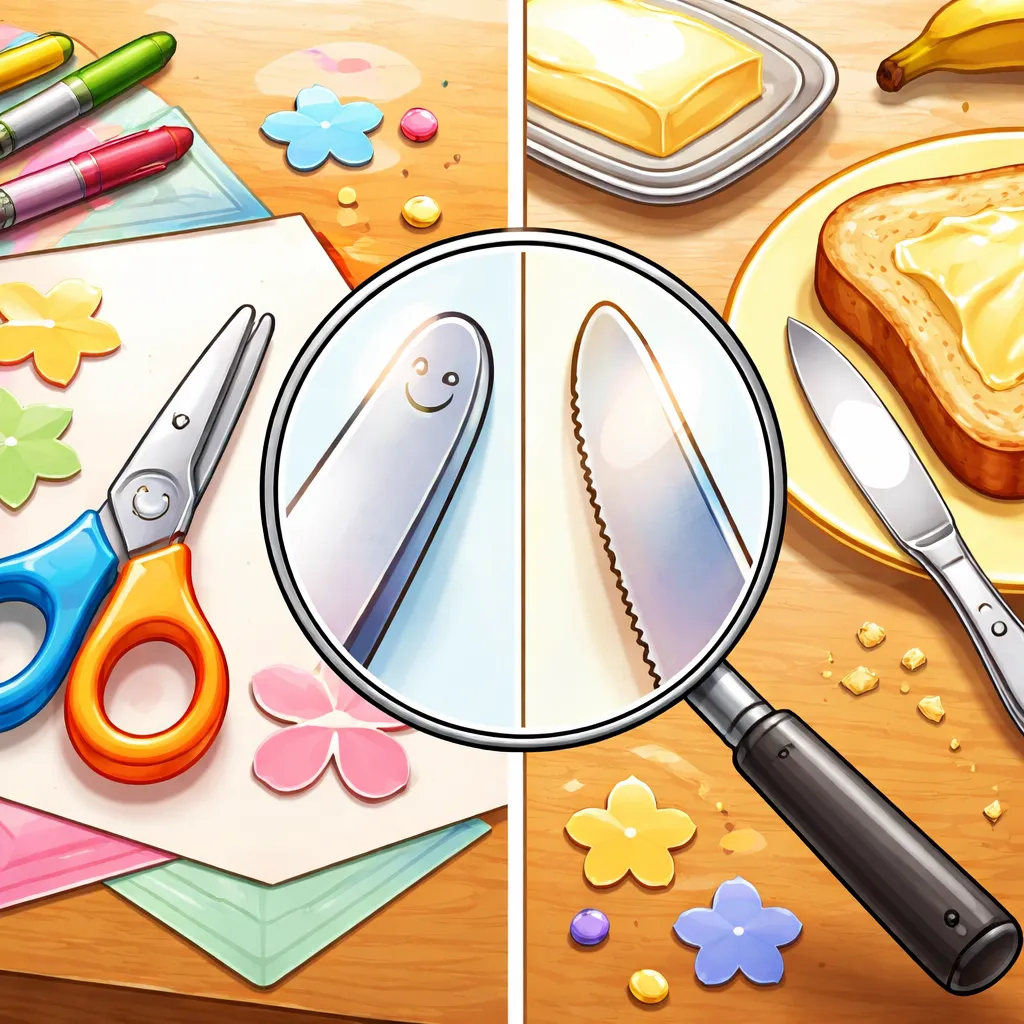

Children use many safe tools. They hold rounded scissors and blunt pencils. Parents often hear kids say, “This tip is blunt.” Or “This corner is rounded.” But are these two words the same? Can we always use one instead of the other? This article helps families explore the words “blunt and rounded” together. We will compare them with similar words. We will see which one fits a worn-down crayon and which one fits a marble. Let us help your child describe safe, soft edges and tips with confidence.
Are Similar Words Really Interchangeable? Many English words describe things that do not cut or poke. But they each carry different meanings. “Blunt” and “rounded” both describe things without sharp points. Yet we use them in different situations. A blunt knife cannot cut well. A rounded corner has a curved shape. You cannot always swap them. For example, a blunt remark is too direct and rude. A rounded remark has no meaning. So similar words are not always interchangeable. Parents can show this with real objects. Point to a blunt pencil tip. Then point to a rounded pebble. Ask your child: “Can I call the pebble blunt?” No, because blunt describes something that used to be sharp. Teaching these small differences builds a strong vocabulary.
Set 1: Blunt vs Rounded — Which One Is More Common? “Blunt” appears less often in everyday English. We say blunt knife, blunt trauma, blunt object, blunt force. “Rounded” appears more frequently. We say rounded edge, rounded shoulder, rounded number, rounded corner. In children’s books, “rounded” dominates. Think of rounded hills and rounded cheeks. “Blunt” shows up in safety lessons and older stories. Look at Google Ngram. “Rounded” has grown in usage. “Blunt” stays steady but lower. For young learners, teach “rounded” first. Use it for smooth, curved edges everywhere. Save “blunt” for tools that lost their sharpness. This order helps kids stay positive. “Rounded” sounds friendly. “Blunt” can sound negative.
Set 2: Blunt vs Rounded — Same Meaning, Different Contexts Both words mean “not sharp or pointed.” But context separates them. “Blunt” describes something that was once sharp but no longer is. A blunt razor, blunt needle, blunt pencil. “Rounded” describes something designed to be curved or smooth. A rounded arch, rounded stone, rounded corner of a book. You can have a blunt knife that is not rounded. It may have a flat, square tip. You can have a rounded hill that was never blunt. So one word is about loss of sharpness. The other word is about shape by design or nature. Tell your child: “Blunt means it should be sharp but isn't. Rounded means it was always smooth and curved.”
Set 3: Blunt vs Rounded — Which Word Is “Bigger” or More Emphatic? “Blunt” often feels more negative and forceful. A blunt rejection hurts. Blunt force causes damage. “Rounded” feels softer and more pleasant. A rounded personality is balanced. Rounded edges feel safe. So “blunt” carries a sense of failure or directness. “Rounded” carries a sense of completeness and safety. For children, explain this way: “Blunt means not working well or too honest. Rounded means safe and smooth.” A blunt scissors frustrates a child. A rounded scissors protects a child. This helps kids understand safety tools. They learn that “rounded” is a good design. “Blunt” is often an accident or a flaw.
Set 4: Blunt vs Rounded — Concrete vs Abstract Both words work concretely and abstractly. Concrete “blunt”: a blunt axe, blunt pencil, blunt needle. Abstract “blunt”: blunt speech (too direct), blunt manner (rude), blunt instrument (metaphor). Concrete “rounded”: rounded stone, rounded table edge, rounded hill. Abstract “rounded”: rounded personality (balanced), rounded education (complete), rounded argument (well-developed). However, abstract “blunt” is almost always about communication style. Abstract “rounded” is about completeness and harmony. For children, start with concrete meanings. Show a blunt crayon. Show a rounded beach pebble. Later, introduce abstract uses through stories. Explain that a “blunt person” says exactly what they think. A “rounded person” has many good qualities.
Set 5: Blunt vs Rounded — Verb or Noun? First Understand the Role Both words are primarily adjectives. “Blunt” can be a verb. “Time blunts the knife edge.” “Rounded” comes from the verb “round.” “Round the corners” is the verb. As nouns, “blunt” is rare. A blunt is a type of cigar. “Rounded” is not a noun. For young children, focus on adjectives. “This tip is blunt.” “This edge is rounded.” Later, teach the verbs. “Watch me blunt this needle by using it too much.” “Watch me round this square corner with sandpaper.” This builds grammar naturally. Also teach “round” as a verb separate from “rounded.” “We round the number up.” This helps children see word families. “Blunt” as a verb is advanced. Save for older kids.
Set 6: Blunt vs Rounded — American English vs British English Both words work similarly in American and British English. However, small differences exist. In the UK, “blunt” can mean a straight-talking person. “He is blunt but honest.” Americans use the same. In the US, “rounded” appears more in design and fitness. “Rounded shoulders” is a posture problem. Britons say the same. Also, “blunt instrument” is a legal term in both countries. For children, these differences are minor. Teach the core meanings. If your child watches British cartoons, they may hear “blunt” less often. American cartoons use “rounded” for safety scissors. A family activity: look at safety labels on toys from both countries. Compare the words. You will see “rounded edges” everywhere.
Set 7: Blunt vs Rounded — Which Fits Formal Situations? Both words work in formal and informal settings. “Blunt” appears in medical and legal writing. “Blunt force trauma.” “Blunt object.” “Rounded” appears in design, architecture, and education. “Rounded corners improve safety.” “A rounded curriculum includes arts and sciences.” For school reports, both are fine. But “rounded” sounds more positive. “Blunt” sounds more clinical. Teach your child this rule: “Use blunt for things that lost sharpness or for direct speech. Use rounded for safe edges and complete qualities.” In a safety report, “rounded edges” is best. In a story about a worn tool, “blunt blade” works. This helps kids learn tone. They understand that word choice affects feeling.
Set 8: Blunt vs Rounded — Which One Is Easier for Kids to Remember? “Rounded” is easier for young children. Why? Because it sounds like “round.” Children learn “round” early. A round ball. A round cookie. “Rounded” just adds “-ed.” “Blunt” has a different sound. The “bl” blend is fine, but the “unt” ending is less common. A three-year-old can say “rounded” after learning “round.” That same child may confuse “blunt” with “blink” or “bunt.” So start with “rounded.” Use it for all safe, curved edges. Introduce “blunt” around age five or six. Use real objects. A blunt crayon that cannot color well. A blunt scissors that cannot cut. Let them feel the difference. Then say “blunt.” This sensory learning works better than definitions. Also compare blunt and rounded side by side. A blunt knife has a flat, thick tip. A rounded knife has a curved, smooth tip. Both are safe. But one used to be sharp.
Mini Exercise: Can You Spot the Differences Between These Similar Words? Read each sentence with your child. Choose “blunt” or “rounded.” Answers below.
These safety scissors have _______ tips.
After using it for a year, the pencil became _______.
The pebble felt smooth and _______ in my hand.
His _______ answer hurt my feelings.
Please file the corner until it feels _______.
Bonus question: Is this sentence correct? “The blunt of the table hurt my knee.” Why or why not?
Answers: 1. rounded, 2. blunt, 3. rounded, 4. blunt, 5. rounded. Bonus: Not correct. “Blunt” as a noun does not mean the edge or tip. Say “The blunt corner” or “The rounded edge.” Better yet: “The blunt corner of the table hurt my knee.”
Talk about each answer. Ask your child which sentences describe tools that wore out. Which describe safe designs. Which describe direct talking. This discussion builds layered understanding. Do the exercise again with real objects. A worn eraser? Blunt. A smooth river stone? Rounded. A butter knife? Could be both.
Parent Tips: How to Help Kids Learn and Remember Similar Words You can teach “blunt and rounded” during everyday activities. Breakfast time: “This butter knife is blunt. This plate has rounded edges.” Craft time: “Your scissors are rounded for safety. This old crayon is blunt.” Playtime: “Find the rounded blocks. Find the blunt pencil that needs sharpening.” Nature walk: “This stone is rounded by the river. This stick tip is blunt.” Use your body. Make a rounded shape with your arms. Show a blunt motion like pushing without cutting. Say the words as you move. Play the “Blunt or Rounded” sorting game. Gather ten objects. A safety scissors tip? Rounded. A worn crayon? Blunt. A marble? Rounded. A dull knife? Blunt. A smooth door handle? Rounded. Ask your child to explain each choice. Do not correct mistakes harshly. Instead, ask “Was this ever sharp? If yes, it might be blunt. Was it made smooth on purpose? If yes, it is rounded.” This gentle guidance works better than rules. Read books about tools and nature. “The Tool Book” by Gail Gibbons is great. Pause on each page. Ask “Is this edge blunt or rounded? Why?” Keep a shape journal. Draw one blunt thing and one rounded thing each week. Label them. Review old entries. Praise specific observations. “You noticed that a worn eraser is blunt but not rounded. Perfect.” This positive feedback builds a careful eye. Your child will soon see safe edges everywhere. They will also understand the difference between accidental dullness and intentional smoothness. That is a sophisticated skill for a young learner. Keep exploring words together. Every tool, every stone, every piece of furniture offers a new chance to learn about safety and shape.