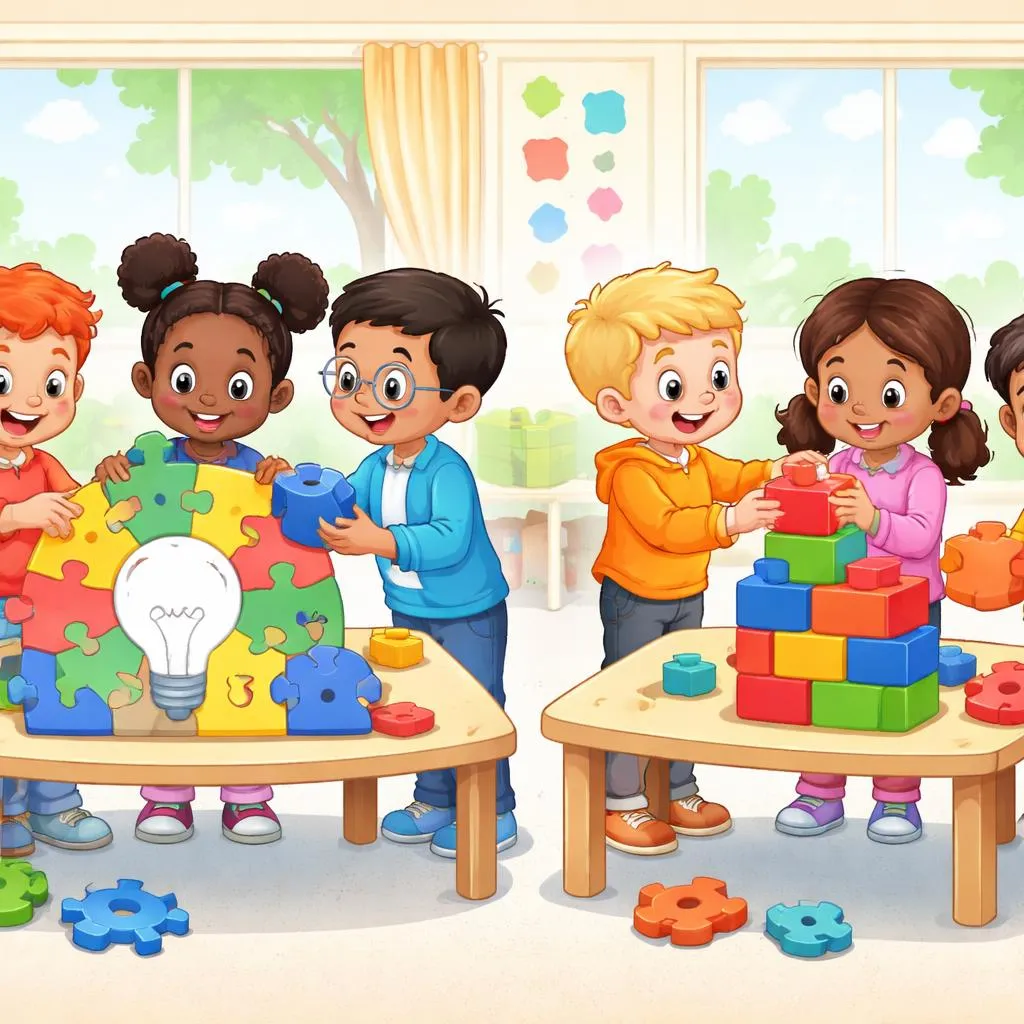

A group of children builds a fort. One holds the blanket. One stacks the pillows. One brings the chairs. The fort rises together. The children feel connected.
Two words describe what just happened. "Teamwork" and "working together." Parents and teachers use both phrases constantly. But they are not exactly the same.
One sounds like a skill to learn. One sounds like an action to take. Children hear both words. They need to understand the small difference.
This article helps families explore cooperation. Your child will learn when to say "teamwork" and when to say "working together." Group activities will feel more meaningful.
What Do These Expressions Mean?
"Teamwork" means "the combined action of a group of people working toward a common goal." The word names a concept. It is a noun. It describes the idea of cooperation.
For a child, think of this like a sports team name. "Teamwork" is the skill. You cannot touch it. But you know it when people help each other. It lives in how the group acts.
"Working together" means "the actual process of two or more people doing something as a group." The phrase describes an action. It is a verb phrase. It shows cooperation happening.
For a child, think of this like building a block tower. One person hands blocks. One person places blocks. One person holds the tower steady. That is working together. You can see it happen.
These two expressions seem similar because both describe people helping each other. Both are good things to do. Both make tasks easier and more fun.
But one is the name of the skill. One is the action itself.
What's the Difference?
The main difference lies in whether you name a concept or describe an action. "Teamwork" is a noun that names the idea. "Working together" is a verb phrase that describes the activity.
One is about the what. One is about the how.
"Teamwork" sounds more abstract and grown-up. You talk about teamwork as a value. You praise a child for showing teamwork. You teach teamwork as a skill for life.
"Working together" sounds more concrete and visible. You describe what you see. "Look at you working together." You can point to the specific actions people take.
Another difference involves teaching. You teach children about teamwork as a concept. "Teamwork means helping each other." Then you watch them working together in real life.
Also, "teamwork" can exist as an idea even when people are not currently cooperating. A coach says "this team needs more teamwork." The concept is missing. "Working together" only exists when people are actively cooperating right now.
So remember: teamwork = the concept, the skill, the noun. working together = the action, the activity, the verb phrase.
When Do We Use Each One?
Use "teamwork" when talking about the idea of cooperation. Use it in lessons. Use it in praise after an activity. Use it when teaching values. Use it as a label.
For example, after a group project, you say "that was great teamwork. Everyone helped." You name the concept that made the success possible.
Use "teamwork" on posters or classroom rules. "Teamwork makes the dream work." "Good teamwork means listening to each other."
Use "working together" when describing the action in real time. Use it during an activity. Use it to point out cooperation as it happens. Use it to give specific directions.
For example, two children clean up toys. You say "I see you working together. One is putting away blocks. One is stacking books." You describe the visible action.
Use "working together" to solve problems. "This puzzle is hard. Try working together. You look for edge pieces. You look for corner pieces."
Also use "working together" for family chores. "We are working together to set the table. You put out plates. I will pour the drinks."
Remember: talking about the idea = "teamwork." Describing the action = "working together."
Example Sentences for Kids
Here are simple sentences for "teamwork":
Building this fort showed great teamwork. Everyone had a job and did it well.
(This names the concept after the activity.)
Teamwork means you share ideas and listen to your friends.
(This defines the concept for a child.)
Our soccer team practices teamwork every day. That is why we win games.
(This explains the value of the concept.)
Here are simple sentences for "working together":
I love watching you two working together to solve that puzzle.
(This describes the action as it happens.)
We are working together to bake cookies. You mix the dough and I will preheat the oven.
(This describes shared action with specific roles.)
Working together makes hard jobs feel easier and faster.
(This describes the benefit of the action.)
Notice how "teamwork" names a concept you can talk about. "Working together" describes actions you can see.
Common Mistakes to Avoid
Many people say "teamwork" when they mean the action. This can sound too formal. A child hands a crayon to a friend. You say "excellent teamwork."
Incorrect: Not wrong, but a bit formal for a small action.
Better: "I see you working together. You shared your crayons."
For small, visible actions, use the action phrase. Save "teamwork" for bigger moments or lessons.
Another mistake: using "working together" when teaching the concept. This can sound imprecise. A teacher wants to explain cooperation as a value.
Incorrect: "Working together is important for life." (not wrong but vague)
Better: "Teamwork is an important life skill. Working together means helping each other."
Use "teamwork" to name the concept. Then use "working together" to explain what it looks like.
A third mistake: forgetting that both phrases need specific examples. Children understand concrete examples better than abstract words.
Do not just say "good teamwork." Say "good teamwork. You listened to each other and took turns." Do not just say "keep working together." Say "keep working together. You find the red pieces and I will find the blue ones."
Easy Memory Tips
Here is a fun trick for kids. Think of a toolbox and a pair of hands.
"Teamwork" = a toolbox. The toolbox holds the idea of fixing things. You cannot see the fixing. But the toolbox represents the skill. Teamwork is the toolbox of cooperation.
"Working together" = a pair of hands. The hands are doing something right now. You see them hammering, sawing, painting. Working together is the visible action of helping.
Another memory tip: look at the word structure. "Teamwork" is one word. It packs the whole idea into a single package. "Working together" is two words. It opens up and shows the action.
Draw a simple picture. Draw a trophy labeled "Teamwork" next to the word. Draw two children carrying a box together next to "working together." The images help children feel the difference.
Also try this question: "Am I naming a skill or describing an action?" If naming a skill, say "teamwork." If describing an action, say "working together."
Quick Practice Time
Try these easy exercises with your child. Fill in the blank with "teamwork" or "working together."
After a group art project, the teacher says "________________ made this beautiful painting possible."
A parent watches two siblings wash dishes. One washes. One dries. The parent says "I love watching you ________________."
A coach gives a speech before a big game. "________________ is the key to winning. Everyone must do their part."
Two children try to lift a heavy box. A third child says "Keep ________________. Lift on three. One, two, three!"
Answers:
Teamwork (naming the concept that enabled the project)
Working together (describing the visible action of washing dishes)
Teamwork (teaching the concept before the game)
Working together (describing the action as it happens)
Now practice using both phrases at home. When you teach your child about cooperation as a value, say "teamwork." When you watch your child cooperate in real time, say "working together." Your child will learn that teamwork is the idea in their mind, and working together is what their hands and heart do with others.
Wrap-up
Use "teamwork" to name the concept and skill of cooperating as a group. Use "working together" to describe the visible action of people helping each other in real time. Both build strong groups, but one lives in your mind while one lives in your hands.