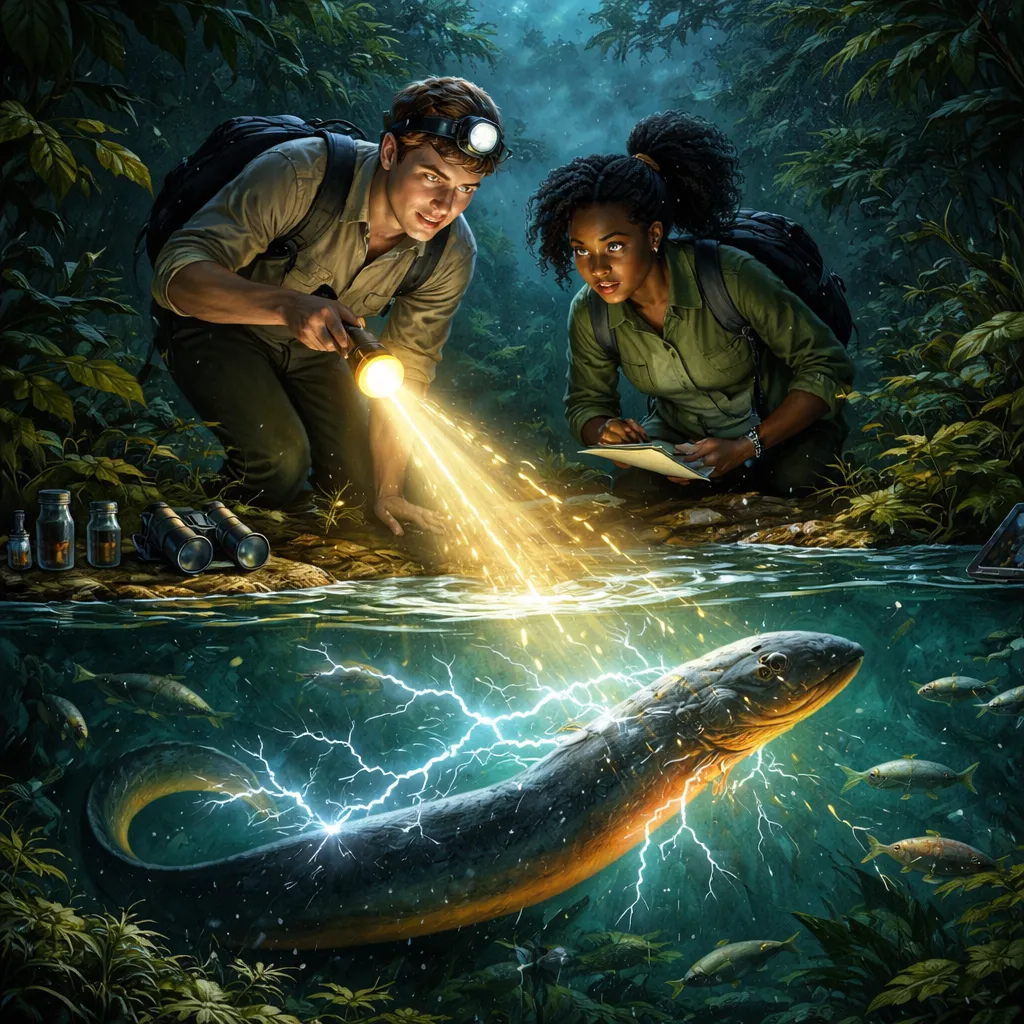

Some animals run fast. Others hide well. The electric eel does something no other creature does quite the same way. It generates electricity. For children, learning about Electric Eel opens a world of biological wonder and natural power. Parents and children can explore this astonishing fish together. No special equipment is needed. Just curiosity about an animal that carries its own power source.
The electric eel is not an eel at all. It belongs to a different family. Yet its name captures its most famous feature. Let us begin our journey into the rivers of South America where this remarkable creature lives.
What Is This Animal?
An electric eel is a long, cylindrical fish with a flattened head. Its body is dark gray or brown. Its underside is lighter. It can grow up to eight feet long. That is taller than most adults. Despite its name, the electric eel is a type of knifefish. It is not a true eel.
Electric eels live in slow-moving rivers and swamps in South America. They prefer murky water where visibility is low. This environment suits their hunting style. They use electricity to navigate and find prey in the darkness.
Children often find electric eels fascinating because of their superpower. They generate electricity. Learning about Electric Eel becomes an exploration of how animals use unique abilities to survive.
English Learning About This Animal
Let us begin with the name “electric eel.” It is pronounced /ɪˈlɛktrɪk iːl/. Electric has three syllables: e-lec-tric. Say it slowly: e-lec-tric eel. The word “electric” comes from the Greek word for amber. Ancient people discovered static electricity by rubbing amber. The name connects this fish to the power of electricity.
When learning about Electric Eel in English, we meet words about power and senses. Here are a few to share.
Voltage – the strength of an electric current.
Organ – a part of the body with a specific function.
Pulse – a brief, strong burst of energy.
Electroreceptor – a cell that detects electric fields.
Use these words in simple sentences. “The electric eel produces high voltage.” “It uses pulses to find food.” These sentences help children understand the fish’s special abilities.
Here is a proverb that fits the electric eel. “With great power comes great responsibility.” The electric eel has tremendous power. It uses it carefully. It does not waste energy. This teaches children that having abilities means using them wisely.
Another meaningful thought comes from scientist Nikola Tesla. He said, “If you want to find the secrets of the universe, think in terms of energy, frequency, and vibration.” The electric eel works with energy every day. It reminds us that energy surrounds all living things.
Animal Facts and Science Knowledge
Electric eels belong to the family Gymnotidae. Their scientific name is Electrophorus electricus. They are knifefish, not true eels. True eels belong to a different order. Electric eels are more closely related to catfish.
Electric eels have three electric organs. These organs make up about eighty percent of their body. The main organ and Hunter’s organ produce high-voltage pulses. The Sach’s organ produces low-voltage pulses. These pulses help the eel communicate, navigate, and hunt.
The high-voltage pulse can reach up to 600 volts. That is five times the voltage of a standard wall outlet. This shock stuns prey instantly. It also deters predators. The electric eel can deliver multiple pulses in quick succession.
Electric eels breathe air. They must surface every ten minutes or so to gulp oxygen. Their mouths have a special tissue that absorbs oxygen directly. This adaptation allows them to live in low-oxygen swamps where other fish cannot survive.
Electric eels are carnivores. They eat fish, small mammals, and amphibians. They hunt using a unique strategy. They deliver high-voltage pulses to locate prey. Then they stun it with a stronger shock. Sometimes they use a double shock to ensure the prey does not escape.
Young electric eels eat invertebrates. As they grow, they target larger prey. They are solitary animals. They only come together to mate. Females lay thousands of eggs in nests made of saliva. Males guard the young for several months.
How to Interact With This Animal Safely
Electric eels are wild animals. They are not pets. They live in remote rivers and swamps in South America. Most people will never encounter one in the wild. This is fortunate because their shock is dangerous to humans.
If you visit regions where electric eels live, follow local guidance. Do not wade into murky water without knowing what lives there. Electric eels can deliver shocks through water. A shock can cause drowning even if it does not kill directly.
In aquariums, electric eels are rare. They require very specialized care. Large tanks, water quality management, and safety precautions are essential. Only experienced professionals keep them. They are not suitable for home aquariums.
If you see an electric eel in a public aquarium, observe from a safe distance. Do not tap the glass. Do not put hands near the tank. Respect the signs and barriers. Aquarium staff handle these animals with extreme care.
Teach children that some animals are meant to be admired from afar. Electric eels have incredible abilities. Those abilities also make them dangerous. Respecting their nature keeps everyone safe.
What Can We Learn From This Animal
Electric eels teach us that power must be controlled. They generate massive energy. But they do not use it constantly. They save it for hunting and defense. Children can learn that having strength or ability comes with the responsibility to use it wisely.
Electric eels also show us that we can adapt to challenging environments. They live in murky, oxygen-poor water. They developed air breathing and electricity to survive. This teaches children that we can find ways to thrive even when conditions are difficult.
Another lesson is precision. Electric eels do not waste energy. They deliver exactly the right pulse for the situation. Low voltage for sensing. High voltage for stunning. Children can learn that doing things with care and precision leads to better results.
Electric eels also teach us about uniqueness. They are the only creatures that produce electricity this way. They do not compare themselves to other fish. They use what makes them special. Children can learn that their own unique qualities are valuable.
Fun Learning Activities
Turn learning about Electric Eel into energetic exploration. Here are a few simple ideas.
Make a Spark Craft
Draw a long eel shape on paper. Cut it out. Glue small pieces of yellow, orange, or silver foil along its body to represent electricity. Talk about how the eel generates power from special organs.
Create a River Story
Ask your child to imagine being an electric eel hunting in murky water. How do you find food when you cannot see? How do you protect yourself? Write or draw the story together. Use new words like voltage, pulse, and organ.
Play the Electric Tag Game
One person is the electric eel. When they touch someone gently, that person freezes for a moment like they have been stunned. This movement game builds understanding through play. Explain that real electric eels use electricity, not touch.
Build a Simple Circuit
With adult help, use a battery, a small bulb, and wires to create a simple circuit. Show how electricity flows. Explain that electric eels have their own built-in circuits inside their bodies.
Watch and Wonder
Find a short video of an electric eel hunting or being studied by scientists. Watch together. Pause and ask open questions. “What do you notice about how it moves?” “Why do you think it needs so much electricity?” Let your child share observations freely.
Learning about Electric Eel takes us to the murky rivers of South America. It is a world where fish breathe air and carry lightning in their bodies. This remarkable creature shows us that nature’s inventions often surpass human imagination. As parents and children explore together, they build language, knowledge, and a shared appreciation for life’s extraordinary variety. The electric eel glides through dark water, silent and powerful. And in that hidden current, young learners discover something electrifying—that the natural world holds powers we are only beginning to understand, and every creature has its own unique way to shine.