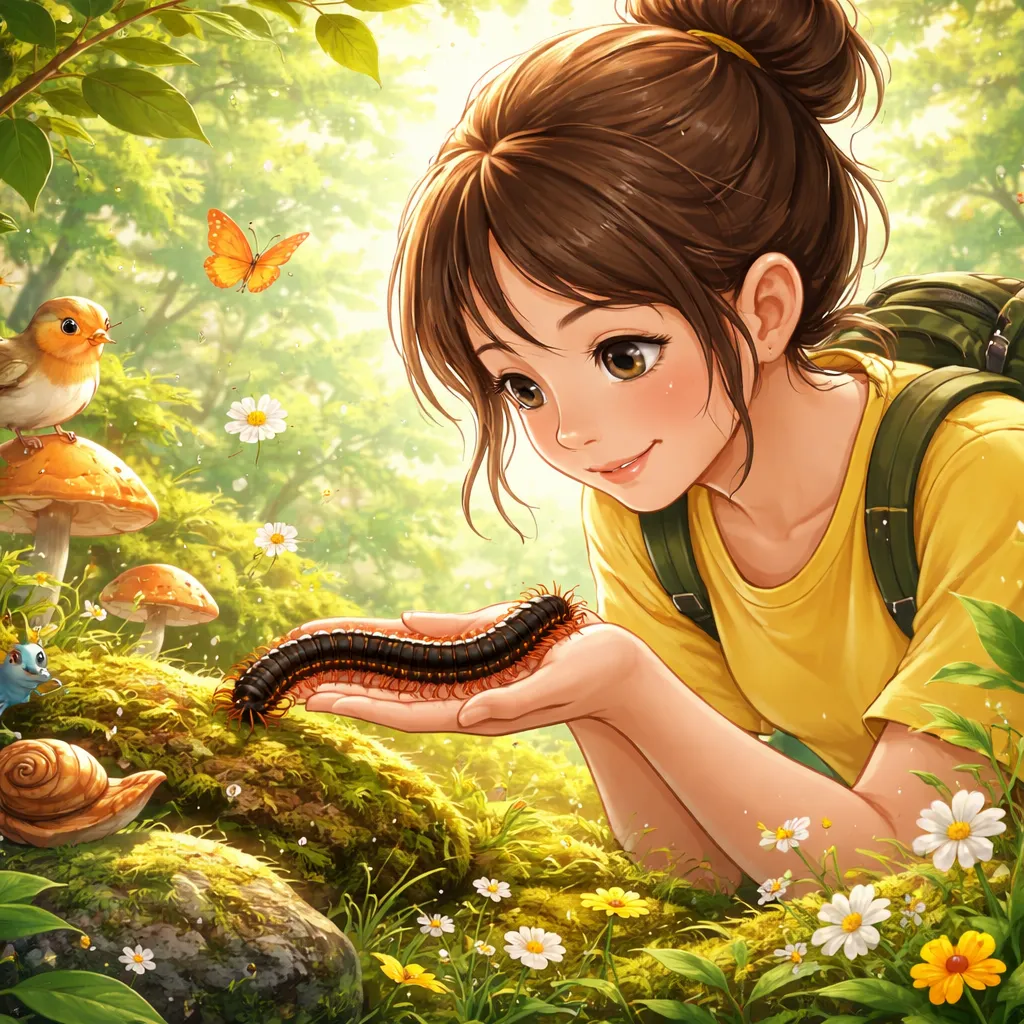

What Is This Animal?
A millipede is a long, tube-shaped creature with many legs. Its body has many segments. Each segment has two pairs of legs. Millipedes move slowly. They curl into a tight spiral when frightened. This protects their soft underside.
Millipedes are not insects. Insects have six legs. Millipedes have many more. They belong to a group called myriapods. Their name means “thousand legs.” No millipede actually has one thousand legs. But some species have over seven hundred. That is more than any other animal.
These creatures live in damp places. You find them under leaves, logs, and rocks. They like soil that stays moist. They come out at night. During the day, they hide in cool, dark spots. Millipedes are gentle and slow.
For children, millipedes are interesting and safe. Their many legs move in a gentle wave. Their bodies feel smooth. They do not bite or sting. They show us that creatures with many legs can be peaceful and helpful.
English Learning About This Animal
Let us learn the English word millipede. We say it like this: /ˈmɪlɪpiːd/. The word has three parts. Milli sounds like “mill-ee.” Pede sounds like “peed.” Put them together: millipede. Say it three times. Millipede. Millipede. Millipede.
Now let us learn words about a millipede’s body. The head holds short antennae and simple eyes. The segments are the body sections. Most segments have two pairs of legs. The exoskeleton is the hard outer shell. The spiracles are tiny breathing holes along the body. The defensive glands release a mild liquid when the millipede feels threatened.
There is a gentle saying about millipedes. Some cultures say, “The millipede moves slowly, but it always arrives.” This reminds us that speed is not the only way to succeed. Another saying is, “The millipede knows the value of a strong curl.” This refers to how millipedes protect themselves by curling up.
These English words help children understand millipede anatomy. When they say segments, they see how the body is built. When they say defensive glands, they learn about protection. Parents can practice these words while looking at pictures or observing a millipede. Point to the parts. Say the words together.
Animal Facts and Science Knowledge
Millipedes belong to the class Diplopoda. This name means “double feet.” Each segment has two pairs of legs. Millipedes are arthropods. They have an exoskeleton. They have been on Earth for over four hundred million years. Ancient millipedes were much larger than today’s species.
Millipedes live in moist environments. They live under leaf litter, in soil, and inside rotting wood. They need dampness to survive. Their bodies dry out easily. During dry weather, they burrow underground. Some millipedes live in forests. Others live in grasslands or caves.
Millipedes are decomposers. They eat decaying leaves, wood, and plant material. They help break down dead plants. This returns nutrients to the soil. Millipedes do not eat living plants. They are not pests. They are important for healthy gardens and forests.
Millipedes have special abilities. They curl into a tight spiral when threatened. This protects their soft legs and underside. Some millipedes release a mild liquid from their defensive glands. The liquid smells or tastes bad. This discourages predators. The liquid is harmless to humans but may stain skin.
Millipedes go through simple metamorphosis. They hatch from eggs. Young millipedes have fewer segments and legs. They add new segments each time they shed their skin. They continue adding segments until they reach adulthood. This process can take several years.
How to Interact With This Animal Safely
Millipedes are gentle wild creatures. They do not bite or sting. They are safe to observe and hold gently. If you find a millipede outside, let your child watch it. Notice how it moves. Watch its legs ripple. Then let it continue on its way.
If your child wants to hold a millipede, show them how. Place a hand flat on the ground near the millipede. Let it crawl onto the hand. Hold the hand still. Feel the gentle movement. Watch it uncurl if it was curled. Then place it back near leaves or soil.
Teach children to be gentle. Millipedes have soft bodies. Their legs are delicate. Do not squeeze them. Do not pull them. Let them move at their own pace. Wash hands after touching a millipede. Some species release a mild liquid that can irritate eyes or skin.
Never keep a millipede in a jar for more than a short time. Millipedes need damp soil and fresh leaves. They need space to move. If your family wants to observe one longer, place it in a small container with damp soil and leaves. Add air holes. Watch it for one day. Then release it where you found it.
Teach children to protect millipede homes. Leave piles of leaves in the garden. Do not use chemicals on soil. Millipedes help keep soil healthy. When we care for their homes, we help the whole garden thrive.
What Can We Learn From This Animal
Millipedes teach us about patience. They move slowly. They do not rush. Children learn that moving slowly has value. Taking time to think, to listen, and to do careful work leads to good results. Patience helps us enjoy the journey.
Millipedes teach us about protection. They curl into a ball when scared. They know how to keep themselves safe. Children learn that protecting themselves is important. Knowing when to step back, when to ask for help, and when to stay calm are ways to stay safe.
Millipedes teach us about being helpful. They eat dead leaves. They turn waste into healthy soil. Children learn that small helpful actions matter. Picking up toys, helping with chores, or sharing kind words all make the world better.
Millipedes teach us that gentle strength is powerful. They do not fight. They do not bite. They use patience and protection. Children learn that being gentle does not mean being weak. Kindness, patience, and quiet strength are powerful qualities.
Fun Learning Activities
Let us make learning about millipede fun. One activity is the millipede movement game. Ask your child to lie on the floor. Move slowly like a millipede. Make gentle waves with the body. Curl into a ball when someone says “danger.” Uncurl and move again. Say “millipede crawls slowly” and “millipede curls up.”
Another activity is counting legs. Look at pictures of millipedes. Count how many legs you see. Notice that each segment has two pairs. Talk about how millipedes have more legs than centipedes. Use words like “segments” and “pairs.”
Draw a millipede and label its parts. Draw the head, segments, legs, and defensive glands. Write the words next to each part. Say them aloud. For younger children, draw the millipede first. Let them point to the parts as you say the words.
Create a story about a millipede’s day. Ask your child where the millipede goes. Does it crawl under a leaf? Does it eat a dead leaf? Does it curl up when a bird passes? Write a few sentences together. Let your child draw pictures. Read the story aloud.
Make a millipede from craft materials. Use a long paper tube or rolled paper for the body. Add many small paper legs along each side. Draw eyes on the head. Move the craft millipede. Watch its many legs. Practice saying “millipede moves gently” and “millipede helps the soil.”
These simple activities bring learning to life. Children build English vocabulary while playing. They learn science through observation. They connect with nature in peaceful ways. Learning about millipede becomes a journey of gentleness. Each moment spent together strengthens language, curiosity, and a lasting appreciation for the slow, steady movers that turn fallen leaves into rich earth beneath our feet.