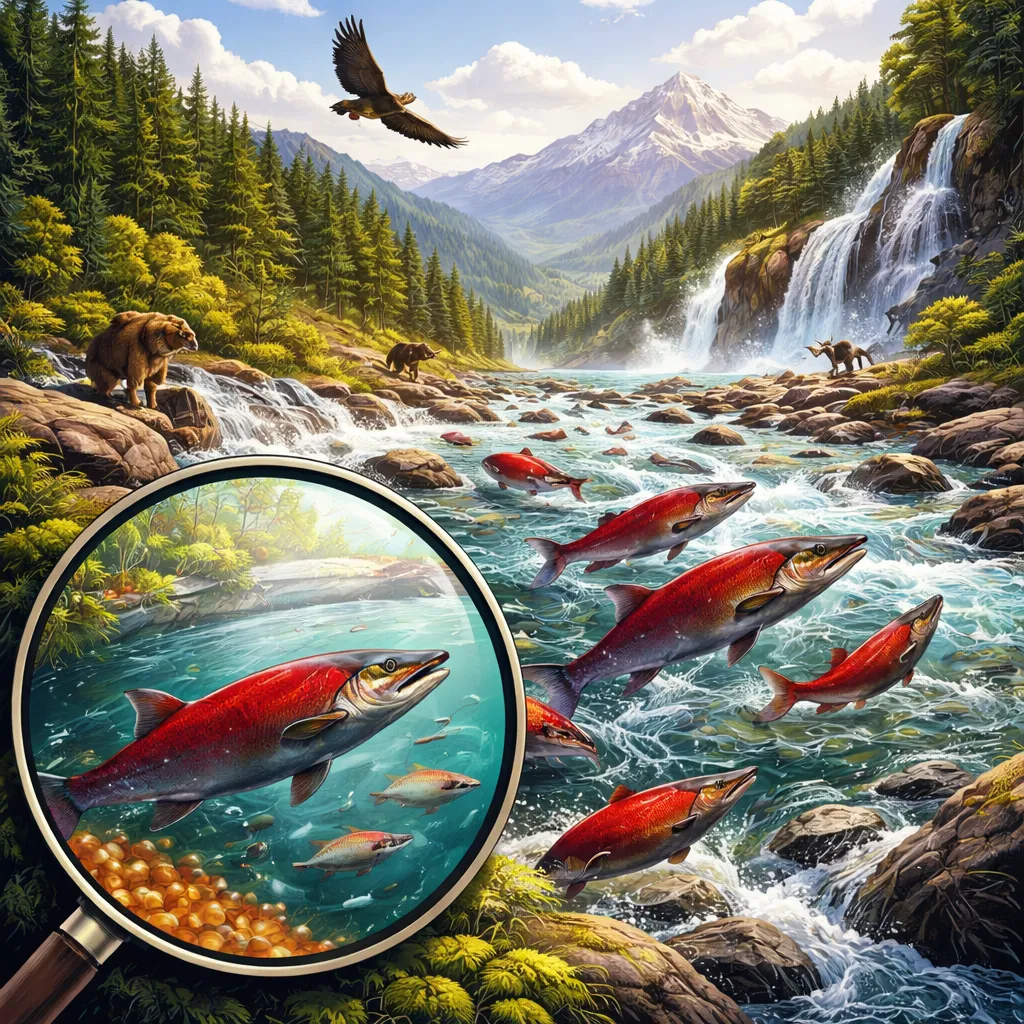

Some fish spend their whole lives in one place. The salmon does something extraordinary. It travels from rivers to the ocean and back again. This journey covers thousands of miles. For children, learning about Salmon opens a window to determination, mystery, and the power of instinct. Parents and children can explore this story together. It is a story of courage. It is a story of homecoming. Let us begin.
The salmon is not just one fish. It is a group of species known for their long migrations. They begin life in freshwater streams. They swim to the saltwater ocean to grow. Then they return to the very stream where they were born. This cycle has fascinated people for generations.
What Is This Animal?
A salmon is a sleek, silver fish with a streamlined body. It has small scales and a forked tail. Its shape helps it swim against strong currents. During spawning season, some salmon change color. They may turn red or develop hooked jaws. This transformation signals they are ready to return to freshwater.
Salmon live in the northern parts of the Atlantic and Pacific Oceans. They are anadromous fish. That means they hatch in fresh water, migrate to salt water, and return to fresh water to reproduce. This life cycle sets them apart from most other fish.
Children often connect with the salmon because of its determination. It swims upstream. It leaps over waterfalls. It does not give up. Learning about Salmon becomes a lesson in perseverance told through nature.
English Learning About This Animal
Let us start with the word “salmon.” It is pronounced /ˈsæmən/. The “l” is silent. Say it with your child: sam-on. It rhymes with “gammon.” The silent letter can be tricky. Practicing together makes it easier to remember.
When learning about Salmon in English, we meet meaningful words. Here are a few to explore.
Migrate – to move from one place to another with the seasons.
Spawning – the process of laying and fertilizing eggs.
Current – the steady flow of water in a river.
Instinct – a natural behavior that an animal is born knowing.
Use these words in simple sentences. “Salmon migrate thousands of miles.” “They return to the same stream for spawning.” These sentences help children understand new words in context.
Here is a famous saying that fits the salmon’s journey. “Not all who wander are lost.” This line from J.R.R. Tolkien reminds us that traveling does not mean being lost. Salmon wander far. Yet they always find their way home. Children can learn that exploring and returning are both valuable.
Another meaningful quote comes from naturalist John Muir. He said, “The rivers flow not past, but through us.” This speaks to the deep connection between living things and the places they call home. Salmon remind us that home is something we carry inside.
Animal Facts and Science Knowledge
Salmon belong to the family Salmonidae. Their relatives include trout and char. There are several species. Atlantic salmon live in the Atlantic Ocean. Pacific salmon include chinook, coho, sockeye, and pink salmon. Each species has its own migration pattern.
Salmon begin life in gravel nests called redds. Females dig these nests in riverbeds. They lay thousands of eggs. Males fertilize them. The eggs hatch into alevins, which carry yolk sacs for food. Young salmon become fry and then smolts. Smolts undergo physical changes to prepare for salt water.
In the ocean, salmon grow rapidly. They eat smaller fish, shrimp, and plankton. They spend one to four years at sea. Then instinct calls them home. They navigate using the Earth’s magnetic field and their sense of smell. They return to the exact stream where they hatched.
The journey home is hard. Salmon swim upstream against strong currents. They leap over waterfalls. They stop eating. Their bodies change. By the time they reach the spawning grounds, they use their remaining energy to reproduce. After spawning, most Pacific salmon die. Their bodies provide nutrients for the river ecosystem.
This life cycle shows the balance of nature. Nothing is wasted. The forest and the river depend on salmon.
How to Interact With This Animal Safely
In the wild, salmon are sensitive during spawning season. If you visit a river where salmon swim, observe from the bank. Do not walk in the water near redds. Stepping on gravel nests can crush eggs. Keep dogs on leashes. Dogs can disturb spawning areas.
If your family enjoys fishing, follow local rules. Many areas have seasons and limits for salmon fishing. Teach children to handle caught fish gently. Use wet hands to protect the fish’s slime coat. Release unwanted fish quickly. This respect helps salmon populations stay healthy.
In some places, you can watch salmon leap at fish ladders or viewing platforms. These structures help salmon pass dams. They also give people a safe way to watch. Stay behind railings. Do not throw objects into the water. Let the salmon complete their journey without interference.
If you eat salmon, talk to children about where it comes from. Choose sustainably sourced salmon. This supports healthy rivers and oceans. Making thoughtful choices teaches children that our actions affect the natural world.
What Can We Learn From This Animal
Salmon teach us about perseverance. They face strong currents, predators, and long distances. They do not stop. Children can learn that challenges are part of any worthwhile journey. When something feels hard, they can think of the salmon swimming upstream.
Salmon also show us the importance of home. After years in the ocean, they return to the place where they began. This teaches children that knowing where you come from is valuable. Family, traditions, and memories give us roots.
Another lesson is sacrifice. Pacific salmon give everything to create the next generation. Their bodies feed the forest. This shows children that giving can be a form of strength. Small acts of care—helping a friend, sharing a toy—have meaning.
Salmon teach us to follow our inner voice. They do not have maps or teachers. Instinct guides them. Children can learn to trust themselves. They have their own instincts about what is right and what matters.
Fun Learning Activities
Turn learning about Salmon into an adventure. Here are a few simple ideas.
Map the Journey
Draw a simple map with a river, an ocean, and the river again. Use a small toy fish or a finger to trace the salmon’s path. Talk about each stage: egg, fry, smolt, adult, spawner. This visual activity builds understanding.
Create a Leaping Salmon
Cut a fish shape from paper. Fold it slightly. Tape a craft stick to the back. Use a box or a ramp to pretend the salmon is leaping up a waterfall. Ask your child to describe the leap. Use words like strong, high, and determined.
Write a Journey Story
Ask your child to imagine being a salmon leaving the river for the first time. What does the ocean feel like? How does it feel to return home? Draw or write the story together. Use new vocabulary like migrate, current, and instinct.
Play the Current Game
Lay a long blanket or rope on the floor to represent a river. Ask your child to “swim” from one end to the other while you gently wiggle the blanket. Explain that salmon swim against currents. This movement game builds understanding through play.
Watch a Salmon Run
Find a short video of salmon swimming upstream or leaping at a fish ladder. Watch together without talking. Then ask open questions. “What do you notice about their movements?” “Why do you think they keep jumping?” Let your child share observations freely.
Learning about Salmon takes us into one of nature’s greatest stories. It is a story of leaving and returning. It is a story of strength and renewal. As parents and children explore together, they build language, knowledge, and a shared sense of awe. The salmon swims upstream, leaping against the current. And in that steady push, young learners find something powerful—a reminder that even the longest journey begins with a single upstream swim.