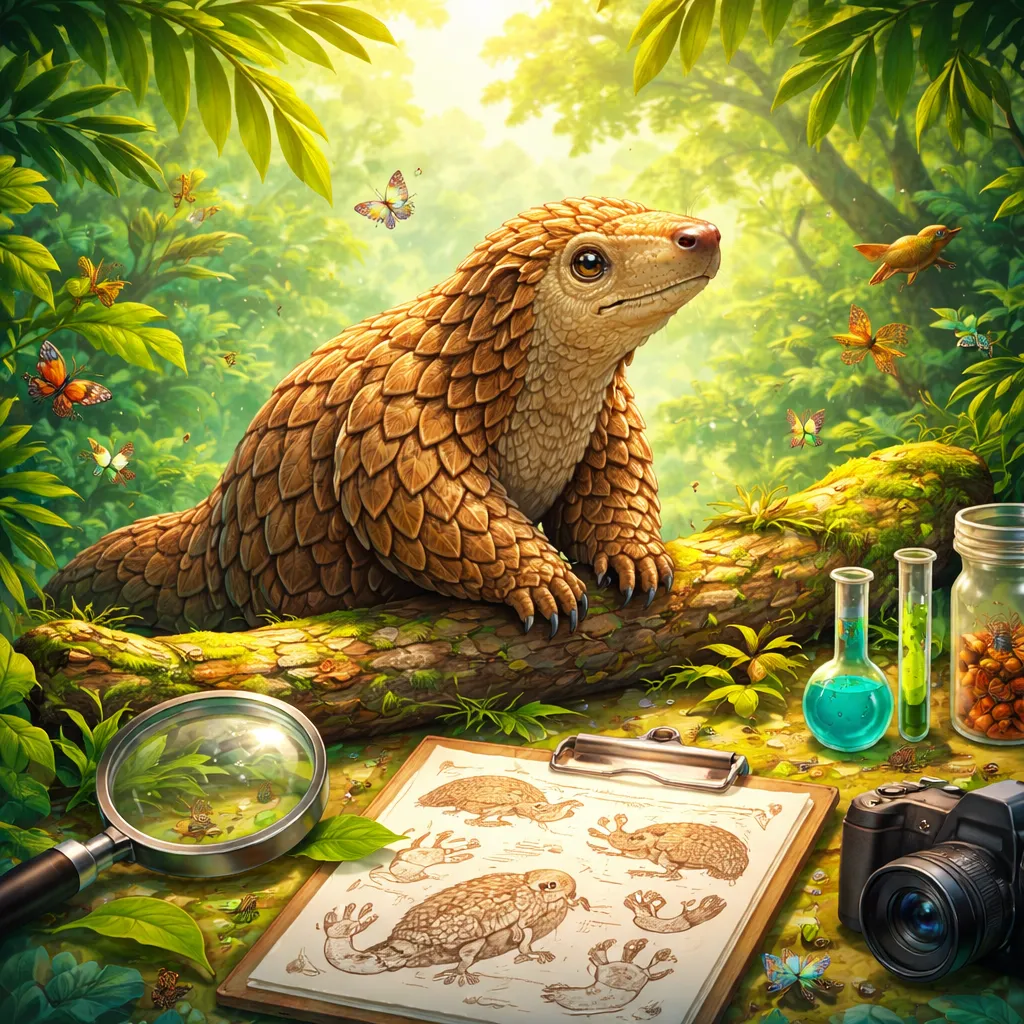

Imagine an animal that looks like a walking pine cone or a tiny dinosaur, covered in hard, overlapping scales. That’s a pangolin! They are shy, gentle animals that roll into a ball when scared. Learning about pangolins is a fascinating adventure that takes us to the forests and grasslands of Africa and Asia. Let’s tiptoe quietly and begin our journey of learning about pangolin mysteries and their fight for survival.
English Language Learning
Vocabulary and Spelling
Our scaly friend is called a pangolin.
The word "pangolin" is a noun. A noun names a person, place, or thing. So, a pangolin is a thing—a unique, living animal.
Spelling "pangolin" is interesting: P-A-N-G-O-L-I-N. The 'P' starts the word, the 'A' and 'N' are in the middle, and it ends with 'G-O-L-I-N'. P-A-N-G-O-L-I-N spells pangolin.
Sound and Pronunciation
Let’s say the word correctly. It sounds like this: /ˈpæŋ.ɡə.lɪn/.
We can say it in three clear parts. First, say "pang". It rhymes with "bang". Next, say "guh". It’s a soft, quick sound. Last, say "lin". It rhymes with "pin".
Now, put it together! "Pang" "guh" "lin". Pangolin! Great job!
The word "pangolin" has three beats, or three syllables. Clap three times: Pan-go-lin. It’s a unique, rolling word.
Related Words
Learning about pangolins is more fun with new words! Here are some important ones.
Body Part: The hard, protective plates on a pangolin’s body are called scales. They are made of keratin, like your fingernails!
Baby: A baby pangolin is called a pangopup.
Action: Pangolins use their long, sticky tongue to catch ants and termites.
A Famous Saying
People sometimes call the pangolin: "The guardian of the forest."
This is because pangolins help control insect populations, which keeps the forest healthy. It’s a name that shows how important they are, even though they are small and shy.
Say the name with me: "The guardian of the forest." It sounds important, doesn’t it?
Now you know the word "pangolin"! Are you ready to learn about these amazing scaled mammals? Let’s walk from words to wonderful knowledge!
Animal Knowledge
Who Are They? – Family and Group
What kind of animal is a pangolin? Pangolins are mammals. They have scales (which are modified hairs), are warm-blooded, and mother pangolins feed their babies milk.
They are so unique, they are in their own order called Pholidota. They are not related to armadillos or anteaters, even though they look a bit similar. They are the only mammals completely covered in scales!
What Do They Look Like? – Amazing Bodies
Pangolins are about the size of a cat or a small dog. They have a cone-shaped head, a long body, and a long tail. Their whole body, except their belly and face, is covered in sharp, brown scales.
Their scales are their super suit! When a pangolin is scared, it rolls into a tight ball, and the sharp scales protect its soft belly. Their scales are so tough that even a lion cannot bite through them!
Pangolins have special adaptations. They have no teeth! They use their long, sticky tongue, which can be longer than their body, to catch insects. They have strong claws for digging into ant hills and termite mounds. They can also close their ears and nostrils to keep insects out.
Where Do They Live and How? – Home and Habits
Pangolins live in Africa and Asia. Their homes are tropical forests, grasslands, and woodlands. Some pangolins live in trees, and some live on the ground.
Pangolins are insectivores. This means they only eat insects. They eat ants and termites. One pangolin can eat millions of insects in a year! This makes them very helpful for farmers and forests.
Pangolins are solitary and secretive. They are nocturnal, meaning they are most active at night. They spend their nights digging for ant nests, climbing trees, and foraging for food. During the day, they sleep in deep burrows or hollow trees.
A Pangolin’s Life Story – Growing Up
A baby pangolin is called a pangopup. Pangolins are mammals, so pangopups are born live from their mother. A mother pangolin usually has one tiny pup at a time.
The mother pangolin is a very protective and caring parent. The pup rides on its mother’s tail or back for the first few months. The mother feeds it milk and later teaches it how to find food.
Pangopups are born with soft, white scales that harden after a few days. They drink their mother’s milk for about three to four months and then start eating insects. They stay with their mother for up to two years, which is a long time in the animal world.
How Do They "Talk"? – Communication
Pangolins are usually very quiet. They can hiss and puff when they are scared. They do not make loud calls.
They use their sense of smell to talk. They have scent glands and leave smells to mark their territory and find each other. They also use their tails for balance and to hug their mothers.
Their best senses are their amazing sense of smell and hearing. They have a great nose to sniff out ant and termite nests. Their ears are good at hearing tiny insect sounds and danger.
Are They Okay? – Taking Care of Them
Pangolins are the most trafficked mammals in the world. This means more pangolins are taken from the wild and sold illegally than any other mammal. All eight species are threatened with extinction.
The main threat is poaching. Bad people hunt them for their scales, which are used in traditional medicine (even though they have no real medical power), and for their meat. They also lose their forest homes when trees are cut down.
You can be a pangolin hero! You can learn and tell everyone about their terrible situation. You can support groups that rescue pangolins and protect their habitats. You can choose to never buy anything made from pangolin scales. Remember, their scales are just like fingernails—they are not medicine!
Life Connections and Inspiration
How to Be With Them – Safety and Love
Pangolins are wild, endangered, and very sensitive animals. We must do everything we can to protect them and never disturb them.
The rule is: Protect from afar and never disturb. We can support their survival by learning about them and supporting conservation. In the wild, we would be very lucky to see one, but we must never try to touch, chase, or take a pangolin. If you see one in a market or online, tell an adult so they can report it to wildlife authorities.
We show our love by being a voice for their protection. We can help by spreading the word that pangolins are precious and must be left to live freely in the wild.
Super Qualities We Learn from Them
Pangolins teach us incredible lessons. One super quality is gentle protection and resilience. Pangolins are gentle and peaceful, but they are incredibly resilient and have survived for millions of years. They protect themselves without attacking. They teach us to be gentle yet strong, to protect ourselves and what we love without harming others.
Another quality is unique purpose. Pangolins have one very special job: to eat insects and keep the forest healthy. They are perfectly designed for this. This reminds us that we all have our own unique role and purpose in the world, and that makes us valuable.
Think about it: How can you be gentle but strong in standing up for what is right? What is a special talent or purpose that you have that helps your family, friends, or community?
Take Action! – Your "Pangolin Protector" Project
Let’s do a powerful and creative activity! Your project is to create a "Save the Pangolins" awareness poster or badge.
On a piece of paper or cardboard, draw a beautiful pangolin. Write a powerful message like: "Save Our Scales! Protect Pangolins!" or "Pangolins Are Precious, Not Medicine." List one or two facts: "Their scales are like fingernails" or "They eat millions of insects." You can wear your badge or hang your poster to teach others. Your voice and art can help spread the word and protect these amazing animals.
Closing
Learning about pangolin wonders is a crucial and moving adventure! We learned the word "pangolin" and how to say its three-part name. We discovered amazing facts about their keratin scales, their long tongues, and their quiet, helpful life. We know that pangolins are gentle, unique mammals who are in grave danger and need our help to survive. You can use your new words to become a champion for these scaled creatures. You can use your knowledge to make choices that help protect all wildlife. The animal world is full of gentle and purposeful teachers. Always remember to stand up for those who cannot speak, value every creature’s unique role, and be a voice for protection. Keep exploring with a compassionate heart, defend the defenseless, and be a friend to the wild. Your caring actions and strong voice can help ensure the gentle pangolin continues to walk the Earth for generations to come.