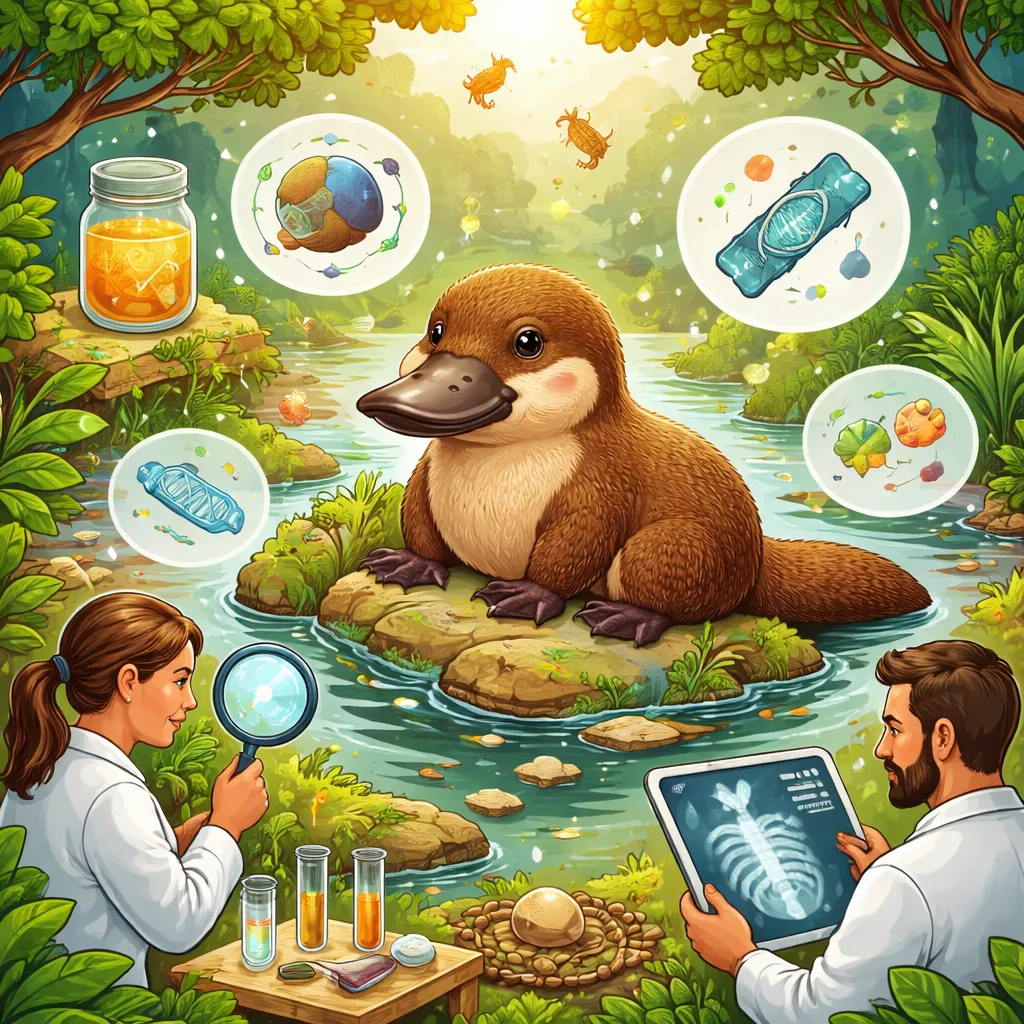

Have you ever seen an animal that looks like a mix of a duck, a beaver, and an otter? That’s the amazing platypus! It’s one of the strangest and most wonderful creatures on Earth. Learning about the platypus is like solving a fantastic puzzle of nature. Let’s dive into the rivers of Australia and begin our adventure of learning about this mysterious animal.
English Language Learning
Vocabulary and Spelling
Our unique friend is called a platypus.
The word "platypus" is a noun. A noun is a word for a person, place, or thing. So, a platypus is a thing—a very special, living creature.
Spelling "platypus" is a bit tricky: P-L-A-T-Y-P-U-S. The 'P' and 'L' start the word. The 'A' and 'T' are in the middle. Then comes 'Y', 'P', 'U', and 'S'. P-L-A-T-Y-P-U-S spells platypus. More than one platypus can be called platypuses or platypi.
Sound and Pronunciation
Let’s say the word correctly. It sounds like this: /ˈplæt.ɪ.pəs/.
We can say it in three clear parts. First, say "plat". It rhymes with "flat" or "cat". Next, say "ih". It’s a quick, soft sound. Last, say "puss". It sounds like the word for a cat, "puss".
Now, put it together! "Plat" "ih" "puss". Platypus! Great job!
The word "platypus" has three beats, or three syllables. Clap three times: Plat-y-pus. It’s a fun, bouncy word to say.
Related Words
Learning about platypuses is more fun with new words! Here are some important ones.
Body Parts: A platypus’s duck-like mouth is called a bill. Its wide, flat tail is like a paddle. A male platypus has a sharp, venomous spur on its back ankle.
Home: A platypus lives in a burrow that it digs in the riverbank.
Special Skill: Platypuses are excellent swimmers. They use their webbed feet to paddle through the water.
A Famous Saying
While there isn’t a famous old saying, scientists have a fun fact: "The platypus is a patchwork animal."
This means it seems to be made of parts from different animals—a duck’s bill, a beaver’s tail, and an otter’s feet. It’s a wonderful reminder that nature is full of surprises and that being unique is a superpower!
Say the phrase with me: "The platypus is a patchwork animal." Isn’t that a cool way to describe it?
Now you know the word "platypus"! Are you ready to solve the puzzle of this amazing creature? Let’s swim from words to wonderful knowledge!
Animal Knowledge
Who Are They? – Family and Group
What kind of animal is a platypus? Platypuses are very special mammals. They have fur, are warm-blooded, and mother platypuses feed their babies milk.
But they are also monotremes. This is a very small and special group of mammals that lay eggs! Their only living relatives are the echidnas, or spiny anteaters.
What Do They Look Like? – Amazing Bodies
A platypus is about the size of a small cat. It has thick, brown fur that is waterproof. Its most famous features are its duck-like bill and its flat, beaver-like tail.
Their bill is not hard like a duck’s. It is soft, rubbery, and full of super sensors. It can detect tiny electric signals from the muscles of moving prey underwater! Their tail stores fat for energy.
Platypuses have special adaptations for swimming. They have webbed feet on their front legs. Their eyes and ears close underwater, so they rely on their bill to find food. Males have a venomous spur on their back ankle for defense.
Where Do They Live and How? – Home and Habits
Platypuses live only in eastern Australia and Tasmania. Their home is in and around freshwater rivers, lakes, and streams. They need clean water and muddy banks for burrows.
Platypuses are carnivores. They eat small water creatures like insect larvae, worms, and shrimp. They store food in their cheek pouches and eat it at the surface.
They are mostly nocturnal, meaning they are most active at night and during dusk and dawn. They are solitary animals, meaning they like to live alone. They spend their time swimming, diving for food, and resting in their burrows.
A Platypus’s Life Story – Growing Up
A baby platypus is called a puggle. Platypuses are monotremes, so the mother lays one to three small, soft-shelled eggs. She keeps them warm in a special nesting burrow.
The mother platypus is the only caregiver. She curls around her eggs to keep them warm. After the puggles hatch, she feeds them milk that comes from patches on her skin, not from nipples.
Puggles are born blind and hairless. They stay in the burrow for about three to four months, drinking milk and growing. When they are big enough, they leave the burrow to swim and hunt on their own.
How Do They "Talk"? – Communication
Platypuses are usually quiet animals. They can make soft growling sounds when disturbed. Baby puggles make chirping sounds.
They communicate mostly through scent and touch. They have scent glands and may leave smells to mark their territory. They use their sensitive bills to explore and understand their world.
Their most amazing sense is their electroreception and touch. Their bill has thousands of special cells that can sense the tiny electric fields made by moving muscles of their prey. It’s like having a sixth sense!
Are They Okay? – Taking Care of Them
Platypuses are near threatened. This means their numbers are going down, and they could become endangered if we don’t help.
The main threats are pollution of their waterways, people building dams that change river flow, and land clearing that destroys their burrows. They can also get caught in fishing nets or traps.
You can be a platypus protector! You can learn and tell others about them. You can support groups that work to keep Australian rivers clean and free from pollution. Saving water and reducing plastic use at home helps all freshwater animals, even those far away.
Life Connections and Inspiration
How to Be With Them – Safety and Love
Platypuses are wild, delicate, and venomous animals. We must admire them from a safe and respectful distance.
The rule is: Look, never touch, and never disturb. In the wild, we must never try to touch or catch a platypus. If you are lucky enough to see one, watch quietly from the riverbank. Never pollute or litter near their home. In zoos, we observe them calmly.
We show our love by protecting the clean, healthy rivers they need to survive. We can be guardians of all waterways.
Super Qualities We Learn from Them
Platypuses teach us incredible lessons. One super quality is embracing uniqueness. The platypus doesn’t fit into a simple box. It is a mix of many things. It teaches us that it’s wonderful to be different, to be yourself, and that our unique traits can be our greatest strengths.
Another quality is sensing the unseen. Platypuses find food using a sense we don’t have. This reminds us to be aware, to use all our senses, and to be open to discovering things that aren’t obvious at first glance.
Think about it: What makes you uniquely wonderful? How can you be more aware of the world around you, using all your senses, just like a platypus?
Take Action! – Your "Platypus Puzzle" Project
Let’s do a fun and creative activity! Your project is to invent your own "patchwork" animal and draw its habitat.
On a piece of paper, think of your favorite animal parts. Would you like the wings of an eagle, the trunk of an elephant, or the stripes of a zebra? Combine them to create your very own unique creature, just like the platypus! Give it a name. Now, draw the habitat where it lives. What does it eat? How does it use its special parts? Write a few sentences about your creature’s amazing adventures. This celebrates creativity and uniqueness!
Closing
Learning about platypus puzzles is a fascinating adventure! We learned the word "platypus" and how to say its three-part name. We discovered amazing facts about their electric-sensing bills, their egg-laying ways, and their life in Australian rivers. We know that platypuses are unique, sensitive animals who need clean water to survive. You can use your new words to teach others about this incredible monotreme. You can use your knowledge to appreciate the wonderful diversity of life on Earth. The animal kingdom is full of unique wonders that teach us to celebrate differences. Always remember to respect wildlife, protect our planet’s water, and be proud of what makes you special. Keep exploring with all your senses, embrace your own uniqueness, and be a voice for conservation. Your curiosity and care help ensure that amazing creatures like the platypus continue to swim in our world’s rivers for generations to come.