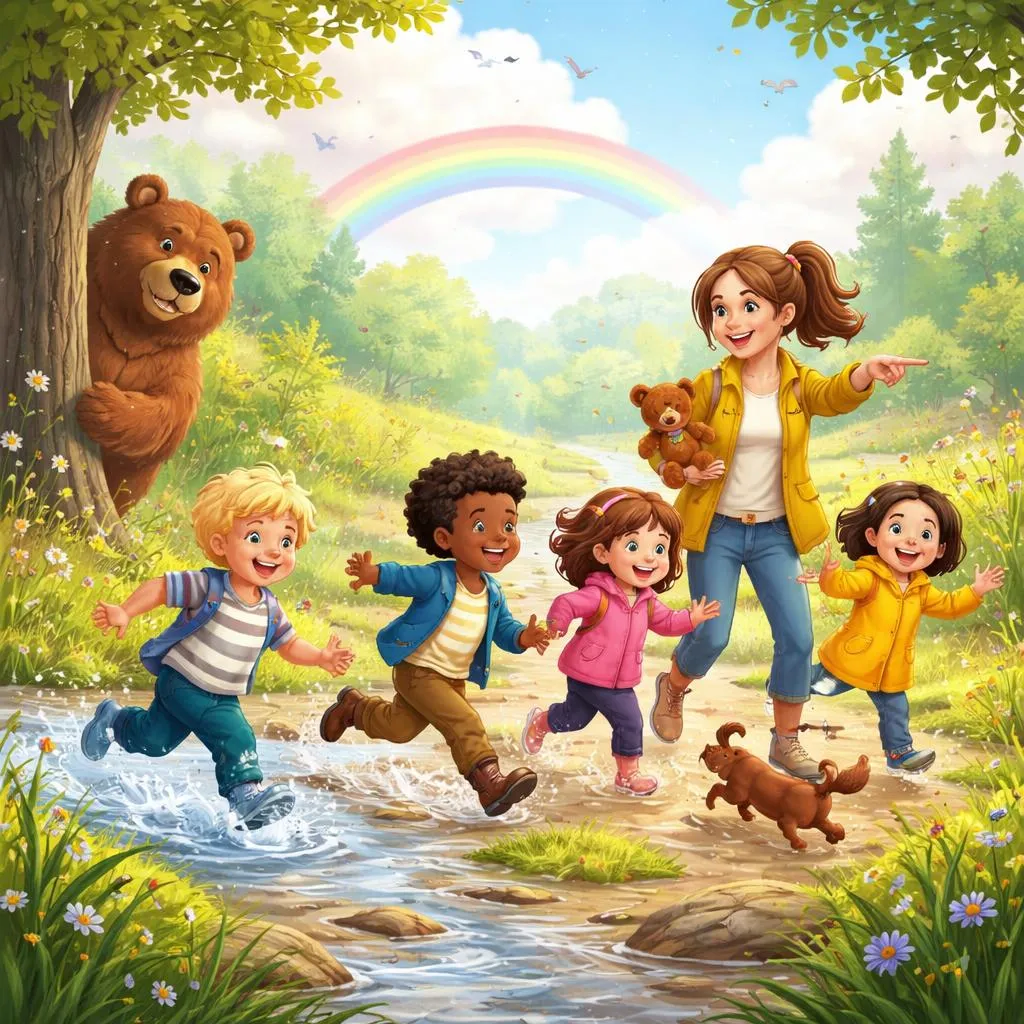

Hello, wonderful teachers and parents! Today brings an exciting opportunity to explore one of the most beloved pieces of children's literature. The story combines adventure, repetition, and delightful sounds. It captures young imaginations instantly. The "We're Going on a Bear Hunt Song" offers so much more than entertainment. This classic tale provides rich language learning possibilities. Every page presents new vocabulary and rhythmic patterns. Let us discover together why this song works magic in the English classroom.
What Is the "We're Going on a Bear Hunt" Story and Song? The "We're Going on a Bear Hunt Song" comes from a wonderful picture book. Michael Rosen and Helen Oxenbury created this modern classic. The story follows a family on an adventure. They decide to go hunting for a bear. The journey takes them through many different places. They encounter long grass, a deep river, and thick mud. They face a dark forest, a snowstorm, and a narrow cave.
What makes this story special is its rhythmic language. The words repeat in a pattern that children love. The family says, "We're going on a bear hunt. We're going to catch a big one. What a beautiful day! We're not scared." This refrain appears throughout the story. After each obstacle, they say, "We can't go over it. We can't go under it. Oh no! We've got to go through it!"
The song version adds musical elements to this text. The rhythm becomes more pronounced. Children can clap along or march as they sing. The sound effects become even more dramatic. Swishy swashy grass, splashy river water, and squelchy mud come alive through music. The "We're Going on a Bear Hunt Song" transforms reading into a full-body experience.
Teachers love this song because it engages every learner. Quiet students start whispering the repeated phrases. Active students love making the sound effects. Everyone joins in the final chase scene back home. The story ends with the family safe in bed, promising never to go on a bear hunt again.
The Lyrics of the "We're Going on a Bear Hunt Song" Let us look closely at the words of this wonderful song. The lyrics follow a clear pattern that helps children predict what comes next. Here are the main parts of the song.
The adventure begins with excitement. The family sets out on a beautiful day. They feel brave and confident. The first verse goes:
We're going on a bear hunt We're going to catch a big one What a beautiful day We're not scared
Then they encounter the first obstacle. Long, wavy grass blocks their path. They cannot go over it. They cannot go under it. They must go through it. The sound effect follows:
Swishy swashy, swishy swashy
The pattern repeats for each obstacle. The river makes a splashy sound. The mud goes squelch squerch. The forest sounds like stumble trip. The snowstorm whooshes. The cave goes tiptoe, tiptoe.
Inside the cave, they find the bear. A sudden, frightened chase begins. They reverse through all the obstacles. The sounds come faster and faster. Finally, they run upstairs, jump into bed, and hide under the covers. The last line whispers:
We're never going on a bear hunt again!
This structure creates a satisfying story arc. Children learn to anticipate each new challenge. They love joining in with the repeated phrases and sounds.
Vocabulary Learning from the Bear Hunt Song The "We're Going on a Bear Hunt Song" introduces wonderful new words. Young learners encounter nature vocabulary throughout the adventure. Let us explore the rich language this song provides.
First, we have landscape words. The family travels through grass, a river, mud, a forest, a snowstorm, and a cave. Each word describes a different natural setting. Children learn to picture these places in their minds. They understand that grass feels different from mud. A forest looks different from a cave.
Next, we have action words. The family goes, catches, and runs. They cannot go over, under, or around obstacles. They must go through each one. The sound effects add more action words. Swishing, splashing, squelching, stumbling, and whooshing all describe movement. Children learn that different surfaces create different actions.
The song also teaches emotion words. The family starts feeling brave and not scared. When they see the bear, fear takes over. The mad dash home shows their panic. The safe ending under the covers brings relief. These emotional words help children express their own feelings.
Prepositions appear naturally in the song. Over, under, and through show spatial relationships. Upstairs and into bed show direction. Children absorb these small but important words through the repetitive context.
Teachers can extend vocabulary learning beyond the song. After singing, discuss what other obstacles the family might meet. What would happen if they found a lake? A mountain? A field of flowers? This creative thinking builds vocabulary further.
Phonics Points in the Bear Hunt Song Phonics learning happens naturally with this song. The repeated sounds draw attention to letter patterns. Children hear specific sounds again and again. This builds important pre-reading skills.
The sound effects offer perfect phonics practice. "Swishy swashy" emphasizes the "sh" sound. Students hear this digraph in a memorable context. They feel the sound on their lips when they join in. "Splash splosh" highlights the "spl" blend. This combination appears in fewer words, making it special. "Squelch squerch" offers the "sq" blend, which always captures attention.
Rhyming appears throughout the song. While not a traditional rhyming song, word patterns create satisfying echoes. "Catch a big one" and "not scared" repeat exactly each time. This predictability builds confidence. Children know what comes next and feel proud joining in.
The repetitive structure supports phonemic awareness. Students hear the same sounds in the same order. They begin to connect written words with spoken sounds. When teachers point to the words while singing, children make important connections between print and speech.
Teachers can extend phonics learning with simple activities. After singing, list all the "sh" words from the song. Swishy, splash, and whoosh all contain this sound. Practice making the sound together. Feel where the tongue goes. Find other "sh" words in the classroom. This turns a fun song into a focused phonics lesson.
Grammar Patterns Emerging from the Song Grammar teaching becomes effortless with this song. The natural language provides perfect models. Children absorb correct structures without formal lessons.
The title phrase "We're going on a bear hunt" introduces the present continuous tense. This form describes actions happening right now. "We're going" shows an adventure in progress. Children learn that "going on" means starting a journey. They can later create their own sentences using this pattern.
The refrain "We're going to catch a big one" introduces the future intention. "Going to" expresses plans and predictions. Children understand that the family plans to catch a bear. This future form appears naturally in conversation. Singing it repeatedly builds familiarity.
The obstacles teach negative forms. "We can't go over it. We can't go under it." These sentences show how to express impossibility. The contraction "can't" appears in a meaningful context. Children learn that "can't" means "cannot." They understand why the family cannot avoid each obstacle.
Prepositions receive special attention. "Over," "under," and "through" appear in every obstacle verse. This repetition helps children understand spatial relationships. They learn that "over" means above, "under" means below, and "through" means entering and exiting. Physical movements during the song reinforce these meanings.
Questions can emerge from the song naturally. "What comes after the river?" "Why can't they go over the mud?" "Where does the bear live?" These questions encourage critical thinking. They also model correct question formation for young learners.
Learning Activities for the Bear Hunt Song The "We're Going on a Bear Hunt Song" inspires countless learning activities. These ideas extend the song into deeper language practice. Each activity builds different skills while maintaining the fun.
Sensory play brings the obstacles to life. Create a grass sensory bin with green shredded paper. Add small toys for the family to walk through. Make a river with blue water and plastic fish. Use brown play dough for mud. Add plastic trees for the forest. Cotton balls make a perfect snowstorm. A cardboard box becomes the dark cave. Children move toy figures through each obstacle while singing. This tactile experience reinforces vocabulary meaning.
Movement activities get everyone involved. Clear a space in the classroom. Designate areas for each obstacle. The grass area involves swishing hands back and forth. The river area requires splashing steps. The mud area needs slow, squelchy walking. The forest demands careful stepping over pretend logs. The snowstorm means shivering and blowing. The cave requires quiet tiptoeing. Lead a procession through each area while singing. The final chase happens quickly back to home base.
Art projects extend the learning. Create a mural showing the whole adventure. Divide a long paper into sections for each obstacle. Children draw grass, a river, mud, a forest, a snowstorm, and a cave. Add the family and the bear. Label each section with the sound words. Display the mural for repeated singing practice.
Story sequencing builds comprehension. Print pictures of each obstacle and the bear. Mix them up. Challenge students to put them in the correct order. This checks understanding of the story structure. For advanced learners, add the sound words to each picture.
Creative writing emerges from the song. Ask students to imagine a new obstacle. What would happen if the family found a lake? A mountain of pillows? A field of flowers? Write new verses together. What sound would each new obstacle make? This extends the pattern while building writing skills.
Printable Materials for the Bear Hunt Song Printable materials support learning at home and school. These resources give children something to hold and use. They extend the song into independent practice.
Picture cards work wonderfully for vocabulary review. Print images of grass, a river, mud, a forest, a snowstorm, and a cave. On the back, print the corresponding sound words. Swishy swashy, splash splosh, squelch squerch, stumble trip, whoosh, and tiptoe. Children can practice matching places with sounds. They can use the cards to retell the story independently.
Mini books let children own the story. Create a simple folded book with pages for each obstacle. Include the bear at the end. Children color each page and practice reading the words. The repetitive text builds reading confidence. They can take these books home and sing for their families.
Word cards focus on key vocabulary. Print each noun and verb from the song separately. Children can arrange them in story order. They can match words with picture cards. They can use them for spelling practice. Laminating makes them last longer.
Sequencing strips provide another ordering activity. Print the story in sentence strips. Cut them apart. Children arrange them in the correct order. This builds reading comprehension and logical thinking. For younger children, use pictures instead of words.
Sound word posters decorate the classroom. Create large posters for each sound word. Swishy swashy gets wavy lines. Splash splosh gets blue water drops. Squelch squerch gets brown mud spots. Display these around the room. Point to them during singing. Children associate the written words with the sounds and actions.
Educational Games Based on the Bear Hunt Song Games turn learning into pure joy. These game ideas use the "We're Going on a Bear Hunt Song" as their foundation. Children practice language skills while having fun.
Bear Hunt Bingo brings excitement to vocabulary review. Create bingo cards with pictures from the story. Grass, river, mud, forest, snowstorm, cave, bear, and family members. Call out the words. Children cover matching pictures. The first to cover a row shouts "Bear hunt!" This builds listening comprehension and vocabulary recognition.
Obstacle Course Memory challenges physical and mental skills. Set up a simple obstacle course in the classroom or playground. At each station, place a card with a sound word. Children complete the obstacle, then read the word. They must remember the sequence of sounds at the end. This combines movement with reading practice.
Sound Charades brings the story to life without words. One student acts out a sound from the song. Swishing means grass. Splashing means river. Squelching means mud. Stumbling means forest. Shivering means snowstorm. Tiptoeing means cave. Others guess which obstacle comes next. This builds understanding of the connection between actions and words.
I Spy with Bear Hunt vocabulary sharpens observation skills. Look at the storybook pictures together. Say, "I spy something swishy and green." Children find the grass. "I spy something cold and white." Children find the snowstorm. This builds descriptive language and careful looking.
Story Retell Relay Race gets everyone moving. Divide students into teams. Place picture cards at the far end of the room. One student from each team runs to the cards, finds the first obstacle, and brings it back. The next student finds the second obstacle. Continue through the whole story. The first team to collect all obstacles in order wins. This reinforces story sequence while burning energy.
The "We're Going on a Bear Hunt Song" keeps giving long after the singing ends. Its rich language, engaging story, and repetitive structure make it a treasure for English learning. Every classroom should have this song in regular rotation. Children never tire of the adventure. They always join in with enthusiasm. The language sticks because the experience delights. Through this song, children learn without even trying. They absorb vocabulary, grammar, and phonics through joyful participation. That is the magic of learning through beloved stories and songs.