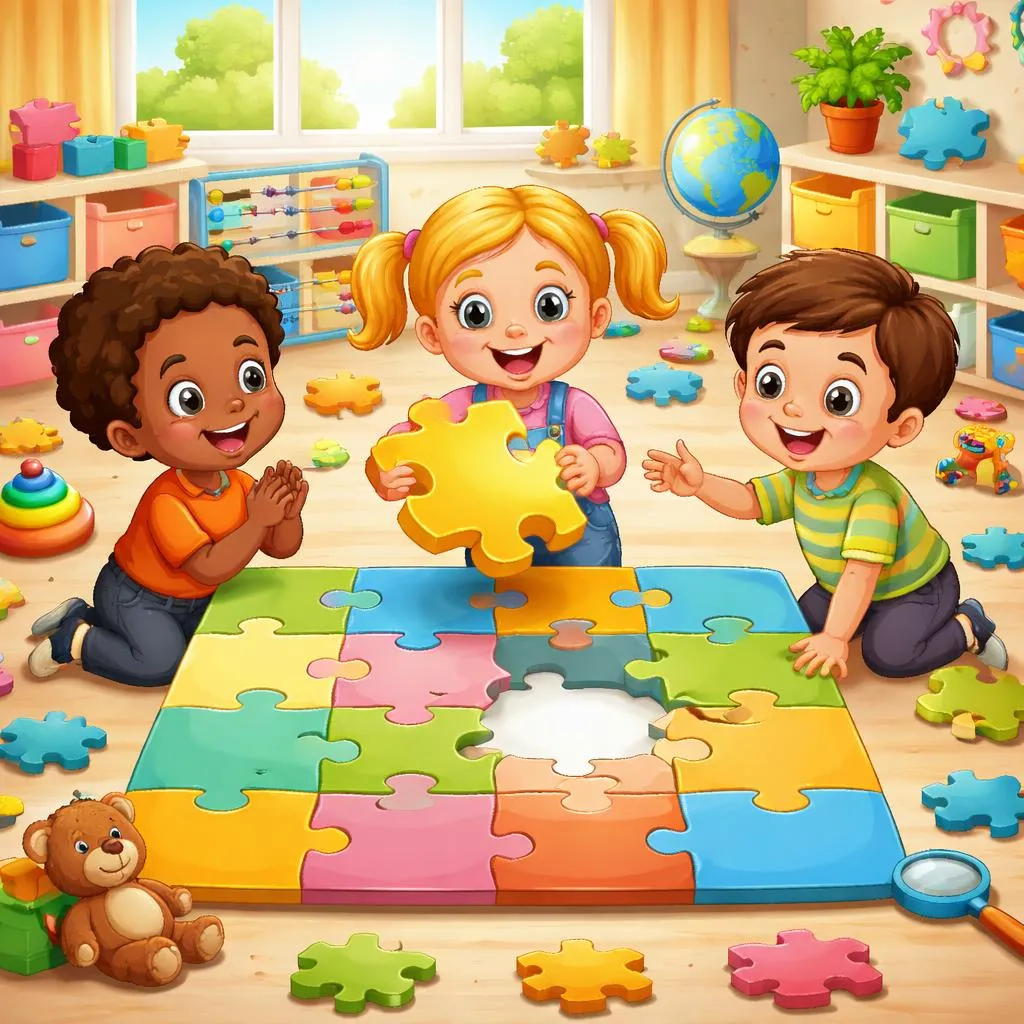

Hello, little puzzle solver! Do you know about jigsaw puzzles? You have a puzzle piece that shows a dog's head. But the piece is missing the dog's tail! The picture is not complete. You need the tail piece. Sentences can have a missing piece too. The piece that completes the picture is called a complement. A complement is a word or words that complete the meaning of a sentence. It makes the idea whole. Today, we will find sixty missing puzzle pieces. Our guide is Penny the Puzzle Piece. She loves to make pictures complete! She will show us complements at home, the playground, school, and in the puzzle box. Let's solve the puzzle!
What Is a Complement?
A complement is your sentence's missing puzzle piece. It comes after a special kind of verb called a linking verb. Linking verbs are like "is", "am", "are", "was", "were", "feel", "seem", "become". They do not show action. They link the subject to a word that describes it or renames it. That word is the complement. It completes the idea. At home, you say "I am happy." The word "happy" is the complement. It completes the idea about "I". Without it, "I am" feels unfinished. At the playground, you say "The slide is fun." The complement is "fun". At school, you say "My teacher is kind." The complement is "kind". In nature, Penny says "The sky is blue." "Penny feels helpful." Learning these must-know complements helps you finish your thoughts clearly.
Why Do We Need the Missing Piece?
Complements are your completion tools! They help your ears listen. You get the full picture of what someone is describing. They help your mouth speak. You can tell people exactly how things are. "I feel tired." They help your eyes read. You will see them in sentences that describe characters and settings. They help your hand write. You can write sentences that give full descriptions. A sentence with a linking verb often needs that missing piece to make sense.
What Are the Two Main Puzzle Pieces?
We have two main types of complements. Each one completes the picture in a different way.
First, the predicate adjective. This is a describing piece. It is an adjective that comes after a linking verb. It describes the subject. "The cake is delicious." (Delicious describes the cake).
Next, the predicate noun (or nominative). This is a naming piece. It is a noun that comes after a linking verb. It renames or identifies the subject. "My dad is a chef." (Chef renames dad).
For 5-year-olds, we will use many simple predicate adjectives. They are very common and easy to use.
How Can You Spot the Missing Piece?
Spotting a complement is a two-step game. First, find a linking verb (is, am, are, feel, seem, etc.). Then, look for the word that comes right after it. Ask: "Does this word describe or rename the subject?" If yes, you have found the complement! Look at Penny's puzzle. "This puzzle is challenging." Linking verb: is. Word after: challenging. Does it describe the puzzle? Yes! "Challenging" is the complement. Another trick: Try removing the word after the linking verb. Does the sentence feel incomplete? If yes, that word is probably the missing piece.
How Do We Fit the Piece In?
Using a complement is about placing it after a linking verb. The pattern is: Subject + Linking Verb + Complement. "The baby seems sleepy." You cannot put an action verb there. You would not say "The baby seems cry." The linking verb needs a describing or naming word to complete it. Penny shows us. "I + am + a good helper." Subject: I. Linking verb: am. Complement (predicate noun): a good helper. Start with "I am" and add a feeling or a describing word.
Let's Fix Some Puzzle Mix-ups.
Sometimes we try to use the wrong piece. Let's fix that. A common mix-up is using an adverb after a linking verb when you need an adjective. A child might say "I feel badly." This is often used, but for a feeling, we usually use the adjective "bad". "I feel bad" (meaning I feel sad or sorry). Another mix-up is using an action verb after a linking verb. "The flower is grow" is wrong. "Grow" is an action. Use the adjective: "The flower is growing" (here, growing is an adjective) or "The flower is big." Also, remember that the complement must match the subject. "We is happy" is wrong. "We are happy" is right.
Can You Be a Puzzle Master?
You are a great master! Let's play a game. The "Complete the Picture" game. I will start a sentence with a subject and linking verb. You add the complement. "The cat is " You say: "soft!" or "sleepy!" "I feel " You say: "happy!" Great! Here is a harder challenge. Look at your snack. Can you describe it with a linking verb and a complement? "My apple is crunchy. It is red. It tastes sweet." You are using must-know complements.
Your Puzzle Box of 60 Must-Know Complements.
Ready to open the puzzle box? Here are sixty wonderful sentences with their missing pieces. Penny the Puzzle Piece has sorted them. They are grouped by the scene. The complement is in stars.
Home Puzzle Box (15).
- My mom is kind.
- I am hungry.
- The soup is hot.
- My bed feels soft.
- Dad seems tired.
- The baby is sleepy.
- Our house is warm.
- The story was funny.
- I feel loved.
- The milk tastes good.
- The light is bright.
- My room looks messy.
- Dinner smells yummy.
- My family is happy.
- Home is safe.
Playground Puzzle Box (15).
- The slide is fast.
- My friend is funny.
- The sun feels warm.
- The game seems exciting.
- I am brave.
- The sand is soft.
- The swing is high.
- My hands are dirty.
- Everyone looks happy.
- The park is big.
- Playing is fun.
- The ball is bouncy.
- I feel strong.
- The day is perfect.
- Recess is over.
School Puzzle Box (15).
- My teacher is smart.
- School is fun.
- The book is interesting.
- I am ready.
- The crayon is blue.
- The rule is important.
- My work looks neat.
- The classroom seems quiet.
- Learning is cool.
- The answer is correct.
- I feel proud.
- The bell is loud.
- My friends are kind.
- The puzzle is hard.
- Our class is the best.
Nature and Animal Puzzle Box (15).
- The sky is blue.
- The grass is green.
- The flower is pretty.
- The bear is big.
- The butterfly is beautiful.
- The water feels cold.
- The rock is hard.
- The day is sunny.
- The forest seems quiet.
- The apple tastes sweet.
- The puppy is friendly.
- The night is dark.
- The air smells fresh.
- The world is amazing.
- Nature is wonderful.
Predicate Nouns (Naming Pieces).
Here are a few examples of the other type of complement, the predicate noun:
My dad is a teacher.
She is my mom.
I am a big kid.
This is my home.
He is a good friend.
They are students.
That is a tree.
It is a cat.
These sixty sentences show you must-know complements. They are the missing pieces that complete your thoughts.
Making Your Sentence Pictures Whole.
You did it! You are now a complement expert. You know a complement is the missing puzzle piece in a sentence with a linking verb. It describes or renames the subject. You know the two types: predicate adjectives and predicate nouns. You can find them and use them to finish your ideas. Penny the Puzzle Piece is proud of your solving skills. Now you can make sentences that give a full, clear picture. Your descriptions will be complete and lovely.
Here is what you can learn from our puzzle adventure. You will know what a complement is. You will understand that a complement completes the meaning after a linking verb. You can identify complements in a sentence. You can use adjectives and nouns as complements correctly. You have a puzzle box of sixty key complements to use every day.
Now, let's do some life practice! Your mission is today. Be a puzzle solver. Describe three things around you using a linking verb and a complement. Tell your grown-up: "This shirt is soft. I am happy. The water is cold." You just used three complements! Keep finding the missing pieces for your sentences. Have fun, little solver!