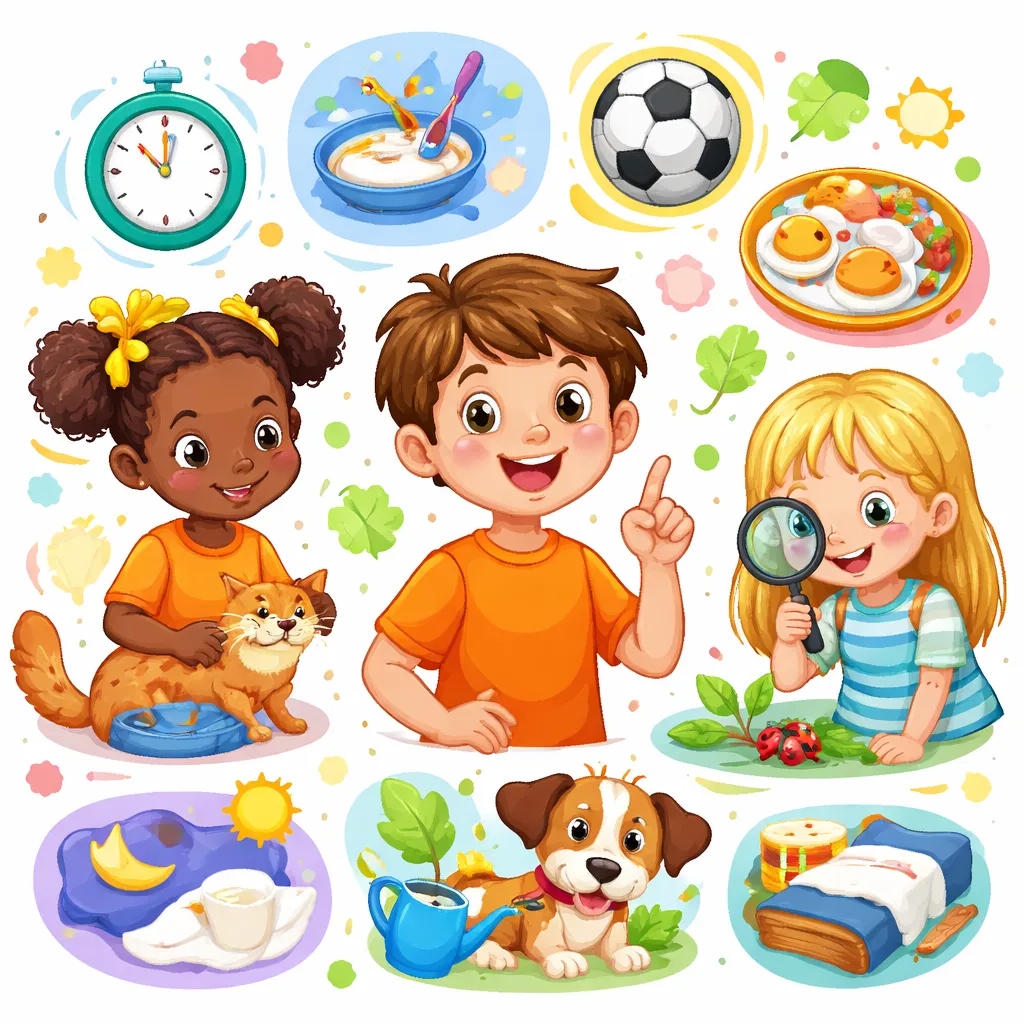

Simple present is the most basic and important verb tense in English. It describes habits, routines, facts, and things that are always true. I eat breakfast every day. The sun rises in the east. She likes pizza. These sentences all use simple present. Today we explore the 90 essential simple present verbs for 8-year-old children and how mastering this tense builds a foundation for all communication.
Eight-year-olds talk constantly about what they do every day, what they like, and what they know to be true. Simple present is their go-to tense for all of this. Understanding how to form it correctly, especially for he, she, it, is essential for clear communication.
What Is Simple Present? Let us begin with a clear definition we can share with our children. Simple present is the verb tense we use to talk about habits, routines, facts, and things that are always true. It describes actions that happen regularly or situations that stay the same.
Think of simple present as the "every day" tense. "I walk to school every day." "She brushes her teeth every morning." "The sun rises in the east always." It's for things that happen regularly or are always true.
Simple present has two forms. For I, you, we, they, we use the base verb. "I like pizza." "You play soccer." "We eat lunch at noon." "They live nearby." No ending added.
For he, she, it, we add -s or -es to the verb. "He likes pizza." "She plays soccer." "It eats fish." "The cat sleeps all day." The ending is the key to correct simple present.
For eight-year-olds, we can explain it simply. Simple present is for things you do every day, things you like, and things that are always true. It's the tense you use most often. The 90 essential simple present verbs for 8-year-old learners are the ones children need for daily communication.
Meaning and Explanation for Young Learners How do we explain simple present to an eight-year-old in ways they understand? We use examples from their world and show how this tense works for different situations.
Tell your child that simple present is your "every day" tense. When you talk about what you do every day, you use simple present. "I wake up at 7 every day." When you talk about things you like, you use simple present. "I like chocolate." When you talk about facts, you use simple present. "The sky is blue."
Here are some simple present sentences children use. "I play with my friends." "She lives next door." "We eat dinner at 6." "Cats like milk." "The sun shines." Each tells about habits, routines, or facts.
Remember the special rule for he, she, it. We add -s or -es. "He run s." "She eat s." "It go es." This is the most important rule to remember.
We use simple present for feelings and thoughts too. "I think you're funny." "She believes in magic." "He wants a new bike." These are states, not actions, but still use simple present.
These explanations help children understand the 90 essential simple present verbs for 8-year-old speakers. They see that this tense covers most of what they say.
Conjugation of Simple Present Conjugation means changing the verb to match the subject. Simple present conjugation is straightforward but has important rules.
For I, use the base verb. "I walk." "I eat." "I go." First person singular is easy.
For you, use the base verb. "You walk." "You eat." "You go." Second person singular and plural are the same.
For we, use the base verb. "We walk." "We eat." "We go." First person plural is easy.
For they, use the base verb. "They walk." "They eat." "They go." Third person plural is easy.
For he, she, it, add -s to most verbs. "He walk s." "She eat s." "It rain s." This is the only place where the verb changes.
For verbs ending in s, sh, ch, x, o, add -es. "He kiss es." "She wash es." "It catch es." "He fix es." "She go es." The -es adds an extra syllable.
For verbs ending in consonant + y, change y to i and add -es. "Cry" becomes "he cri es." "Try" becomes "she tri es." "Fly" becomes "it fli es." But if a vowel comes before y, just add -s. "Play" becomes "he play s."
The verb to be is completely irregular. "I am." "You are." "He/she/it is." "We are." "They are." This must be memorized.
These conjugation patterns appear in the 90 essential simple present verbs for 8-year-old learners. Practice makes them automatic.
Daily Life Examples Simple present appears constantly in family conversations. Here are examples from a typical day with an eight-year-old.
Morning time brings many simple present sentences. "I wake up at 7 o'clock. I get dressed quickly. My mom makes breakfast. She cooks pancakes on Saturdays. My dad drinks coffee. We eat together. The bus comes at 8." Every routine uses simple present.
During school, simple present multiplies. "Our teacher reads us a story. We sit on the carpet. My friend sits next to me. She likes to draw. I prefer math. The bell rings at noon. We eat lunch in the cafeteria." School routines need simple present.
After school brings more simple present. "I play soccer on Tuesdays. My coach teaches us new skills. My team practices hard. We want to win. My mom picks me up at 5. We drive home together. My dog waits for me at the door." Habits and routines continue.
Evening and bedtime have their own simple present. "We eat dinner at 6. My family sits around the table. My little brother always spills his milk. I help clear the dishes. Then I do my homework. My dad reads me a story. I fall asleep by 9." Every day follows patterns.
Throughout the day, children use simple present constantly. The 90 essential simple present verbs for 8-year-old children appear again and again in these everyday moments.
Present Simple for Habits and Routines One of the main uses of simple present is to talk about habits and routines. Eight-year-olds use this constantly to describe their daily lives.
Daily routines use simple present. "I wake up. I brush my teeth. I eat breakfast. I walk to school. I come home. I do homework. I eat dinner. I take a bath. I go to bed." Each action happens regularly.
Frequency words often go with habits. Always, usually, often, sometimes, rarely, never. "I always brush my teeth." "She sometimes walks to school." "We never eat spiders." These words tell how often.
Weekly and monthly routines use simple present. "We visit Grandma on Sundays." "I have piano lessons on Tuesdays." "She goes to dance class after school." "They play soccer every Saturday."
Children describe their routines naturally. "Every morning I eat cereal." "On weekends we go to the park." "I always feed my cat before school." Simple present makes routines clear.
These habit and routine patterns appear in the 90 essential simple present verbs for 8-year-old speakers. They help children describe their daily lives.
Present Simple for Facts and General Truths Simple present also expresses facts and things that are always true. Eight-year-olds use this for sharing knowledge.
Scientific facts use simple present. "The sun rises in the east." "Water boils at 100 degrees." "Birds fly." "Fish swim." "Plants need water." These are always true.
General truths about people and animals use simple present. "Dogs bark." "Cats meow." "Children grow." "Babies cry." "Teachers teach." These describe typical behavior.
Opinions and preferences use simple present even though they're not universal facts. "I think pizza is delicious." "She believes in fairies." "He likes blue best." These are true for the speaker.
Definitions and descriptions use simple present. "A doctor helps sick people." "A dentist fixes teeth." "A chef cooks food." These describe what people do.
Children share facts constantly. "Did you know that snakes smell with their tongues?" "My mom says carrots help you see in the dark." "Everyone knows that!" Simple present shares knowledge.
These fact patterns appear in the 90 essential simple present verbs for 8-year-old learners. They help children share what they know.
Present Simple for Feelings and Thoughts Simple present expresses feelings, thoughts, and states of mind. These are not actions but states, and they use simple present.
Emotion verbs use simple present. "I love my family." "She likes ice cream." "He hates broccoli." "We enjoy playing together." "They fear the dark." Feelings are states, not actions.
Thought verbs use simple present. "I think you're funny." "She believes in magic." "He knows the answer." "We understand the rules." "They remember the story." Thoughts are mental states.
Preference verbs use simple present. "I prefer chocolate to vanilla." "She wants a new bike." "He needs a hug." "We wish for snow." "They hope to win." Desires and needs are states.
Possession verbs use simple present. "I have a dog." "She owns a bicycle." "He belongs to the soccer team." "This book belongs to me." Possession is a state.
Children express feelings constantly. "I love you, Mommy." "I want a cookie." "I think that's funny." "I know the answer!" Simple present shares the inner world.
These feeling and thought patterns appear in the 90 essential simple present verbs for 8-year-old speakers. They help children express their inner lives.
Present Simple for Future Events Sometimes simple present is used for future events, especially scheduled events. Eight-year-olds encounter this pattern often.
Scheduled events use simple present for future. "School starts at 8 tomorrow." "The bus leaves at 3 this afternoon." "My birthday is next week." "The store closes at 9 tonight." These are fixed schedules.
Timetables and calendars use simple present. "We have a test on Friday." "Grandma arrives on Sunday." "The movie begins at 7." "The game ends at 5." These are planned in advance.
After certain time words, we use present for future. "I'll call you when I get home." Not will get. "We'll play after dinner ends." Not will end. After when, after, before, until, we use present for future.
Children use this pattern. "When do we leave tomorrow?" "The party starts at 2." "I'll eat after Mom comes home." Simple present works for scheduled future.
These future uses of simple present appear in the 90 essential simple present verbs for 8-year-old learners. They help children talk about plans.
Questions in Simple Present Questions in simple present have special forms. Eight-year-olds ask hundreds of questions using this tense.
Yes/no questions with be invert subject and verb. "Are you happy?" "Is she tired?" "Are they ready?" The verb be comes before the subject.
Yes/no questions with other verbs use do/does. "Do you like pizza?" "Does she play soccer?" "Do they live nearby?" Do for I, you, we, they. Does for he, she, it. The main verb goes back to base form.
Wh-questions put the question word first. "Where do you live?" "What does she like?" "Why do they want that?" Question word + do/does + subject + base verb.
When who or what is the subject, we don't use do/does. "Who likes pizza?" Not does like. "What happens next?" The verb agrees with the subject.
Children ask constantly. "Do you want to play?" "Does she have a brother?" "Where do you live?" "Who knows the answer?" Questions use simple present correctly.
These question patterns appear in the 90 essential simple present verbs for 8-year-old speakers. They help children ask about the world.
Negative Sentences in Simple Present Negative sentences in simple present have special forms. Eight-year-olds need to form negatives correctly.
Negative with be: add not after the verb. "I am not tired." "She is not here." "They are not ready." Contracted forms: I'm not, she isn't, they aren't.
Negative with other verbs: use do/does + not + base verb. "I do not like broccoli." "She does not play soccer." "We do not have school today." Contracted forms: don't, doesn't.
For he, she, it, remember: does + not + base verb. Not doesn't + -s. "He doesn't like spinach." Not he doesn't likes.
Never is another way to make negatives. "I never eat meat." "She never tells lies." "We never go there." Never is stronger than not.
Children use negatives constantly. "I don't want to go." "She doesn't like that." "That's not true." "We never do that!" Negatives express refusal and disagreement.
These negative patterns appear in the 90 essential simple present verbs for 8-year-old learners. They help children express what they don't want or don't do.
Common Simple Present Verbs Some simple present verbs are especially common. Eight-year-olds should master these essential words.
Action verbs: go, come, run, walk, eat, drink, sleep, wake, play, work, study, read, write, draw, sing, dance, jump, sit, stand, talk, listen, watch, help, make, do, get, put, take, give, bring, buy, sell, pay, find, lose, keep, hold, carry, push, pull, open, close.
Mental verbs: think, know, believe, understand, remember, forget, mean, wonder, imagine, dream, hope, wish, want, need, like, love, hate, prefer, care, mind.
State verbs: be, have, own, belong, seem, appear, look, sound, feel, taste, smell, weigh, cost, matter.
Communication verbs: say, tell, ask, answer, explain, describe, promise, agree, disagree, argue, shout, whisper, cry, laugh, smile.
School verbs: learn, teach, study, read, write, spell, count, add, subtract, multiply, divide, measure, draw, paint, color, cut, glue, listen, follow, remember.
Children use these constantly. "I go to school." "I like pizza." "I have a dog." "I think you're funny." These verbs form the core of daily communication.
These common verbs appear in the 90 essential simple present verbs for 8-year-old speakers. Mastery of these builds fluency.
Learning Tips for Parents Supporting your child's simple present use happens naturally through conversation. Here are gentle ways to encourage this growth.
Model correct simple present in your own speech. Use varied subjects and verbs. "I like coffee. Your dad prefers tea. We enjoy breakfast together. The cat sleeps on the couch." Your child hears these patterns.
Notice simple present during read-aloud time. When you encounter simple present in books, discuss why it's used. "Listen, the author says 'The sun rises every morning.' That's a fact, so they use simple present." Building awareness.
Practice the he/she/it rule. When your child forgets the -s, gently remind them. "You said 'He like pizza.' Remember, for he, she, it we add -s. He like s pizza." Gentle repetition helps.
Play subject-verb agreement games. Give a subject and have your child choose the correct verb form. "She" – "She plays." "They" – "They play." Quick practice builds skill.
Talk about routines using simple present. "What do you do every morning?" "I wake up, I eat breakfast, I brush my teeth." Natural conversation practices the tense.
These tips support mastery of the 90 essential simple present verbs for 8-year-old children through natural, positive interaction.
Printable Flashcards for Simple Present Practice Flashcards can help children learn and remember simple present forms. Here are ideas for making your own set.
Create subject cards: I, you, he, she, it, we, they. Practice matching with correct verb forms.
Create verb cards with base forms: play, eat, run, go, do, have, like, want, need, think, know, say, see, come, make.
Create sentence cards with blanks. "She ___ soccer." Fill in with plays. "They ___ pizza." Fill in with like. "It ___ fast." Fill in with runs. Practice subject-verb agreement.
Create frequency word cards: always, usually, often, sometimes, rarely, never. Practice adding to sentences. "I ___ eat breakfast." Fill in with frequency words.
Create question cards. "___ you like pizza?" Fill in with Do. "___ she play piano?" Fill in with Does. Practice question formation.
How to play with the cards. Spread cards out and take turns picking one. Use the subject and verb to make a correct simple present sentence. "He" and "play" become "He plays soccer."
These flashcards make the 90 essential simple present verbs for 8-year-old learners tangible and fun. Children learn to match subjects with correct verb forms.
Learning Activities and Games Games make learning about simple present playful and memorable. Here are some activities to enjoy together.
The Daily Routines Game practices simple present for habits. Take turns describing your daily routine using simple present. "I wake up at 7. I eat breakfast. I brush my teeth. I go to school." See who can make the longest list.
The Subject-verb Agreement Race practices the he/she/it rule. Call out a subject and a verb. Child says the correct form as fast as possible. "She, play" → "She plays." "They, eat" → "They eat." "He, go" → "He goes." Race against the clock.
The Fact or Opinion Game practices using simple present for both. Say a sentence. Child decides if it's a fact or opinion. "The sky is blue." Fact. "Pizza is delicious." Opinion. Discuss why both use simple present.
The Interview Game practices questions and answers. One person plays interviewer. Asks questions using simple present. "What do you like to eat?" "Where do you live?" "Do you have any pets?" Answer using simple present.
The Never Game practices negatives with never. Take turns saying things you never do. "I never eat bugs." "I never go to bed late." "I never forget to feed my cat." Silly answers are fun too.
The Story Chain Game builds a story using simple present. One person starts a story in simple present. Next person adds a sentence. Continue building. "There is a dragon. He lives in a cave. He guards a treasure. He breathes fire. He likes pizza." Keep the tense consistent.
These games turn learning the 90 essential simple present verbs for 8-year-old children into active family fun. No pressure, just playful language exploration.
Simple present is the foundation of English communication. It describes habits, routines, facts, feelings, and scheduled events. It's the tense children use most often. Mastering simple present means mastering subject-verb agreement, especially the tricky -s for he, she, it. It means forming questions correctly with do and does. It means making negatives with don't and doesn't. By age eight, children should use simple present confidently for all these purposes. They should know the common verbs and use them automatically. The next time your child tells you about their day, notice the simple present verbs they use. "I go to school. I play with my friends. I like recess best." These sentences show they understand how to talk about their world. Building strong simple present skills builds confident communicators who can share their lives clearly. This foundation will serve them in every conversation, every story, every moment they describe.