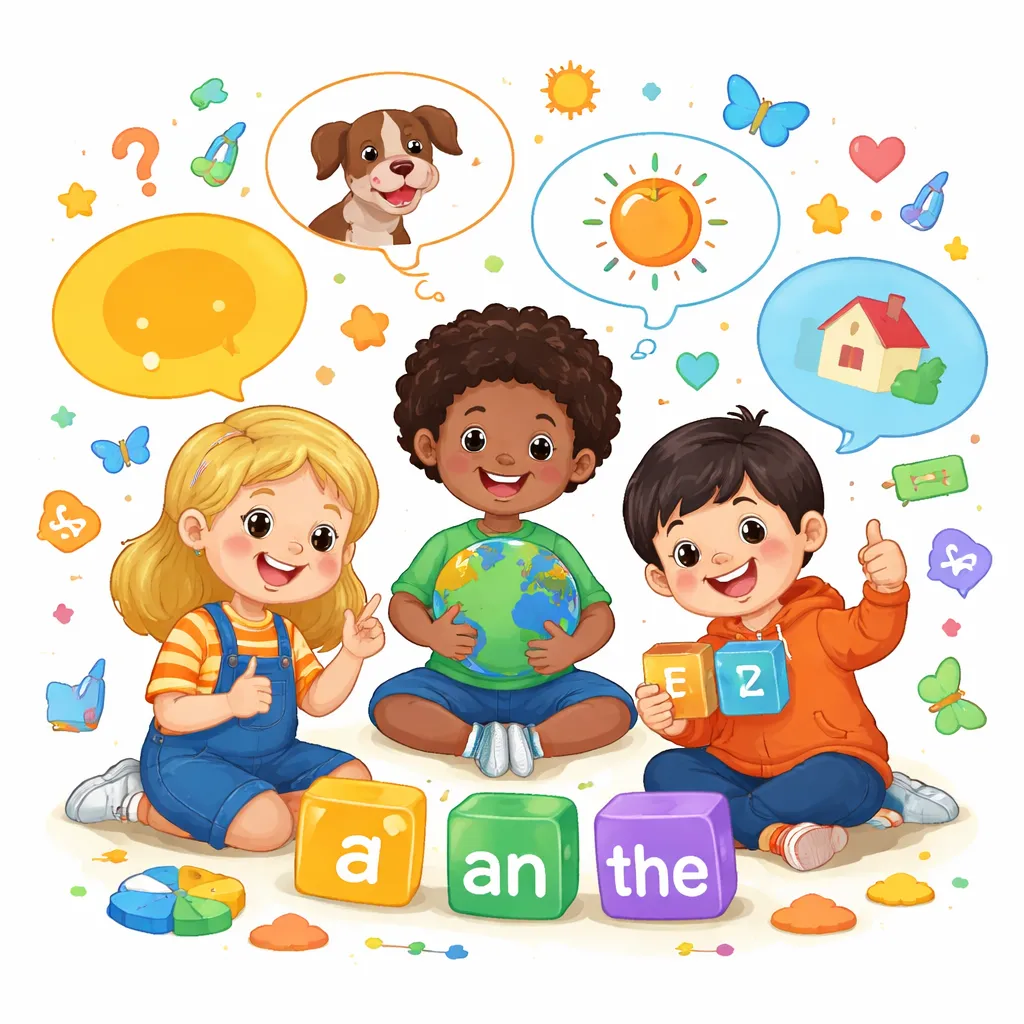

Your child uses small words like a, an, and the constantly. These words are called articles. They appear before almost every noun. They tell listeners whether we are talking about something specific or something general. Using articles correctly is essential for natural-sounding English. Mastering the top 100 article examples for elementary students helps children use these small but important words correctly. This guide will explain what articles are, list the most important examples, and show how to practice at home.
What Are Articles? Articles are small words that come before nouns. They tell us something about the noun. English has three articles: a, an, and the. They are the most common words in the English language. We use them constantly.
A and an are called indefinite articles. We use them when talking about something general or something mentioned for the first time. "I saw a dog." This means any dog, not a specific one. "She ate an apple." The word an is used because apple starts with a vowel sound.
The is called the definite article. We use it when talking about something specific or something already mentioned. "I saw a dog. The dog was brown." Now we are talking about that specific dog. "Please pass the salt." This means the specific salt on the table.
Articles are essential for clear communication. They tell listeners whether we mean something general or something specific. The top 100 article examples for elementary children cover all the situations where children need to choose the right article.
Meaning and Explanation: Why Articles Matter Articles might seem small, but they carry important meaning. Using the wrong article can confuse listeners or make speech sound unnatural. Understanding articles helps children sound like native speakers.
Think about the difference articles make. "I need a pen" means any pen will do. "I need the pen" means a specific pen, maybe the one you are holding. The article changes the meaning completely.
In reading, articles appear on every page. Recognizing them helps with reading flow. In writing, using articles correctly makes sentences look professional. Small words, big impact.
For English learners, articles can be tricky. Many languages don't have articles at all. But in English, they are essential. Every noun usually needs an article or another determiner. Mastering articles is a key step toward fluency.
The top 100 article examples for elementary students build this important foundation.
Categories or Lists: The Top 100 Article Examples Here are the top 100 article examples for elementary students, grouped by category. These are the sentences and phrases children use and encounter most often.
A + Noun (General, Singular, Consonant Sound) (25): a dog a cat a house a car a book a pencil a teacher a student a friend a parent a child a baby a bird a fish a tree a flower a star a cloud a river a mountain a city a country a store a park a school. Use a before words that start with a consonant sound. "I saw a dog." "She has a cat." "We live in a house."
An + Noun (General, Singular, Vowel Sound) (20): an apple an elephant an igloo an octopus an umbrella an hour an honest person an orange an egg an insect an animal an uncle an aunt an idea an invitation an adventure an answer an error an offer an opening. Use an before words that start with a vowel sound. "She ate an apple." "He saw an elephant." "It will take an hour."
The + Specific Noun (Already Mentioned or Known) (25): the dog (the one we just talked about) the cat the house the car the book the pencil the teacher the student the friend the parent the child the baby the bird the fish the tree the flower the star the cloud the river the mountain the city the country the store the park the school. Use the when the listener knows which one you mean. "I saw a dog. The dog was brown." "Please open the door." "I love the park near our house."
The + Unique Things (One of a Kind) (10): the sun the moon the world the earth the sky the ground the air the ocean the universe the future. These things are one of a kind. "The sun is hot." "Look at the moon." "We live on the earth."
The + Superlatives (10): the best the worst the biggest the smallest the tallest the shortest the fastest the slowest the most interesting the most fun. Use the with superlative adjectives. "This is the best day." "She is the tallest in class." "That was the funniest movie."
No Article (General Plurals and Uncountable Nouns) (10): Dogs are friendly. Cats like milk. Children play outside. Water is wet. Milk is healthy. Love is important. Happiness feels good. Music makes me happy. Pizza is delicious. Ice cream is cold. Use no article when talking about things in general. "I like dogs" (all dogs). "Water is important" (water in general).
The top 100 article examples for elementary students include these essential patterns. Children will use them every day.
Daily Life Examples: Articles All Around Us Articles appear in almost every sentence we speak. Pointing them out helps children see that these small words are part of real language.
In morning routines, we use articles constantly. "I ate an apple." "I saw a bird." "The sun is shining." "I need a pencil." "Please pass the cereal." Every noun usually needs an article.
During meals, articles help us communicate. "Can I have a banana?" "Pass me the salt." "I want an orange." "This is the best pizza." "The milk is cold." Articles tell us whether we mean something specific or general.
In car rides, we use articles to point things out. "Look at the big truck!" "I see a bird in that tree." "We are going to the park." "That's an interesting building." "The sky is blue." Articles are everywhere.
In stories, articles are essential. "Once upon a time, there was a princess. The princess lived in a castle. The castle was made of stone." The pattern of first and second mention appears clearly in stories.
In conversations, articles help us be specific. "I need a pencil" (any pencil). "I need the pencil you're holding" (that specific one). Articles carry meaning.
The top 100 article examples for elementary students help children notice and use these patterns.
Printable Flashcards: Visual Tools for Learning Flashcards make articles concrete. Creating and using them together turns learning into an activity. Here are some ways to use flashcards for article practice.
Create cards with nouns written on them. On each card, write a noun and a simple picture. "dog" "apple" "house" "hour" "university" "umbrella" Practice choosing the correct article for each. "a dog" "an apple" "a house" "an hour" "a university" (because it starts with a consonant sound) "an umbrella."
Create sentence cards with the article missing. "I saw ___ cat." "Please open ___ door." "She ate ___ orange." "___ sun is hot." Have your child fill in the correct article. "a cat" "the door" "an orange" "The sun."
Create matching cards that show the difference between first and second mention. One card might have "a bird" and a picture. Another card has "the bird" and the same picture. Talk about why we use different articles.
Create category cards that show which article to use. One card might have a list of words that use a. Another card has words that use an. Another has words that use the. Another has words that use no article.
Learning Activities or Games: Making Articles Fun Games turn grammar into play. Here are some games that help children practice the top 100 article examples for elementary students in enjoyable ways.
A or An Game: Say a word and have your child say whether it needs a or an. You say "dog." They say "a dog." You say "apple." They say "an apple." For tricky ones like "hour" and "university," explain the rule about sound, not letter.
The Detective Game: Go on a hunt for things that need the. "the ceiling" "the floor" "the front door" "the refrigerator" Talk about why these use the. There is only one of each in the room.
First Mention Game: Take turns telling a short story. The first time you mention something, use a or an. When you mention it again, use the. "I saw a frog." "The frog was green." "It sat on a lily pad." "The lily pad was round."
Article Bingo: Create bingo cards with nouns in each square. Call out sentences with articles missing. "I saw ___ elephant." Your child covers "elephant" and says "an." "Please pass ___ salt." Your child covers "salt" and says "the." First to get five in a row wins.
Article Hunt: Read a book together and search for articles. See how many a, an, and the words you can find. Talk about why each one is used. Is it first mention? Specific thing? Unique thing?
Fill in the Blank Game: Say sentences with the article missing and have your child add the correct one. "I want ___ cookie." "Please give me ___ blue one." "She is ___ best student." "___ moon is bright tonight."
No Article Game: Practice when to use no article. Talk about things in general. "I like cats" not "I like the cats." "Dogs are friendly" not "The dogs are friendly" when talking about all dogs. "Water is wet" not "The water is wet" in general.
Picture Description Game: Look at a picture together and describe it using articles. "I see a tree." "The tree has a bird in it." "The bird is singing." This practices articles in a natural context.
As your child becomes familiar with the top 100 article examples for elementary students, their English becomes more natural and fluent. They no longer have to stop and think about whether to use a or an. They know when to use the and when to use no article. This automatic correct usage makes their speech flow smoothly and their writing look professional. Articles are small words, but they appear in almost every sentence. Mastering them is a huge step toward English fluency. Keep practice connected to real conversations and books. Point out articles when you read together. Celebrate when your child uses articles correctly without thinking. These small words will make a big difference in their communication.