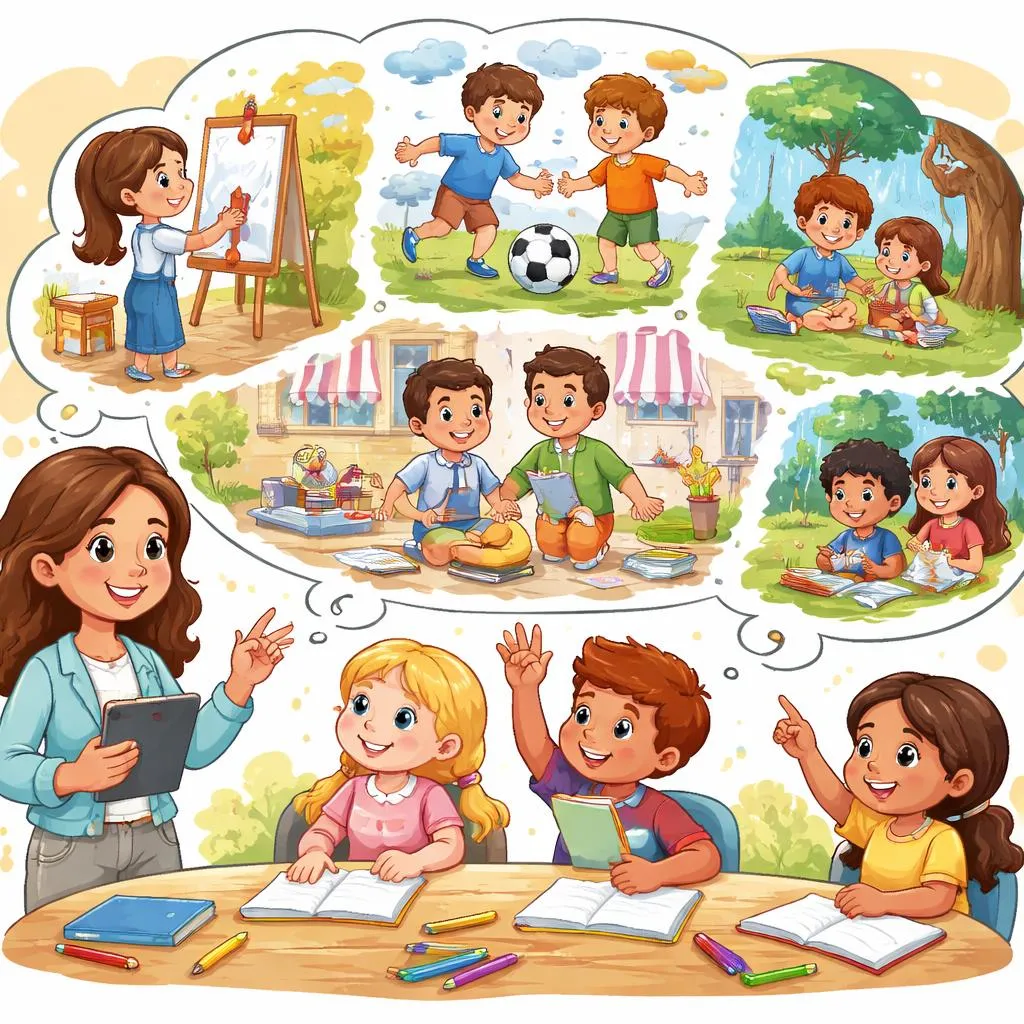

Your child is learning to describe what was happening at a specific time in the past. "I was playing when you called." "She was sleeping all morning." "They were running in the park." These sentences use the past continuous tense. This tense describes actions that were in progress at a particular moment in the past. Mastering the top 100 past continuous sentences for elementary students helps children create vivid descriptions and tell more detailed stories. This guide will explain what past continuous is, list the most important examples, and show how to practice at home.
Meaning: What Is Past Continuous Tense?
Past continuous tense describes actions that were in progress at a specific time in the past. It answers the question "What was happening?" This tense often sets the scene for another action or describes something that continued for a while.
Think about actions in progress at a past moment. "At 3 o'clock, I was playing outside." At that exact time, the playing was happening. "Yesterday morning, she was sleeping late." The sleeping continued through that time.
Think about interrupted actions. "I was watching TV when the phone rang." The watching was in progress, then the ringing interrupted it. "They were walking home when it started to rain." The walking was happening when the rain began.
Think about two actions happening at the same time. "While I was cooking, my sister was setting the table." Both actions were in progress together.
Past continuous uses was or were plus the -ing form of the main verb. I was playing, you were playing, he was playing, they were playing. The top 100 past continuous sentences for elementary students cover all these uses.
Conjugation: How Past Continuous Works
Past continuous follows a clear pattern. Use the correct past form of be for the subject, then add the main verb with -ing.
For I, he, she, it: was + verb-ing. "I was waiting." "He was running." "She was singing." "It was raining."
For you, we, they: were + verb-ing. "You were playing." "We were studying." "They were laughing."
Spelling rules for adding -ing are the same as for present continuous. For most verbs, just add -ing. play becomes playing, eat becomes eating. For verbs ending in e, drop the e and add -ing. make becomes making, write becomes writing. For short verbs ending in consonant-vowel-consonant, double the last letter. run becomes running, swim becomes swimming.
The top 100 past continuous sentences for elementary students include practice with all these forms.
Categories or Lists: The Top 100 Past Continuous Sentences
Here are the top 100 past continuous sentences for elementary students, grouped by category. These are the sentences children use and encounter most often.
Sentences About Specific Times (15): At 7 AM, I was sleeping. At 8 AM, I was eating breakfast. At 9 AM, I was going to school. At 10 AM, I was learning math. At 11 AM, I was reading a book. At noon, I was eating lunch. At 1 PM, I was playing outside. At 2 PM, I was writing a story. At 3 PM, I was listening to the teacher. At 4 PM, I was coming home. At 5 PM, I was doing homework. At 6 PM, I was watching TV. At 7 PM, I was eating dinner. At 8 PM, I was taking a bath. At 9 PM, I was reading in bed. These describe what was happening at different times.
Sentences With When (Interrupted Actions) (15): I was sleeping when the alarm rang. She was eating when the phone rang. He was playing when his friend arrived. They were watching TV when the power went out. We were walking when it started to rain. I was reading when my mom called. She was singing when I walked in. He was running when he fell. They were talking when the teacher came. We were cooking when the guests arrived. I was drawing when my pencil broke. She was writing when she got an idea. He was building when his tower fell. They were waiting when the bus came. We were cleaning when the doorbell rang. These show one action interrupting another.
Sentences With While (Two Actions Together) (10): While I was cooking, my sister was setting the table. While she was reading, he was watching TV. While they were playing, we were working. While Mom was baking, Dad was fixing the car. While the baby was sleeping, I was doing homework. While it was raining, we were staying inside. While the teacher was talking, the students were listening. While I was running, my dog was chasing me. While she was singing, he was playing guitar. While we were eating, they were laughing. These show simultaneous actions.
Sentences About Background Scenes in Stories (10): The sun was shining. Birds were singing. Children were playing in the park. A dog was running nearby. The wind was blowing gently. Clouds were floating in the sky. Flowers were blooming everywhere. People were walking along the street. Music was playing softly. Everything was peaceful. These set the scene in stories.
Sentences About Temporary Past Situations (10): I was living with my grandma last summer. She was staying at her friend's house. He was working at the store for a month. They were renting an apartment downtown. We were using the spare bedroom. Mom was helping Grandma every day. Dad was taking a break from work. The store was offering a big sale. The library was having a reading contest. Everyone was waiting for the results. These describe temporary past situations.
Sentences About Feelings in Progress (10): I was feeling happy all day. She was feeling tired after the game. He was feeling nervous before the test. They were feeling excited about the trip. We were feeling proud of our work. I was hoping for a good grade. She was wishing for a puppy. He was dreaming of becoming a pilot. They were thinking about their vacation. We were planning a surprise party. These describe ongoing feelings in the past.
Questions in Past Continuous (10): What were you doing at 3 PM? Where was she going? Why was he running? When were they arriving? How were you feeling? Were you sleeping when I called? Was it raining yesterday? Were they playing in the park? What was she reading? Who was singing? These are common questions.
Negative Sentences (10): I was not sleeping. She was not listening. He was not playing. They were not watching. We were not eating. It was not raining. I wasn't feeling well. She wasn't paying attention. They weren't laughing. We weren't expecting you. These show actions that were not happening.
Sentences With Always (5): He was always talking in class. She was always smiling. They were always helping others. I was always losing my pencil. We were always having fun. These describe repeated past actions with always.
Sentences About Changing States (5): It was getting darker. The sky was becoming cloudy. The weather was improving. The baby was growing bigger. The flowers were opening. These describe gradual changes in the past.
The top 100 past continuous sentences for elementary students include these essential examples. Children will use them in stories and descriptions.
Daily Life Examples: Past Continuous All Around Us
Past continuous sentences appear when people describe what was happening at a certain time. Pointing them out helps children see that this tense is part of real storytelling.
When someone asks what you were doing at a specific time, we use past continuous. "What were you doing at 8 o'clock last night?" "I was watching a movie." "What was she doing when you called?" "She was sleeping."
In stories, past continuous sets the scene. "It was a dark and stormy night. The wind was blowing. Rain was falling. Everyone was staying inside." This creates the atmosphere.
When describing interrupted actions, past continuous is essential. "I was walking home when I saw a rainbow." "We were having dinner when the lights went out." "She was brushing her teeth when she heard a noise."
When talking about what people were doing at the same time, we use past continuous. "While I was cooking, the kids were playing in the yard." "While Mom was shopping, Dad was cleaning the garage."
When remembering past moments, past continuous brings them to life. "I remember that day. The sun was shining. Everyone was laughing. We were having the best time."
The top 100 past continuous sentences for elementary students help children notice and use these patterns.
Printable Flashcards: Visual Tools for Learning
Flashcards make past continuous concrete. Creating and using them together turns learning into an activity. Here are some ways to use flashcards for past continuous practice.
Create cards with sentences on one side and pictures on the other. "I was sleeping" on front. A picture of someone sleeping with a clock showing 3 AM on back. "She was running" on front. A picture of someone running in the rain on back. Your child reads the sentence and checks the picture.
Create time cards showing specific past times. "at 3 o'clock" "yesterday morning" "last night at 8" "when you called" "while I was cooking" Practice adding these to sentences.
Create subject-verb cards to practice was/were + -ing. Make cards with subjects: I, you, he, she, we, they. Make cards with actions: sleeping, running, eating, playing. Your child makes sentences: "I was sleeping." "They were playing."
Create sentence cards with the verb missing. "I ___ when you called." (was sleeping) "She ___ at 3 PM." (was running) "They ___ in the park." (were playing) Your child fills in the correct form.
Learning Activities or Games: Making Past Continuous Fun
Games turn grammar into play. Here are some games that help children practice the top 100 past continuous sentences for elementary students in enjoyable ways.
What Were You Doing Game: Ask each other about specific past times. "What were you doing at 7 o'clock this morning?" "I was sleeping." "What were you doing at noon?" "I was eating lunch." "What were you doing when I called?" This builds conversational skills.
Alibi Game: Pretend something happened at a certain time. Players must say what they were doing at that time. "Where were you at 3 PM?" "I was at the library. I was reading a book." "What were you reading?" This practices giving details in past continuous.
Picture Description: Show a busy picture of a scene in the past. A picture of a park from long ago. Your child describes what was happening. "Children were playing. A dog was running. Birds were singing. A woman was reading on a bench." This builds descriptive skills.
When and While Game: Give your child two actions. They make a sentence using when or while. "watch TV + phone ring" becomes "I was watching TV when the phone rang." "cook + set table" becomes "While I was cooking, my sister was setting the table."
Past Continuous Bingo: Create bingo cards with past continuous sentences in each square. Call out situations. "You were sleeping when the alarm rang." Your child covers "I was sleeping." "They were playing in the park." Your child covers "They were playing." First to get five in a row wins.
Story Building with Past Continuous: Build a story together using past continuous to set the scene. "It was a beautiful morning. The sun was shining. Birds were singing. Children were playing in the street." Then add simple past for events. "Suddenly, a strange noise started." The story grows while tense practice happens.
Interrupted Actions Game: Give your child an action in progress and an interrupting event. They make a sentence. "eat dinner + doorbell ring" becomes "I was eating dinner when the doorbell rang." "sleep + alarm clock ring" becomes "I was sleeping when the alarm clock rang."
Memory Game: Describe a scene using past continuous. Then ask questions about what was happening. "In the picture, a girl was reading. A dog was sleeping. A bird was singing. What was the dog doing?" "It was sleeping." This practices listening and recall.
As your child becomes familiar with the top 100 past continuous sentences for elementary students, their storytelling becomes richer and more detailed. They can set scenes, describe interrupted actions, and talk about what was happening at specific times. Past continuous adds depth to narratives. Keep practice connected to real memories and stories. Ask about what was happening at different times. Encourage descriptions of past scenes. Celebrate when your child uses past continuous correctly. These -ing sentences from the past help them paint pictures with words.