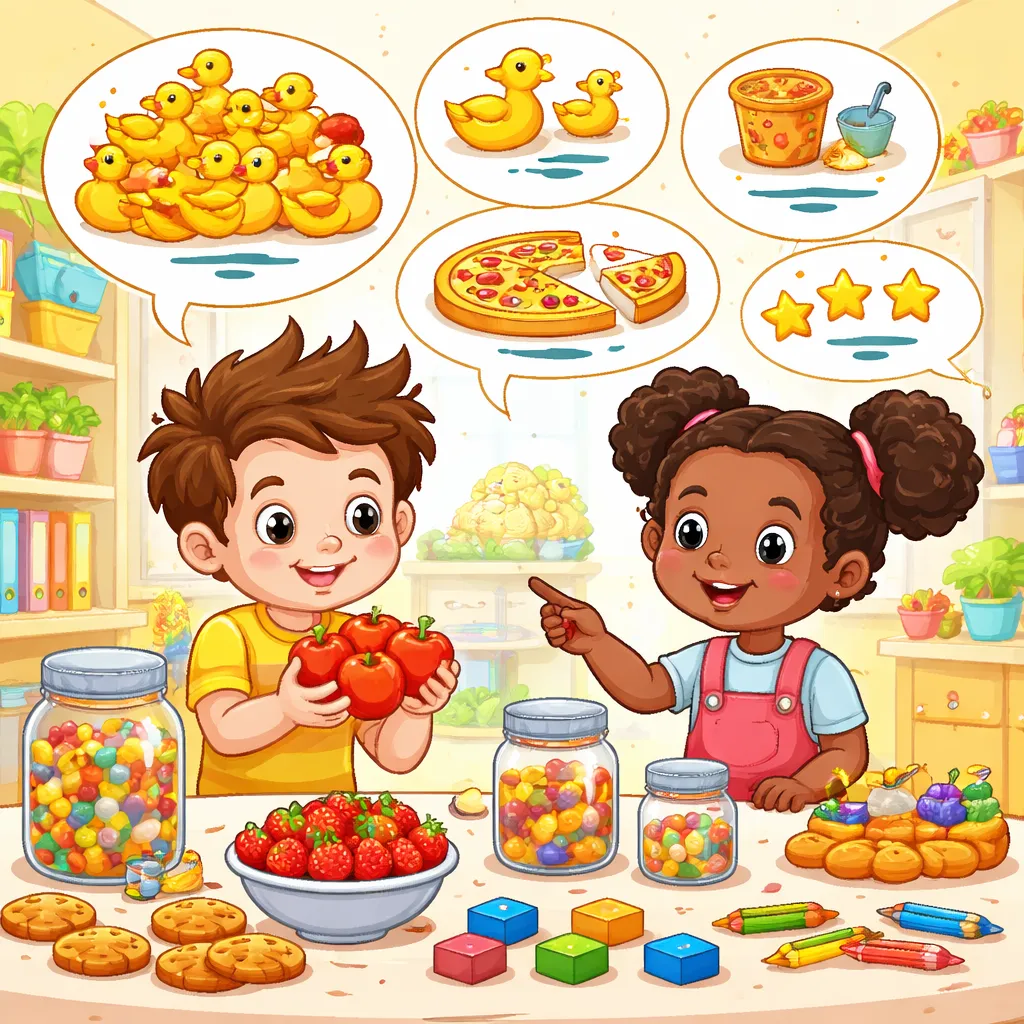

Children constantly talk about amounts. They want some milk, more cookies, or all the toys. They ask for a few minutes or tell you they have no energy left. These amount words are called quantifiers. They answer questions about how much or how many. Today we explore the 70 most common quantifiers for 6-year-old children and how these words help them express quantity clearly.
Quantifiers come before nouns. They tell us about amount without using exact numbers. Some, any, many, much, a few, a little, several, all, no – these words help children communicate about quantity in a flexible way. Understanding quantifiers helps children ask for what they want and describe their world accurately.
What Are Quantifiers?
Let us begin with a clear definition we can share with our children. Quantifiers are words that tell us how much or how many without using numbers. They come before nouns and answer questions about amount.
Think of quantifiers as amount helpers. Instead of saying "I want five cookies," you might say "I want some cookies." Instead of "I have zero energy," you say "I have no energy." Quantifiers give us flexibility to talk about amounts without counting exactly.
Some quantifiers work with countable nouns. Countable nouns are things you can count. Cookies, dogs, toys, books. Words like many, several, a few, both work with these. "I have many toys." "She has several books." "He ate a few cookies."
Other quantifiers work with uncountable nouns. Uncountable nouns are things you cannot count easily. Water, milk, sand, time, energy. Words like much, a little, less work with these. "I need much water." "Give me a little time." "I have less energy now."
For young children, we can explain it simply. Quantifiers are amount words. They tell if there is a lot, a little, or none at all. The 70 most common quantifiers for 6-year-old learners are the words children use every day to talk about how much.
Meaning and Explanation for Young Learners
How do we explain quantifiers to a six-year-old in ways they understand? We use examples from their world and show how these words describe amounts.
Tell your child that sometimes we need to say how much of something we want. We might want a lot or a little. We might want some or none. These amount words are called quantifiers. They help people understand exactly what we mean.
Here are some quantifiers children use. "I want some juice." That means a certain amount, not all. "I have many friends." That means a lot of friends. "I have no energy." That means zero energy. "Give me a few more minutes." That means a small number of minutes.
Some quantifiers go with things you can count. You can count cookies, so you say "many cookies" or "several cookies." Some quantifiers go with things you cannot count. You cannot count water, so you say "much water" or "a little water."
Children learn these patterns naturally. "I want more milk" sounds right. "I want more cookies" also sounds right. More works with both. But "many milk" sounds wrong because many needs countable nouns. Their ears help them learn.
These explanations help children understand the 70 most common quantifiers for 6-year-old speakers. They see that different nouns need different amount words.
Categories of Quantifiers
Quantifiers fall into several categories based on meaning and what nouns they work with. Understanding these categories helps children choose correctly.
Large amount quantifiers tell about big quantities. Many, much, a lot of, lots of, plenty of. "I have many toys." Countable. "I have much homework." Uncountable. "I ate a lot of pizza." Works with both.
Small amount quantifiers tell about small quantities. A few, a little, several, some. "I have a few crayons." Countable, small number. "Give me a little time." Uncountable, small amount. "I want some milk." Uncountable, unspecified amount.
Zero amount quantifiers tell about nothing. No, none, not any. "I have no cookies." Zero cookies. "There is no milk." Zero milk. "I have none left." Zero of whatever.
Universal quantifiers tell about all of something. All, every, each, both. "I ate all the cookies." Every single one. "Every child gets a turn." Each one individually. "I want both toys." The two of them.
Sufficiency quantifiers tell about enough or too much. Enough, too, too much, too many. "I have enough money." The right amount. "I ate too many cookies." More than good. "There is too much noise." More than comfortable.
These categories make up the 70 most common quantifiers for 6-year-old learners. Each helps children express different amount ideas.
Daily Life Examples
Quantifiers appear constantly in family conversations. Here are examples from a typical day with a six-year-old.
Morning time brings many quantifiers. "I want some cereal." Unspecified amount. "Pour a little milk." Small amount. "I have no clean socks." Zero socks. "I need more time." Additional time. "I ate too many pancakes." Excessive amount.
During play, quantifiers multiply. "I have many LEGOs." Large countable amount. "Give me a few blocks." Small countable amount. "I have no turns left." Zero turns. "We have all the toys." Every toy. "I want both dolls." The two of them.
Mealtime produces many quantifiers. "I want some peas." Unspecified amount. "Just a little broccoli." Small amount. "I ate too much pasta." Excessive uncountable. "I have enough food." Sufficient amount. "No more carrots." Zero additional.
Bedtime brings its own quantifiers. "Read one more story." Additional single. "I need a few minutes." Small countable time. "I have no energy." Zero energy. "I love you so much." Large amount of love. "I want all the hugs." Every hug.
Throughout the day, children use quantifiers without thinking about it. The 70 most common quantifiers for 6-year-old children appear again and again in these everyday moments.
Quantifiers with Countable Nouns
Some quantifiers work only with countable nouns. These are nouns you can count: one dog, two dogs, three dogs.
Many means a large number. "I have many friends." "She read many books." "We saw many animals." Many tells us the number is large but not exact.
Several means more than a few but not many. "I ate several cookies." Probably three to five. "He has several toys." More than a couple. "She invited several friends." A small group.
A few means a small number. "I need a few minutes." Probably two or three. "She has a few crayons." A small handful. "He made a few mistakes." Not many.
Both means two out of two. "I want both presents." The two of them. "Both dogs are barking." The two dogs we know. "She held both hands." Her two hands.
Each and every mean all individuals separately. "Each child gets a turn." Every one individually. "Every cookie was eaten." All cookies without exception.
These quantifiers with countable nouns appear throughout the 70 most common quantifiers for 6-year-old learners. They help children talk about numbers of things.
Quantifiers with Uncountable Nouns
Some quantifiers work only with uncountable nouns. These are nouns you cannot count: water, milk, sand, time, energy.
Much means a large amount. "I don't have much time." "Is there much milk left?" "She doesn't have much energy." Much is often used in questions and negative sentences.
A little means a small amount. "I need a little help." "Add a little water." "Wait a little while." A little tells us the amount is small but positive.
Less means a smaller amount than something else. "I have less patience now." "There is less milk than yesterday." "She has less energy in the afternoon."
Enough means the right amount. "Do we have enough time?" "I have enough money." "There is enough food for everyone." Enough tells us the amount is sufficient.
Too much means more than wanted. "I ate too much cake." "There is too much noise." "She had too much sugar." Too much tells us the amount is excessive.
These quantifiers with uncountable nouns form part of the 70 most common quantifiers for 6-year-old speakers. They help children talk about amounts of things they cannot count.
Quantifiers That Work with Both
Some quantifiers work with both countable and uncountable nouns. These are flexible and very useful.
Some works with both. "I want some cookies." Countable. "I want some milk." Uncountable. Some means an unspecified amount. It is positive and offers or requests.
Any works with both, often in questions and negatives. "Do you have any cookies?" Countable. "Do you have any milk?" Uncountable. "I don't have any." Both. Any asks about existence.
No works with both. "I have no cookies." Countable zero. "I have no milk." Uncountable zero. No means none at all.
A lot of and lots of work with both. "I have a lot of friends." Countable many. "I have a lot of homework." Uncountable much. These are informal and common.
More works with both. "I want more cookies." Countable additional. "I want more milk." Uncountable additional. More asks for increase.
Most works with both. "I ate most of the cookies." Countable majority. "I drank most of the milk." Uncountable majority. Most means almost all.
These flexible quantifiers appear throughout the 70 most common quantifiers for 6-year-old children. They are very useful in daily conversation.
Questions with Quantifiers
Questions often contain quantifiers. Children ask for amounts and existence using these words.
Questions about existence use any. "Do you have any cookies?" Asks if there are some. "Is there any milk?" Asks about uncountable existence. "Are there any toys left?" Asks about countable items.
Questions about amount use how many and how much. "How many cookies did you eat?" Countable. "How much milk do you want?" Uncountable. These ask for exact or approximate amounts.
Questions about sufficiency use enough. "Do we have enough time?" Asks if time is sufficient. "Is there enough food?" Asks about food quantity. "Do you have enough money?" Asks about funds.
Questions about preference use some in offers. "Would you like some cookies?" Offering. "Do you want some milk?" Offering. Some makes the offer positive and inviting.
Children ask questions like "Can I have some juice?" "Do we have any crackers?" "How many more minutes?" "Is there enough for me?" These questions use quantifiers naturally.
These question patterns appear in the 70 most common quantifiers for 6-year-old speakers. They help children ask about amounts.
Other Uses of Quantifiers
Quantifiers serve many purposes beyond simple amount statements. Children use them in varied ways as language develops.
Making comparisons uses quantifiers. "I have more toys than you." Comparative amount. "She has less juice than me." Comparative uncountable. "He ate the most cookies." Superlative amount.
Making requests uses quantifiers politely. "Can I have a little more?" Small additional amount. "I want just a few." Small countable. "That's too much." Excessive amount.
Making observations uses quantifiers. "There are so many stars!" Large countable. "I have no energy left." Zero uncountable. "We have plenty of time." Sufficient amount.
Making promises uses quantifiers. "I will eat all my vegetables." Every single one. "I will share some." An unspecified amount. "I will not make any more mess." Zero additional.
These varied uses appear throughout the 70 most common quantifiers for 6-year-old children. Each adds precision to communication.
Learning Tips for Parents
Supporting your child's use of quantifiers happens naturally through conversation. Here are gentle ways to encourage this growth.
Model quantifiers clearly in your own speech. Use a variety of amount words naturally. "I have many things to do today." "Would you like some grapes?" "There are a few cookies left." "I don't have any money." Your child hears these patterns constantly.
Notice quantifiers during read-aloud time. When you encounter a quantifier in a book, point it out casually. "Listen, the book says 'the giant had many treasures.' Many tells us he had a lot." Simple observations build awareness.
Ask questions that invite quantifier responses. "How many friends do you have?" Invites many or a few. "How much milk do you want?" Invites a little or a lot. "Do we have any crackers?" Invites some or none.
Correct gently by repeating. If your child says "I want many water," you can respond with "You want a lot of water? Okay." This models the correct quantifier for uncountable nouns.
Play with amounts during daily routines. When pouring milk, talk about it. "I'm giving you a little milk. Do you want more?" When counting toys, talk about it. "You have so many toys! You have more than yesterday."
These tips support mastery of the 70 most common quantifiers for 6-year-old children through natural, positive interaction.
Printable Flashcards for Quantifier Practice
Flashcards can help children practice quantifiers. Here are ideas for making your own set.
Create noun cards on one color of paper. Write countable nouns. "cookies" "toys" "dogs" "books" "crayons" Write uncountable nouns. "milk" "water" "time" "juice" "sand"
Create quantifier cards on another color. Write quantifiers that work with countable nouns. "many" "several" "a few" "both" "each" Write quantifiers for uncountable nouns. "much" "a little" "less" "enough" Write quantifiers for both. "some" "any" "no" "more" "most" "a lot of"
Create picture cards showing amounts. Draw a jar with many cookies for "many." Draw a glass with a little milk for "a little." Draw an empty plate for "no." Pictures make amounts visual.
How to play with the cards. Lay out noun cards. Ask your child to choose quantifier cards that can work with each noun. "cookies" can go with many, several, a few, some, any, no, more. "milk" can go with much, a little, some, any, no, more.
Try the matching game. Spread noun cards and quantifier cards face up. Take turns finding pairs that work together. "cookies" and "many" work. "milk" and "much" work. Discuss why each pair works or does not work.
Create sentence building challenges. Combine quantifier and noun cards into complete sentences. "I have many cookies." "I want some milk." "There are no toys." Practice making sentences with different quantifiers.
These flashcards make the 70 most common quantifiers for 6-year-old learners tangible and fun. Children see how quantifiers work with different kinds of nouns.
Learning Activities and Games
Games make learning about quantifiers playful and memorable. Here are some activities to enjoy together.
The How Many Game practices countable quantifiers. Look around the room and talk about amounts. "How many books do you see?" "I see many books." "How many pillows?" "I see a few pillows." Count and use quantifiers together.
The How Much Game practices uncountable quantifiers. Talk about liquids and materials. "How much milk is in your cup?" "There is a little milk." "How much water is in the pool?" "There is a lot of water." Use quantifiers naturally.
The Shopping Game practices quantifiers in context. Pretend to go shopping. "We need some apples." "We need a little milk." "We don't need any cookies." "We have enough bread." Make a list and shop using quantifiers.
The Snack Time Game practices requesting with quantifiers. During snack, practice asking with quantifiers. "Can I have some grapes?" "I want a few crackers." "Just a little juice please." "I don't want any more." Make it part of the routine.
The Story Building Game uses quantifiers in narratives. One person starts a story with a quantifier. "There were many dragons." Next person adds. "They had a lot of treasure." "One dragon had no friends." Continue building with quantifiers throughout.
These games turn learning the 70 most common quantifiers for 6-year-old children into active family fun. No pressure, just playful language exploration.
Quantifiers give children power to talk about amounts without needing exact numbers. They can ask for some milk, complain about too many chores, or announce they have no energy left. These words help children navigate daily life with precision. The distinction between countable and uncountable nouns takes time to learn. Some children will say "many water" while learning. Gentle modeling over time will help them internalize the patterns. Every "I want some" and "I have many" and "that's too much" represents growing mastery of amount language. The next time your child uses a quantifier correctly, recognize the sophisticated thinking behind that small word. They are learning to describe quantity in all its forms. This skill will serve them well in math, science, and everyday communication for the rest of their lives.