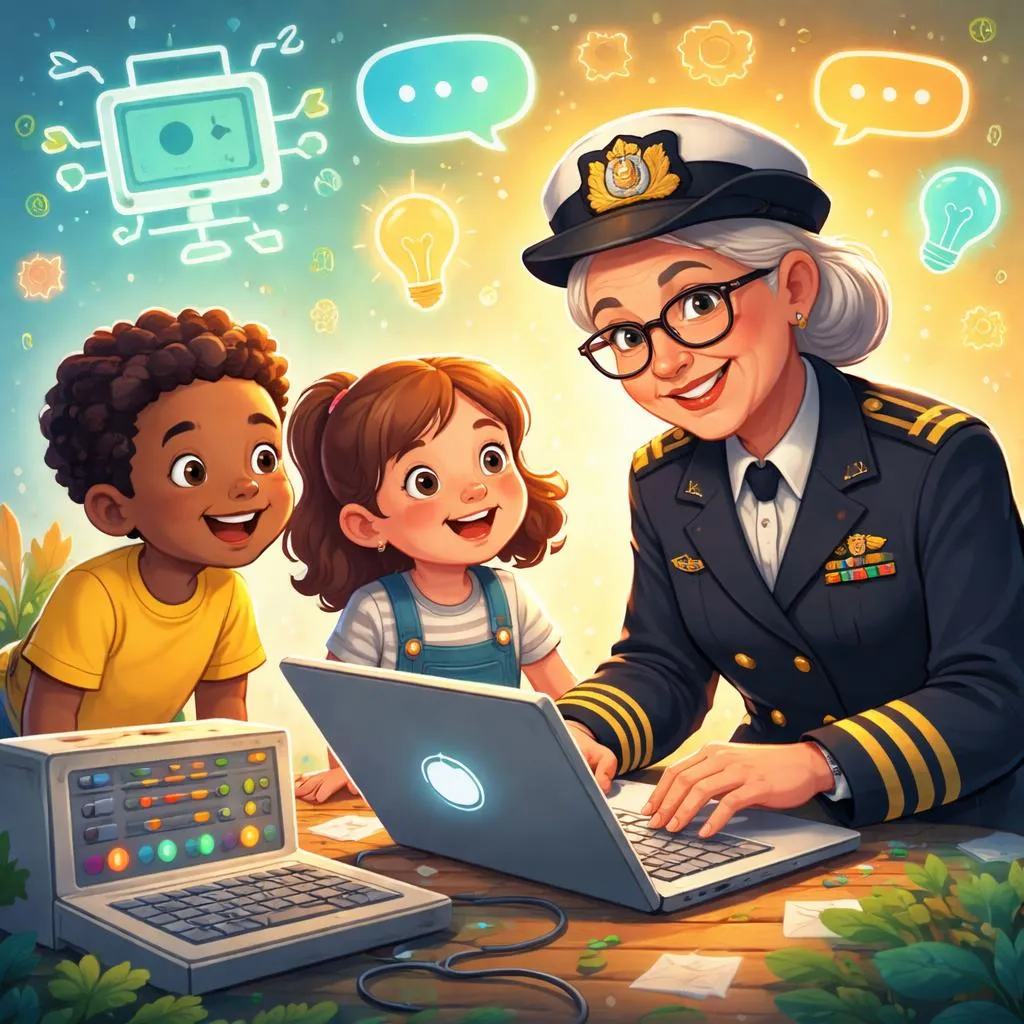

Introduction to Grace Hopper
Grace Hopper was an American computer scientist and United States Navy rear admiral. She invented the first compiler, which turns English-like commands into computer code. This celebrity story: Grace Hopper shows that computers do not have to be hard to use. Hopper believed that anyone should be able to talk to a machine. Children can learn that big ideas often start with simple questions. Parents can use her story to teach curiosity and breaking rules. Hopper joined the Navy at age 37. She retired at age 79 as one of the oldest officers in service. Her work led to the COBOL programming language. That language still runs many banking and government systems today. Her life proves that age is just a number. Curiosity never retires.
Early Life and Background
Grace Brewster Murray was born on December 9, 1906, in New York City. Her father, Walter Fletcher Murray, was an insurance executive. Her mother, Mary Campbell Van Horne Murray, loved math. Young Grace was very curious. At age seven, she took apart seven alarm clocks to see how they worked. Her mother limited her to one clock per week after that. Grace loved learning. She attended private schools for girls. At age 16, she applied to Vassar College. She failed the Latin exam. Her father hired a tutor. She passed and entered Vassar in 1924. She studied mathematics and physics. She graduated with honors in 1928. She earned a master's degree from Yale University in 1930. She married Vincent Foster Hopper, an English teacher, in 1930. She earned a PhD in mathematics from Yale in 1934. She was one of the few women to earn a PhD in math at that time. She taught mathematics at Vassar College and became an associate professor. When World War Two began, she wanted to serve her country. She was 34 years old. The Navy said she was too old and too small. She weighed only 105 pounds. She did not give up.
Career Highlights and Achievements
Grace Hopper joined the United States Navy Reserve in 1943. She was commissioned as a lieutenant. The Navy sent her to work on the Harvard Mark I computer. The Mark I was 51 feet long and weighed five tons. It used paper tape and mechanical switches. Hopper loved it. She became the third person to program the Mark I. In 1949, she joined the Eckert-Mauchly Computer Corporation. She worked on the UNIVAC I, the first commercial computer in the United States. At UNIVAC, Hopper had a radical idea. She believed programmers should write code using English-like words. A compiler would translate those words into machine code. Everyone told her it was impossible. She built the first compiler anyway in 1952. She called it the A-0 system. In 1959, Hopper helped develop COBOL, Common Business-Oriented Language. COBOL used English words like ADD, SUBTRACT, and MOVE. It became the most popular business programming language in the world. Hopper retired from the Navy in 1966 at age 60. The Navy called her back to active duty in 1967. They needed her expertise. She stayed for 19 more years. She became a rear admiral in 1985. She was the oldest active-duty officer in the Navy at age 79.
Famous Works or Performances
Grace Hopper's most famous work is the first compiler. A compiler takes instructions written in a human-readable language and turns them into binary machine code. Before compilers, programmers wrote everything in machine code using only 0s and 1s. That was slow and full of errors. Hopper's compiler made programming faster and more accurate. Another famous work is COBOL. Hopper believed that programming languages should look like English. COBOL uses sentences and periods. A COBOL command might say "ADD SALES-TAX TO TOTAL-COST." Anyone who speaks English can guess what that does. COBOL became the standard for business, banking, and government. As of 2024, over 200 billion lines of COBOL code still run daily. That includes most ATM transactions and Social Security systems. Hopper also coined the term "debugging." In 1947, a moth flew into the Harvard Mark II computer. The moth caused a relay to stick. The team taped the moth into their logbook with the note, "First actual case of bug being found." Hopper popularized the phrase "debugging" to mean fixing computer problems. The logbook with the moth is now in the Smithsonian Museum.
Personal Life and Fun Facts
Grace Hopper had many wonderful personal stories. She was famous for handing out "nanoseconds." A nanosecond is one billionth of a second. She carried pieces of wire that were 11.8 inches long. That is the distance light travels in one nanosecond. She would tell students, "This is a nanosecond." A fun fact is that she loved to wear her Navy uniform everywhere. She even wore it to give talks at universities and companies. Another fun fact is that she hated the phrase "We have always done it that way." She kept a clock on her wall that ran counterclockwise. It ran backwards. She said it reminded people to question assumptions. Hopper never had children. She divorced Vincent Hopper in 1945. She did not remarry. She considered her Navy colleagues and young programmers her family. She loved to teach. She visited schools and universities constantly. She would stand on a chair to be seen by the back of the room. She had a loud, cheerful voice. People remembered her laugh. Hopper also loved to cook. She made large meals for her teams during late-night programming sessions. She died on January 1, 1992, at age 85. She is buried at Arlington National Cemetery.
Legacy and Influence
Grace Hopper changed how humans talk to computers. Before her, only engineers could program. After her, anyone who could read English could learn. Her compiler concept made modern software possible. Every programming language today uses a compiler or interpreter. Python, Java, JavaScript, and C++ all descend from Hopper's work. COBOL still powers most of the world's financial systems. The Grace Hopper Celebration is the world's largest gathering of women in computing. Over 30,000 people attend each year. The U.S. Navy named a destroyer, the USS Hopper, after her. The ship's nickname is "Amazing Grace." The Hopper Prize is a computer science award for young researchers. Google named a building at its California headquarters after her. Yale University renamed a college in her honor. The Grace Hopper Program at the New York Academy of Sciences teaches girls to code. Her portrait hangs in the National Portrait Gallery in Washington, D.C. Her legacy proves that a woman in a male-dominated field can rise to the top. It proves that old ideas about age and gender are wrong. It proves that one person's "impossible" idea can become everyone's daily tool.
Quotes or Famous Sayings
Grace Hopper spoke many unforgettable words. One famous quote is, "The most dangerous phrase in the language is, 'We have always done it that way.'" Another wise saying is, "A ship in port is safe, but that is not what ships are built for." She also said, "I've always been more interested in the future than in the past." Children might like this one: "If it's a good idea, go ahead and do it. It's much easier to apologize than to get permission." Families can read these quotes together. Ask children, "What is something your family has always done that you could change?" Parents can help children see that Hopper broke rules. She joined the Navy when they said she was too old. She built a compiler when experts said it was impossible. She asked for forgiveness, not permission. Her quotes remind us that safe is not always best. Sometimes you need to leave the harbor.
How to Learn from Grace Hopper
Children can learn several lessons from Grace Hopper. First, ask "what if." Hopper asked, "What if computers could understand English?" That question changed the world. Second, ignore people who say "impossible." Many experts told Hopper her compiler would never work. She built it anyway. Third, keep learning your whole life. Hopper earned a PhD, learned programming in her 30s, and stayed curious until age 85. Parents can encourage young children to take things apart safely. Old clocks, broken toys, and simple machines. See how they work. Older children can learn to code. Free websites like Code.org and Khan Academy teach programming basics. Try writing a simple program in Python. Use English-like words like "print" and "if." Families can also do the "nanosecond" activity. Cut a piece of string 11.8 inches long. That is one nanosecond. Ask children how far light travels in one second. That is 186,000 miles. Wrap a string that long around a playground. Another activity is to find something "we have always done that way" at home. Folding towels. Setting the table. Walking to school. Can you find a better way? Grace Hopper showed that a curious mind has no age limit. She was a teacher, a Navy officer, and a computer pioneer. She was funny, loud, and brilliant. Every child can be a little like Grace. Ask questions. Break rules that need breaking. Make things easier for the next person. That is real power. That is amazing grace.