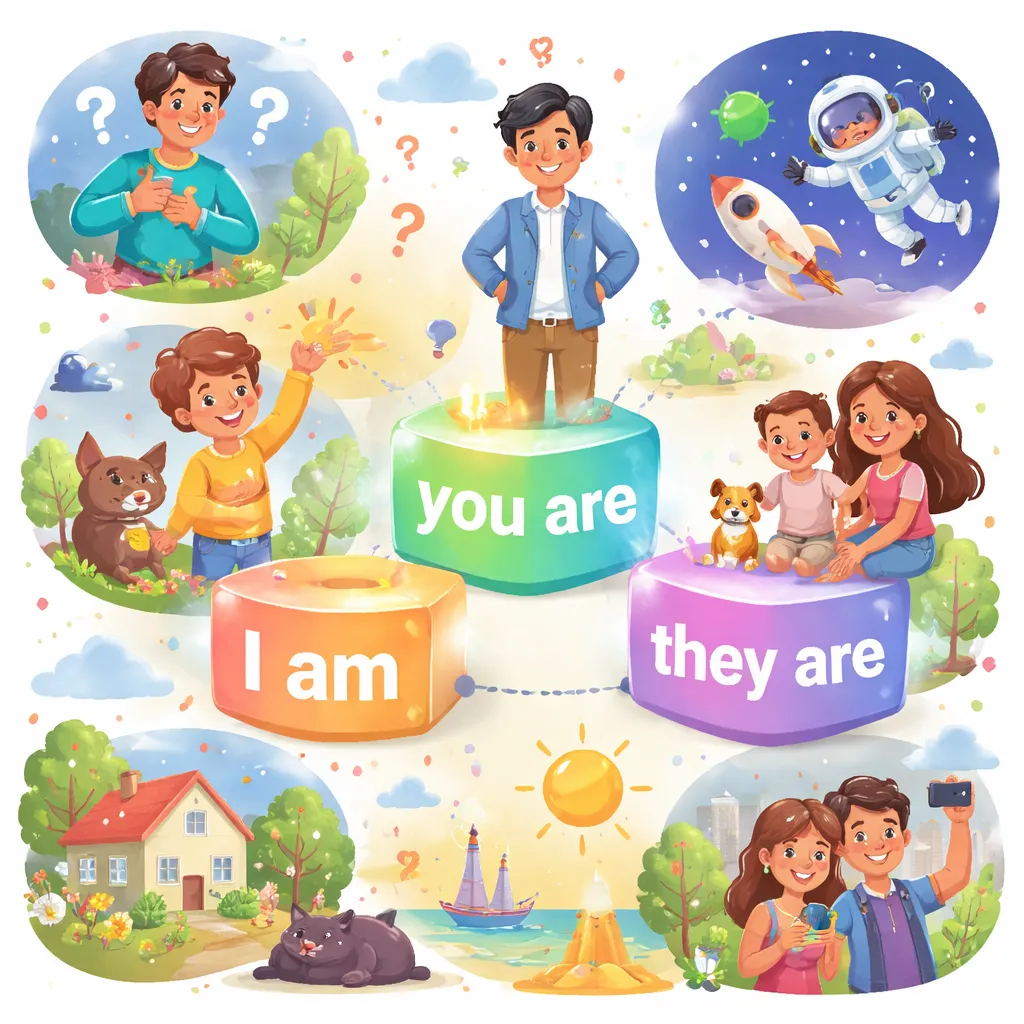

每個句子都需要一個動詞。許多句子都需要最重要的動詞。那個動詞就是“to be”。它告訴我們某人是誰。它告訴我們某物的感覺。它也告訴我們某物存在於哪裡。
現在簡單式:'to be' 有三種形式。Am。Is。Are。這三個小小的詞語蘊含著巨大的意義。“I am happy.”“She is a doctor.”“They are outside.”
孩子們在使用任何其他動詞之前都會使用“to be”。“I am hungry.”“He is my friend.”“We are tired.”他們不會思考。他們只是說。
父母可以通過在日常談話中注意到“to be”來提供幫助。當你說“It is cold today”時,你使用了“to be”的現在簡單式。當你的孩子說“I am five years old”時,他們也使用了它。
這個動詞打破了常規規則。它不像其他動詞那樣添加 -s。它完全改變了。Am,is,are。沒有模式。只有記憶。
但沒關係。“To be”很短。它很常見。孩子們很快就學會了它,因為他們每天都會聽到數百次。
讓我們一起探索這個基本的動詞。
什麼是現在簡單式:'To Be'? 現在簡單式:'to be' 描述存在的狀態。它不顯示動作。它顯示存在、身份或狀況。
將“to be”視為等號。“She is a teacher”表示她 = 老師。“The sky is blue”表示天空 = 藍色。“I am tired”表示我 = 疲倦的狀態。
英語將“to be”用於許多目的。為了給出你的名字:“I am Maria。”為了說明你的年齡:“He is seven。”為了描述感受:“We are excited。”為了說明事物在哪裡:“The book is on the table。”
其他動詞顯示動作。跑、跳、吃、睡。“To be”不顯示任何動作。它只是將主語連接到更多信息。
孩子們首先學習“to be”,因為它可以回答基本問題。“你是誰?”“I am Leo。”“你好嗎?”“I am fine。”“爸爸在哪裡?”“He is at work。”
現在簡單式中的三種形式是:am、is、are。Am 與 I 一起使用。Is 與 he、she、it 一起使用。Are 與 you、we、they 一起使用。
父母可以指出“to be”比任何其他動詞變化更大。大多數動詞為 he/she/it 添加 -s。“To be”完全改變了。這使它變得特別。這也使它值得練習。
名稱“現在簡單式:'to be'”提醒我們這就是現在的形式。不是過去式(was/were)。不是將來式(will be)。只是現在。
現在簡單式的規則:'To Be' “to be”的規則與所有其他動詞都不同。學習這五個規則。它們永遠不會改變。
規則一:將 'am' 與代詞 I 一起使用 I am a student. I am hungry. I am here. 永遠是“I am”。從來沒有“I is”。從來沒有“I are”。I am 是一個固定的配對。
規則二:將 'is' 與 he、she、it 一起使用 He is my brother. She is a dentist. It is a sunny day. He is。She is。It is。任何單獨的人、地點或事物都使用 is。
規則三:將 'are' 與 you、we、they 一起使用 You are my best friend. We are ready. They are late. You 總是使用 are。即使是一個人。“You are kind”為一個人使用 are。
規則四:通過將 am/is/are 移到前面來形成問題 Am I late? Is she sleeping? Are you okay? Where is the bathroom? 不要使用 do 或 does。只需移動動詞。“Is he happy?”而不是“Does he be happy?”
規則五:通過在 am/is/are 後面添加 'not' 來形成否定式 I am not tired. He is not here. They are not home. 使用縮寫:I'm not, isn't, aren't。“She isn't ready.”“We aren't lost.”
這五個規則涵蓋了一切。“To be”沒有例外。分別練習每個規則。逐一掌握 am、is、are。
如何使用現在簡單式:'To Be' 在八種日常情況下使用現在簡單式:'to be'。每種情況對於家庭對話來說都很自然。
情況一:識別人和事物 告訴某物是什麼或什麼。“I am your father.”“This is my house.”“That is a butterfly.”
情況二:描述特徵 談論品質。“She is tall.”“He is funny.”“The soup is hot.”這些描述在“to be”之後使用形容詞。
情況三:陳述感受和情緒 分享你的感受。“I am happy.”“We are worried.”“She is excited about the party.”
情況四:給出年齡 說出某人的年齡。“I am eight years old.”“My sister is five.”“They are teenagers.”
情況五:談論位置 說明某物存在於哪裡。“The keys are on the table.”“Mom is in the kitchen.”“We are at the park.”
情況六:描述天氣 談論外部條件。“It is rainy.”“The sky is cloudy.”“It is very hot today.”
情況七:陳述職業 說出某人的工作。“She is a teacher.”“He is a firefighter.”“I am a student.”
情況八:表達時間 告訴現在幾點了。“It is three o'clock.”“It is time for bed.”“Lunch is at noon.”
父母可以整天使用“to be”。“It is time to wake up.”“You are doing great.”“Where is your shoe?”每個句子都自然地教導。
孩子們可以在睡前玩“I am...”遊戲。說出關於你自己的三件事。“I am tired. I am happy. I am ready for a story.”這將培養自我表達和語法。
現在簡單式的例子:'To Be' 大聲朗讀這些例子。按主語和用法分組。
I am 的例子
I am a kind person.
I am seven years old.
I am in my bedroom.
I am hungry for breakfast.
I am not afraid of the dark.
Am I late for dinner?
he, she, it 的例子
He is my best friend from school.
She is a wonderful painter.
It is a beautiful morning.
The cat is sleeping on the couch.
My grandpa is seventy years old.
Is she your sister?
He isn't feeling well today.
you, we, they 的例子
You are very good at drawing.
We are all ready to go.
They are outside playing soccer.
You are my favorite person.
We are excited about the trip.
Are they coming to the party?
You aren't wearing shoes!
帶 am, is, are 的問題
Am I in the right classroom?
Is the movie starting soon?
Are you listening to me?
Where is my blue backpack?
Why are they so happy?
How old is your dog?
帶 not 的否定式
I am not tired. I am wide awake.
He is not here right now.
She isn't a doctor. She is a nurse.
We are not lost. We know where we are.
They aren't ready yet.
每餐前閱讀三個例子。讓你的孩子將“I am”更改為“She is”。將“They are”更改為“He is”。這些小小的變化可以建立靈活性。
常見錯誤 這五個錯誤經常發生。通過練習溫和地修復它們。
錯誤一:將 is 與 I 一起使用 錯誤:“I is happy.” 正確:“I am happy.” I 總是使用 am。從來沒有 is。這是孩子們最常見的錯誤。每次都友善地糾正它。
錯誤二:將 are 與 he/she/it 一起使用 錯誤:“She are a teacher.” 正確:“She is a teacher.” He、she、it 使用 is。不是 are。單個主語需要 is。
錯誤三:在問題中忘記 to be 錯誤:“Where the bathroom?” 正確:“Where is the bathroom?” 問題需要 am、is 或 are。不要省略動詞。
錯誤四:將 do/does 與 to be 一起使用 錯誤:“Does she be happy?” 正確:“Is she happy?” to be 不使用 do 或 does。而是將動詞移到前面。
錯誤五:混淆 it's 和 its 錯誤:“The dog wagged it's tail.” 正確:“The dog wagged its tail.”(所有格) 正確:“It's a beautiful day.”(it is) It's = it is。Its = 屬於它。所有格沒有撇號。
將這些錯誤寫在冰箱上。每次有人發現錯誤時,他們都會在它旁邊放一顆星。五顆星可以獲得小小的獎勵。這將糾正變成一場遊戲。
比較:'To Be' 與其他動詞 將“to be”與常規動作動詞進行比較。它們的工作方式非常不同。
意義差異 to be:描述狀態。“I am tired.”(條件) 動作動詞:描述動作。“I sleep.”(你做什麼)
問題差異 to be:將動詞移到前面。“Are you ready?” 動作動詞:添加 do/does。“Do you sleep well?”
否定差異 to be:在動詞後添加 not。“She is not here.” 動作動詞:添加 don't/doesn't。“She doesn't sleep here.”
主語-動詞一致性差異 to be:完全改變。I am, he is, you are。 動作動詞:只為 he/she/it 添加 -s。I eat, he eats, you eat。
帶形容詞 to be + 形容詞:“The flower is red.” 動作動詞很少使用形容詞。“The flower smells red”是錯誤的。
給孩子們的一個簡單規則:使用“to be”來表示事物的狀態。使用動作動詞來表示事物的作用。
父母可以玩“狀態或動作?”遊戲。說一個句子。“The baby sleeps。”動作。“The baby is tired。”狀態。“The dog runs。”動作。“The dog is fast。”狀態。這個遊戲需要兩分鐘。它建立清晰的思維。
練習題 一起完成這些練習。在紙上寫下答案。
練習一:選擇 am、is 或 are
I ______ a student at this school.
She ______ my best friend.
They ______ playing in the garden.
He ______ a very good cook.
We ______ ready for the test.
It ______ cold outside today.
You ______ so kind to me.
The books ______ on the shelf.
練習二:提出問題 將每個陳述變成一個問題。
You are happy.
He is a doctor.
They are at home.
She is seven years old.
We are late.
練習三:造否定句 使用 not 將每個陳述變成否定式。
I am tired.
She is a teacher.
They are ready.
He is my brother.
We are lost.
練習四:糾正錯誤 每個句子都有一個錯誤。正確重寫。
I is hungry for lunch.
Where the nearest bathroom?
She are a wonderful singer.
Does he be a firefighter?
The dog wagged it's tail.
練習五:用正確的形式填空 24. ______ (I / be) late for school? 25. The children ______ (be) very noisy today.
答案和解釋 一起檢查你的答案。閱讀每個解釋。
練習一答案: am (I + am) is (she + is) are (they + are) is (he + is) are (we + are) is (it + is) are (you + are) are (the books = they)
練習二答案: 9. Are you happy? 10. Is he a doctor? 11. Are they at home? 12. Is she seven years old? 13. Are we late?
練習三答案: 14. I am not tired. / I'm not tired. 15. She is not a teacher. / She isn't a teacher. 16. They are not ready. / They aren't ready. 17. He is not my brother. / He isn't my brother. 18. We are not lost. / We aren't lost.
練習四答案: 19. I am hungry for lunch. (I needs am) 20. Where is the nearest bathroom? (Needs is) 21. She is a wonderful singer. (She needs is) 22. Is he a firefighter? (No does. Move is) 23. The dog wagged its tail. (Its, no apostrophe)
練習五答案: 24. Am I late for school? (I + am in question form) 25. The children are very noisy today. (children = they)
關鍵解釋: 問題 22 顯示了最常見的錯誤。切勿將“does”與“to be”一起使用。只需將“is”移到前面。
問題 24 使用“am I”,因為主語是 I。即使在問題中,I 也保留 am。
慶祝每一個正確的答案。平靜地複習錯誤。學習“to be”需要時間。
學習技巧 讓現在簡單式:'to be' 成為每次對話的一部分。這七個技巧適用於忙碌的家庭。
技巧一:每天早上從感受開始 早餐時,問“你好嗎?”回答“I am happy.”“I am sleepy.”“I am excited.”每個人在一天開始前都會練習“to be”。
技巧二:玩“I spy”與位置 “I spy with my little eye something that is on the wall.”“I spy something that is under the table.”這個遊戲自然地練習 is 和 are。
技巧三:描述你看到的人 在散步時,描述陌生人。“That man is tall.”“Those children are young.”“The dog is brown.”快速描述再次使用“to be”。
技巧四:使用便利貼表示 am, is, are 在藍色便箋上寫下“I am”。在黃色便箋上寫下“He is / She is / It is”。在綠色便箋上寫下“You are / We are / They are”。把它們貼在牆上。在練習時指向它們。
技巧五:用“to be”唱歌 許多兒童歌曲都使用“to be”。“I am the music man.”“If you are happy and you know it.”“Row, row, row your boat”在“are you listening?”中使用“are”。一起唱。
技巧六:創建一個“關於我”海報 在頂部寫下“I am...”。幫助你的孩子完成句子。“I am 7 years old. I am a sister. I am good at drawing. I am brave.”將海報掛在臥室的門上。
技巧七:微笑著糾正 當你的孩子說“She are nice”時,說“She is nice. She is one person. One person uses is. Can you say it for me?”微笑著糾正。沒有壓力。只是練習。
現在簡單式:'to be' 是英語中使用最多的動詞。沒有它,你就無法進行真正的對話。掌握 am、is 和 are 可以打開每一扇門。
每天練習五分鐘。描述你的世界。“The sky is blue. The grass is green. I am happy we are learning together.”
現在用“to be”說出關於這一刻的三個句子。“I am reading. The words are clear. This lesson is helpful.”你剛剛練習了英語中最重要的動詞。繼續。你做得很好。