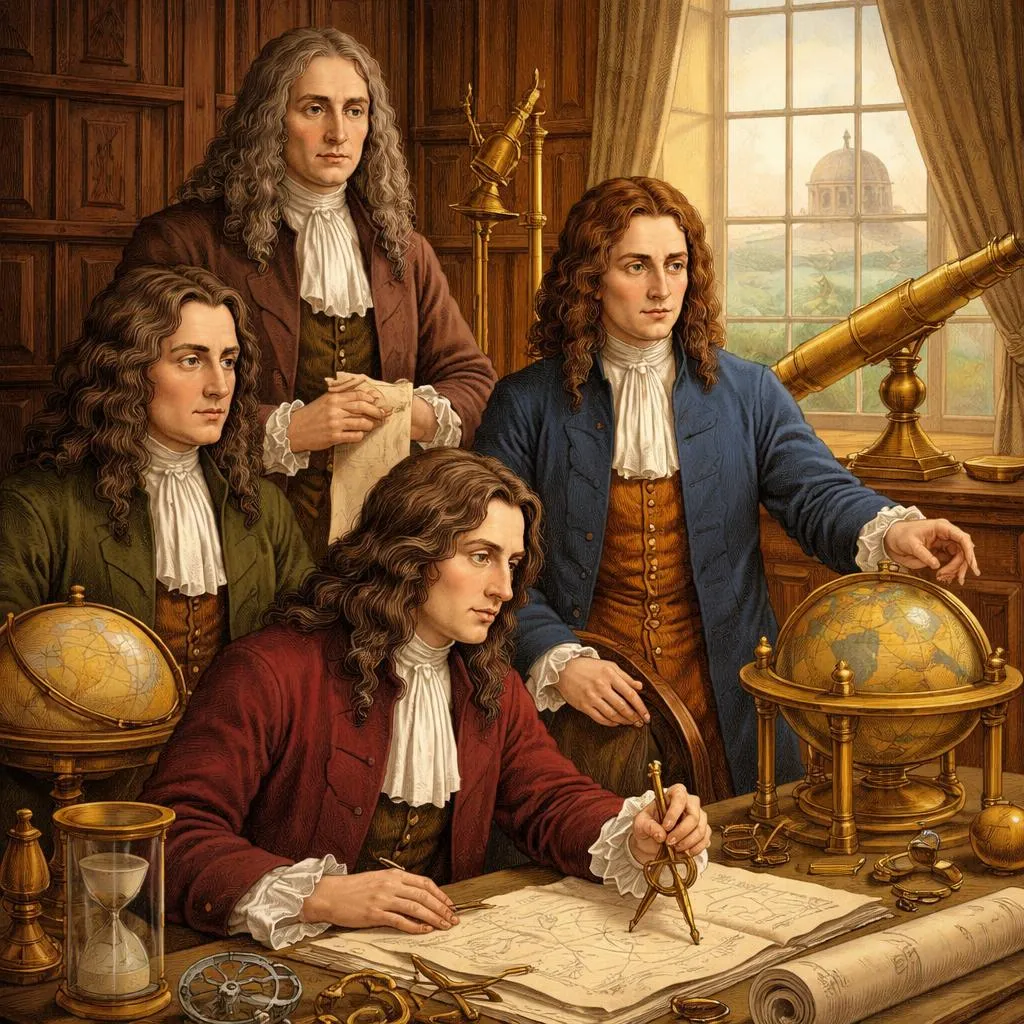

It was almost a matter of course that the English should at first have adopted the notation of Newton in the infinitesimal calculus in preference to that of Leibnitz and consequently the English school would in any case have developed on somewhat different lines to that on the continent, where a knowledge of the infinitesimal calculus was derived solely from Leibnitz and the Bernoullis. But this separation into two distinct schools became very marked owing to the action of Leibnitz and John Bernoulli, which was naturally resented by Newton's friends; and so for forty or fifty years, to the disadvantage of both sides, the quarrel raged. The leading members of the English school were Cotes, Demoivre, Ditton, David Gregory, Halley, Maclaurin, Simpson, and Taylor. I may, however, again remind my readers that as we approach modern times the number of capable mathematicians in Britain, France, Germany and Italy becomes very considerable, but that in a popular sketch like this book it is only the leading men whom I propose to mention.
To David Gregory, Halley and Ditton I need devote but few words.
David Gregory
David Gregory, the nephew of the James Gregory mentioned above, born at Aberdeen on June 24, 1661, and died at Maidenhead on Oct. 10, 1708, was appointed professor at Edinburgh in 1684, and in 1691 was on Newton's recommendation elected Savilian professor at Oxford. His chief works are one on geometry, issued in 1684; one on optics, published in 1695, which contains [p. 98] the earliest suggestion of the possibility of making an achromatic combinations of lenses; and one on the Newtonian geometry, physics, and astronomy, issued in 1702.
Halley
Edmund Halley, born in London in 1656, and died at Greenwich in 1742, was educated at St. Paul's School, London, and Queen's College, Oxford, in 1703 succeeded Wallis as Savilian professor, and subsequently in 1720 was appointed astronomer-royal in succession to Flamsteed, whose Historia Coelestis Britannica he edited; the first and imperfect edition was issued in 1712. Halley's name will be recollected for the generous manner in which he secured the immediate publication of Newton's Principia in 1687. Most of his original work was on astronomy and allied subjects, and lies outside the limits of this book; it may be, however, said that the work is of excellent quality, and both Lalande and Mairan speak of it in the highest terms. Halley conjecturally restored the eighth and lost book of the conics of Apollonius, and in 1710 brought out a magnificent edition of the whole work; he also edited the works of Serenus, those of Menelaus, and some of the minor works of Apollonius. He was in his turn succeeded at Greenwich as astronomer-royal by Bradley.
Ditton
Humphry Ditton was born at Salisbury on May 29, 1675, and died in London in 1715 at Christ's Hospital, where he was mathematical master. He does not seem to have paid much attention to mathematics until he came to London about 1705, and his early death was a distinct loss to English science. He published in 1706 a text book on fluxions; this and another similar work by William Jones, which was issued in 1711, occupied in England much the same place as l'Hospital's treatise did in France. In 1709 Ditton issued an algebra, and in 1712 a treatise on perspective. He also wrote numerous papers in the Philosophical Transactions . He was the earliest writer to attempt to explain the phenomenon of capillarity on mathematical principles; and he invented a method for finding the longditude, which has been since used on various occasions.
Cotes
Roger Cotes was born near Leicester on July 10, 1682, and died at Cambridge on June 5, 1716. He was educated at Trinity College, Cambridge, of which society he was a fellow, and in 1706 was elected to the newly-created Plumian chair of astronomy in the university of Cambridge. From 1709 to 1713 his time was mainly occupied in editing the second edition of the Principia . The remark of Newton that if only Cotes had lived "we might have known something" indicates the opinion of his abilities held by most of his contemporaries.
Cotes's writings were collected and published in 1722 under the titles Harmonia Mensurarum and Opera Miscellanea . His lectures on hydrostatics were published in 1738. A large part of the Harmonia Mensurarum is given up to the decomposition and integration of rational algebraical expressions. That part which deals with the theory of partial fractions was left unfinished, but was completed by de Moivre. Cotes's theorem in trigonometry, which depends on forming the quadratic factors of x n - 1, is well known. The proposition that "if from a fixed point O a line be drawn cutting a curve in Q 1 , Q 2 , ... , Q n , and a point P be taken on the line so that the reciprocal of OP is the arithmetic mean of the reciprocals of OQ 1 , OQ 2 , ... , OQ n , then the locus of P will be a straight line" is also due to Cotes. The title of the book was derived from the latter theorem. The Opera Miscellanea contains a paper on the method for determining the most probable result from a number of observations. This was the earliest attempt to frame a theory of errors. It also contains essays on Newton's Methodus Differentialis , on the construction of tables by the method of differences, on the descent of a body under gravity, on the cycloidal pendulum, and on projectiles.
de Moivre
Abraham de Moivre was born at Vitry on May 26, 1667, and died in London on November 27, 1754. His parents came to England when he was a boy, and his education and friends were alike English. His interest in the higher mathematics is said to have originated in his coming by chance across a copy of Newton's Principia . From the éloge on him delivered in 1754 before the French Academy it would seem that his work as a teacher of mathematics had led him to the house of the Earl of Devonshire at the instant when Newton, who had asked permission to present a copy of his work to the earl, was coming out. Taking up the book, and charmed by the far-reaching conclusions and the apparent simplicity of the reasoning, de Moivre thought nothing would be easier than to master the subject, but to his surprise found that to follow the argument overtaxed his powers. He, however, bought a copy, and as he had but little leisure he tore out the pages in order to carry one or two of them loose in his pocket so that he could study them in the intervals of his work as a teacher. Subsequently he joined the Royal Society, and became intimately connected with Newton, Halley, and other mathematicians of the English school. The manner of his death has a certain interest for psychologists. Shortly before it he declared that it was necessary for him to sleep some ten minutes or a quarter of an hour longer each day than the preceding one. The day after he had thus reached a total of something over twenty-three hours he slept up to the limit of twenty-four hours, and then died in his sleep.
He is best known for having, together with Lambert, created that part of trigonometry which deals with imaginary quantities. Two theorems on this part of the subject are still connected with his name, namely, that which asserts that sin nx + i cos nx is one of the values of (sin x + i cos x ) n , and that which gives the various quadratic factors of x 2 n - 2 px n + 1. His chief works, other than numerous papers in the Philosophical Transactions , were The Doctrine of Chances , published in 1718, and the Miscellanea Analytica , published in 1730. In the former the theory of recurring series was first given, and the theory of partial fractions which Cotes's premature death had left unfinished was completed, while the rule for finding the probability of a compound event was enunciated. The latter book, besides the trigonometrical propositions mentioned above, contains some theorems in astronomy, but they are treated as problems in analysis.
Stewart
Maclaurin was succeeded in his chair at Edinburgh by his pupil Matthew Stewart, born at Rothesay in 1717 and died at Edinburgh on January 23, 1785, a mathematician of considerable power, to whom I allude in passing, for his theorems on the problem of three bodies, and for his discussion, treated by transversals and involution, of the properties of the circle and straight line.
نظرة عامة وسياق تاريخي
يقدم هذا النص لمحة رائعة عن تطور الرياضيات وعلم الفلك في بريطانيا خلال أواخر القرن السابع عشر وأوائل القرن الثامن عشر. يصف التنافس بين المدارس الإنجليزية والأوروبية في حساب التفاضل والتكامل، مع التركيز على أتباع إسحاق نيوتن وغوتفريد فيلهلم لايبنتز. هذا التنافس شكل مسار الفكر الرياضي لعقود. كانت الشخصيات المذكورة - ديفيد غريغوري، وإدموند هالي، وهامفري ديتون، وروجر كوتس، وإبراهام دي موافر، وماثيو ستيوارت - مساهمين رئيسيين في تقدم العلوم والرياضيات خلال هذه الفترة.
حول المؤلفين وعلماء الرياضيات
- إسحاق نيوتن (1643–1727): على الرغم من عدم تفصيله هنا، فقد وضع عمل نيوتن الأساس لكثير من حساب التفاضل والتكامل والفيزياء التي نوقشت. أحدث كتابه "الأصول الرياضية للفلسفة الطبيعية" ثورة في فهم الحركة والجاذبية.
- ديفيد غريغوري (1661–1708): عالم رياضيات وعالم فلك ساهم في الهندسة والبصريات، بما في ذلك الأفكار المبكرة حول العدسات اللا لونية.
- إدموند هالي (1656–1742): اشتهر بمذنب هالي، وكان أيضًا فعالًا في نشر عمل نيوتن وقدم مساهمات كبيرة في علم الفلك.
- هامفري ديتون (1675–1715): اشتهر بكتبه المدرسية عن التدفقات (حساب التفاضل والتكامل) والجبر، وعمله المبكر في الشعرية وحساب خط الطول.
- روجر كوتس (1682–1716): محرر الطبعة الثانية من كتاب نيوتن "الأصول الرياضية للفلسفة الطبيعية"، والمعروف بنظرياته الهامة في علم المثلثات والعمل المبكر في نظرية الأخطاء.
- أبراهام دي موافر (1667–1754): رائد في نظرية الاحتمالات وعلم المثلثات التي تتضمن أعدادًا تخيلية، وضع عمله الأساس للإحصاء.
- ماثيو ستيوارت (1717–1785): اشتهر بعمله في مسألة الأجسام الثلاثة والخصائص الهندسية.
التفسير التفصيلي والأهمية
تسلط هذه المجموعة من السير الذاتية والإنجازات الضوء على الطبيعة التعاونية والتنافسية في بعض الأحيان للتقدم العلمي. أثر تفضيل المدرسة الإنجليزية لترميز نيوتن على اتجاه حساب التفاضل والتكامل في بريطانيا، بينما اتبع علماء الرياضيات الأوروبيون نهج لايبنتز. أدى الخلاف بين هاتين المدرستين إلى إبطاء التقدم ولكنه عزز أيضًا الدقة الرياضية.
تُظهر الأعمال المذكورة - التي تتراوح من الهندسة والبصريات إلى علم الفلك والاحتمالات - مدى ترابط هذه المجالات. على سبيل المثال، ضمنت جهود هالي وصول أفكار نيوتن الثورية إلى جمهور أوسع، في حين أصبحت نظرية الاحتمالات لدي موافر أساسية للإحصاء وتحليل المخاطر اليوم.
الدروس والأفكار للطلاب
- المثابرة والفضول: واجه العديد من هؤلاء الرياضيين تحديات، من الخلافات الفكرية إلى الصعوبات الشخصية. تعلمهم مثابرتهم في دراسة المشكلات المعقدة الطلاب قيمة التفاني.
- التعلم متعدد التخصصات: يوضح مزج الهندسة والفيزياء وعلم الفلك والاحتمالات أهمية ربط المجالات المختلفة لحل المشكلات.
- التعاون والاحترام: على الرغم من المنافسات، غالبًا ما اعتمد هؤلاء العلماء على عمل بعضهم البعض. يوضح هذا أهمية احترام مساهمات الآخرين والعمل معًا.
- الابتكار والتفكير النقدي: يوضح نهج دي موافر للأعداد التخيلية والاحتمالات كيف يمكن للتفكير المبتكر أن يفتح مجالات جديدة للمعرفة.
- التطبيقات العملية: من تحسين الملاحة عن طريق حساب خط الطول إلى فهم الشعرية، كان لهذه الاكتشافات تأثيرات واقعية، مما يشجع الطلاب على رؤية أهمية الرياضيات والعلوم.
تطبيق هذه الدروس في الحياة اليومية
- في التعلم: قم بتقليد فضول وانضباط هؤلاء الرياضيين من خلال معالجة الموضوعات الصعبة خطوة بخطوة والسعي إلى فهم تطبيقاتها في العالم الحقيقي.
- في الأوساط الاجتماعية: قدّر وجهات النظر المتنوعة وتعاون باحترام، مع إدراك أن التقدم غالبًا ما يأتي من الجهد المشترك.
- في حل المشكلات: استخدم مناهج متعددة التخصصات - اجمع المعرفة من مجالات مختلفة لإيجاد حلول إبداعية.
- في النمو الشخصي: طور الصبر والمثابرة، مع العلم أن الإتقان يتطلب الوقت والجهد.
تنمية الصفات الإيجابية من هذه القصص
يمكن للطلاب أن يتعلموا تقدير التعلم مدى الحياة، واحتضان التحديات، والحفاظ على التواضع الفكري. تشجع القصص على تبني الأفكار الجديدة، حتى عندما تكون صعبة، وتسلط الضوء على أهمية المساهمة في مجتمع أكبر للمعرفة.
من خلال دراسة هذه الشخصيات التاريخية وأعمالهم، لا يكتسب الطلاب المعرفة الرياضية فحسب، بل يكتسبون أيضًا الإلهام للسعي في مساراتهم الخاصة في العلوم والتكنولوجيا والهندسة والرياضيات (STEM)، مما يعزز عقلية تقدر الفضول والتعاون والمثابرة.
