
Everybody knows that the great reversed triangle of land, with its base in the north and its apex in the south, which is called India, embraces fourteen hundred thousand square miles, upon which is spread unequally a population of one hundred and eighty millions of souls. The British Crown exercises a real and despotic dominion over the larger portion of this vast country, and has a governor–general stationed at Calcutta, governors at Madras, Bombay, and in Bengal, and a lieutenant–governor at Agra.
But British India, properly so called, only embraces seven hundred thousand square miles, and a population of from one hundred to one hundred and ten millions of inhabitants. A considerable portion of India is still free from British authority; and there are certain ferocious rajahs in the interior who are absolutely independent. The celebrated East India Company was all–powerful from 1756, when the English first gained a foothold on the spot where now stands the city of Madras, down to the time of the great Sepoy insurrection. It gradually annexed province after province, purchasing them of the native chiefs, whom it seldom paid, and appointed the governor–general and his subordinates, civil and military. But the East India Company has now passed away, leaving the British possessions in India directly under the control of the Crown. The aspect of the country, as well as the manners and distinctions of race, is daily changing.
Formerly one was obliged to travel in India by the old cumbrous methods of going on foot or on horseback, in palanquins or unwieldy coaches; now fast steamboats ply on the Indus and the Ganges, and a great railway, with branch lines joining the main line at many points on its route, traverses the peninsula from Bombay to Calcutta in three days. This railway does not run in a direct line across India. The distance between Bombay and Calcutta, as the bird flies, is only from one thousand to eleven hundred miles; but the deflections of the road increase this distance by more than a third.
The general route of the Great Indian Peninsula Railway is as follows: Leaving Bombay, it passes through Salcette, crossing to the continent opposite Tannah, goes over the chain of the Western Ghauts, runs thence north–east as far as Burhampoor, skirts the nearly independent territory of Bundelcund, ascends to Allahabad, turns thence eastwardly, meeting the Ganges at Benares, then departs from the river a little, and, descending south–eastward by Burdivan and the French town of Chandernagor, has its terminus at Calcutta.
The passengers of the Mongolia went ashore at half–past four p.m.; at exactly eight the train would start for Calcutta.
Mr. Fogg, after bidding good–bye to his whist partners, left the steamer, gave his servant several errands to do, urged it upon him to be at the station promptly at eight, and, with his regular step, which beat to the second, like an astronomical clock, directed his steps to the passport office. As for the wonders of Bombay its famous city hall, its splendid library, its forts and docks, its bazaars, mosques, synagogues, its Armenian churches, and the noble pagoda on Malabar Hill, with its two polygonal towers—he cared not a straw to see them. He would not deign to examine even the masterpieces of Elephanta, or the mysterious hypogea, concealed south–east from the docks, or those fine remains of Buddhist architecture, the Kanherian grottoes of the island of Salcette.
Having transacted his business at the passport office, Phileas Fogg repaired quietly to the railway station, where he ordered dinner. Among the dishes served up to him, the landlord especially recommended a certain giblet of "native rabbit," on which he prided himself.
Mr. Fogg accordingly tasted the dish, but, despite its spiced sauce, found it far from palatable. He rang for the landlord, and, on his appearance, said, fixing his clear eyes upon him, "Is this rabbit, sir?"
"Yes, my lord," the rogue boldly replied, "rabbit from the jungles."
"And this rabbit did not mew when he was killed?"
"Mew, my lord! What, a rabbit mew! I swear to you—"
"Be so good, landlord, as not to swear, but remember this: cats were formerly considered, in India, as sacred animals. That was a good time."
"For the cats, my lord?"
"Perhaps for the travellers as well!"
After which Mr. Fogg quietly continued his dinner. Fix had gone on shore shortly after Mr. Fogg, and his first destination was the headquarters of the Bombay police. He made himself known as a London detective, told his business at Bombay, and the position of affairs relative to the supposed robber, and nervously asked if a warrant had arrived from London. It had not reached the office; indeed, there had not yet been time for it to arrive. Fix was sorely disappointed, and tried to obtain an order of arrest from the director of the Bombay police. This the director refused, as the matter concerned the London office, which alone could legally deliver the warrant. Fix did not insist, and was fain to resign himself to await the arrival of the important document; but he was determined not to lose sight of the mysterious rogue as long as he stayed in Bombay. He did not doubt for a moment, any more than Passepartout, that Phileas Fogg would remain there, at least until it was time for the warrant to arrive.
Passepartout, however, had no sooner heard his master's orders on leaving the Mongolia than he saw at once that they were to leave Bombay as they had done Suez and Paris, and that the journey would be extended at least as far as Calcutta, and perhaps beyond that place. He began to ask himself if this bet that Mr. Fogg talked about was not really in good earnest, and whether his fate was not in truth forcing him, despite his love of repose, around the world in eighty days!
Having purchased the usual quota of shirts and shoes, he took a leisurely promenade about the streets, where crowds of people of many nationalities—Europeans, Persians with pointed caps, Banyas with round turbans, Sindes with square bonnets, Parsees with black mitres, and long–robed Armenians—were collected. It happened to be the day of a Parsee festival. These descendants of the sect of Zoroaster—the most thrifty, civilised, intelligent, and austere of the East Indians, among whom are counted the richest native merchants of Bombay—were celebrating a sort of religious carnival, with processions and shows, in the midst of which Indian dancing–girls, clothed in rose–coloured gauze, looped up with gold and silver, danced airily, but with perfect modesty, to the sound of viols and the clanging of tambourines. It is needless to say that Passepartout watched these curious ceremonies with staring eyes and gaping mouth, and that his countenance was that of the greenest booby imaginable.
Unhappily for his master, as well as himself, his curiosity drew him unconsciously farther off than he intended to go. At last, having seen the Parsee carnival wind away in the distance, he was turning his steps towards the station, when he happened to espy the splendid pagoda on Malabar Hill, and was seized with an irresistible desire to see its interior. He was quite ignorant that it is forbidden to Christians to enter certain Indian temples, and that even the faithful must not go in without first leaving their shoes outside the door. It may be said here that the wise policy of the British Government severely punishes a disregard of the practices of the native religions.
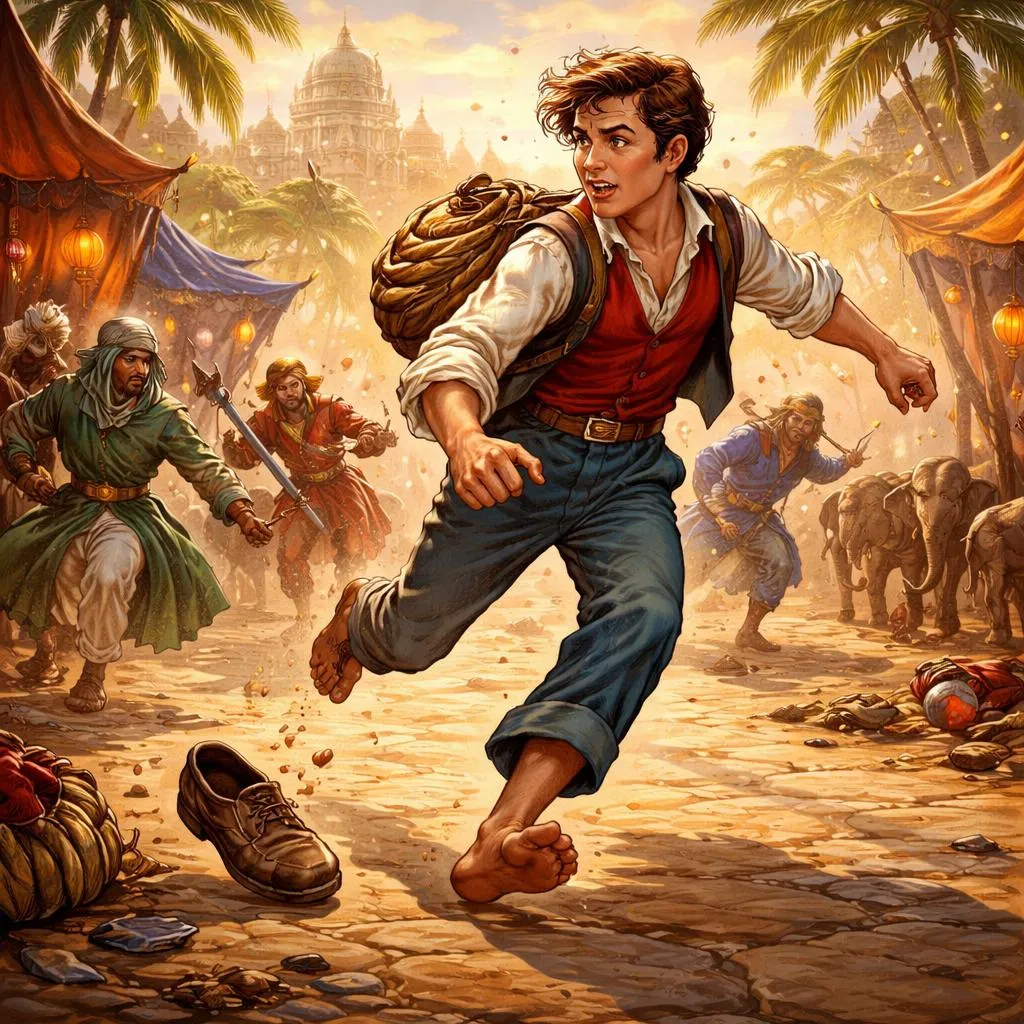
Passepartout, however, thinking no harm, went in like a simple tourist, and was soon lost in admiration of the splendid Brahmin ornamentation which everywhere met his eyes, when of a sudden he found himself sprawling on the sacred flagging. He looked up to behold three enraged priests, who forthwith fell upon him; tore off his shoes, and began to beat him with loud, savage exclamations. The agile Frenchman was soon upon his feet again, and lost no time in knocking down two of his long–gowned adversaries with his fists and a vigorous application of his toes; then, rushing out of the pagoda as fast as his legs could carry him, he soon escaped the third priest by mingling with the crowd in the streets.
At five minutes before eight, Passepartout, hatless, shoeless, and having in the squabble lost his package of shirts and shoes, rushed breathlessly into the station.
Fix, who had followed Mr. Fogg to the station, and saw that he was really going to leave Bombay, was there, upon the platform. He had resolved to follow the supposed robber to Calcutta, and farther, if necessary. Passepartout did not observe the detective, who stood in an obscure corner; but Fix heard him relate his adventures in a few words to Mr. Fogg.
"I hope that this will not happen again," said Phileas Fogg coldly, as he got into the train. Poor Passepartout, quite crestfallen, followed his master without a word. Fix was on the point of entering another carriage, when an idea struck him which induced him to alter his plan.
"No, I'll stay," muttered he. "An offence has been committed on Indian soil. I've got my man."
Just then the locomotive gave a sharp screech, and the train passed out into the darkness of the night.
خلفية ومقدمة عن المؤلف
هذه الفقرة مأخوذة من رواية المغامرات الكلاسيكية حول العالم في ثمانين يومًا لجول فيرن، وهو مؤلف فرنسي مشهور بأعماله الخيالية والرائدة في الخيال العلمي والأدب المغامر. كُتبت الرواية عام 1873، وتجسد روح القرن التاسع عشر بشغفها بالاستكشاف والتكنولوجيا والعالم المتضائل بسبب التطورات في النقل. لقد جعلت أوصاف فيرن الحية وقصته المثيرة هذه القصة مفضلة خالدة للقراء من جميع الأعمار.
التفسير التفصيلي وأهمية القصة
يصف المقتطف رحلة فيلياس فوج وخادمه باسبارتو أثناء سفرهما عبر الهند البريطانية، مع إبراز التنوع الثقافي والسياق الاستعماري والتحديث السريع للعصر، مثل إدخال السكك الحديدية والمراكب البخارية. لا تعرض الرواية الرحلة المادية فحسب، بل تعرض أيضًا صراع الثقافات واندماجها، وتعقيدات الحكم الاستعماري، والتحديات التي يواجهها المسافرون في الأراضي الأجنبية.
تجسد شخصية فيلياس فوج الدقة والتصميم والهدوء تحت الضغط، بينما يوفر باسبارتو منظورًا إنسانيًا، غالبًا ما يكون فكاهيًا، ويتفاعل مع العادات والبيئات غير المألوفة. تقدم القصة أيضًا المحقق فيكس، الذي يشتبه في أن فوج ارتكب جريمة، مما يضيف التشويق والإثارة.
الدروس والأفكار للطلاب والقراء الشباب
- الفضول والانفتاح: إن افتتان باسبارتو بمهرجان بارسي والثقافة الهندية يشجع القراء على تقدير واحترام التنوع الثقافي. إنه يعلم قيمة الفضول المتوازن مع الحساسية للعادات والتقاليد المحلية.
- المثابرة وإدارة الوقت: يعكس التزام فوج بالمواعيد والتقدم المطرد أهمية الانضباط والتخطيط الدقيق في تحقيق الأهداف. يمكن لهذا أن يلهم الطلاب لإدارة وقتهم بفعالية في الدراسات والمساعي الشخصية.
- القدرة على التكيف: تُظهر الرحلة عبر مختلف البلدان والثقافات الحاجة إلى التكيف مع البيئات والمواقف الجديدة، وهي مهارة حيوية في عالم اليوم المعولم.
- العدالة والأخلاق: يثير الخط الفرعي الذي يتضمن المحقق فيكس أسئلة حول العدالة والشك والحقيقة، مما يشجع على التفكير النقدي حول الإنصاف وعواقب الافتراضات.
التطبيق في الحياة اليومية والتعلم والتفاعل الاجتماعي
- في التعلم: يمكن للطلاب محاكاة نهج فوج المنهجي في مواجهة التحديات، وتقسيم المهام والحفاظ على التركيز على الرغم من المشتتات أو النكسات.
- في الأوساط الاجتماعية: تذكرنا تجارب باسبارتو بأن نكون محترمين ومراقبين عند مواجهة ثقافات أو آراء مختلفة، وتعزيز التعاطف والوئام الاجتماعي.
- في النمو الشخصي: تشجع القصة على تبني تجارب جديدة بشجاعة وتواضع، والتعلم من الأخطاء، والثبات في قيم المرء مثل فوج.
تنمية الصفات الإيجابية من القصة
- الانضباط: تدرب على الالتزام بالمواعيد وحدد أهدافًا واضحة لبناء الموثوقية.
- الفضول: استكشف موضوعات وثقافات جديدة بقلب منفتح، ولكن اسعَ أيضًا إلى فهم واحترام الحدود.
- الشجاعة: واجه التحديات بشجاعة، كما يفعل باسبارتو عند الهروب من الكهنة، مما يدل على المرونة.
- النزاهة: مثل فوج، حافظ على الأمانة والهدوء حتى تحت الشك أو الضغط.
الخاتمة
حول العالم في ثمانين يومًا هي أكثر من مجرد مغامرة مثيرة؛ إنها مصدر غني للدروس الحياتية والتقدير الثقافي. من خلال قراءة القصة والتفكير فيها، يمكن للطلاب تطوير منظور عالمي، وتحسين الانضباط الشخصي، وتنمية الصفات التي ستساعدهم على النجاح أكاديميًا واجتماعيًا. تدعو هذه القصة الكلاسيكية القراء الشباب إلى الحلم الكبير، والاستكشاف على نطاق واسع، والتصرف بحكمة.
