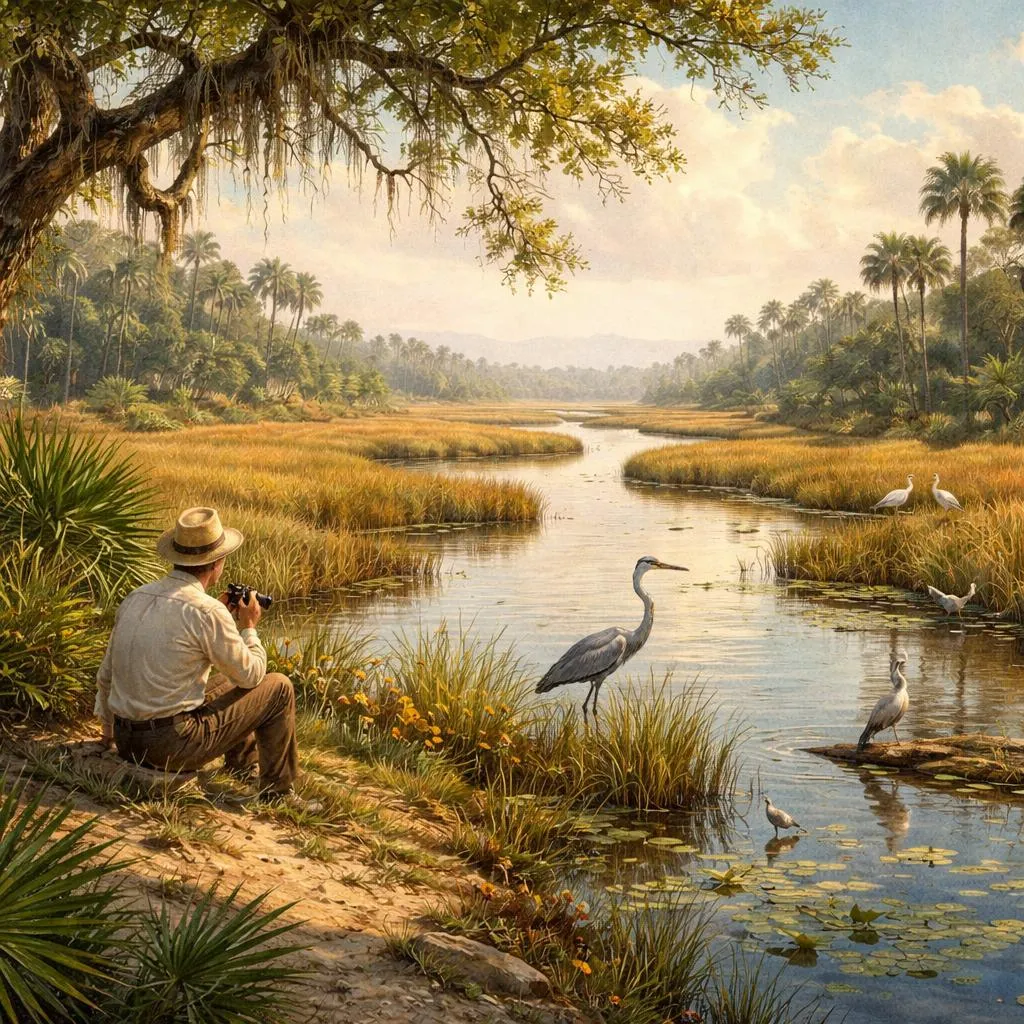

I am sitting upon the upland bank of a narrow winding creek. Before me is a sea of grass, brown and green of many shades. To the north themarsh is bounded by live-oak woods,—a line with numberlessindentations,—beyond which runs the Matanzas River, as I know by thepassing and repassing of sails behind the trees. Eastward aresand-hills, dazzling white in the sun, with a ragged green fringe alongtheir tops. Then comes a stretch of the open sea, and then, more to thesouth, St. Anastasia Island, with its tall black-and-white lighthouseand the cluster of lower buildings at its base. Small sailboats, and nowand then a tiny steamer, pass up and down the river to and from St.Augustine.
A delicious south wind is blowing (it is the 15th of February), and Isit in the shade of a cedar-tree and enjoy the air and the scene. Acontrast, this, to the frozen world I was living in, less than a weekago.
As I approached the creek, a single spotted sandpiper was teeteringalong the edge of the water, and the next moment a big blue heron rosejust beyond him and went flapping away to the middle of the marsh. Now,an hour afterward, he is still standing there, towering above the tallgrass. Once when I turned that way I saw, as I thought, a stake, andthen something moved upon it,—a bird of some kind. And what an enormousbeak! I raised my field-glass. It was the heron. His body was the post,and his head was the bird. Meanwhile, the sandpiper has stolen away, Iknow not when or where. He must have omitted the “tweet, tweet,” withwhich ordinarily he signalizes his flight. He is the first of his kindthat I have seen during my brief stay in these parts.
Now a multitude of crows pass over; fish crows, I think they must be,from their small size and their strange, ridiculous voices. And now asecond great blue heron comes in sight, and keeps on over the marsh andover the live-oak wood, on his way to the San Sebastian marshes, or somepoint still more remote. A fine show he makes, with his wide expanse ofwing, and his feet drawn up and standing out behind him. Next a marshhawk in brown plumage comes skimming over the grass. This way and thathe swerves in ever graceful lines. For one to whom ease and grace comeby nature, even the chase of meadow mice is an act of beauty, whileanother goes awkwardly though in pursuit of a goddess.
Several times I have noticed a kingfisher hovering above the grass (soit looks, but no doubt he is over an arm of the creek), striking the airwith quick strokes, and keeping his head pointed downward, after themanner of a tern. Then he disappeared while I was looking at somethingelse. Now I remark him sitting motionless upon the top of a post in themidst of the marsh.
A third blue heron appears, and he too flies over without stopping.Number One still keeps his place; through the glass I can see himdressing his feathers with his clumsy beak. The lively strain of awhite-eyed vireo, pertest of songsters, comes to me from somewhere on myright, and the soft chipping of myrtle warblers is all but incessant. Ilook up from my paper to see a turkey buzzard sailing majesticallynorthward. I watch him till he fades in the distance. Not once does heflap his wings, but sails and sails, going with the wind, yet turningagain and again to rise against it,—helping himself thus to itsadverse, uplifting pressure in the place of wing-strokes, perhaps,—andpassing onward all the while in beautiful circles. He, too, scavengerthough he is, has a genius for being graceful. One might almost bewilling to be a buzzard, to fly like that!
The kingfisher and the heron are still at their posts. An exquisiteyellow butterfly, of a sort strange to my Yankee eyes, flits past,followed by a red admiral. The marsh hawk is on the wing again, andwhile looking at him I descry a second hawk, too far away to be madeout. Now the air behind me is dark with crows,—a hundred or two, atleast, circling over the low cedars. Some motive they have for all theirclamor, but it passes my owlish wisdom to guess what it can be. A fourthblue heron appears, and drops into the grass out of sight.
Between my feet is a single blossom of the yellow oxalis, the onlyflower to be seen; and very pretty it is, each petal with an orange spotat the base.
Another buzzard, another marsh hawk, another yellow butterfly, and thena smaller one, darker, almost orange. It passes too quickly over thecreek and away. The marsh hawk comes nearer, and I see the strong yellowtinge of his plumage, especially underneath. He will grow handsomer ashe grows older. A pity the same could not be true of men. Behind me aresharp cries of titlarks. From the direction of the river come frequentreports of guns. Somebody is doing his best to be happy! All at once Iprick up my ears. From the grass just across the creek rises the brief,hurried song of a long-billed marsh wren. So he is in Florida, is he?Already I have heard confused noises which I feel sure are the work ofrails of some kind. No doubt there is abundant life concealed in thoseacres on acres of close grass.
The heron and the kingfisher are still quiet. Their morning hunt wassuccessful, and for to-day Fate cannot harm them. A buzzard, withnervous, rustling beats, goes directly above the low cedar under which Iam resting.
At last, after a siesta of two hours, the heron has changed his place. Ilooked up just in season to see him sweeping over the grass, into whichhe dropped the next instant. The tide is falling. The distant sand-hillsare winking in the heat, but the breeze is deliciously cool, the veryperfection of temperature, if a man is to sit still in the shade. It iseleven o’clock. I have a mile to go in the hot sun, and turn away. Butfirst I sweep the line once more with my glass. Yonder to the south aretwo more blue herons standing in the grass. Perhaps there are morestill. I sweep the line. Yes, far, far away I can see four heads in arow. Heads and necks rise above the grass. But so far away! Are theybirds, or only posts made alive by my imagination? I look again. Ibelieve I was deceived. They are nothing but stakes. See how in a rowthey stand. I smile at myself. Just then one of them moves, and anotheris pulled down suddenly into the grass. I smile again. “Ten great blueherons,” I say to myself.
All this has detained me, and meantime the kingfisher has taken wing andgone noisily up the creek. The marsh hawk appears once more. Akilldeer’s sharp, rasping note—a familiar sound in St. Augustine—comesfrom I know not where. A procession of more than twenty black vulturespasses over my head. I can see their feet drawn up under them. My own Imust use in plodding homeward.
خلفية ومقدمة المؤلف
هذا السرد الطبيعي الحي هو ملاحظة تفصيلية لنظام بيئي للأراضي الرطبة، يلتقط جمال وحياة البيئة الساحلية. يظهر المؤلف، الذي لم يتم تحديد هويته هنا، عينًا ثاقبة للتفاصيل وتقديرًا عميقًا للحياة البرية، وخاصة الطيور. هذا النوع من الكتابة الوصفية نموذجي لكتاب الطبيعة الذين يمزجون الملاحظة العلمية باللغة الشعرية لإحياء الطبيعة للقراء. تشجع هذه الطريقة القراء، وخاصة الطلاب والشباب، على التباطؤ وملاحظة العجائب الصغيرة للعالم الطبيعي من حولهم.
التفسير التفصيلي والأهمية
تقدم الفقرة لمحة عن يوم مشمس وسلمي في مستنقع بالقرب من سانت أوغسطين، فلوريدا. إن اهتمام المؤلف الدقيق بسلوك ومظهر الطيور - البلشون الأزرق، والزقزاق، والرفراف، والصقر المستنقعي، والنسر الرومي، وغيرهم - يدعو القراء إلى تقدير تنوع ورشاقة الحياة البرية. كما يقارن السرد المشهد الدافئ والحيوية بتجربة المؤلف الأخيرة لمشهد شتوي متجمد، مع التأكيد على تجدد وحيوية الطبيعة في المناخات الأكثر دفئًا.
القصة لا تدور فقط حول الطيور، بل حول الترابط بين الحياة والإيقاعات الهادئة للعالم الطبيعي. تكشف حركات الطيور ونداءاتها وتفاعلاتها عن نظام بيئي معقد حيث يلعب كل مخلوق دورًا. تشير تأملات المؤلف حول جمال ورشاقة حتى طيور القمامة مثل النسر إلى رسالة حول إيجاد قيمة وكرامة في جميع أشكال الحياة.
الدروس والأفكار للطلاب
-
مهارات الملاحظة: تشجع الأوصاف التفصيلية الطلاب على تطوير مهارات الملاحظة الدقيقة. يمكن أن يؤدي ملاحظة التفاصيل الصغيرة - مثل البقع البرتقالية على بتلة زهرة أو نمط طيران الصقر - إلى تعميق الفهم والتقدير للطبيعة.
-
الصبر والوعي: يقضي المؤلف ساعات في مشاهدة المستنقع بهدوء، مما يدل على الصبر والوعي. يمكن للطلاب أن يتعلموا أهمية التباطؤ والتواجد لتجربة وتعلم حقيقية من بيئتهم.
-
احترام الطبيعة: يعزز السرد احترام الحياة البرية والبيئة. يساعد فهم الأدوار التي تلعبها الحيوانات المختلفة على بناء شعور بالإشراف على العالم الطبيعي.
-
الاتصال بالمكان: يوضح ارتباط المؤلف بالمستنقع ومخلوقاته كيف يمكن للأماكن أن تحمل معنى خاصًا. يمكن تشجيع الطلاب على استكشاف بيئاتهم المحلية والتواصل معها.
التطبيقات في الحياة والتعلم والأوساط الاجتماعية
-
في التعلم: يمكن للطلاب تطبيق تقنيات الملاحظة الموضحة هنا على الدراسات العلمية، وتحسين قدرتهم على تسجيل البيانات وتفسيرها. يمكن لهذه القصة أن تلهم تدوين الملاحظات الطبيعية أو الدراسات الميدانية.
-
في الحياة الاجتماعية: يعلم احترام جميع المخلوقات، بما في ذلك تلك الأقل إعجابًا مثل النسور، التعاطف وقبول التنوع، وهي صفات قيمة في العلاقات الاجتماعية.
-
في النمو الشخصي: يمكن أن يساعد الصبر والهدوء الموضح في مساعدة الطلاب على إدارة التوتر وتطوير ممارسات اليقظة.
تنمية الصفات الإيجابية من القصة
-
الفضول والعجب: يمكن أن يؤدي تشجيع الفضول بشأن العالم الطبيعي إلى التعلم والاكتشاف مدى الحياة.
-
الصبر: تعلم الانتظار والمشاهدة بعناية هي مهارة تفيد العديد من مجالات الحياة.
-
الاحترام والتعاطف: إن رؤية القيمة في جميع المخلوقات تعزز اللطف والتفاهم تجاه الآخرين.
-
الاتصال بالطبيعة: يمكن أن يؤدي قضاء الوقت في الهواء الطلق ومراقبة الحياة البرية إلى تحسين الصحة العقلية وتعزيز المسؤولية البيئية.
الخاتمة
هذه الفقرة مثال جميل على الكتابة عن الطبيعة التي تدعو القراء الشباب إلى التباطؤ والملاحظة وتقدير العالم الحي من حولهم. إنها تعلم دروسًا قيمة حول الصبر والاحترام وجمال الحياة بجميع أشكالها. من خلال الانخراط في مثل هذه القصص، يمكن للطلاب تطوير المهارات والمواقف التي تثري تعليمهم وحياتهم الشخصية، مما يساعدهم على النمو ليصبحوا أفرادًا مفكرين ومهتمين ومتصلين بالطبيعة والمجتمع.
