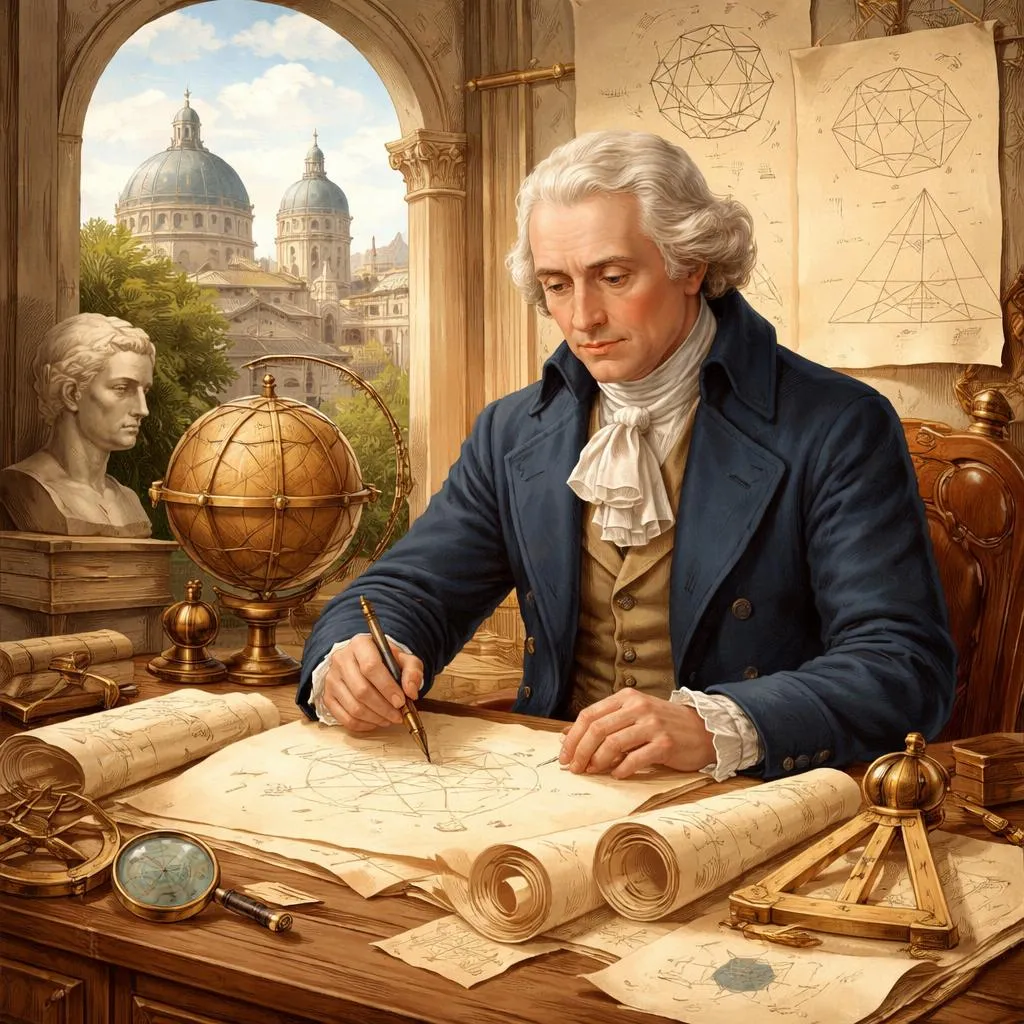

Gaspard Monge was born at Beaune on May 10, 1746, and died at Paris on July 28, 1818. He was the son of a small pedlar, and was educated in the schools of the Oratorians, in one of which he subsequently became an usher. A plan of Beaune which he had made fell into the hands of an officer who recommended the military authorities to admit him to their training school at Mézières. His birth, however, precluded his receiving a commission in the army, but his attendance at an annexe of the school where surveying and drawing were taught was tolerated, though he was told that he was not sufficiently well born to be allowed to attempt problems which required calculation. At last his opportunity came. A plan of a fortress having to be drawn from the data supplied by certain observations, he did it by a geometrical construction. At first the officer in charge refused to receive it, because etiquette required that not less than a certain time should be used in making such drawings, but the superiority of the method over that then taught was so obvious that it was accepted; and in 1768 Monge was made professor, on the understanding that the results of his descriptive geometry were to be a military secret confined to officers above a certain rank.
In 1780 he was appointed to a chair in mathematics in Paris, and this with some provincial appointments which he held gave him a comfortable income. The earliest paper of any special importance which he communicated to the French Academy was one in 1781, in which he discussed the lines of curvature drawn on a surface. These had been first considered by Euler in 1760, and defined as those normal sections whose curvature was a maximum or a minimum. Monge treated them as the locus of those points on the surface at which successive normals intersect, and thus obtained the general differential equation. He applied his results to the central quadrics in 1795. In 1786 he published his well-known work on statics.
Monge eagerly embraced the doctrines of the revolution. In 1792 he became minister of the marine, and assisted the committee of public safety in utilizing science for the defence of the republic. When the Terrorists obtained power he was denounced, and escaped the guillotine only by a hasty flight. On his return in 1794 he was made a professor at the short-lived Normal school, where he gave lectures on descriptive geometry; the notes of these were published under the regulation above alluded to. In 1796 he went to Italy on the roving commission which was sent with orders to compel the various Italian towns to offer pictures, sculpture, or other works of art that they might possess, as a present or in lieu of contributions to the French republic for removal to Paris. In 1798 he accepted a mission to Rome, and after executing it joined Napoleon in Egypt. Thence after the naval and military victories of England he escaped to France.
Monge then settled down at Paris, and was made professor at the Polytechnic school, where he gave lectures on descriptive geometry; these were published in 1800 in the form of a textbook entitled Géométrie descriptive . This work contains propositions on the form and relative position of geometrical figures deduced by the use of transversals. The theory of perspective is considered; this includes the art of representing in two dimensions geometrical objects which are of three dimensions, a problem which Monge usually solved by the aid of two diagrams, one being the plan and the other the elevation. Monge also discussed the question as to whether, if in solving a problem certain subsidiary quantities introduced to facilitate the solution become imaginary, the validity of the solution is thereby impaired, and he shewed that the result would not be affected. On the restoration he was deprived of his offices and honours, a degradation which preyed on his mind and which he did not long survive.
Most of his miscellaneous papers are embodied in his works, Application de l'algèbre à la géométrie , published in 1805, and Application de l'analyse à la géométrie , the fourth edition of which, published in 1819, was revised by him just before his death. It contains among other results his solution of a partial differential equation of the second order.
خلفية ومقدمة المؤلف
كان غاسبار مونج عالم رياضيات وعالم فرنسي بارز ولد عام 1746 في مدينة بون بفرنسا. انطلاقًا من خلفية متواضعة كونه ابن بائع متجول صغير، فإن قصة حياة مونج هي قصة عزم وذكاء فائق يتغلب على الحواجز الاجتماعية. على الرغم من العقبات المبكرة بسبب وضعه عند الولادة، فقد تابع تعليمه بشغف وتميز بسرعة في مجالات الهندسة والرياضيات. وضع عمله الأساس للهندسة الوصفية، وهي فرع من الرياضيات يساعدنا على تمثيل الأجسام ثلاثية الأبعاد في بعدين - وهي مهارة حاسمة في الهندسة والعمارة والفن.
عاش مونج فترة مضطربة في التاريخ الفرنسي، بما في ذلك الثورة الفرنسية. لم يكن عالمًا فحسب، بل كان أيضًا موظفًا عامًا استخدم معرفته لدعم الحكومة الثورية. تضمنت مسيرته المهنية أدوارًا كأستاذ ووزير ومستشار علمي لنابليون. كانت مساهماته في الرياضيات والعلوم متشابكة بعمق مع التغيرات الاجتماعية والسياسية في عصره.
التفسير المفصل والأهمية
قصة غاسبار مونج ليست حكاية خيالية بل رواية واقعية للمثابرة والابتكار وقوة التعليم. كان تطويره للهندسة الوصفية بمثابة انفراجة في كيفية تصورنا وحل المشكلات المكانية. تسمح هذه الطريقة بفهم الأشكال ثلاثية الأبعاد المعقدة من خلال الرسومات ثنائية الأبعاد، وهو أمر أساسي في العديد من المجالات اليوم.
كما أن عمل مونج على خطوط الانحناء والإحصائيات والمعادلات التفاضلية قد طور الفهم الرياضي بشكل كبير. جمع نهجه بين الرؤية النظرية والتطبيق العملي، موضحًا كيف يمكن للرياضيات المجردة أن تحل مشاكل العالم الحقيقي. علاوة على ذلك، يبرز دوره خلال الثورة الفرنسية كيف يمكن للعلوم والسياسة أن تتقاطع، وأحيانًا بمخاطر شخصية كبيرة.
الدروس والأفكار للطلاب
يمكن للطلاب الذين يقرأون عن مونج أن يتعلموا عدة دروس قيمة:
-
التغلب على العقبات: تعلمنا حياة مونج المبكرة أن الخلفية أو الوضع الاجتماعي لا يحدد إمكانات الفرد. مع التفاني والعمل الجاد، يمكن لأي شخص تحقيق العظمة.
-
أهمية التعليم: بُني نجاح مونج على معرفته العميقة وتعلمه المستمر. وهذا يشجع الطلاب على تقدير تعليمهم والسعي إلى فهم الموضوعات بعمق.
-
الابتكار والإبداع: تُظهر أساليب مونج الجديدة في الهندسة كيف يمكن للتفكير الإبداعي أن يؤدي إلى انفراجات. يجب تشجيع الطلاب على التفكير خارج الصندوق والتعامل مع المشكلات من زوايا جديدة.
-
العلوم والمجتمع: يذكرنا انخراط مونج في السياسة بأن العلم ليس منفصلاً عن العالم. يمكن استخدام المعرفة لخدمة المجتمع والمساهمة في القضايا الهامة.
التطبيقات العملية في الحياة اليومية
-
في التعلم: يمكن للهندسة الوصفية لمونج أن تلهم الطلاب على تحسين مهاراتهم في التفكير المكاني، وهي مفيدة في مواد مثل الرياضيات والفيزياء والفن.
-
في حل المشكلات: يشجع مثال مونج الطلاب على التحلي بالصبر والمثابرة عند مواجهة المشكلات الصعبة، مع العلم أن الحلول المبتكرة غالبًا ما تتطلب الوقت والجهد.
-
في التفاعل الاجتماعي: يمكن أن يلهم فهم شجاعة مونج في مواجهة الخطر السياسي الطلاب على الدفاع عن معتقداتهم والمساهمة بشكل إيجابي في مجتمعاتهم.
تنمية الصفات الإيجابية
لتجسيد روح مونج، يمكن للطلاب:
-
تنمية الفضول وحب التعلم، واستكشاف الموضوعات خارج الفصل الدراسي.
-
ممارسة المرونة من خلال النظر إلى الإخفاقات على أنها فرص للتعلم.
-
احتضان الإبداع من خلال تجربة أفكار وأساليب جديدة.
-
إدراك قيمة المساهمة في المجتمع، سواء من خلال العلوم أو الفن أو العمل الاجتماعي.
الخلاصة
تقدم حياة وعمل غاسبار مونج مصدر إلهام غني للطلاب الصغار. تُظهر رحلته من خلفية متواضعة إلى أن يصبح رائدًا في الرياضيات وشخصية رئيسية في التاريخ قوة التعليم والابتكار والشجاعة. من خلال دراسة قصته، يمكن للطلاب الحصول ليس فقط على المعرفة ولكن أيضًا على الدافع لتحقيق أهدافهم الخاصة بعزم ونزاهة.
