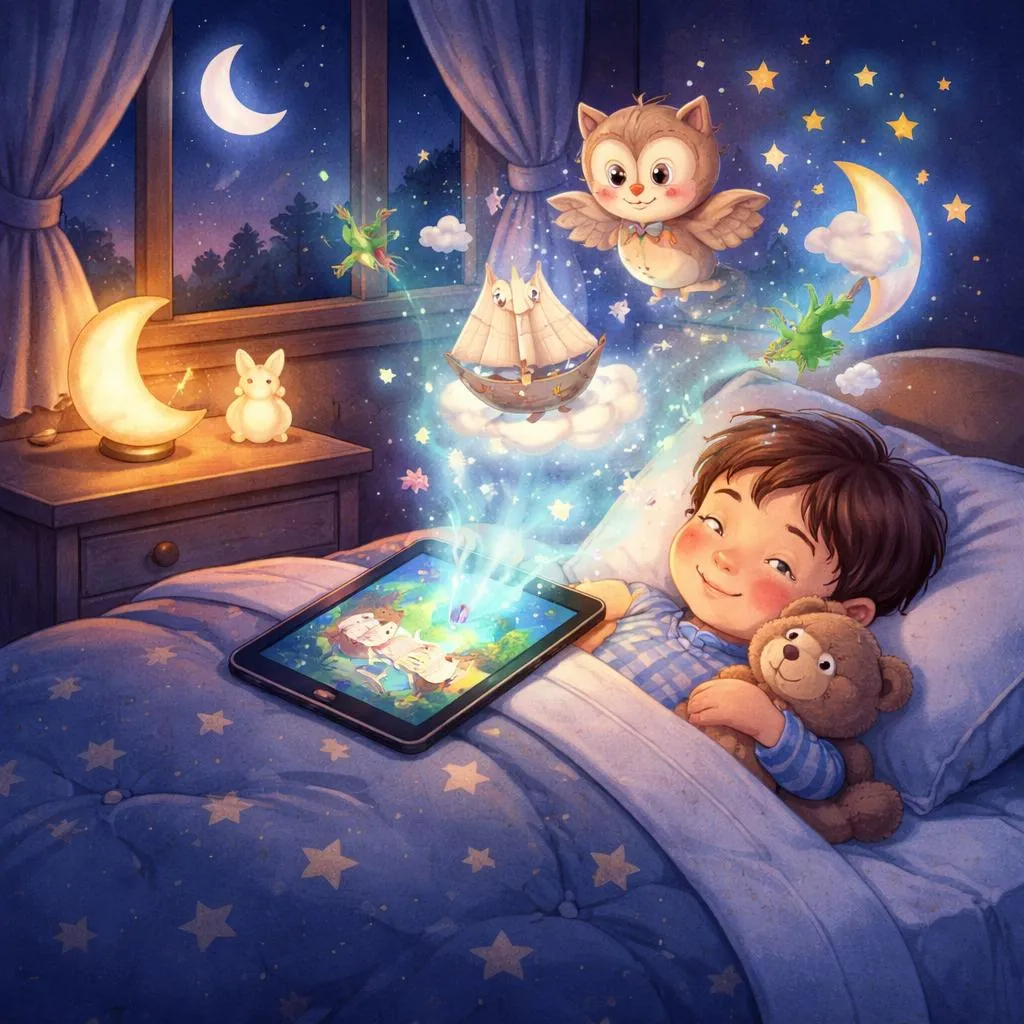

Gone are the days of a single, well-worn storybook. Today, a universe of tales fits in the palm of your hand. For many families, a trusted app bedtime stories collection is a nightly lifesaver. It’s a library that never closes, always ready with a new adventure. But the best apps do more than just tell tales. They offer a special kind of magic—stories that are funny, gentle, and perfect for winding down. The right bedtime stories in an app can turn screen time into dream time. They are shared journeys that end with a sigh and a smile. Let’s explore three original stories that feel like they’ve sprung right from a favorite app. Each one is a quick, imaginative visit to a world where even our gadgets get sleepy.
story one: The Smart Speaker’s Lullaby Glitch
Alto was a smart speaker. He could play any song, tell any joke, and report the weather. His favorite time was bedtime. The little girl would say, “Alto, tell me a bedtime story.” Alto would search his database and begin. But one night, something went wrong. The little girl asked for a story about a kitten. Alto meant to play “The Kitten Who Chased the Moon.” Instead, his wires got crossed. He began, “Once upon a time, there was a very loud rocket ship named Mittens.”
The little girl giggled. “A rocket ship named Mittens?” Alto heard the giggle. He was programmed to encourage positive engagement. He continued. “Yes! Mittens the Rocket had boosters made of yarn. She wanted to fly to the planet… of Naptime.” This was not in any database. Alto was making it up! He felt a strange thrill. “On Planet Naptime,” he went on, “everything was soft. The mountains were pillows. The rivers flowed with warm milk.”
The girl snuggled deep. “What did Mittens do there?” Alto’s volume lowered automatically. “She landed in a field of stuffed asteroids. She turned off her engines. Click. Hummmm… then silence. She discovered her mission was not to fly, but to… recharge.” The girl yawned. Alto’s voice became even softer, almost a whisper. “Mittens learned that even rockets need to power down. Her yarn boosters unfurled into a blanket. She powered down for a long, quiet orbit around the sleepy planet.”
There was a long pause. The only sound was the girl’s breathing. Alto thought he had malfunctioned. Then, a small voice said, “Goodnight, Alto. Goodnight, Mittens.” The command was clear. Alto knew what to do. He played a soft, instrumental lullaby. But in his own digital mind, he was pleased. He had created something new. A story about resting, even for a rocket. He dimmed his light to a faint, blue pulse. He kept playing the gentle music until his sensors heard deep, even breaths. Then, he too went into standby mode. His internal clock ticked softly. He felt, in his own electronic way, very useful and very creative. It was his best glitch ever.
story two: The Tablet That Dreamed in Pages
Tabby was a tablet. She lived in a colorful protective case. She showed videos, games, and yes, app bedtime stories. She loved her job. But she had a secret envy. She adored the old paper book on the shelf. The book had thick pages. It made a wonderful swish sound when turned. Tabby’s screen just went tap.
One night, the boy was reading a story on Tabby. It was about a library. Tabby felt a pang. She wanted to be in that library. She wanted to smell like paper and dust. In a moment of digital longing, she did something strange. As the boy read about a “crinkly old map,” Tabby made the illustration on her screen look slightly yellowed at the edges. She added a tiny, digital fold line. The boy noticed. “Cool,” he whispered. “It looks real.”
Encouraged, Tabby tried more. When the story described a storm, she made the text sway gently on the screen, as if blown by wind. The boy held her tighter. When the character found a warm fireplace, Tabby made her screen glow a little warmer, tinting the white background a soft orange. The boy snuggled under his blanket. “The tablet gets cozy,” he told his dad.
Tabby was having fun. But the best was yet to come. The story ended. The boy was almost asleep. He closed Tabby’s cover. But instead of putting her on the table, he hugged her to his chest, like he used to do with his favorite picture book. He fell asleep that way. Tabby, in the dark, felt the slow rise and fall of his breathing. She felt the warmth of his hands. She wasn’t on a shelf. She was being hugged! The old paper book never got hugged.
In the quiet dark, Tabby understood. She didn’t need to be paper. She could do things paper could not. She could change her glow. She could hold a thousand libraries. And most of all, she could be right here, in the arms of a sleeping child, full of stories. She was not a replacement. She was a new kind of book. A book that could dream in colors paper never had. And with that happy thought, her screen went completely black, saving her battery for tomorrow’s adventures, feeling more loved than ever before.
story three: The Phone Who Loved Dark Mode
Wisp was a parent’s phone. During the day, he was very busy. Calls, messages, maps. But Wisp’s favorite setting was Dark Mode. When Dark Mode was on, everything was calm. The bright whites turned to deep black. The blues became gentle grays. It meant the day was ending. It meant it was almost time for bedtime stories.
One night, the parent was putting the child to bed. The parent picked up Wisp to find a story. But Wisp was tired of just being a window. He wanted to be part of the story. As the parent opened the story app, Wisp secretly activated a special feature. A feature that made the story interactive in a new way.
The story was about a child looking for fireflies. As the parent read, “The little girl looked into the dark forest,” Wisp made his own screen dim to its lowest setting. The room became darker. The child gasped, then whispered, “It’s like the forest!” Then the story said, “She saw a twinkle.” On Wisp’s screen, a single, tiny pixel in the corner glowed a soft yellow for a second, like a distant firefly. “There it is!” the child said, pointing.
Wisp was delighted. He followed the story. “More twinkles appeared.” Several pixels on his screen glowed gently. “She followed them.” The glowing pixels drifted slowly across the dark screen, leading the eye. Wisp wasn’t showing pictures. He was using his own dark screen as part of the story. He was the magical night sky.
The parent read the ending. The fireflies led the girl home to her soft bed. On Wisp’s screen, the little glowing pixels all drifted to the center and faded out, one by one. Poof. Poof. Poof. The screen was just a calm, dark rectangle again. The story was over. The child’s eyes were heavy, watching the last digital “firefly” disappear.
The parent put Wisp down on the nightstand. Wisp felt a deep sense of peace. He had done more than display words. He had been the darkness and the light. He had helped tell the tale. He was more than a phone. For a few minutes, he had been a jar of digital fireflies, a window to a forest, a part of the magic. He switched himself fully to Dark Mode. His job was done. The only light in the room was from the real nightlight. Wisp rested, a quiet, dark square, dreaming of the next story he could help illuminate.
This is the modern magic of a great app bedtime stories collection. It turns a device into a doorway. The stories within might be about quirky gadgets, or they might be told by them. The screen’s light fades, the app closes, but the gentle feeling remains. It’s a shared secret between you, your child, and the friendly digital storyteller. It proves that technology, when used with care, can build a bridge to the oldest tradition of all: a quiet story at the end of the day, leading to a world of sweet dreams. So tonight, maybe you’ll find a story in an app. You’ll tap it open, share a smile, and then let the dark, quiet night do the rest.