
Are Similar Words Really Interchangeable?
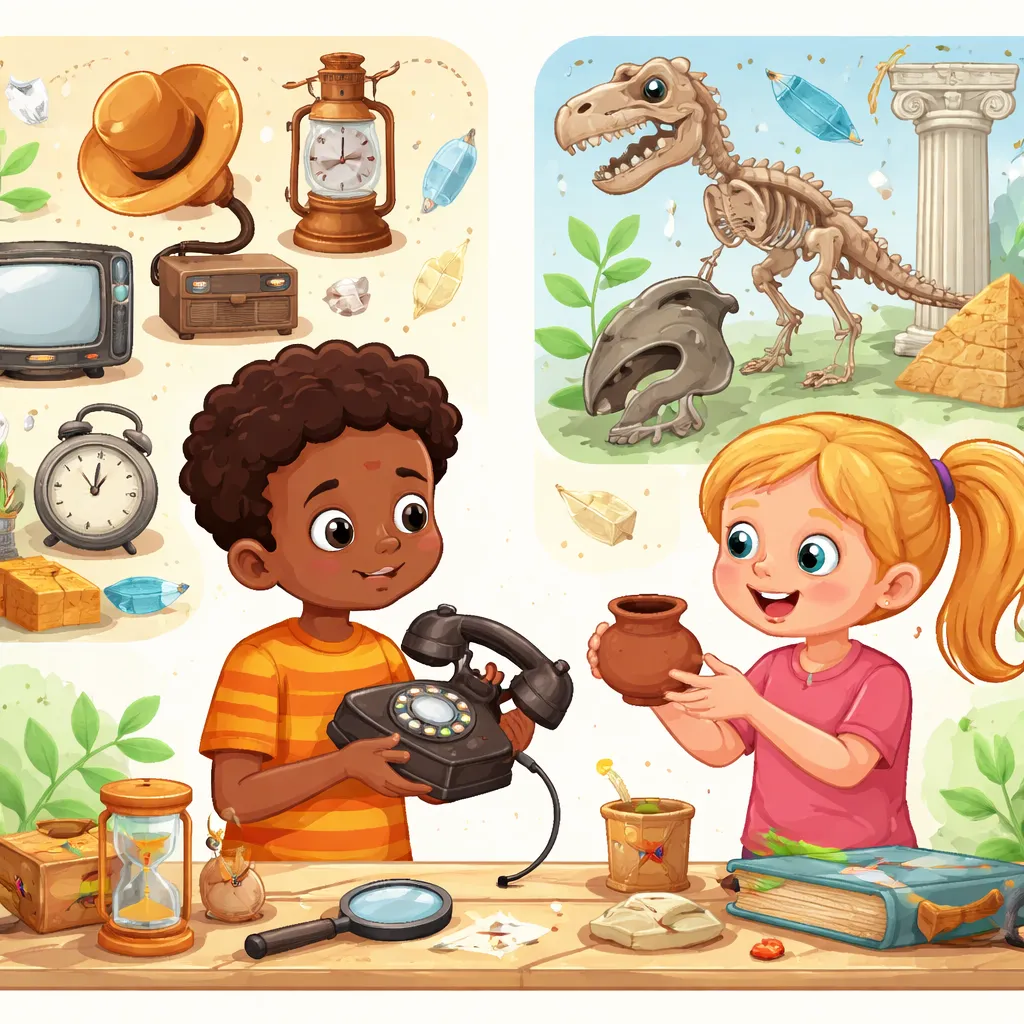
Words with similar meanings often confuse young learners. “Old and ancient” is a strong example. Both words relate to time. Both describe things from the past. Yet they do not always mean the same thing.
Children often learn “old” first. It is simple and appears in daily life. Later, they meet “ancient” in books or stories. At that moment, they may think both words are equal.
This idea can lead to small mistakes. For example, a child may say “an ancient toy” when they only mean “an old toy.” The sentence sounds unusual.
Learning the difference helps children describe time more clearly. It also helps them understand history and storytelling better. Parents can guide children gently through examples and comparisons.
Set 1: Old vs Ancient — Which One Is More Common?
“Old” is very common. Children hear it every day. It describes people, animals, objects, and places. It fits almost any situation.
For example, “an old chair” or “an old dog” sounds natural. The word simply means something is not new. It does not always suggest a very long time.
“Ancient” is less common. It appears more in books, history lessons, or documentaries. It describes things from a very long time ago.
For example, “ancient ruins” or “ancient civilizations” refers to times far in the past. Children do not use it as often in daily speech.
Because “old” is more frequent, children learn it quickly. “Ancient” comes later and adds deeper meaning to their vocabulary.
Set 2: Old vs Ancient — Same Meaning, Different Contexts
Both words describe age, but they appear in different contexts. “Old” works in everyday situations. It can describe something that is a few years old or many years old.
For example, “an old bike” may be only five years old. The word is flexible. It depends on context.
“Ancient” describes something from a distant past. It often connects to history, culture, or early human life.
For example, “ancient Egypt” or “ancient tools” suggests thousands of years ago. The time difference is much greater.
Children can learn that “old” is general, while “ancient” is specific. “Ancient” often appears when talking about history or important past events.
Set 3: Old vs Ancient — Which Word Is “Bigger” or More Emphatic?
“Old” is a neutral word. It simply tells us something has existed for some time. The strength of the meaning depends on context.
For example, “an old house” may be 20 years old or 200 years old. The word does not show strong emphasis.
“Ancient” is much stronger. It suggests extreme age. It often creates a sense of wonder or importance.
For example, “an ancient temple” feels powerful and meaningful. It tells us the object comes from a distant past.
In this way, “ancient” is more emphatic. It adds emotion and depth. Children can use it to describe history in a more vivid way.
Set 4: Old vs Ancient — Concrete vs Abstract
“Old” often describes concrete things. Children can see and touch them. For example, an old toy, an old book, or an old building.
This makes the word easy to understand. It connects directly to daily life. Children quickly learn how to use it.
“Ancient” can also describe real objects, but it often carries abstract ideas. It connects to history, culture, and time.
For example, “ancient traditions” or “ancient knowledge” are not physical objects. They represent ideas from the past.
Because of this, “ancient” requires deeper thinking. Children need examples and stories to understand it fully.
Set 5: Old vs Ancient — Verb or Noun? First Understand the Role
Both “old” and “ancient” are adjectives. They describe nouns. They do not act as verbs in normal use.
“Old” is very flexible. It can appear in many sentence forms. For example, “This book is old” or “an old car.”
“Ancient” usually appears before a noun. For example, “ancient history” or “ancient ruins.” It is less common in short sentences like “This is ancient.”
This difference affects sentence building. Children can use “old” easily in simple sentences. “Ancient” often appears in more descriptive phrases.
Understanding this helps children create clearer sentences.
Set 6: Old vs Ancient — American English vs British English
Both words appear in American and British English. Their meanings remain the same across regions.
“Old” is universal. It is used in daily conversation everywhere. Children will hear it in all English-speaking environments.
“Ancient” also keeps the same meaning. However, it appears more in formal contexts such as history lessons or documentaries.
In both American and British English, “ancient” often connects to historical topics. This consistency helps learners feel confident.
Learning that meanings stay stable across regions builds trust in language patterns.
Set 7: Old vs Ancient — Which Fits Formal Situations?
“Old” works well in casual speech. It is simple and clear. However, in formal writing, it may sound too general.
For example, “old buildings” is correct but not very detailed. It does not tell the reader how old the buildings are.
“Ancient” fits formal and academic contexts better. It adds precision and depth. For example, “ancient structures” suggests historical importance.
In formal situations, word choice matters. “Ancient” helps create a more thoughtful tone. It shows a deeper understanding of time and history.
Children can learn that choosing the right word improves communication.
Set 8: Old vs Ancient — Which One Is Easier for Kids to Remember?
“Old” is easy for children to remember. It is short and used often. They hear it in daily conversations from an early age.
They also connect it to real experiences. For example, an old toy or an old book creates clear meaning.
“Ancient” is longer and less familiar. It may take more time to learn. Children need repeated exposure and examples.
Stories help a lot. When children hear about ancient kings or ancient cities, they begin to understand the word.
With time and practice, children can remember both words and use them correctly.
Mini Exercise: Can You Spot the Differences Between These Similar Words?
Try these simple activities to build understanding.
Choose the correct word: “This is an ______ castle from thousands of years ago.” (old / ancient) Fill in the blank: “My bicycle is ______, but I still use it.” (old / ancient) Choose the better sentence: a) This is an ancient toy I bought last year. b) This is an old toy I bought last year. Match the words: Old → ______ (not new) Ancient → ______ (very long time ago) Think and answer: Can something be old but not ancient? Give an example.
These exercises help children notice meaning differences. They also build confidence in using new vocabulary.
Parent Tips: How to Help Kids Learn and Remember Similar Words
Parents can support learning in simple and effective ways. Daily exposure makes a big difference.
Use both words in conversation. Talk about an old object at home and an ancient object from history. This shows clear contrast.
Read stories together. Many children’s books include ancient settings. Pause and discuss the meaning of the word.
Encourage observation. Ask children to describe objects around them. Is it old or ancient? Why?
Use visuals and comparisons. Show pictures of modern items and ancient artifacts. Let children describe what they see.
Create small discussions. Ask questions like, “Is a 10-year-old car ancient?” This helps children think critically.
Keep the learning process calm and positive. Children learn best when they feel relaxed and curious. Over time, they build a rich vocabulary and a deeper understanding of language.