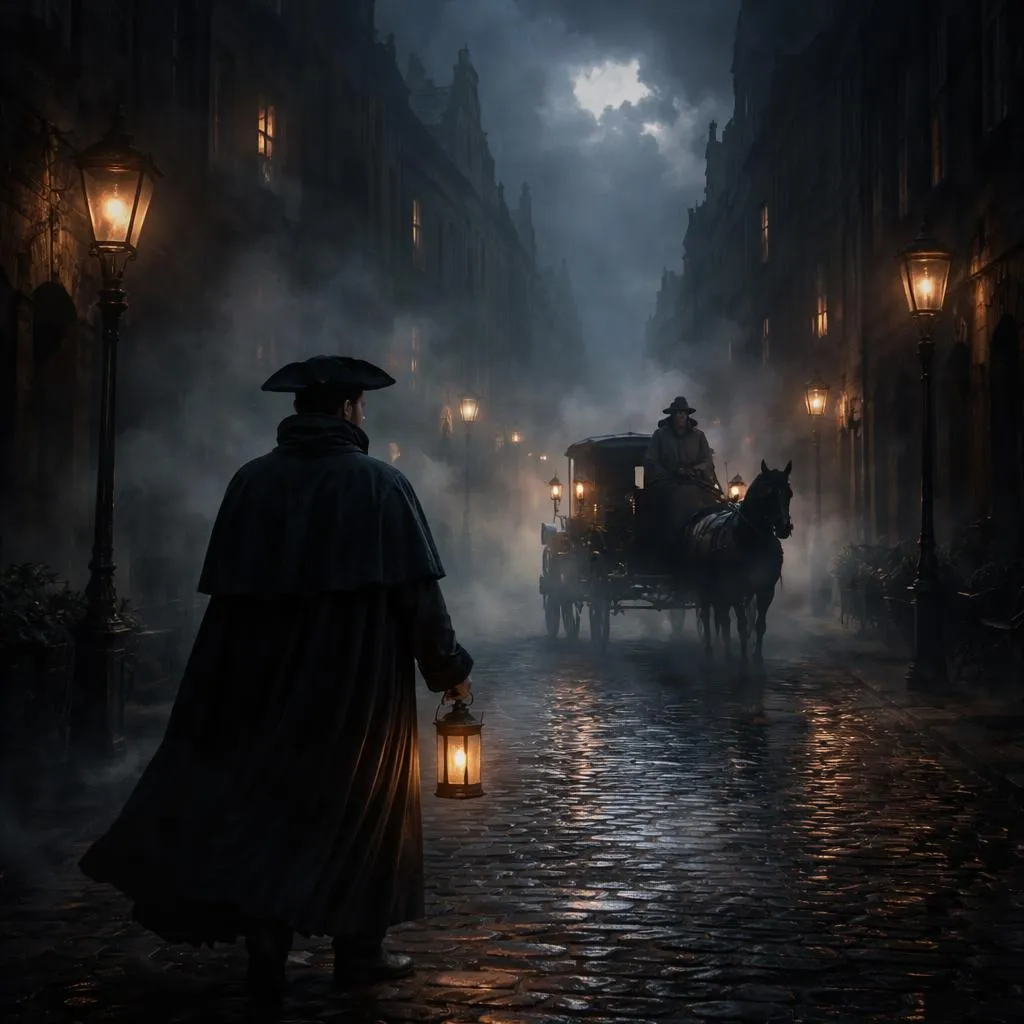

A Wonderful fact to reflect upon, that every human creature is constituted to be that profound secret and mystery to every other. A solemn consideration, when I enter a great city by night, that every one of those darkly clustered houses encloses its own secret; that every room in every one of them encloses its own secret; that every beating heart in the hundreds of thousands of breasts there, is, in some of its imaginings, a secret to the heart nearest it! Something of the awfulness, even of Death itself, is referable to this. No more can I turn the leaves of this dear book that I loved, and vainly hope in time to read it all. No more can I look into the depths of this unfathomable water, wherein, as momentary lights glanced into it, I have had glimpses of buried treasure and other things submerged. It was appointed that the book should shut with a a spring, for ever and for ever, when I had read but a page. It was appointed that the water should be locked in an eternal frost, when the light was playing on its surface, and I stood in ignorance on the shore. My friend is dead, my neighbour is dead, my love, the darling of my soul, is dead; it is the inexorable consolidation and perpetuation of the secret that was always in that individuality, and which I shall carry in mine to my life’s end. In any of the burial-places of this city through which I pass, is there a sleeper more inscrutable than its busy inhabitants are, in their innermost personality, to me, or than I am to them?
As to this, his natural and not to be alienated inheritance, the messenger on horseback had exactly the same possessions as the King, the first Minister of State, or the richest merchant in London. So with the three passengers shut up in the narrow compass of one lumbering old mail coach; they were mysteries to one another, as complete as if each had been in his own coach and six, or his own coach and sixty, with the breadth of a county between him and the next.
The messenger rode back at an easy trot, stopping pretty often at ale-houses by the way to drink, but evincing a tendency to keep his own counsel, and to keep his hat cocked over his eyes. He had eyes that assorted very well with that decoration, being of a surface black, with no depth in the colour or form, and much too near together—as if they were afraid of being found out in something, singly, if they kept too far apart. They had a sinister expression, under an old cocked-hat like a three-cornered spittoon, and over a great muffler for the chin and throat, which descended nearly to the wearer’s knees. When he stopped for drink, he moved this muffler with his left hand, only while he poured his liquor in with his right; as soon as that was done, he muffled again.
“No, Jerry, no!” said the messenger, harping on one theme as he rode. “It wouldn’t do for you, Jerry. Jerry, you honest tradesman, it wouldn’t suit YOUR line of business! Recalled—! Bust me if I don’t think he’d been a drinking!”
His message perplexed his mind to that degree that he was fain, several times, to take off his hat to scratch his head. Except on the crown, which was raggedly bald, he had stiff, black hair, standing jaggedly all over it, and growing down hill almost to his broad, blunt nose. It was so like Smith’s work, so much more like the top of a strongly spiked wall than a head of hair, that the best of players at leap-frog might have declined him, as the most dangerous man in the world to go over.
While he trotted back with the message he was to deliver to the night watchman in his box at the door of Tellson’s Bank, by Temple Bar, who was to deliver it to greater authorities within, the shadows of the night took such shapes to him as arose out of the message, and took such shapes to the mare as arose out of HER private topics of uneasiness. They seemed to be numerous, for she shied at every shadow on the road.
What time, the mail-coach lumbered, jolted, rattled, and bumped upon its tedious way, with its three fellow-inscrutables inside. To whom, likewise, the shadows of the night revealed themselves, in the forms their dozing eyes and wandering thoughts suggested.
Tellson’s Bank had a run upon it in the mail. As the bank passenger— with an arm drawn through the leathern strap, which did what lay in it to keep him from pounding against the next passenger, and driving him into his corner, whenever the coach got a special jolt—nodded in his place, with half-shut eyes, the little coach-windows, and the coach-lamp dimly gleaming through them, and the bulky bundle of opposite passenger, became the bank, and did a great stroke of business. The rattle of the harness was the chink of money, and more drafts were honoured in five minutes than even Tellson’s, with all its foreign and home connection, ever paid in thrice the time. Then the strong-rooms underground, at Tellson’s, with such of their valuable stores and secrets as were known to the passenger (and it was not a little that he knew about them), opened before him, and he went in among them with the great keys and the feebly-burning candle, and found them safe, and strong, and sound, and still, just as he had last seen them.
But, though the bank was almost always with him, and though the coach (in a confused way, like the presence of pain under an opiate) was always with him, there was another current of impression that never ceased to run, all through the night. He was on his way to dig some one out of a grave.
Now, which of the multitude of faces that showed themselves before him was the true face of the buried person, the shadows of the night did not indicate; but they were all the faces of a man of five-and- forty by years, and they differed principally in the passions they expressed, and in the ghastliness of their worn and wasted state. Pride, contempt, defiance, stubbornness, submission, lamentation, succeeded one another; so did varieties of sunken cheek, cadaverous colour, emaciated hands and figures. But the face was in the main one face, and every head was prematurely white. A hundred times the dozing passenger inquired of this spectre:
“Buried how long?”
The answer was always the same: “Almost eighteen years.”
“You had abandoned all hope of being dug out?”
“Long ago.”
“You know that you are recalled to life?”
“They tell me so.”
“I hope you care to live?”
“I can’t say.”
“Shall I show her to you? Will you come and see her?”
The answers to this question were various and contradictory. Sometimes the broken reply was, “Wait! It would kill me if I saw her too soon.” Sometimes, it was given in a tender rain of tears, and then it was, “Take me to her.” Sometimes it was staring and bewildered, and then it was, “I don’t know her. I don’t understand.”
After such imaginary discourse, the passenger in his fancy would dig, and dig, dig—now with a spade, now with a great key, now with his hands—to dig this wretched creature out. Got out at last, with earth hanging about his face and hair, he would suddenly fan away to dust. The passenger would then start to himself, and lower the window, to get the reality of mist and rain on his cheek.
Yet even when his eyes were opened on the mist and rain, on the moving patch of light from the lamps, and the hedge at the roadside retreating by jerks, the night shadows outside the coach would fall into the train of the night shadows within. The real Banking-house by Temple Bar, the real business of the past day, the real strong rooms, the real express sent after him, and the real message returned, would all be there. Out of the midst of them, the ghostly face would rise, and he would accost it again.
“Buried how long?”
“Almost eighteen years.”
“I hope you care to live?”
“I can’t say.”
Dig—dig—dig—until an impatient movement from one of the two passengers would admonish him to pull up the window, draw his arm securely through the leathern strap, and speculate upon the two slumbering forms, until his mind lost its hold of them, and they again slid away into the bank and the grave.
“Buried how long?”
“Almost eighteen years.”
“You had abandoned all hope of being dug out?”
“Long ago.”
The words were still in his hearing as just spoken—distinctly in his hearing as ever spoken words had been in his life—when the weary passenger started to the consciousness of daylight, and found that the shadows of the night were gone.
He lowered the window, and looked out at the rising sun. There was a ridge of ploughed land, with a plough upon it where it had been left last night when the horses were unyoked; beyond, a quiet coppice-wood, in which many leaves of burning red and golden yellow still remained upon the trees. Though the earth was cold and wet, the sky was clear, and the sun rose bright, placid, and beautiful.
“Eighteen years!” said the passenger, looking at the sun. “Gracious Creator of day! To be buried alive for eighteen years!”
Hintergrund und Einführung des Autors
Diese Passage stammt aus Charles Dickens' Roman Eine Geschichte aus zwei Städten, der erstmals 1859 veröffentlicht wurde. Dickens war einer der berühmtesten englischen Schriftsteller der viktorianischen Ära, bekannt für seine lebendigen Charaktere, Gesellschaftskritik und komplizierten Erzählungen. Eine Geschichte aus zwei Städten spielt in den turbulenten Zeiten der Französischen Revolution und erforscht Themen wie Wiederauferstehung, Opferbereitschaft und die Dualität der menschlichen Natur. Der Roman kontrastiert das Leben in London und Paris und enthüllt die Kämpfe und Geheimnisse, die sich hinter den Fassaden der Gesellschaft verbergen.
Detaillierte Interpretation und Bedeutung
Der Auszug reflektiert das tiefe Geheimnis jedes Menschen – wie jede Person ein Geheimnis für andere ist, selbst für diejenigen, die ihnen am nächsten stehen. Der Erzähler sinniert über die Einsamkeit und Unergründlichkeit des menschlichen Lebens und vergleicht Menschen mit verschlossenen Büchern oder tiefen Gewässern, die Schätze und Geheimnisse verbergen. Die Bilder des Boten, der Postkutsche und der Bankpassagiere symbolisieren die Schichten von Geheimnissen und verborgenen Leben innerhalb einer geschäftigen Stadt.
Das wiederkehrende Thema des „lebendig begraben“ seins für achtzehn Jahre deutet metaphorisch auf emotionale oder spirituelle Gefangenschaft hin – einen Zustand der Verzweiflung, Isolation oder verlorenen Hoffnung. Der traumartige Dialog des Passagiers mit der geisterhaften Gestalt repräsentiert einen inneren Kampf mit vergangenen Bedauern und der Hoffnung auf Wiederauferstehung oder Erneuerung. Dies steht im Einklang mit den umfassenderen Themen des Romans über Erlösung und Transformation.
Lektionen und Einsichten für Schüler
-
Das Verständnis menschlicher Komplexität: Diese Passage lehrt die Schüler, dass jeder Mensch eine einzigartige innere Welt hat, die für andere möglicherweise nicht sichtbar ist. Sie fördert Empathie und Geduld in Beziehungen und erinnert uns daran, dass wir die Kämpfe oder Gefühle eines anderen nicht vollständig kennen können.
-
Die Kraft der Hoffnung und der Wiederauferstehung: Die Idee, nach vielen Jahren „zum Leben erweckt“ zu werden, symbolisiert Hoffnung und die Möglichkeit der Veränderung, egal wie lange man in Verzweiflung oder Not feststeckt. Die Schüler können lernen, niemals sich selbst oder andere aufzugeben.
-
Reflexion über Sterblichkeit und Leben: Die Betrachtung des Todes und der Geheimnisse des Lebens lädt junge Leser ein, tief über ihre eigene Existenz und den Wert des Lebens nachzudenken, Achtsamkeit und Wertschätzung für die Gegenwart zu fördern.
-
Die Bedeutung von Geheimnissen und Privatsphäre: Die Erkenntnis, dass jeder Geheimnisse hat, kann den Respekt vor persönlichen Grenzen fördern und eine nachdenkliche Kommunikation fördern.
Anwendung dieser Lektionen im täglichen Leben
-
In der Schule: Die Schüler können Empathie üben, indem sie verstehen, dass Klassenkameraden möglicherweise unsichtbaren Herausforderungen gegenüberstehen. Dies kann Freundlichkeit fördern und Mobbing reduzieren.
-
In sozialen Umgebungen: Die Achtung der Privatsphäre anderer und die Geduld, wenn Menschen ihre Gefühle mitteilen, tragen dazu bei, stärkere Freundschaften aufzubauen.
-
In der persönlichen Entwicklung: Die Akzeptanz der Idee der Wiederauferstehung ermutigt die Schüler, Fehler oder Rückschläge als Chancen für Neuanfänge zu betrachten.
Förderung positiver Eigenschaften aus der Geschichte
-
Neugier und Reflexion: Wie der Erzähler, der über die Geheimnisse des Lebens nachdenkt, sollten die Schüler Neugier auf Menschen und die Welt um sie herum kultivieren, gepaart mit reflektierendem Denken.
-
Resilienz: Das Thema, „aus dem Grab ausgegraben“ zu werden, lehrt metaphorisch Resilienz – die Stärke, nach Schwierigkeiten wieder aufzustehen.
-
Empathie: Das Verständnis, dass jeder verborgene Kämpfe austrägt, fördert Mitgefühl und unterstützendes Verhalten.
Fazit
Diese Passage aus Eine Geschichte aus zwei Städten bietet jungen Lesern reichhaltiges Material, um die menschliche Natur, die Bedeutung der Hoffnung und den Wert der Empathie zu erforschen. Indem sie über diese Themen nachdenken, können die Schüler eine tiefere emotionale Intelligenz und eine mitfühlendere Lebenseinstellung entwickeln, was ihnen in ihren Studien, Freundschaften und zukünftigen Herausforderungen zugute kommen wird.
