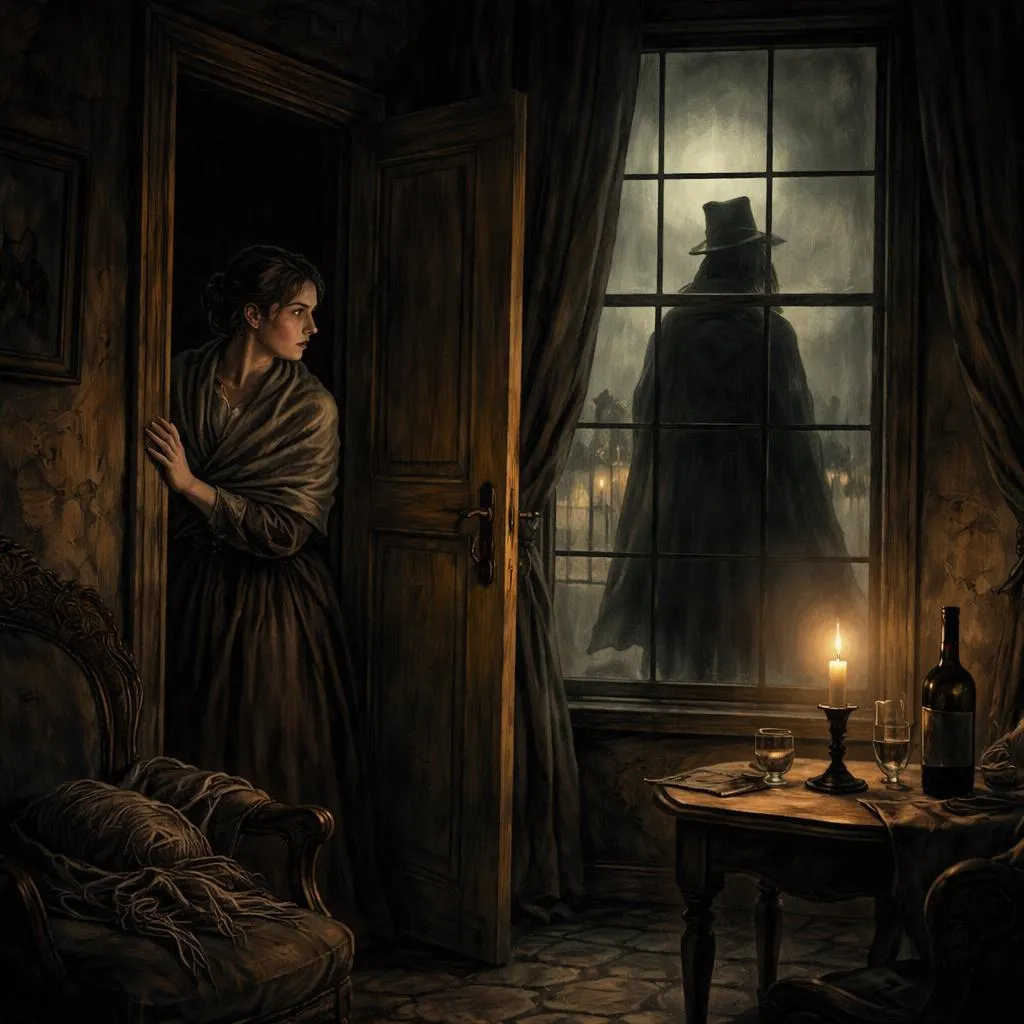

One of the first considerations which arose in the business mind of Mr. Lorry when business hours came round, was this:—that he had no right to imperil Tellson’s by sheltering the wife of an emigrant prisoner under the Bank roof, His own possessions, safety, life, he would have hazarded for Lucie and her child, without a moment’s demur; but the great trust he held was not his own, and as to that business charge he was a strict man of business.
At first, his mind reverted to Defarge, and he thought of finding out the wine-shop again and taking counsel with its master in reference to the safest dwelling-place in the distracted state of the city. But, the same consideration that suggested him, repudiated him; he lived in the most violent Quarter, and doubtless was influential there, and deep in its dangerous workings.
Noon coming, and the Doctor not returning, and every minute’s delay tending to compromise Tellson’s, Mr. Lorry advised with Lucie. She said that her father had spoken of hiring a lodging for a short term, in that Quarter, near the Banking-house. As there was no business objection to this, and as he foresaw that even if it were all well with Charles, and he were to be released, he could not hope to leave the city, Mr. Lorry went out in quest of such a lodging, and found a suitable one, high up in a removed by-street where the closed blinds in all the other windows of a high melancholy square of buildings marked deserted homes.
To this lodging he at once removed Lucie and her child, and Miss Pross: giving them what comfort he could, and much more than he had himself. He left Jerry with them, as a figure to fill a doorway that would bear considerable knocking on the head, and retained to his own occupations. A disturbed and doleful mind he brought to bear upon them, and slowly and heavily the day lagged on with him.
It wore itself out, and wore him out with it, until the Bank closed. He was again alone in his room of the previous night, considering what to do next, when he heard a foot upon the stair. In a few moments, a man stood in his presence, who, with a keenly observant look at him, addressed him by his name.
“Your servant,” said Mr. Lorry. “Do you know me?”
He was a strongly made man with dark curling hair, from forty-five to fifty years of age. For answer he repeated, without any change of emphasis, the words:
“Do you know me?”
“I have seen you somewhere.”
“Perhaps at my wine-shop?”
Much interested and agitated, Mr. Lorry said: “You come from Doctor Manette?”
“Yes. I come from Doctor Manette.”
“And what says he? What does he send me?”
Defarge gave into his anxious hand, an open scrap of paper. It bore the words in the Doctor’s writing:
“Charles is safe, but I cannot safely leave this place yet.
I have obtained the favour that the bearer has a short note from Charles to his wife. Let the bearer see his wife.”
It was dated from La Force, within an hour.
“Will you accompany me,” said Mr. Lorry, joyfully relieved after reading this note aloud, “to where his wife resides?”
“Yes,” returned Defarge.
Scarcely noticing as yet, in what a curiously reserved and mechanical way Defarge spoke, Mr. Lorry put on his hat and they went down into the courtyard. There, they found two women; one, knitting.
“Madame Defarge, surely!” said Mr. Lorry, who had left her in exactly the same attitude some seventeen years ago.
“It is she,” observed her husband.
“Does Madame go with us?” inquired Mr. Lorry, seeing that she moved as they moved.
“Yes. That she may be able to recognise the faces and know the persons. It is for their safety.”
Beginning to be struck by Defarge’s manner, Mr. Lorry looked dubiously at him, and led the way. Both the women followed; the second woman being The Vengeance.
They passed through the intervening streets as quickly as they might, ascended the staircase of the new domicile, were admitted by Jerry, and found Lucie weeping, alone. She was thrown into a transport by the tidings Mr. Lorry gave her of her husband, and clasped the hand that delivered his note—little thinking what it had been doing near him in the night, and might, but for a chance, have done to him.
“DEAREST,—Take courage. I am well, and your father has influence around me. You cannot answer this. Kiss our child for me.”
That was all the writing. It was so much, however, to her who received it, that she turned from Defarge to his wife, and kissed one of the hands that knitted. It was a passionate, loving, thankful, womanly action, but the hand made no response—dropped cold and heavy, and took to its knitting again.
There was something in its touch that gave Lucie a check. She stopped in the act of putting the note in her bosom, and, with her hands yet at her neck, looked terrified at Madame Defarge. Madame Defarge met the lifted eyebrows and forehead with a cold, impassive stare.
“My dear,” said Mr. Lorry, striking in to explain; “there are frequent risings in the streets; and, although it is not likely they will ever trouble you, Madame Defarge wishes to see those whom she has the power to protect at such times, to the end that she may know them—that she may identify them. I believe,” said Mr. Lorry, rather halting in his reassuring words, as the stony manner of all the three impressed itself upon him more and more, “I state the case, Citizen Defarge?”
Defarge looked gloomily at his wife, and gave no other answer than a gruff sound of acquiescence.
“You had better, Lucie,” said Mr. Lorry, doing all he could to propitiate, by tone and manner, “have the dear child here, and our good Pross. Our good Pross, Defarge, is an English lady, and knows no French.”
The lady in question, whose rooted conviction that she was more than a match for any foreigner, was not to be shaken by distress and, danger, appeared with folded arms, and observed in English to The Vengeance, whom her eyes first encountered, “Well, I am sure, Boldface! I hope YOU are pretty well!” She also bestowed a British cough on Madame Defarge; but, neither of the two took much heed of her.
“Is that his child?” said Madame Defarge, stopping in her work for the first time, and pointing her knitting-needle at little Lucie as if it were the finger of Fate.
“Yes, madame,” answered Mr. Lorry; “this is our poor prisoner’s darling daughter, and only child.”
The shadow attendant on Madame Defarge and her party seemed to fall so threatening and dark on the child, that her mother instinctively kneeled on the ground beside her, and held her to her breast. The shadow attendant on Madame Defarge and her party seemed then to fall, threatening and dark, on both the mother and the child.
“It is enough, my husband,” said Madame Defarge. “I have seen them. We may go.”
But, the suppressed manner had enough of menace in it—not visible and presented, but indistinct and withheld—to alarm Lucie into saying, as she laid her appealing hand on Madame Defarge’s dress:
“You will be good to my poor husband. You will do him no harm. You will help me to see him if you can?”
“Your husband is not my business here,” returned Madame Defarge, looking down at her with perfect composure. “It is the daughter of your father who is my business here.”
“For my sake, then, be merciful to my husband. For my child’s sake! She will put her hands together and pray you to be merciful. We are more afraid of you than of these others.”
Madame Defarge received it as a compliment, and looked at her husband. Defarge, who had been uneasily biting his thumb-nail and looking at her, collected his face into a sterner expression.
“What is it that your husband says in that little letter?” asked Madame Defarge, with a lowering smile. “Influence; he says something touching influence?”
“That my father,” said Lucie, hurriedly taking the paper from her breast, but with her alarmed eyes on her questioner and not on it, “has much influence around him.”
“Surely it will release him!” said Madame Defarge. “Let it do so.”
“As a wife and mother,” cried Lucie, most earnestly, “I implore you to have pity on me and not to exercise any power that you possess, against my innocent husband, but to use it in his behalf. O sister-woman, think of me. As a wife and mother!”
Madame Defarge looked, coldly as ever, at the suppliant, and said, turning to her friend The Vengeance:
“The wives and mothers we have been used to see, since we were as little as this child, and much less, have not been greatly considered? We have known THEIR husbands and fathers laid in prison and kept from them, often enough? All our lives, we have seen our sister-women suffer, in themselves and in their children, poverty, nakedness, hunger, thirst, sickness, misery, oppression and neglect of all kinds?”
“We have seen nothing else,” returned The Vengeance.
“We have borne this a long time,” said Madame Defarge, turning her eyes again upon Lucie. “Judge you! Is it likely that the trouble of one wife and mother would be much to us now?”
She resumed her knitting and went out. The Vengeance followed. Defarge went last, and closed the door.
“Courage, my dear Lucie,” said Mr. Lorry, as he raised her. “Courage, courage! So far all goes well with us—much, much better than it has of late gone with many poor souls. Cheer up, and have a thankful heart.”
“I am not thankless, I hope, but that dreadful woman seems to throw a shadow on me and on all my hopes.”
“Tut, tut!” said Mr. Lorry; “what is this despondency in the brave little breast? A shadow indeed! No substance in it, Lucie.”
But the shadow of the manner of these Defarges was dark upon himself, for all that, and in his secret mind it troubled him greatly.
Hintergrund und Einführung des Autors
Dieser Abschnitt stammt aus Eine Geschichte aus zwei Städten, einem historischen Roman von Charles Dickens, einem der berühmtesten englischen Romanautoren des 19. Jahrhunderts. Der Roman, der 1859 veröffentlicht wurde, spielt in den turbulenten Zeiten der Französischen Revolution und konzentriert sich auf das Leben der Menschen in London und Paris. Dickens schrieb diesen Roman, um Themen wie Opferbereitschaft, Wiederauferstehung und den Kampf zwischen Tyrannei und Gerechtigkeit zu untersuchen.
Charles Dickens war bekannt für seine lebendigen Charaktere und seine Sozialkritik, wobei er oft die Not der Armen und Unterdrückten hervorhob. Eine Geschichte aus zwei Städten ist eines seiner berühmtesten Werke, das sich durch seine dramatische Erzählweise und seinen einprägsamen Anfangssatz auszeichnet: „Es war die beste der Zeiten, es war die schlechteste der Zeiten...“
Detaillierte Interpretation und Bedeutung
Dieser Auszug offenbart die Spannung und Gefahr, die die Charaktere umgibt, während sie sich durch das Chaos des revolutionären Paris bewegen. Mr. Lorry, ein loyaler und umsichtiger Bankier, kämpft mit seiner Pflicht, Lucie Manette und ihr Kind zu beschützen und gleichzeitig die Interessen der Bank zu wahren. Die Szene stellt die Defarges vor, Schlüsselfiguren der Revolution, deren kalte und bedrohliche Haltung in scharfem Kontrast zu Lucies Wärme und Verletzlichkeit steht.
Die Geschichte beleuchtet Themen wie Loyalität, Mut und die harten Realitäten politischer Umwälzungen. Lucies Flehen um Gnade und Schutz für ihren Mann Charles Darnay unterstreicht die menschlichen Kosten des Konflikts. Madame Defarges Stricken, ein Symbol für das Schicksal und das drohende Unheil, fügt eine beklemmende Ebene der Spannung hinzu.
Lektionen und Erkenntnisse für Schüler
-
Mut in der Not: Lucies Tapferkeit und Hoffnung angesichts der Gefahr lehren uns, wie wichtig es ist, stark und mitfühlend zu bleiben, auch wenn die Umstände düster erscheinen.
-
Die Komplexität der Gerechtigkeit: Die Defarges repräsentieren die Härte der revolutionären Gerechtigkeit und erinnern uns daran, dass Gerechtigkeit kompliziert und manchmal unversöhnlich sein kann. Sie fördert kritisches Denken über Fairness und Empathie.
-
Loyalität und Opferbereitschaft: Mr. Lorrys Hingabe an Lucie und ihre Familie zeigt den Wert von Loyalität und Selbstlosigkeit, Eigenschaften, die Vertrauen und starke Beziehungen aufbauen.
-
Geschichte verstehen: Die Geschichte bietet einen Einblick in die Auswirkungen der Französischen Revolution auf das Leben der einfachen Menschen und hilft den Schülern, den Einfluss der Geschichte auf das menschliche Leben und die Gesellschaft zu verstehen.
Anwendung dieser Lektionen im Leben
-
In der Schule: Die Schüler können lernen, sich Herausforderungen mit Widerstandsfähigkeit zu stellen, so wie Lucie es tut. Wenn man sich überfordert fühlt, kann die Erinnerung an ihren Mut zu Ausdauer inspirieren.
-
In sozialen Situationen: Die Geschichte fördert Empathie für die Kämpfe anderer. Das Verständnis verschiedener Perspektiven, wie der der Defarges und Lucies, hilft, Freundlichkeit und Toleranz aufzubauen.
-
In der persönlichen Entwicklung: Die Entwicklung von Loyalität und das Eintreten für Freunde und Familie, wie es Mr. Lorry tut, stärkt den Charakter und die Bindungen in der Gemeinschaft.
Positive Werte aus der Geschichte kultivieren
-
Empathie: Versuchen Sie, Situationen aus der Sicht anderer zu betrachten, auch wenn sie hart oder unfreundlich erscheinen, um das Verständnis und das Mitgefühl zu vertiefen.
-
Mut: Üben Sie Mut, indem Sie sich für das Richtige aussprechen und diejenigen unterstützen, die Hilfe benötigen.
-
Verantwortung: Wie Mr. Lorry, bringen Sie persönliche Gefühle mit Pflichten und Verpflichtungen in Einklang und lernen Sie, durchdachte Entscheidungen zu treffen.
-
Hoffnung: Behalten Sie die Hoffnung in schwierigen Zeiten, da sie Ausdauer und positive Ergebnisse beflügelt.
Indem sie über diese Charaktere und ihre Entscheidungen nachdenken, können die Schüler eine reichere Wertschätzung für die Literatur und ihre Relevanz für das tägliche Leben entwickeln. Eine Geschichte aus zwei Städten unterhält nicht nur, sondern vermittelt auch zeitlose Lektionen über Menschlichkeit, Gerechtigkeit und die Kraft der Liebe und des Opfers.
