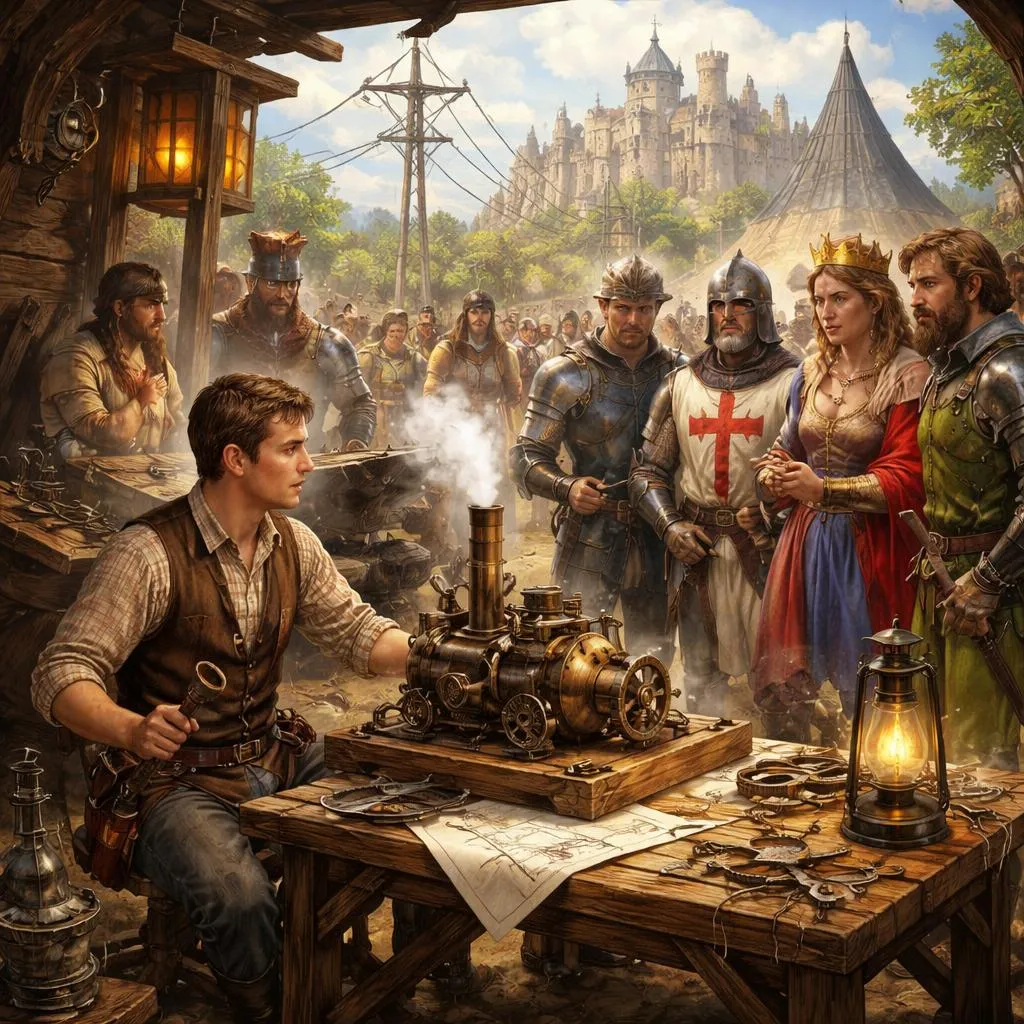

The Round Table soon heard of the challenge, and of course it was a good deal discussed, for such things interested the boys. The king thought I ought now to set forth in quest of adventures, so that I might gain renown and be the more worthy to meet Sir Sagramor when the several years should have rolled away. I excused myself for the present; I said it would take me three or four years yet to get things well fixed up and going smoothly; then I should be ready; all the chances were that at the end of that time Sir Sagramor would still be out grailing, so no valuable time would be lost by the postponement; I should then have been in office six or seven years, and I believed my system and machinery would be so well developed that I could take a holiday without its working any harm.
I was pretty well satisfied with what I had already accomplished. In various quiet nooks and corners I had the beginnings of all sorts of industries under way—nuclei of future vast factories, the iron and steel missionaries of my future civilization. In these were gathered together the brightest young minds I could find, and I kept agents out raking the country for more, all the time. I was training a crowd of ignorant folk into experts—experts in every sort of handiwork and scientific calling. These nurseries of mine went smoothly and privately along undisturbed in their obscure country retreats, for nobody was allowed to come into their precincts without a special permit—for I was afraid of the Church.
I had started a teacher-factory and a lot of Sunday-schools the first thing; as a result, I now had an admirable system of graded schools in full blast in those places, and also a complete variety of Protestant congregations all in a prosperous and growing condition. Everybody could be any kind of a Christian he wanted to; there was perfect freedom in that matter. But I confined public religious teaching to the churches and the Sunday-schools, permitting nothing of it in my other educational buildings. I could have given my own sect the preference and made everybody a Presbyterian without any trouble, but that would have been to affront a law of human nature: spiritual wants and instincts are as various in the human family as are physical appetites, complexions, and features, and a man is only at his best, morally, when he is equipped with the religious garment whose color and shape and size most nicely accommodate themselves to the spiritual complexion, angularities, and stature of the individual who wears it; and, besides, I was afraid of a united Church; it makes a mighty power, the mightiest conceivable, and then when it by and by gets into selfish hands, as it is always bound to do, it means death to human liberty and paralysis to human thought.
All mines were royal property, and there were a good many of them. They had formerly been worked as savages always work mines—holes grubbed in the earth and the mineral brought up in sacks of hide by hand, at the rate of a ton a day; but I had begun to put the mining on a scientific basis as early as I could.
Yes, I had made pretty handsome progress when Sir Sagramor’s challenge struck me.
Four years rolled by—and then! Well, you would never imagine it in the world. Unlimited power is the ideal thing when it is in safe hands. The despotism of heaven is the one absolutely perfect government. An earthly despotism would be the absolutely perfect earthly government, if the conditions were the same, namely, the despot the perfectest individual of the human race, and his lease of life perpetual. But as a perishable perfect man must die, and leave his despotism in the hands of an imperfect successor, an earthly despotism is not merely a bad form of government, it is the worst form that is possible.
My works showed what a despot could do with the resources of a kingdom at his command. Unsuspected by this dark land, I had the civilization of the nineteenth century booming under its very nose! It was fenced away from the public view, but there it was, a gigantic and unassailable fact—and to be heard from, yet, if I lived and had luck. There it was, as sure a fact and as substantial a fact as any serene volcano, standing innocent with its smokeless summit in the blue sky and giving no sign of the rising hell in its bowels. My schools and churches were children four years before; they were grown-up now; my shops of that day were vast factories now; where I had a dozen trained men then, I had a thousand now; where I had one brilliant expert then, I had fifty now. I stood with my hand on the cock, so to speak, ready to turn it on and flood the midnight world with light at any moment. But I was not going to do the thing in that sudden way. It was not my policy. The people could not have stood it; and, moreover, I should have had the Established Roman Catholic Church on my back in a minute.
No, I had been going cautiously all the while. I had had confidential agents trickling through the country some time, whose office was to undermine knighthood by imperceptible degrees, and to gnaw a little at this and that and the other superstition, and so prepare the way gradually for a better order of things. I was turning on my light one-candle-power at a time, and meant to continue to do so.
I had scattered some branch schools secretly about the kingdom, and they were doing very well. I meant to work this racket more and more, as time wore on, if nothing occurred to frighten me. One of my deepest secrets was my West Point—my military academy. I kept that most jealously out of sight; and I did the same with my naval academy which I had established at a remote seaport. Both were prospering to my satisfaction.
Clarence was twenty-two now, and was my head executive, my right hand. He was a darling; he was equal to anything; there wasn’t anything he couldn’t turn his hand to. Of late I had been training him for journalism, for the time seemed about right for a start in the newspaper line; nothing big, but just a small weekly for experimental circulation in my civilization-nurseries. He took to it like a duck; there was an editor concealed in him, sure. Already he had doubled himself in one way; he talked sixth century and wrote nineteenth. His journalistic style was climbing, steadily; it was already up to the back settlement Alabama mark, and couldn’t be told from the editorial output of that region either by matter or flavor.
We had another large departure on hand, too. This was a telegraph and a telephone; our first venture in this line. These wires were for private service only, as yet, and must be kept private until a riper day should come. We had a gang of men on the road, working mainly by night. They were stringing ground wires; we were afraid to put up poles, for they would attract too much inquiry. Ground wires were good enough, in both instances, for my wires were protected by an insulation of my own invention which was perfect. My men had orders to strike across country, avoiding roads, and establishing connection with any considerable towns whose lights betrayed their presence, and leaving experts in charge. Nobody could tell you how to find any place in the kingdom, for nobody ever went intentionally to any place, but only struck it by accident in his wanderings, and then generally left it without thinking to inquire what its name was. At one time and another we had sent out topographical expeditions to survey and map the kingdom, but the priests had always interfered and raised trouble. So we had given the thing up, for the present; it would be poor wisdom to antagonize the Church.
As for the general condition of the country, it was as it had been when I arrived in it, to all intents and purposes. I had made changes, but they were necessarily slight, and they were not noticeable. Thus far, I had not even meddled with taxation, outside of the taxes which provided the royal revenues. I had systematized those, and put the service on an effective and righteous basis. As a result, these revenues were already quadrupled, and yet the burden was so much more equably distributed than before, that all the kingdom felt a sense of relief, and the praises of my administration were hearty and general.
Personally, I struck an interruption, now, but I did not mind it, it could not have happened at a better time. Earlier it could have annoyed me, but now everything was in good hands and swimming right along. The king had reminded me several times, of late, that the postponement I had asked for, four years before, had about run out now. It was a hint that I ought to be starting out to seek adventures and get up a reputation of a size to make me worthy of the honor of breaking a lance with Sir Sagramor, who was still out grailing, but was being hunted for by various relief expeditions, and might be found any year, now. So you see I was expecting this interruption; it did not take me by surprise.
Hintergrund und Einführung des Autors
Diese Passage stammt aus "Ein Yankee am Hofe des Königs Artus", einem klassischen Roman von Mark Twain, einem der größten amerikanischen Autoren, der für seinen scharfen Witz und seine Gesellschaftskritik bekannt ist. Der 1889 veröffentlichte Roman verbindet Abenteuer, Fantasie und Satire. Twain nutzt die Geschichte, um Themen wie Fortschritt, Technologie und den Zusammenstoß zwischen modernen und mittelalterlichen Werten zu erforschen.
Der Roman erzählt die Geschichte eines amerikanischen Ingenieurs aus dem 19. Jahrhundert, der sich durch einen mysteriösen Unfall in die Zeit von König Artus und den Rittern der Tafelrunde zurückversetzt findet. Mit seinem Wissen über Wissenschaft und Technologie versucht er, die mittelalterliche Gesellschaft zu modernisieren, was oft zu Konflikten mit der etablierten Kirche und dem Feudalismus führt.
Detaillierte Interpretation und Bedeutung
In diesem Auszug beschreibt der Erzähler seine Bemühungen, Fortschritt und Aufklärung in ein rückständiges Königreich zu bringen. Heimlich hat er Schulen, Fabriken und sogar Militärakademien gebaut, junge Menschen ausgebildet und Wissen verbreitet. Sein Ziel ist es, die Gesellschaft auf eine bessere Zukunft vorzubereiten, aber er muss vorsichtig vorgehen, um die mächtige Kirche und die eingefahrenen Traditionen nicht zu provozieren.
Die Geschichte beleuchtet die Spannung zwischen Innovation und Tradition, Freiheit und Kontrolle sowie die Gefahren absoluter Macht – selbst wenn sie von einem gutmeinenden Despoten ausgeübt wird. Die Überlegungen des Erzählers über Despotismus offenbaren Twains Skepsis gegenüber konzentrierter Autorität und betonen, dass selbst die besten Herrscher sterblich und ihre Nachfolger unvollkommen sind.
Lektionen und Erkenntnisse für Schüler
-
Der Wert von Bildung und Wissen: Das Engagement des Erzählers für die Schaffung von Schulen und die Ausbildung von Experten zeigt, wie Bildung die Grundlage für Fortschritt ist. Die Schüler können lernen, dass kontinuierliches Lernen und Neugier für das persönliche Wachstum und die Verbesserung der Gesellschaft unerlässlich sind.
-
Mut, Traditionen in Frage zu stellen: Die Geschichte ermutigt junge Leser, veraltete Überzeugungen und Systeme zu hinterfragen, insbesondere wenn sie den Fortschritt oder die Freiheit behindern. Sie lehrt die Bedeutung von kritischem Denken und dafür einzustehen, was richtig ist, auch wenn es schwierig ist.
-
Geduld und strategische Planung: Der Erzähler überstürzt seine Reformen nicht, sondern arbeitet sorgfältig und leise und versteht, dass Veränderungen Zeit brauchen. Dies ist eine wertvolle Lektion in Ausdauer und der Bedeutung von durchdachtem Handeln.
-
Respekt vor Vielfalt: Indem er Religionsfreiheit zulässt und seine eigenen Überzeugungen nicht aufzwingt, respektiert der Erzähler die individuellen Unterschiede. Dies fördert Toleranz und Verständnis – Schlüsselqualitäten für ein friedliches Zusammenleben.
-
Die Verantwortung der Macht: Die Passage warnt vor den Gefahren absoluter Macht und der Notwendigkeit, dass Führungskräfte gerecht und weise sind. Die Schüler können über die Bedeutung von Fairness, Demut und Rechenschaftspflicht in Führungsrollen nachdenken.
Anwendung dieser Lektionen im täglichen Leben
-
Im Lernen: Nehmen Sie Bildung als eine lebenslange Reise an. So wie der Erzähler Schulen baut und Experten ausbildet, sollten die Schüler aktiv nach Wissen suchen, Fragen stellen und neue Fähigkeiten entwickeln.
-
In sozialen Interaktionen: Respektieren Sie die Überzeugungen und Meinungen anderer, so wie der Erzähler Religionsfreiheit zulässt. Dies hilft, Freundschaften und eine harmonische Gemeinschaft aufzubauen.
-
Bei der Bewältigung von Herausforderungen: Seien Sie geduldig und planen Sie sorgfältig, wenn Sie an Zielen arbeiten. Veränderungen erfordern oft Zeit und stetige Anstrengung, daher ist Ausdauer der Schlüssel.
-
In Führung und Verantwortung: Üben Sie Fairness und hören Sie anderen zu, egal ob in Schulgruppen oder zu Hause. Verstehen Sie, dass Führung darin besteht, zu dienen und zu helfen, nicht zu kontrollieren.
Positive Eigenschaften aus der Geschichte kultivieren
-
Innovation: Fördern Sie Kreativität und Problemlösung, indem Sie über neue Wege nachdenken, um Ihre Umgebung zu verbessern oder anderen zu helfen.
-
Mut: Stehen Sie für Ihre Werte ein und seien Sie bereit, unfaire Regeln oder Ideen respektvoll in Frage zu stellen.
-
Toleranz: Schätzen Sie Vielfalt und lernen Sie von Menschen mit unterschiedlichem Hintergrund und unterschiedlichen Perspektiven.
-
Weisheit: Treffen Sie durchdachte Entscheidungen und berücksichtigen Sie die Konsequenzen Ihres Handelns.
Indem sie sich mit dieser Geschichte auseinandersetzen, können die Schüler nicht nur ein aufregendes Abenteuer genießen, sondern auch wertvolle Einblicke in Geschichte, Ethik und persönliche Entwicklung gewinnen. Mark Twains Roman ist nach wie vor ein zeitloser Leitfaden zum Verständnis der Komplexität von Fortschritt und menschlicher Natur.
