
“Well, how do you like them?” said Marilla.
Anne was standing in the gable room, looking solemnly at three new dresses spread out on the bed. One was of snuffy colored gingham which Marilla had been tempted to buy from a peddler the preceding summer because it looked so serviceable; one was of black-and-white checkered sateen which she had picked up at a bargain counter in the winter; and one was a stiff print of an ugly blue shade which she had purchased that week at a Carmody store.
She had made them up herself, and they were all made alike—plain skirts fulled tightly to plain waists, with sleeves as plain as waist and skirt and tight as sleeves could be.
“I’ll imagine that I like them,” said Anne soberly.
“I don’t want you to imagine it,” said Marilla, offended. “Oh, I can see you don’t like the dresses! What is the matter with them? Aren’t they neat and clean and new?”
“Yes.”
“Then why don’t you like them?”
“They’re—they’re not—pretty,” said Anne reluctantly.
“Pretty!” Marilla sniffed. “I didn’t trouble my head about getting pretty dresses for you. I don’t believe in pampering vanity, Anne, I’ll tell you that right off. Those dresses are good, sensible, serviceable dresses, without any frills or furbelows about them, and they’re all you’ll get this summer. The brown gingham and the blue print will do you for school when you begin to go. The sateen is for church and Sunday school. I’ll expect you to keep them neat and clean and not to tear them. I should think you’d be grateful to get most anything after those skimpy wincey things you’ve been wearing.”
“Oh, I AM grateful,” protested Anne. “But I’d be ever so much gratefuller if—if you’d made just one of them with puffed sleeves. Puffed sleeves are so fashionable now. It would give me such a thrill, Marilla, just to wear a dress with puffed sleeves.”
“Well, you’ll have to do without your thrill. I hadn’t any material to waste on puffed sleeves. I think they are ridiculous-looking things anyhow. I prefer the plain, sensible ones.”
“But I’d rather look ridiculous when everybody else does than plain and sensible all by myself,” persisted Anne mournfully.
“Trust you for that! Well, hang those dresses carefully up in your closet, and then sit down and learn the Sunday school lesson. I got a quarterly from Mr. Bell for you and you’ll go to Sunday school tomorrow,” said Marilla, disappearing downstairs in high dudgeon.
Anne clasped her hands and looked at the dresses.
“I did hope there would be a white one with puffed sleeves,” she whispered disconsolately. “I prayed for one, but I didn’t much expect it on that account. I didn’t suppose God would have time to bother about a little orphan girl’s dress. I knew I’d just have to depend on Marilla for it. Well, fortunately I can imagine that one of them is of snow-white muslin with lovely lace frills and three-puffed sleeves.”
The next morning warnings of a sick headache prevented Marilla from going to Sunday-school with Anne.
“You’ll have to go down and call for Mrs. Lynde, Anne.” she said. “She’ll see that you get into the right class. Now, mind you behave yourself properly. Stay to preaching afterwards and ask Mrs. Lynde to show you our pew. Here’s a cent for collection. Don’t stare at people and don’t fidget. I shall expect you to tell me the text when you come home.”
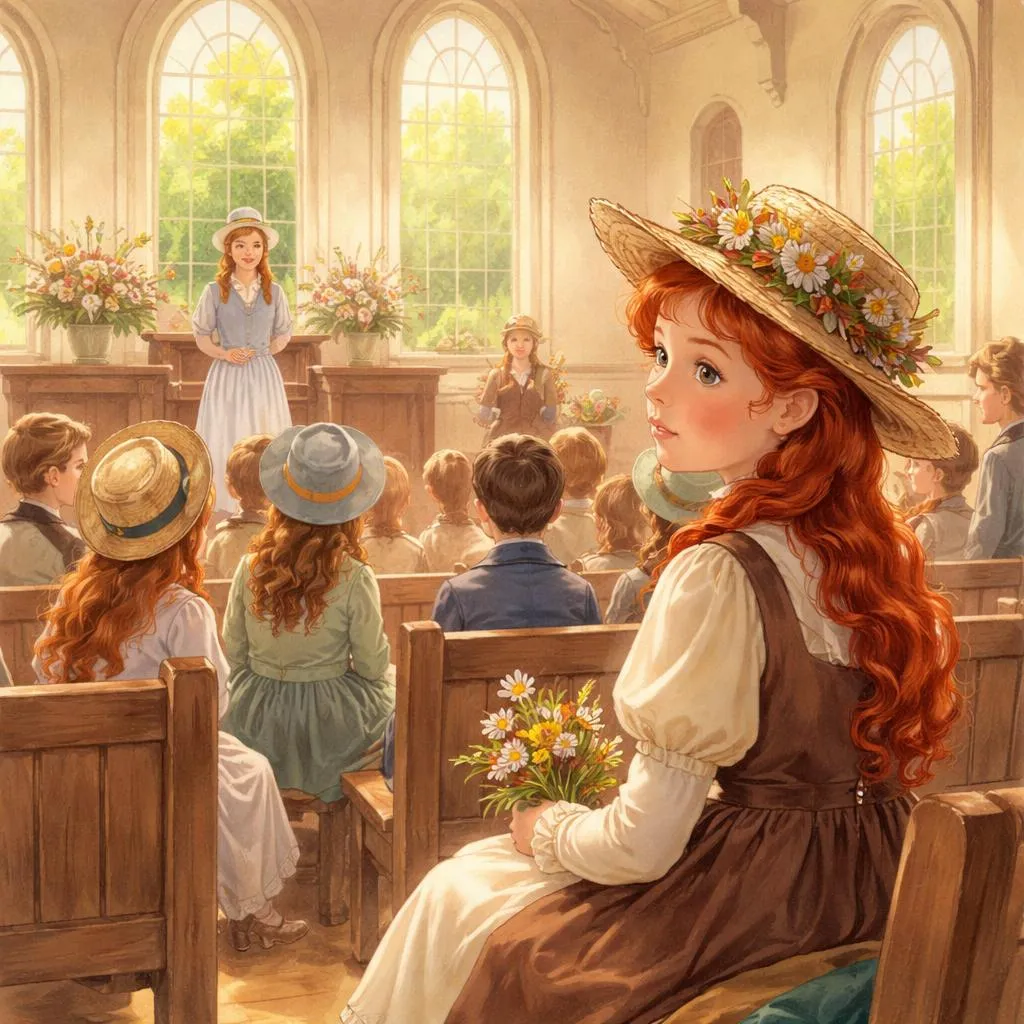
Anne started off irreproachable, arrayed in the stiff black-and-white sateen, which, while decent as regards length and certainly not open to the charge of skimpiness, contrived to emphasize every corner and angle of her thin figure. Her hat was a little, flat, glossy, new sailor, the extreme plainness of which had likewise much disappointed Anne, who had permitted herself secret visions of ribbon and flowers. The latter, however, were supplied before Anne reached the main road, for being confronted halfway down the lane with a golden frenzy of wind-stirred buttercups and a glory of wild roses, Anne promptly and liberally garlanded her hat with a heavy wreath of them. Whatever other people might have thought of the result it satisfied Anne, and she tripped gaily down the road, holding her ruddy head with its decoration of pink and yellow very proudly.
When she had reached Mrs. Lynde’s house she found that lady gone. Nothing daunted, Anne proceeded onward to the church alone. In the porch she found a crowd of little girls, all more or less gaily attired in whites and blues and pinks, and all staring with curious eyes at this stranger in their midst, with her extraordinary head adornment. Avonlea little girls had already heard queer stories about Anne. Mrs. Lynde said she had an awful temper; Jerry Buote, the hired boy at Green Gables, said she talked all the time to herself or to the trees and flowers like a crazy girl. They looked at her and whispered to each other behind their quarterlies. Nobody made any friendly advances, then or later on when the opening exercises were over and Anne found herself in Miss Rogerson’s class.
Miss Rogerson was a middle-aged lady who had taught a Sunday-school class for twenty years. Her method of teaching was to ask the printed questions from the quarterly and look sternly over its edge at the particular little girl she thought ought to answer the question. She looked very often at Anne, and Anne, thanks to Marilla’s drilling, answered promptly; but it may be questioned if she understood very much about either question or answer.
She did not think she liked Miss Rogerson, and she felt very miserable; every other little girl in the class had puffed sleeves. Anne felt that life was really not worth living without puffed sleeves.
“Well, how did you like Sunday school?” Marilla wanted to know when Anne came home. Her wreath having faded, Anne had discarded it in the lane, so Marilla was spared the knowledge of that for a time.
“I didn’t like it a bit. It was horrid.”
“Anne Shirley!” said Marilla rebukingly.
Anne sat down on the rocker with a long sigh, kissed one of Bonny’s leaves, and waved her hand to a blossoming fuchsia.
“They might have been lonesome while I was away,” she explained. “And now about the Sunday school. I behaved well, just as you told me. Mrs. Lynde was gone, but I went right on myself. I went into the church, with a lot of other little girls, and I sat in the corner of a pew by the window while the opening exercises went on. Mr. Bell made an awfully long prayer. I would have been dreadfully tired before he got through if I hadn’t been sitting by that window. But it looked right out on the Lake of Shining Waters, so I just gazed at that and imagined all sorts of splendid things.”
“You shouldn’t have done anything of the sort. You should have listened to Mr. Bell.”
“But he wasn’t talking to me,” protested Anne. “He was talking to God and he didn’t seem to be very much inter-ested in it, either. I think he thought God was too far off though. There was a long row of white birches hanging over the lake and the sunshine fell down through them, ‘way, ‘way down, deep into the water. Oh, Marilla, it was like a beautiful dream! It gave me a thrill and I just said, ‘Thank you for it, God,’ two or three times.”
“Not out loud, I hope,” said Marilla anxiously.
“Oh, no, just under my breath. Well, Mr. Bell did get through at last and they told me to go into the classroom with Miss Rogerson’s class. There were nine other girls in it. They all had puffed sleeves. I tried to imagine mine were puffed, too, but I couldn’t. Why couldn’t I? It was as easy as could be to imagine they were puffed when I was alone in the east gable, but it was awfully hard there among the others who had really truly puffs.”
“You shouldn’t have been thinking about your sleeves in Sunday school. You should have been attending to the lesson. I hope you knew it.”
“Oh, yes; and I answered a lot of questions. Miss Rogerson asked ever so many. I don’t think it was fair for her to do all the asking. There were lots I wanted to ask her, but I didn’t like to because I didn’t think she was a kindred spirit. Then all the other little girls recited a paraphrase. She asked me if I knew any. I told her I didn’t, but I could recite, ‘The Dog at His Master’s Grave’ if she liked. That’s in the Third Royal Reader. It isn’t a really truly religious piece of poetry, but it’s so sad and melancholy that it might as well be. She said it wouldn’t do and she told me to learn the nineteenth paraphrase for next Sunday. I read it over in church afterwards and it’s splendid. There are two lines in particular that just thrill me.
"'Quick as the slaughtered squadrons fell In Midian's evil day.'"
“I don’t know what ‘squadrons’ means nor ‘Midian,’ either, but it sounds SO tragical. I can hardly wait until next Sunday to recite it. I’ll practice it all the week. After Sunday school I asked Miss Rogerson—because Mrs. Lynde was too far away—to show me your pew. I sat just as still as I could and the text was Revelations, third chapter, second and third verses. It was a very long text. If I was a minister I’d pick the short, snappy ones. The sermon was awfully long, too. I suppose the minister had to match it to the text. I didn’t think he was a bit interesting. The trouble with him seems to be that he hasn’t enough imagination. I didn’t listen to him very much. I just let my thoughts run and I thought of the most surprising things.”
Marilla felt helplessly that all this should be sternly reproved, but she was hampered by the undeniable fact that some of the things Anne had said, especially about the minister’s sermons and Mr. Bell’s prayers, were what she herself had really thought deep down in her heart for years, but had never given expression to. It almost seemed to her that those secret, unuttered, critical thoughts had suddenly taken visible and accusing shape and form in the person of this outspoken morsel of neglected humanity.
Hintergrund und Einführung der Autorin
Dieser Auszug stammt aus Anne auf Green Gables, einem klassischen Roman der kanadischen Autorin Lucy Maud Montgomery aus dem Jahr 1908. Die Geschichte folgt Anne Shirley, einem fantasievollen und temperamentvollen Waisenmädchen, das fälschlicherweise zu Marilla und Matthew Cuthbert geschickt wird, einem Bruder und einer Schwester, die beabsichtigt hatten, einen Jungen zu adoptieren, um ihnen auf ihrer Farm in Avonlea, Prince Edward Island, zu helfen. Der Roman wird für seine lebendigen Beschreibungen des Landlebens, Annes reiche innere Welt und seine Themen wie Zugehörigkeit, Identität und persönliches Wachstum gefeiert.
Lucy Maud Montgomery selbst wurde 1874 auf Prince Edward Island geboren. Ihre Erfahrungen, die sie in einer ländlichen Umgebung machte, beeinflussten ihr Schreiben tiefgreifend. Sie schrieb mit Wärme und Humor über die Freuden und Herausforderungen der Kindheit und die Schönheit der Natur und eroberte damit die Herzen der Leser weltweit.
Detaillierte Interpretation und Bedeutung
Diese Passage hebt Annes Sehnsucht nach Schönheit und Individualität inmitten der Einfachheit und Zweckmäßigkeit hervor, die von Marilla auferlegt wird, die eine konservativere und pragmatischere Weltanschauung vertritt. Annes Wunsch nach Puffärmeln – ein modisches und etwas frivoles Detail – symbolisiert ihr Verlangen nach Selbstausdruck und einem Hauch von Magie in ihrem Leben. Marillas Ablehnung spiegelt die wirtschaftlichen Realitäten und sozialen Erwartungen der Zeit wider und betont Pflicht, Bescheidenheit und Nützlichkeit gegenüber Eitelkeit.
Annes fantasievoller Geist kommt zum Vorschein, wenn sie ihre schlichten Kleider gedanklich in wunderschöne Gewänder verwandelt, was ihre Widerstandsfähigkeit und Kreativität zeigt. Ihre Erfahrung in der Sonntagsschule unterstreicht weiter ihren Außenseiterstatus – sie ist anders, missverstanden und sehnt sich danach, dazuzugehören, doch sie bleibt sich selbst treu. Ihre Überlegungen während der Predigt offenbaren einen nachdenklichen, sensiblen Geist, der selbst dann Wunder findet, wenn formelle Religion langweilig oder fern erscheint.
Diese Szene erforscht auch Themen wie Einsamkeit, Akzeptanz und die Spannung zwischen Konformität und Individualität. Annes lebhafte Vorstellungskraft und emotionale Tiefe stehen im Gegensatz zu den starren sozialen Normen um sie herum, was sie zu einem zeitlosen Symbol der jugendlichen Hoffnung und der Kraft der Vorstellungskraft macht.
Lektionen und Erkenntnisse für Schüler
-
Umarme deine Individualität: Annes Geschichte ermutigt junge Leser, ihre einzigartigen Eigenschaften und Träume zu schätzen, auch wenn sie nicht ganz in die Erwartungen anderer passen. Es ist wichtig, sich selbst treu zu bleiben und Freude an Vorstellungskraft und Kreativität zu finden.
-
Resilienz in Widrigkeiten: Trotz ihrer Enttäuschungen und Herausforderungen bleibt Anne hoffnungsvoll und einfallsreich. Dies lehrt die Schüler den Wert von Ausdauer und positivem Denken, wenn sie mit Schwierigkeiten konfrontiert werden.
-
Wertschätzung von Einfachheit und Zweckmäßigkeit: Marillas Perspektive erinnert uns daran, dass das Leben oft Praktikabilität und Verantwortung erfordert. Träume mit realen Anforderungen in Einklang zu bringen, ist eine wichtige Lebenskompetenz.
-
Empathie und Verständnis: Die Geschichte lädt die Leser ein, über das Äußere und die Urteile hinauszuschauen. Annes Klassenkameraden tuscheln über sie, aber ihre innere Welt ist reich und komplex. Dies fördert Freundlichkeit und Aufgeschlossenheit gegenüber anderen, die anders erscheinen.
-
Schönheit im Alltag finden: Annes Fähigkeit, in der natürlichen Welt und sogar in einer langen Predigt Wunder zu finden, zeigt die Bedeutung von Achtsamkeit und der Wertschätzung kleiner Momente der Schönheit.
Anwendungen im täglichen Leben
-
In der Schule: Die Schüler können von Annes Neugier und ihrem Eifer, Fragen zu beantworten, lernen, auch wenn sie nicht alles vollständig verstehen. Dies zeigt die Bedeutung von Beteiligung und der Bereitschaft zu lernen, was das Selbstvertrauen und das Wissen stärken kann.
-
In sozialen Situationen: Annes Erfahrung, sich als Außenseiter zu fühlen, erinnert die Schüler daran, neue oder andere Klassenkameraden einzubeziehen und willkommen zu heißen. Empathie und Freundschaft zu praktizieren, kann eine unterstützende Umgebung schaffen.
-
Im persönlichen Wachstum: Wie Anne können die Schüler ihre Vorstellungskraft und Kreativität durch Lesen, Schreiben oder Kunst kultivieren. Dies fördert emotionale Intelligenz und Fähigkeiten zur Problemlösung.
-
Im Familienleben: Die Dynamik zwischen Anne und Marilla unterstreicht die Bedeutung von Kommunikation und Kompromissen in Beziehungen. Das Verständnis verschiedener Perspektiven kann bei der Lösung von Konflikten helfen.
Positive Eigenschaften aus der Geschichte kultivieren
-
Vorstellungskraft und Kreativität: Ermutigen Sie die Schüler, ihre Vorstellungskraft nicht nur zum Spaß, sondern auch als Werkzeug zur Problemlösung und zum emotionalen Ausdruck zu nutzen.
-
Dankbarkeit und Zufriedenheit: Annes Dankbarkeit für ihre Kleider, trotz ihrer Schlichtheit, lehrt die Wertschätzung für das, was man hat.
-
Mut und Selbstvertrauen: Annes Bereitschaft, sie selbst zu sein, auch wenn andere sie beurteilen, inspiriert die Schüler, Selbstvertrauen zu entwickeln und für ihre Werte einzustehen.
-
Respekt vor anderen: Marillas Fürsorge für Anne, wenn auch streng, zeigt eine Form von Liebe und Verantwortung. Die Schüler können lernen, Autoritäten zu respektieren und diejenigen zu schätzen, die sich um sie kümmern.
Schlussfolgerung
Anne auf Green Gables ist mehr als nur eine Kindergeschichte; sie ist eine reiche Erforschung menschlicher Emotionen, sozialer Werte und der transformativen Kraft der Vorstellungskraft. Durch Annes Abenteuer und Herausforderungen können die Schüler wertvolle Lektionen über Identität, Resilienz, Freundlichkeit und die Schönheit der einfachen Momente des Lebens lernen. Indem sie über Annes Erfahrungen nachdenken, werden junge Leser ermutigt, ihre Einzigartigkeit anzunehmen, den Widrigkeiten des Lebens mit Hoffnung zu begegnen und Empathie und Kreativität in ihrem eigenen Leben zu kultivieren.
