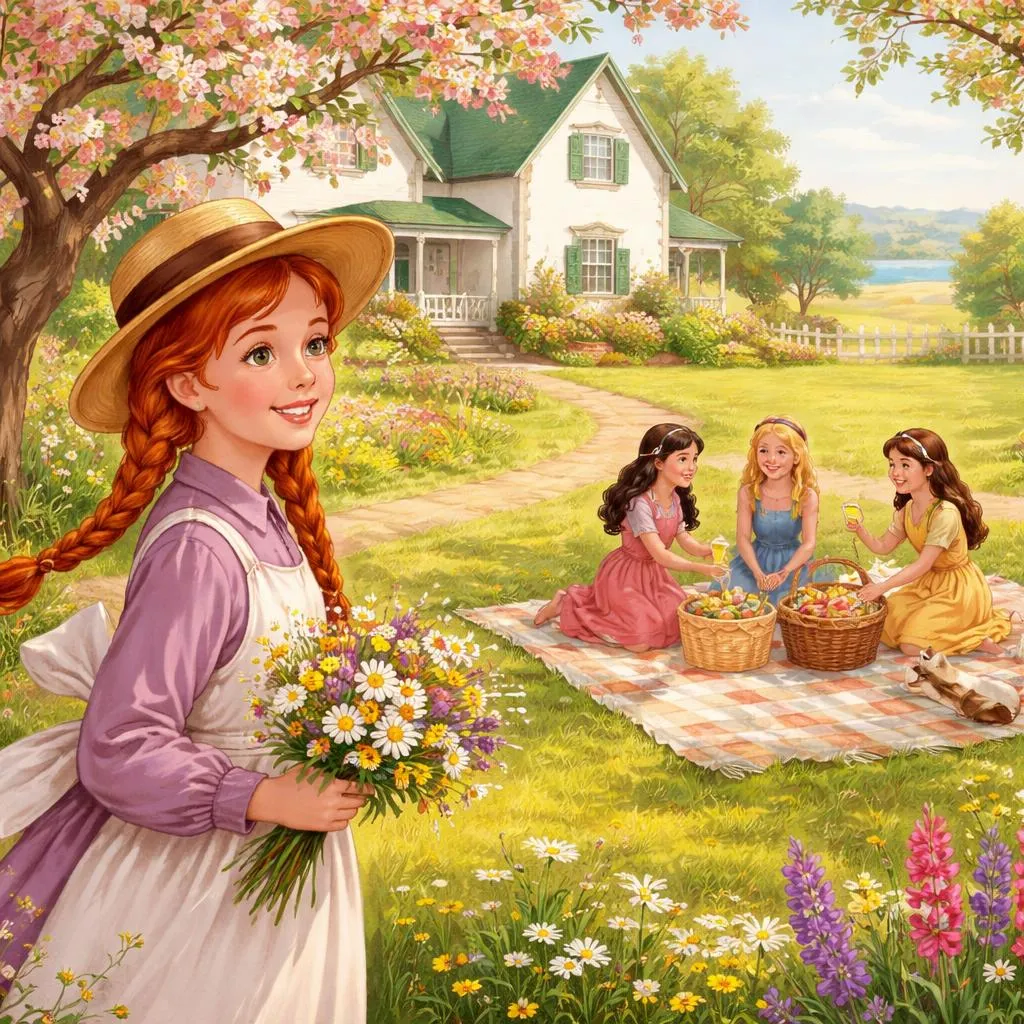

THE next afternoon Anne, bending over her patchwork at the kitchen window, happened to glance out and beheld Diana down by the Dryad’s Bubble beckoning mysteriously. In a trice Anne was out of the house and flying down to the hollow, astonishment and hope struggling in her expressive eyes. But the hope faded when she saw Diana’s dejected countenance.
“Your mother hasn’t relented?” she gasped.
Diana shook her head mournfully.
“No; and oh, Anne, she says I’m never to play with you again. I’ve cried and cried and I told her it wasn’t your fault, but it wasn’t any use. I had ever such a time coaxing her to let me come down and say good-bye to you. She said I was only to stay ten minutes and she’s timing me by the clock.”
“Ten minutes isn’t very long to say an eternal farewell in,” said Anne tearfully. “Oh, Diana, will you promise faithfully never to forget me, the friend of your youth, no matter what dearer friends may caress thee?”
“Indeed I will,” sobbed Diana, “and I’ll never have another bosom friend—I don’t want to have. I couldn’t love anybody as I love you.”
“Oh, Diana,” cried Anne, clasping her hands, “do you LOVE me?”
“Why, of course I do. Didn’t you know that?”
“No.” Anne drew a long breath. “I thought you LIKED me of course but I never hoped you LOVED me. Why, Diana, I didn’t think anybody could love me. Nobody ever has loved me since I can remember. Oh, this is wonderful! It’s a ray of light which will forever shine on the darkness of a path severed from thee, Diana. Oh, just say it once again.”
“I love you devotedly, Anne,” said Diana stanchly, “and I always will, you may be sure of that.”
“And I will always love thee, Diana,” said Anne, solemnly extending her hand. “In the years to come thy memory will shine like a star over my lonely life, as that last story we read together says. Diana, wilt thou give me a lock of thy jet-black tresses in parting to treasure forevermore?”
“Have you got anything to cut it with?” queried Diana, wiping away the tears which Anne’s affecting accents had caused to flow afresh, and returning to practicalities.
“Yes. I’ve got my patchwork scissors in my apron pocket fortunately,” said Anne. She solemnly clipped one of Diana’s curls. “Fare thee well, my beloved friend. Henceforth we must be as strangers though living side by side. But my heart will ever be faithful to thee.”
Anne stood and watched Diana out of sight, mournfully waving her hand to the latter whenever she turned to look back. Then she returned to the house, not a little consoled for the time being by this romantic parting.
“It is all over,” she informed Marilla. “I shall never have another friend. I’m really worse off than ever before, for I haven’t Katie Maurice and Violetta now. And even if I had it wouldn’t be the same. Somehow, little dream girls are not satisfying after a real friend. Diana and I had such an affecting farewell down by the spring. It will be sacred in my memory forever. I used the most pathetic language I could think of and said ‘thou’ and ‘thee.’ ‘Thou’ and ‘thee’ seem so much more romantic than ‘you.’ Diana gave me a lock of her hair and I’m going to sew it up in a little bag and wear it around my neck all my life. Please see that it is buried with me, for I don’t believe I’ll live very long. Perhaps when she sees me lying cold and dead before her Mrs. Barry may feel remorse for what she has done and will let Diana come to my funeral.”
“I don’t think there is much fear of your dying of grief as long as you can talk, Anne,” said Marilla unsympathetically.
The following Monday Anne surprised Marilla by coming down from her room with her basket of books on her arm and hip and her lips primmed up into a line of determination.
“I’m going back to school,” she announced. “That is all there is left in life for me, now that my friend has been ruthlessly torn from me. In school I can look at her and muse over days departed.”
“You’d better muse over your lessons and sums,” said Marilla, concealing her delight at this development of the situation. “If you’re going back to school I hope we’ll hear no more of breaking slates over people’s heads and such carryings on. Behave yourself and do just what your teacher tells you.”
“I’ll try to be a model pupil,” agreed Anne dolefully. “There won’t be much fun in it, I expect. Mr. Phillips said Minnie Andrews was a model pupil and there isn’t a spark of imagination or life in her. She is just dull and poky and never seems to have a good time. But I feel so depressed that perhaps it will come easy to me now. I’m going round by the road. I couldn’t bear to go by the Birch Path all alone. I should weep bitter tears if I did.”
Anne was welcomed back to school with open arms. Her imagination had been sorely missed in games, her voice in the singing and her dramatic ability in the perusal aloud of books at dinner hour. Ruby Gillis smuggled three blue plums over to her during testament reading; Ella May MacPherson gave her an enormous yellow pansy cut from the covers of a floral catalogue—a species of desk decoration much prized in Avonlea school. Sophia Sloane offered to teach her a perfectly elegant new pattern of knit lace, so nice for trimming aprons. Katie Boulter gave her a perfume bottle to keep slate water in, and Julia Bell copied carefully on a piece of pale pink paper scalloped on the edges the following effusion:“
When twilight drops her curtain down And pins it with a star Remember that you have a friend Though she may wander far.
It’s so nice to be appreciated,” sighed Anne rapturously to Marilla that night.
The girls were not the only scholars who “appreciated” her. When Anne went to her seat after dinner hour—she had been told by Mr. Phillips to sit with the model Minnie Andrews—she found on her desk a big luscious “strawberry apple.” Anne caught it up all ready to take a bite when she remembered that the only place in Avonlea where strawberry apples grew was in the old Blythe orchard on the other side of the Lake of Shining Waters. Anne dropped the apple as if it were a red-hot coal and ostentatiously wiped her fingers on her handkerchief. The apple lay untouched on her desk until the next morning, when little Timothy Andrews, who swept the school and kindled the fire, annexed it as one of his perquisites. Charlie Sloane’s slate pencil, gorgeously bedizened with striped red and yellow paper, costing two cents where ordinary pencils cost only one, which he sent up to her after dinner hour, met with a more favorable reception. Anne was graciously pleased to accept it and rewarded the donor with a smile which exalted that infatuated youth straightway into the seventh heaven of delight and caused him to make such fearful errors in his dictation that Mr. Phillips kept him in after school to rewrite it.
But as,
The Caesar's pageant shorn of Brutus' bust Did but of Rome's best son remind her more.
so the marked absence of any tribute or recognition from Diana Barry who was sitting with Gertie Pye embittered Anne’s little triumph.
“Diana might just have smiled at me once, I think,” she mourned to Marilla that night. But the next morning a note most fearfully and wonderfully twisted and folded, and a small parcel were passed across to Anne.
Dear Anne (ran the former)
Mother says I’m not to play with you or talk to you even in school. It isn’t my fault and don’t be cross at me, because I love you as much as ever. I miss you awfully to tell all my secrets to and I don’t like Gertie Pye one bit. I made you one of the new bookmarkers out of red tissue paper. They are awfully fashionable now and only three girls in school know how to make them. When you look at it remember
Your true friend
Diana Barry.
Anne read the note, kissed the bookmark, and dispatched a prompt reply back to the other side of the school.
My own darling Diana:—
Of course I am not cross at you because you have to obey your mother. Our spirits can commune. I shall keep your lovely present forever. Minnie Andrews is a very nice little girl—although she has no imagination—but after having been Diana’s busum friend I cannot be Minnie’s. Please excuse mistakes because my spelling isn’t very good yet, although much improoved.
Yours until death us do part
Anne or Cordelia Shirley.
P.S. I shall sleep with your letter under my pillow tonight. A. OR C.S.
Marilla pessimistically expected more trouble since Anne had again begun to go to school. But none developed. Perhaps Anne caught something of the “model” spirit from Minnie Andrews; at least she got on very well with Mr. Phillips thenceforth. She flung herself into her studies heart and soul, determined not to be outdone in any class by Gilbert Blythe. The rivalry between them was soon apparent; it was entirely good natured on Gilbert’s side; but it is much to be feared that the same thing cannot be said of Anne, who had certainly an unpraiseworthy tenacity for holding grudges. She was as intense in her hatreds as in her loves. She would not stoop to admit that she meant to rival Gilbert in schoolwork, because that would have been to acknowledge his existence which Anne persistently ignored; but the rivalry was there and honors fluctuated between them. Now Gilbert was head of the spelling class; now Anne, with a toss of her long red braids, spelled him down. One morning Gilbert had all his sums done correctly and had his name written on the blackboard on the roll of honor; the next morning Anne, having wrestled wildly with decimals the entire evening before, would be first. One awful day they were ties and their names were written up together. It was almost as bad as a take-notice and Anne’s mortification was as evident as Gilbert’s satisfaction. When the written examinations at the end of each month were held the suspense was terrible. The first month Gilbert came out three marks ahead. The second Anne beat him by five. But her triumph was marred by the fact that Gilbert congratulated her heartily before the whole school. It would have been ever so much sweeter to her if he had felt the sting of his defeat.
Mr. Phillips might not be a very good teacher; but a pupil so inflexibly determined on learning as Anne was could hardly escape making progress under any kind of teacher. By the end of the term Anne and Gilbert were both promoted into the fifth class and allowed to begin studying the elements of “the branches”—by which Latin, geometry, French, and algebra were meant. In geometry Anne met her Waterloo.
“It’s perfectly awful stuff, Marilla,” she groaned. “I’m sure I’ll never be able to make head or tail of it. There is no scope for imagination in it at all. Mr. Phillips says I’m the worst dunce he ever saw at it. And Gil—I mean some of the others are so smart at it. It is extremely mortifying, Marilla.
“Even Diana gets along better than I do. But I don’t mind being beaten by Diana. Even although we meet as strangers now I still love her with an INEXTINGUISHABLE love. It makes me very sad at times to think about her. But really, Marilla, one can’t stay sad very long in such an interesting world, can one?”
Hintergrund und Einführung der Autorin
Dieser Auszug stammt aus Anne auf Green Gables, einem klassischen Roman der kanadischen Autorin Lucy Maud Montgomery, der erstmals 1908 veröffentlicht wurde. Die Geschichte folgt Anne Shirley, einem fantasievollen und temperamentvollen Waisenmädchen, das fälschlicherweise zu Marilla und Matthew Cuthbert geschickt wird, einem Bruder und einer Schwester, die beabsichtigt hatten, einen Jungen zu adoptieren, um ihnen bei ihrer Farm auf Prince Edward Island zu helfen. Annes Abenteuer, Freundschaften und ihr Wachstum bilden das Herzstück des Romans, der weltweit für seine Wärme, seinen Humor und seine lebendige Darstellung der Kindheit und des Gemeinschaftslebens geliebt wird.
Lucy Maud Montgomery ließ sich von ihrer eigenen Kindheit und den Landschaften von Prince Edward Island inspirieren und verlieh ihren Schriften ein starkes Gefühl für Ort und Charakter. Anne auf Green Gables ist der erste Band einer Reihe von Büchern, die Annes Leben chronologisch erzählen, und wurde in zahlreiche Filme, Fernsehserien und Bühnenproduktionen umgesetzt.
Detaillierte Interpretation und Bedeutung
Diese Passage fängt einen ergreifenden Moment in Annes Leben ein – die schmerzhafte Trennung von ihrer besten Freundin Diana Barry, die von Dianas Mutter erzwungen wurde. Die Abschiedsszene beleuchtet Themen wie Freundschaft, Loyalität und die bittersüße Natur des Erwachsenwerdens. Annes poetische Sprache und ihre tiefe emotionale Bindung zu Diana offenbaren ihre sensible und romantische Persönlichkeit. Die Haarsträhne symbolisiert eine bleibende Bindung, selbst wenn die Umstände eine physische Trennung erzwingen.
Annes Rückkehr zur Schule und ihre Interaktionen mit ihren Klassenkameraden veranschaulichen die Herausforderungen des Sich-Einfügens, der Rivalität und des Wunsches nach Akzeptanz und Anerkennung. Ihre Rivalität mit Gilbert Blythe führt eine Dynamik ein, die sich im Laufe der Serie entwickeln wird und Wettbewerb mit eventueller Freundschaft verbindet. Die Passage berührt auch Annes Schwierigkeiten mit akademischen Fächern wie Geometrie und zeigt, dass selbst kluge und entschlossene Schüler Schwierigkeiten haben, was eine realistische und ermutigende Botschaft für junge Leser ist.
Lektionen und Inspirationen für Schüler
-
Der Wert wahrer Freundschaft: Annes und Dianas Bindung lehrt uns Loyalität, Vertrauen und den Schmerz der Trennung. Wahre Freunde unterstützen sich gegenseitig emotional, auch wenn äußere Kräfte Distanz schaffen. Die Schüler können lernen, ihre Freundschaften zu schätzen und in schwierigen Zeiten offen mit Freunden zu kommunizieren.
-
Emotionaler Ausdruck und Widerstandsfähigkeit: Annes herzlicher Abschied und ihre poetischen Ausdrücke zeigen, dass es gesund ist, Emotionen tief auszudrücken. Gleichzeitig zeigt Annes Entscheidung, zur Schule zurückzukehren und sich auf ihr Studium zu konzentrieren, Widerstandsfähigkeit – die Fähigkeit, sich der Traurigkeit zu stellen und weiterzumachen.
-
Positiver Umgang mit Rivalität: Die Rivalität zwischen Anne und Gilbert ist wettbewerbsorientiert, aber auch respektvoll. Dies lehrt, dass Wettbewerb uns motivieren kann, uns zu verbessern, aber nicht zu Verbitterung oder Groll führen sollte. Die Schüler können dies anwenden, indem sie nach persönlichen Bestleistungen streben und gleichzeitig Freundlichkeit gegenüber Gleichaltrigen bewahren.
-
Herausforderungen annehmen: Annes Schwierigkeiten mit der Geometrie erinnern uns daran, dass jeder Stärken und Schwächen hat. Ausdauer und eine positive Einstellung zum Erlernen neuer Dinge sind entscheidend. Die Schüler sollten sich nicht von Fächern entmutigen lassen, die sie schwierig finden, sondern stattdessen Hilfe suchen und es immer wieder versuchen.
-
Fantasie und Individualität: Annes fantasievolle Natur bereichert ihr Leben und das Leben der Menschen um sie herum. Die Schüler werden ermutigt, ihre einzigartigen Qualitäten und kreativen Talente zu schätzen, die ihnen helfen können, Probleme zu lösen und das Leben mehr zu genießen.
Anwendung dieser Lektionen im täglichen Leben
-
In der Schule: Die Schüler können Freundschaften pflegen, indem sie freundlich, vertrauenswürdig und unterstützend sind. Wenn sie vor akademischen Herausforderungen stehen, sollten sie sich an Annes Entschlossenheit erinnern und bei Bedarf Hilfe suchen. Gesunder Wettbewerb kann ein Werkzeug für Wachstum und nicht für Konflikte sein.
-
In sozialen Situationen: Ehrliches und respektvolles Ausdrücken von Gefühlen kann Beziehungen vertiefen. Wenn Freundschaften Schwierigkeiten haben, ist es wichtig, Hoffnung und Kommunikation aufrechtzuerhalten. Wie Anne können die Schüler Trost in Erinnerungen und kleinen Zeichen der Freundschaft finden.
-
In der persönlichen Entwicklung: Die Kultivierung von Widerstandsfähigkeit hilft, Rückschläge zu überwinden. Die Akzeptanz der eigenen Einzigartigkeit und Fantasie kann zu einem erfüllten und freudigen Leben führen. Die Schüler sollten ihre Erfolge feiern und aus Fehlern lernen, ohne das Selbstvertrauen zu verlieren.
Positive Eigenschaften aus der Geschichte kultivieren
- Loyalität: Sei ein zuverlässiger Freund, der anderen in guten und schlechten Zeiten zur Seite steht.
- Empathie: Verstehe und teile die Gefühle von Freunden, besonders in schwierigen Momenten.
- Ausdauer: Arbeite weiter hart, auch wenn Aufgaben schwierig oder entmutigend erscheinen.
- Respektvolle Rivalität: Tritt fair an und feiere die Erfolge anderer.
- Kreativität: Nutze die Fantasie, um das Lernen zu bereichern und Probleme zu lösen.
Indem sie über Annes Erfahrungen nachdenken, können die Schüler emotionale Intelligenz, soziale Fähigkeiten und die Liebe zum Lernen entwickeln, die ihnen im Laufe ihres Lebens von Nutzen sein werden. Anne auf Green Gables bleibt eine zeitlose Geschichte, die die Leser dazu inspiriert, die Freuden und Herausforderungen des Lebens mit Mut, Freundlichkeit und Hoffnung anzunehmen.
