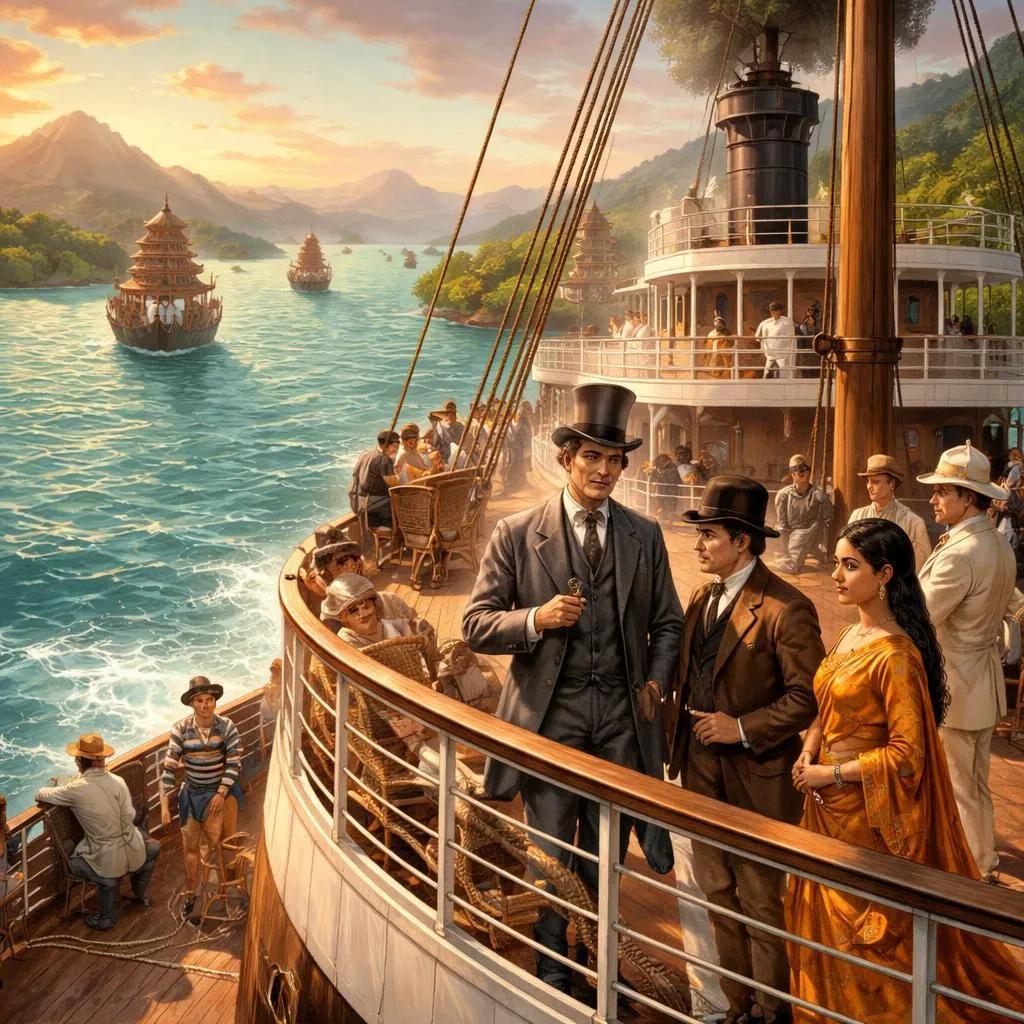

The detective and Passepartout met often on deck after this interview, though Fix was reserved, and did not attempt to induce his companion to divulge any more facts concerning Mr. Fogg. He caught a glimpse of that mysterious gentleman once or twice; but Mr. Fogg usually confined himself to the cabin, where he kept Aouda company, or, according to his inveterate habit, took a hand at whist.
Passepartout began very seriously to conjecture what strange chance kept Fix still on the route that his master was pursuing. It was really worth considering why this certainly very amiable and complacent person, whom he had first met at Suez, had then encountered on board the Mongolia, who disembarked at Bombay, which he announced as his destination, and now turned up so unexpectedly on the Rangoon, was following Mr. Fogg's tracks step by step. What was Fix's object? Passepartout was ready to wager his Indian shoes—which he religiously preserved—that Fix would also leave Hong Kong at the same time with them, and probably on the same steamer.
Passepartout might have cudgelled his brain for a century without hitting upon the real object which the detective had in view. He never could have imagined that Phileas Fogg was being tracked as a robber around the globe. But, as it is in human nature to attempt the solution of every mystery, Passepartout suddenly discovered an explanation of Fix's movements, which was in truth far from unreasonable. Fix, he thought, could only be an agent of Mr. Fogg's friends at the Reform Club, sent to follow him up, and to ascertain that he really went round the world as had been agreed upon.
"It's clear!" repeated the worthy servant to himself, proud of his shrewdness. "He's a spy sent to keep us in view! That isn't quite the thing, either, to be spying Mr. Fogg, who is so honourable a man! Ah, gentlemen of the Reform, this shall cost you dear!"
Passepartout, enchanted with his discovery, resolved to say nothing to his master, lest he should be justly offended at this mistrust on the part of his adversaries. But he determined to chaff Fix, when he had the chance, with mysterious allusions, which, however, need not betray his real suspicions.
During the afternoon of Wednesday, 30th October, the Rangoon entered the Strait of Malacca, which separates the peninsula of that name from Sumatra. The mountainous and craggy islets intercepted the beauties of this noble island from the view of the travellers. The Rangoon weighed anchor at Singapore the next day at four a.m., to receive coal, having gained half a day on the prescribed time of her arrival. Phileas Fogg noted this gain in his journal, and then, accompanied by Aouda, who betrayed a desire for a walk on shore, disembarked.
Fix, who suspected Mr. Fogg's every movement, followed them cautiously, without being himself perceived; while Passepartout, laughing in his sleeve at Fix's manoeuvres, went about his usual errands.
The island of Singapore is not imposing in aspect, for there are no mountains; yet its appearance is not without attractions. It is a park checkered by pleasant highways and avenues. A handsome carriage, drawn by a sleek pair of New Holland horses, carried Phileas Fogg and Aouda into the midst of rows of palms with brilliant foliage, and of clove–trees, whereof the cloves form the heart of a half–open flower. Pepper plants replaced the prickly hedges of European fields; sago–bushes, large ferns with gorgeous branches, varied the aspect of this tropical clime; while nutmeg–trees in full foliage filled the air with a penetrating perfume. Agile and grinning bands of monkeys skipped about in the trees, nor were tigers wanting in the jungles.
After a drive of two hours through the country, Aouda and Mr. Fogg returned to the town, which is a vast collection of heavy–looking, irregular houses, surrounded by charming gardens rich in tropical fruits and plants; and at ten o'clock they re–embarked, closely followed by the detective, who had kept them constantly in sight.
Passepartout, who had been purchasing several dozen mangoes—a fruit as large as good–sized apples, of a dark–brown colour outside and a bright red within, and whose white pulp, melting in the mouth, affords gourmands a delicious sensation—was waiting for them on deck. He was only too glad to offer some mangoes to Aouda, who thanked him very gracefully for them.
At eleven o'clock the Rangoon rode out of Singapore harbour, and in a few hours the high mountains of Malacca, with their forests, inhabited by the most beautifully–furred tigers in the world, were lost to view. Singapore is distant some thirteen hundred miles from the island of Hong Kong, which is a little English colony near the Chinese coast. Phileas Fogg hoped to accomplish the journey in six days, so as to be in time for the steamer which would leave on the 6th of November for Yokohama, the principal Japanese port.
The Rangoon had a large quota of passengers, many of whom disembarked at Singapore, among them a number of Indians, Ceylonese, Chinamen, Malays, and Portuguese, mostly second–class travellers.
The weather, which had hitherto been fine, changed with the last quarter of the moon. The sea rolled heavily, and the wind at intervals rose almost to a storm, but happily blew from the south–west, and thus aided the steamer's progress. The captain as often as possible put up his sails, and under the double action of steam and sail the vessel made rapid progress along the coasts of Anam and Cochin China. Owing to the defective construction of the Rangoon, however, unusual precautions became necessary in unfavourable weather; but the loss of time which resulted from this cause, while it nearly drove Passepartout out of his senses, did not seem to affect his master in the least. Passepartout blamed the captain, the engineer, and the crew, and consigned all who were connected with the ship to the land where the pepper grows. Perhaps the thought of the gas, which was remorselessly burning at his expense in Saville Row, had something to do with his hot impatience.
"You are in a great hurry, then," said Fix to him one day, "to reach Hong Kong?"
"A very great hurry!"
"Mr. Fogg, I suppose, is anxious to catch the steamer for Yokohama?"
"Terribly anxious."
"You believe in this journey around the world, then?"
"Absolutely. Don't you, Mr. Fix?"
"I? I don't believe a word of it."
"You're a sly dog!" said Passepartout, winking at him.
This expression rather disturbed Fix, without his knowing why. Had the Frenchman guessed his real purpose? He knew not what to think. But how could Passepartout have discovered that he was a detective? Yet, in speaking as he did, the man evidently meant more than he expressed.
Passepartout went still further the next day; he could not hold his tongue.
"Mr. Fix," said he, in a bantering tone, "shall we be so unfortunate as to lose you when we get to Hong Kong?"
"Why," responded Fix, a little embarrassed, "I don't know; perhaps—"
"Ah, if you would only go on with us! An agent of the Peninsular Company, you know, can't stop on the way! You were only going to Bombay, and here you are in China. America is not far off, and from America to Europe is only a step."
Fix looked intently at his companion, whose countenance was as serene as possible, and laughed with him. But Passepartout persisted in chaffing him by asking him if he made much by his present occupation.
"Yes, and no," returned Fix; "there is good and bad luck in such things. But you must understand that I don't travel at my own expense."
"Oh, I am quite sure of that!" cried Passepartout, laughing heartily.
Fix, fairly puzzled, descended to his cabin and gave himself up to his reflections. He was evidently suspected; somehow or other the Frenchman had found out that he was a detective. But had he told his master? What part was he playing in all this: was he an accomplice or not? Was the game, then, up? Fix spent several hours turning these things over in his mind, sometimes thinking that all was lost, then persuading himself that Fogg was ignorant of his presence, and then undecided what course it was best to take.
Nevertheless, he preserved his coolness of mind, and at last resolved to deal plainly with Passepartout. If he did not find it practicable to arrest Fogg at Hong Kong, and if Fogg made preparations to leave that last foothold of English territory, he, Fix, would tell Passepartout all. Either the servant was the accomplice of his master, and in this case the master knew of his operations, and he should fail; or else the servant knew nothing about the robbery, and then his interest would be to abandon the robber.
Such was the situation between Fix and Passepartout. Meanwhile Phileas Fogg moved about above them in the most majestic and unconscious indifference. He was passing methodically in his orbit around the world, regardless of the lesser stars which gravitated around him. Yet there was near by what the astronomers would call a disturbing star, which might have produced an agitation in this gentleman's heart. But no! the charms of Aouda failed to act, to Passepartout's great surprise; and the disturbances, if they existed, would have been more difficult to calculate than those of Uranus which led to the discovery of Neptune.
It was every day an increasing wonder to Passepartout, who read in Aouda's eyes the depths of her gratitude to his master. Phileas Fogg, though brave and gallant, must be, he thought, quite heartless. As to the sentiment which this journey might have awakened in him, there was clearly no trace of such a thing; while poor Passepartout existed in perpetual reveries.
One day he was leaning on the railing of the engine–room, and was observing the engine, when a sudden pitch of the steamer threw the screw out of the water. The steam came hissing out of the valves; and this made Passepartout indignant.
"The valves are not sufficiently charged!" he exclaimed. "We are not going. Oh, these English! If this was an American craft, we should blow up, perhaps, but we should at all events go faster!"
Hintergrund und Einführung des Autors
Dieser Abschnitt stammt aus dem klassischen Abenteuerroman Reise um die Erde in 80 Tagen von Jules Verne, einem französischen Autor, der für seine wegweisenden Werke in der Science-Fiction- und Abenteuerliteratur bekannt ist. Dieser 1872 verfasste Roman fängt den Geist der Erkundung und die raschen technologischen Fortschritte des 19. Jahrhunderts ein, insbesondere die Ausweitung der globalen Transportnetze wie Dampfschiffe und Eisenbahnen. Vernes fantasievolles Geschichtenerzählen lädt die Leser ein, sich auf aufregende Reisen zu begeben, wobei akribische Details mit Spannung und Humor vermischt werden.
Detaillierte Interpretation der Geschichte
In diesem Auszug werden wir Zeuge eines komplexen Netzes aus Intrigen und Neugier, als Phileas Fogg, ein beherrschter und rätselhafter englischer Gentleman, seine ehrgeizige Reise um den Globus innerhalb von achtzig Tagen fortsetzt. Sein treuer Diener Passepartout beobachtet den verdächtigen Detektiv Fix, der Fogg heimlich verfolgt, da er davon überzeugt ist, dass Fogg ein Krimineller ist. Passepartouts Missverständnis von Fix' wahren Absichten fügt eine Schicht dramatischer Ironie hinzu, da die Leser mehr wissen als die Charaktere selbst.
Die Erzählung beschreibt auch auf wunderschöne Weise die exotischen und vielfältigen Landschaften, denen sie während ihrer Reise begegnen, wie die tropische Flora und Fauna von Singapur und die Herausforderungen, die die Seefahrt mit sich bringt. Der Kontrast zwischen dem ruhigen, methodischen Fogg und dem ängstlichen, impulsiven Passepartout hebt unterschiedliche menschliche Reaktionen auf Abenteuer und Ungewissheit hervor.
Lektionen und Erkenntnisse für Schüler
-
Neugier und kritisches Denken: Passepartouts Versuche, Fix' Motive zu verstehen, zeigen, wie wichtig es ist, Situationen zu hinterfragen und zu analysieren, anstatt das Offensichtliche zu akzeptieren. Die Schüler können lernen, Fähigkeiten zum kritischen Denken zu entwickeln, indem sie die Handlungen und Absichten anderer beobachten und reflektieren.
-
Beharrlichkeit und Gelassenheit: Phileas Foggs ruhige und beständige Natur, selbst wenn er mit Verzögerungen und Hindernissen konfrontiert wird, lehrt den Wert von Ausdauer und dem Bewahren der Fassung unter Druck. Diese Einstellung ist entscheidend für akademische Herausforderungen, Sport und persönliche Ziele.
-
Kulturelles Bewusstsein und Wertschätzung: Die lebendigen Beschreibungen der Umgebung und der Menschen in Singapur ermutigen die Leser, die kulturelle Vielfalt und die Schönheit verschiedener Teile der Welt zu schätzen. Dies fördert Aufgeschlossenheit und Respekt für globale Kulturen, eine wesentliche Fähigkeit in der heutigen vernetzten Welt.
-
Vertrauen und Freundschaft: Die Beziehung zwischen Fogg, Passepartout und Aouda veranschaulicht Themen wie Loyalität, Vertrauen und Freundlichkeit. Die Schüler können darüber nachdenken, wie die Unterstützung von Freunden und das Zeigen von Dankbarkeit Beziehungen bereichert und hilft, Schwierigkeiten zu überwinden.
Anwendung dieser Lektionen im täglichen Leben
- Im Lernen können die Schüler Foggs Disziplin nachahmen, indem sie sich klare Ziele setzen und ruhig darauf hinarbeiten, auch wenn der Fortschritt langsam erscheint.
- In sozialen Interaktionen können sie Empathie üben und vermeiden, voreilige Schlüsse über andere zu ziehen, ähnlich wie Passepartouts anfängliche Fehleinschätzung von Fix.
- In Erkundung und Kreativität werden die Schüler ermutigt, neugierig auf die Welt zu sein, Fragen zu stellen und verschiedene Perspektiven und Kulturen zu schätzen.
- Um positive Charaktereigenschaften zu entwickeln, könnten die Schüler versuchen, in stressigen Situationen ruhig zu bleiben, ihren Freunden gegenüber loyal zu sein und Freundlichkeit gegenüber ihren Mitmenschen zu zeigen, so wie die Charaktere es während ihrer gesamten Reise zeigen.
Förderung eines positiven Geistes und Verhaltens
Die Schüler können den abenteuerlichen und respektvollen Geist dieser Geschichte fördern, indem sie:
- Viel lesen, um ihren Horizont zu erweitern und verschiedene Kulturen und Geschichten zu verstehen.
- Sich an Gruppenaktivitäten beteiligen, die Teamwork und Vertrauen erfordern, was die Zusammenarbeit widerspiegelt, die zwischen den Charakteren zu sehen ist.
- Geduld und Belastbarkeit üben, wenn sie mit Rückschlägen konfrontiert werden, und lernen, dass Ausdauer oft zum Erfolg führt.
- Ihre eigenen Urteile reflektieren und danach streben, die Perspektiven anderer zu verstehen, bevor sie sich eine Meinung bilden.
Schlussfolgerung
Reise um die Erde in 80 Tagen ist mehr als ein aufregendes Abenteuer; es ist eine reiche Quelle an Lebenslektionen und Inspiration. Durch seine Charaktere und lebendigen Schauplätze erhalten junge Leser Einblicke in Mut, Neugier und die Bedeutung von Integrität. Durch die Anwendung dieser Lektionen können die Schüler nicht nur akademisch, sondern auch als nachdenkliche, einfühlsame Individuen wachsen, die bereit sind, die Komplexität der modernen Welt zu bewältigen.
