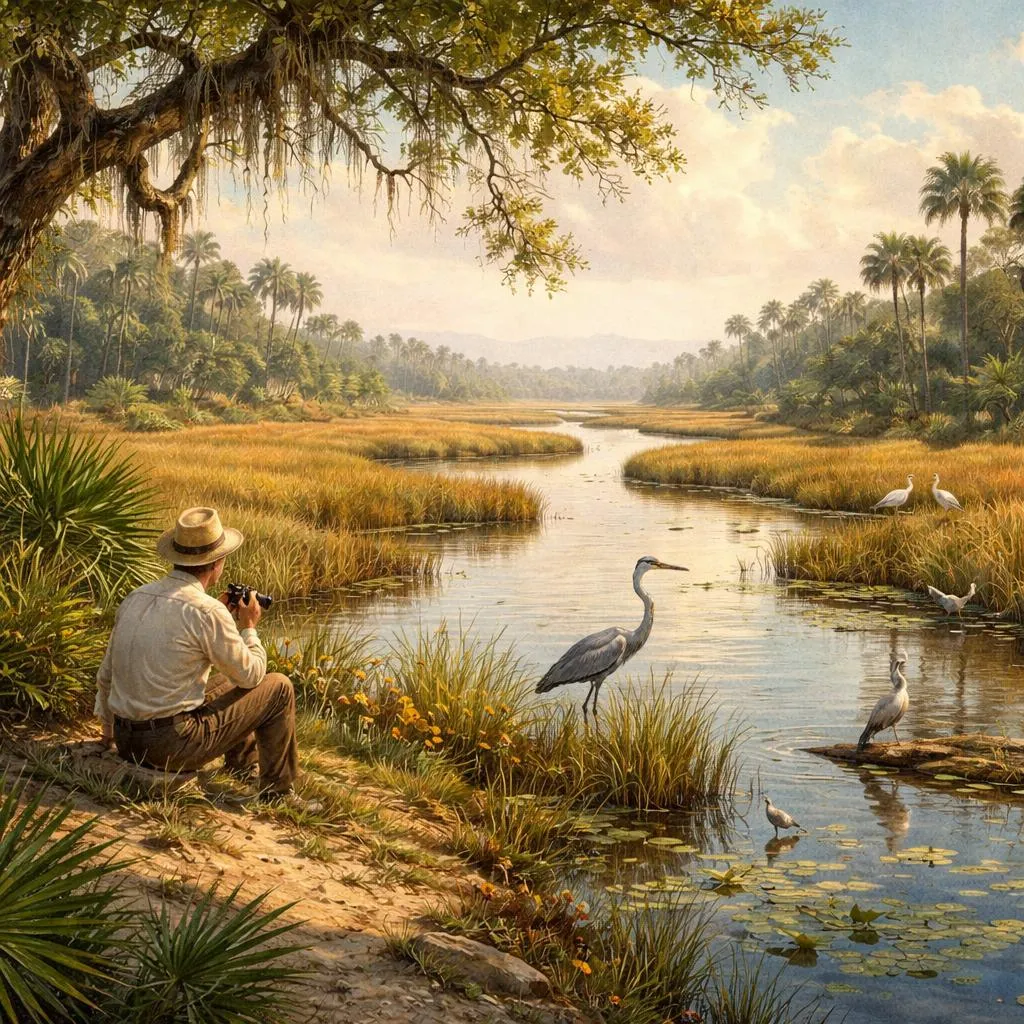

I am sitting upon the upland bank of a narrow winding creek. Before me is a sea of grass, brown and green of many shades. To the north themarsh is bounded by live-oak woods,—a line with numberlessindentations,—beyond which runs the Matanzas River, as I know by thepassing and repassing of sails behind the trees. Eastward aresand-hills, dazzling white in the sun, with a ragged green fringe alongtheir tops. Then comes a stretch of the open sea, and then, more to thesouth, St. Anastasia Island, with its tall black-and-white lighthouseand the cluster of lower buildings at its base. Small sailboats, and nowand then a tiny steamer, pass up and down the river to and from St.Augustine.
A delicious south wind is blowing (it is the 15th of February), and Isit in the shade of a cedar-tree and enjoy the air and the scene. Acontrast, this, to the frozen world I was living in, less than a weekago.
As I approached the creek, a single spotted sandpiper was teeteringalong the edge of the water, and the next moment a big blue heron rosejust beyond him and went flapping away to the middle of the marsh. Now,an hour afterward, he is still standing there, towering above the tallgrass. Once when I turned that way I saw, as I thought, a stake, andthen something moved upon it,—a bird of some kind. And what an enormousbeak! I raised my field-glass. It was the heron. His body was the post,and his head was the bird. Meanwhile, the sandpiper has stolen away, Iknow not when or where. He must have omitted the “tweet, tweet,” withwhich ordinarily he signalizes his flight. He is the first of his kindthat I have seen during my brief stay in these parts.
Now a multitude of crows pass over; fish crows, I think they must be,from their small size and their strange, ridiculous voices. And now asecond great blue heron comes in sight, and keeps on over the marsh andover the live-oak wood, on his way to the San Sebastian marshes, or somepoint still more remote. A fine show he makes, with his wide expanse ofwing, and his feet drawn up and standing out behind him. Next a marshhawk in brown plumage comes skimming over the grass. This way and thathe swerves in ever graceful lines. For one to whom ease and grace comeby nature, even the chase of meadow mice is an act of beauty, whileanother goes awkwardly though in pursuit of a goddess.
Several times I have noticed a kingfisher hovering above the grass (soit looks, but no doubt he is over an arm of the creek), striking the airwith quick strokes, and keeping his head pointed downward, after themanner of a tern. Then he disappeared while I was looking at somethingelse. Now I remark him sitting motionless upon the top of a post in themidst of the marsh.
A third blue heron appears, and he too flies over without stopping.Number One still keeps his place; through the glass I can see himdressing his feathers with his clumsy beak. The lively strain of awhite-eyed vireo, pertest of songsters, comes to me from somewhere on myright, and the soft chipping of myrtle warblers is all but incessant. Ilook up from my paper to see a turkey buzzard sailing majesticallynorthward. I watch him till he fades in the distance. Not once does heflap his wings, but sails and sails, going with the wind, yet turningagain and again to rise against it,—helping himself thus to itsadverse, uplifting pressure in the place of wing-strokes, perhaps,—andpassing onward all the while in beautiful circles. He, too, scavengerthough he is, has a genius for being graceful. One might almost bewilling to be a buzzard, to fly like that!
The kingfisher and the heron are still at their posts. An exquisiteyellow butterfly, of a sort strange to my Yankee eyes, flits past,followed by a red admiral. The marsh hawk is on the wing again, andwhile looking at him I descry a second hawk, too far away to be madeout. Now the air behind me is dark with crows,—a hundred or two, atleast, circling over the low cedars. Some motive they have for all theirclamor, but it passes my owlish wisdom to guess what it can be. A fourthblue heron appears, and drops into the grass out of sight.
Between my feet is a single blossom of the yellow oxalis, the onlyflower to be seen; and very pretty it is, each petal with an orange spotat the base.
Another buzzard, another marsh hawk, another yellow butterfly, and thena smaller one, darker, almost orange. It passes too quickly over thecreek and away. The marsh hawk comes nearer, and I see the strong yellowtinge of his plumage, especially underneath. He will grow handsomer ashe grows older. A pity the same could not be true of men. Behind me aresharp cries of titlarks. From the direction of the river come frequentreports of guns. Somebody is doing his best to be happy! All at once Iprick up my ears. From the grass just across the creek rises the brief,hurried song of a long-billed marsh wren. So he is in Florida, is he?Already I have heard confused noises which I feel sure are the work ofrails of some kind. No doubt there is abundant life concealed in thoseacres on acres of close grass.
The heron and the kingfisher are still quiet. Their morning hunt wassuccessful, and for to-day Fate cannot harm them. A buzzard, withnervous, rustling beats, goes directly above the low cedar under which Iam resting.
At last, after a siesta of two hours, the heron has changed his place. Ilooked up just in season to see him sweeping over the grass, into whichhe dropped the next instant. The tide is falling. The distant sand-hillsare winking in the heat, but the breeze is deliciously cool, the veryperfection of temperature, if a man is to sit still in the shade. It iseleven o’clock. I have a mile to go in the hot sun, and turn away. Butfirst I sweep the line once more with my glass. Yonder to the south aretwo more blue herons standing in the grass. Perhaps there are morestill. I sweep the line. Yes, far, far away I can see four heads in arow. Heads and necks rise above the grass. But so far away! Are theybirds, or only posts made alive by my imagination? I look again. Ibelieve I was deceived. They are nothing but stakes. See how in a rowthey stand. I smile at myself. Just then one of them moves, and anotheris pulled down suddenly into the grass. I smile again. “Ten great blueherons,” I say to myself.
All this has detained me, and meantime the kingfisher has taken wing andgone noisily up the creek. The marsh hawk appears once more. Akilldeer’s sharp, rasping note—a familiar sound in St. Augustine—comesfrom I know not where. A procession of more than twenty black vulturespasses over my head. I can see their feet drawn up under them. My own Imust use in plodding homeward.
Hintergrund und Einführung des Autors
Diese lebendige Naturbeschreibung ist eine detaillierte Beobachtung eines Sumpfland-Ökosystems, die die Schönheit und das Leben einer Küstenumgebung einfängt. Der Autor, dessen Identität hier nicht angegeben ist, beweist einen scharfen Blick für Details und eine tiefe Wertschätzung für die Tierwelt, insbesondere für Vögel. Solche beschreibenden Schriften sind typisch für Naturforscher, die wissenschaftliche Beobachtung mit poetischer Sprache verbinden, um die Natur für die Leser zum Leben zu erwecken. Dieser Stil ermutigt die Leser, insbesondere Schüler und junge Menschen, langsamer zu werden und die kleinen Wunder der Natur um sie herum wahrzunehmen.
Detaillierte Interpretation und Bedeutung
Die Passage bietet eine Momentaufnahme eines friedlichen, sonnigen Tages in einem Sumpf in der Nähe von St. Augustine, Florida. Die sorgfältige Aufmerksamkeit des Autors auf das Verhalten und das Aussehen der Vögel – der Blähe, der Sandläufer, des Eisvogels, des Sumpfhabichts, des Truthahngeiers und anderer – lädt die Leser ein, die Vielfalt und Anmut der Tierwelt zu schätzen. Die Erzählung stellt auch die warme, lebhafte Szene der jüngsten Erfahrung des Autors mit einer gefrorenen Winterlandschaft gegenüber und betont die Erneuerung und Lebendigkeit der Natur in wärmeren Klimazonen.
Die Geschichte handelt nicht nur von Vögeln, sondern auch von der Vernetzung des Lebens und den stillen Rhythmen der Natur. Die Bewegungen, Rufe und Interaktionen der Vögel offenbaren ein komplexes Ökosystem, in dem jedes Lebewesen eine Rolle spielt. Die Überlegungen des Autors über die Schönheit und Anmut selbst von Aasfressern wie dem Geier vermitteln eine Botschaft darüber, wie man Wert und Würde in allen Lebensformen findet.
Lektionen und Erkenntnisse für Schüler
-
Beobachtungsfähigkeiten: Die detaillierten Beschreibungen ermutigen die Schüler, sorgfältige Beobachtungsfähigkeiten zu entwickeln. Das Wahrnehmen kleiner Details – wie der orangenfarbenen Flecken auf einem Blütenblatt oder des Flugmusters eines Habichts – kann das Verständnis und die Wertschätzung der Natur vertiefen.
-
Geduld und Achtsamkeit: Der Autor verbringt Stunden damit, still den Sumpf zu beobachten, was Geduld und Achtsamkeit beweist. Die Schüler können lernen, wie wichtig es ist, langsamer zu werden und präsent zu sein, um ihre Umgebung wirklich zu erleben und von ihr zu lernen.
-
Respekt vor der Natur: Die Erzählung fördert den Respekt vor der Tierwelt und der Umwelt. Das Verständnis der Rollen, die verschiedene Tiere spielen, trägt dazu bei, ein Gefühl der Verantwortung für die natürliche Welt aufzubauen.
-
Verbindung zum Ort: Die Verbindung des Autors zum Sumpf und seinen Kreaturen zeigt, wie Orte eine besondere Bedeutung haben können. Die Schüler können ermutigt werden, ihre lokale Umgebung zu erkunden und sich mit ihr zu verbinden.
Anwendungen im Leben, im Lernen und in sozialen Umgebungen
-
Im Lernen: Die Schüler können die hier gezeigten Beobachtungstechniken auf naturwissenschaftliche Studien anwenden und so ihre Fähigkeit verbessern, Daten zu erfassen und zu interpretieren. Diese Geschichte kann zu Naturjournalen oder Feldstudien inspirieren.
-
Im sozialen Leben: Der Respekt vor allen Lebewesen, auch vor den weniger bewunderten wie Geiern, lehrt Empathie und Akzeptanz von Vielfalt, wertvolle Eigenschaften in sozialen Beziehungen.
-
Im persönlichen Wachstum: Die gezeigte Geduld und Ruhe kann den Schülern helfen, Stress zu bewältigen und Achtsamkeitspraktiken zu entwickeln.
Förderung positiver Eigenschaften aus der Geschichte
-
Neugier und Staunen: Die Förderung der Neugier auf die natürliche Welt kann zu lebenslangem Lernen und Entdecken führen.
-
Geduld: Zu lernen, zu warten und sorgfältig zu beobachten, ist eine Fähigkeit, die vielen Lebensbereichen zugute kommt.
-
Respekt und Empathie: Den Wert in allen Lebewesen zu sehen, fördert Freundlichkeit und Verständnis gegenüber anderen.
-
Verbindung zur Natur: Zeit im Freien zu verbringen und die Tierwelt zu beobachten, kann die psychische Gesundheit verbessern und die Umweltverantwortung fördern.
Schlussfolgerung
Diese Passage ist ein schönes Beispiel für Naturschreiben, das junge Leser dazu einlädt, langsamer zu werden, zu beobachten und die lebendige Welt um sie herum zu schätzen. Sie vermittelt wertvolle Lektionen über Geduld, Respekt und die Schönheit des Lebens in all seinen Formen. Indem sie sich mit solchen Geschichten auseinandersetzen, können die Schüler Fähigkeiten und Einstellungen entwickeln, die ihre Ausbildung und ihr persönliches Leben bereichern und ihnen helfen, zu nachdenklichen, fürsorglichen Individuen heranzuwachsen, die sowohl mit der Natur als auch mit der Gemeinschaft verbunden sind.
