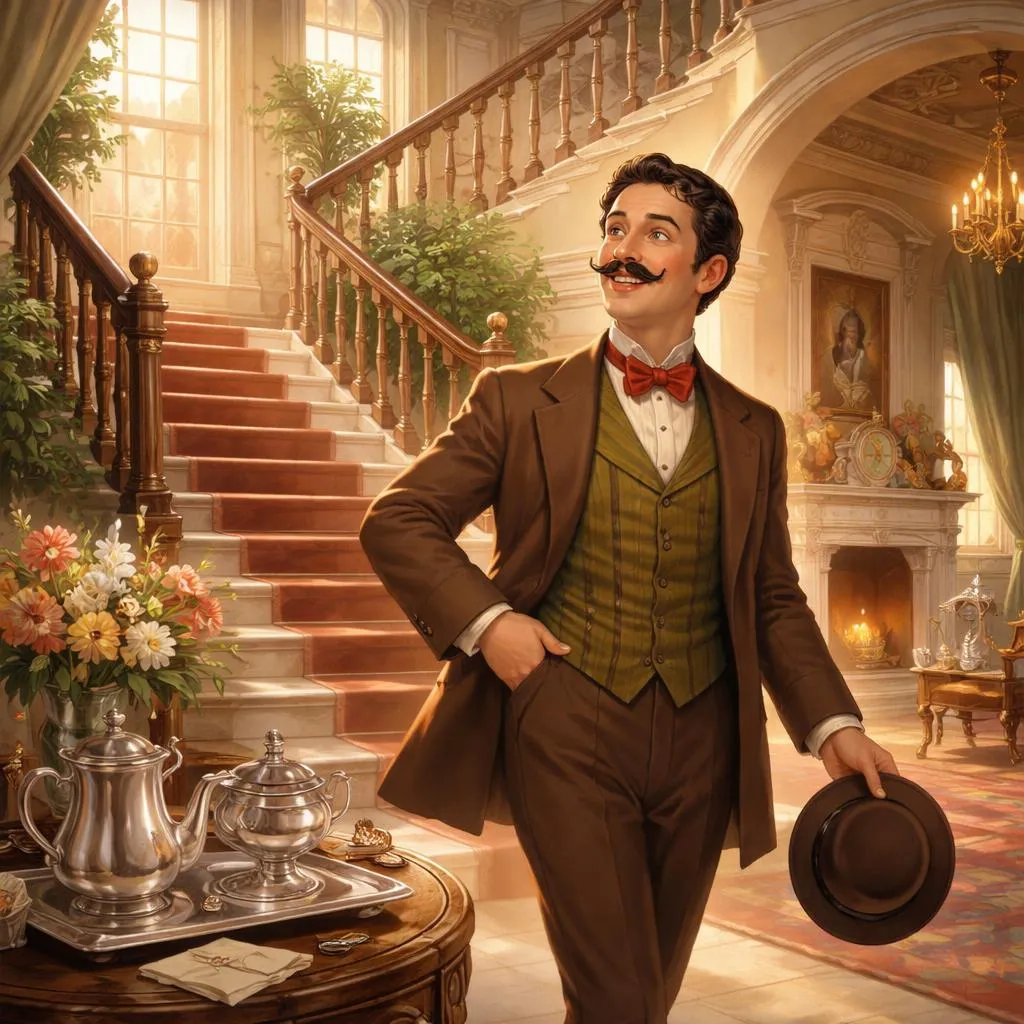

"Faith," muttered Passepartout, somewhat flurried, "I've seen people at Madame Tussaud's as lively as my new master!"
Madame Tussaud's "people," let it be said, are of wax, and are much visited in London; speech is all that is wanting to make them human.
During his brief interview with Mr. Fogg, Passepartout had been carefully observing him. He appeared to be a man about forty years of age, with fine, handsome features, and a tall, well-shaped figure; his hair and whiskers were light, his forehead compact and unwrinkled, his face rather pale, his teeth magnificent. His countenance possessed in the highest degree what physiognomists call "repose in action," a quality of those who act rather than talk. Calm and phlegmatic, with a clear eye, Mr. Fogg seemed a perfect type of that English composure which Angelica Kauffmann has so skilfully represented on canvas. Seen in the various phases of his daily life, he gave the idea of being perfectly well-balanced, as exactly regulated as a Leroy chronometer. Phileas Fogg was, indeed, exactitude personified, and this was betrayed even in the expression of his very hands and feet; for in men, as well as in animals, the limbs themselves are expressive of the passions.
He was so exact that he was never in a hurry, was always ready, and was economical alike of his steps and his motions. He never took one step too many, and always went to his destination by the shortest cut; he made no superfluous gestures, and was never seen to be moved or agitated. He was the most deliberate person in the world, yet always reached his destination at the exact moment.
He lived alone, and, so to speak, outside of every social relation; and as he knew that in this world account must be taken of friction, and that friction retards, he never rubbed against anybody.
As for Passepartout, he was a true Parisian of Paris. Since he had abandoned his own country for England, taking service as a valet, he had in vain searched for a master after his own heart. Passepartout was by no means one of those pert dunces depicted by Moliere with a bold gaze and a nose held high in the air; he was an honest fellow, with a pleasant face, lips a trifle protruding, soft-mannered and serviceable, with a good round head, such as one likes to see on the shoulders of a friend. His eyes were blue, his complexion rubicund, his figure almost portly and well-built, his body muscular, and his physical powers fully developed by the exercises of his younger days. His brown hair was somewhat tumbled; for, while the ancient sculptors are said to have known eighteen methods of arranging Minerva's tresses, Passepartout was familiar with but one of dressing his own: three strokes of a large-tooth comb completed his toilet.
It would be rash to predict how Passepartout's lively nature would agree with Mr. Fogg. It was impossible to tell whether the new servant would turn out as absolutely methodical as his master required; experience alone could solve the question. Passepartout had been a sort of vagrant in his early years, and now yearned for repose; but so far he had failed to find it, though he had already served in ten English houses. But he could not take root in any of these; with chagrin, he found his masters invariably whimsical and irregular, constantly running about the country, or on the look-out for adventure. His last master, young Lord Longferry, Member of Parliament, after passing his nights in the Haymarket taverns, was too often brought home in the morning on policemen's shoulders. Passepartout, desirous of respecting the gentleman whom he served, ventured a mild remonstrance on such conduct; which, being ill-received, he took his leave. Hearing that Mr. Phileas Fogg was looking for a servant, and that his life was one of unbroken regularity, that he neither travelled nor stayed from home overnight, he felt sure that this would be the place he was after. He presented himself, and was accepted, as has been seen.
At half-past eleven, then, Passepartout found himself alone in the house in Saville Row. He begun its inspection without delay, scouring it from cellar to garret. So clean, well-arranged, solemn a mansion pleased him; it seemed to him like a snail's shell, lighted and warmed by gas, which sufficed for both these purposes. When Passepartout reached the second story he recognised at once the room which he was to inhabit, and he was well satisfied with it. Electric bells and speaking-tubes afforded communication with the lower stories; while on the mantel stood an electric clock, precisely like that in Mr. Fogg's bedchamber, both beating the same second at the same instant. "That's good, that'll do," said Passepartout to himself.
He suddenly observed, hung over the clock, a card which, upon inspection, proved to be a programme of the daily routine of the house. It comprised all that was required of the servant, from eight in the morning, exactly at which hour Phileas Fogg rose, till half-past eleven, when he left the house for the Reform Club—all the details of service, the tea and toast at twenty-three minutes past eight, the shaving-water at thirty-seven minutes past nine, and the toilet at twenty minutes before ten. Everything was regulated and foreseen that was to be done from half-past eleven a.m. till midnight, the hour at which the methodical gentleman retired.
Mr. Fogg's wardrobe was amply supplied and in the best taste. Each pair of trousers, coat, and vest bore a number, indicating the time of year and season at which they were in turn to be laid out for wearing; and the same system was applied to the master's shoes. In short, the house in Saville Row, which must have been a very temple of disorder and unrest under the illustrious but dissipated Sheridan, was cosiness, comfort, and method idealised. There was no study, nor were there books, which would have been quite useless to Mr. Fogg; for at the Reform two libraries, one of general literature and the other of law and politics, were at his service. A moderate-sized safe stood in his bedroom, constructed so as to defy fire as well as burglars; but Passepartout found neither arms nor hunting weapons anywhere; everything betrayed the most tranquil and peaceable habits.
Having scrutinised the house from top to bottom, he rubbed his hands, a broad smile overspread his features, and he said joyfully, "This is just what I wanted! Ah, we shall get on together, Mr. Fogg and I! What a domestic and regular gentleman! A real machine; well, I don't mind serving a machine."
Hintergrund und Einführung des Autors
Dieser Auszug stammt aus dem klassischen Roman Reise um die Erde in achtzig Tagen von Jules Verne, einem gefeierten französischen Autor, der für seine Abenteuer- und Science-Fiction-Werke bekannt ist. Dieser 1873 verfasste Roman fängt den Geist der industriellen Revolution und die Faszination für neue Technologien und globale Reisen ein. Vernes lebhafte Vorstellungskraft und detaillierte Beschreibungen erwecken die Aufregung und die Herausforderungen einer Weltreise zu einer Zeit, als solche Reisen noch eine bemerkenswerte Leistung darstellten, zum Leben.
Detaillierte Interpretation der Geschichte
Der Auszug stellt zwei Hauptfiguren vor: Phileas Fogg, einen Mann von strenger Routine und Präzision, und seinen neu eingestellten Diener Passepartout, dessen lebhafte und flexible Natur im Gegensatz zu Foggs mechanischer Regelmäßigkeit steht. Fogg wird als ein Vorbild englischer Gelassenheit und Genauigkeit dargestellt, der ein so geordnetes Leben führt, dass jede Minute und Bewegung geplant und mit Sorgfalt ausgeführt wird. Passepartout hingegen ist eine warme, menschliche Figur mit einer bunten Vergangenheit und dem Wunsch nach Stabilität.
Dieser Einstieg bereitet die Bühne für das zentrale Abenteuer des Romans: Foggs Wette, die Welt in achtzig Tagen zu umrunden. Der Kontrast zwischen Foggs methodischer Natur und der unvorhersehbaren Welt, der er sich stellen wird, erzeugt Spannung und Humor in der gesamten Geschichte.
Was die Schüler lernen können
-
Der Wert von Disziplin und Routine: Phileas Foggs Charakter veranschaulicht die Kraft der Disziplin. Seine Pünktlichkeit, sorgfältige Planung und sein ruhiges Auftreten zeigen, wie Struktur helfen kann, ehrgeizige Ziele zu erreichen. Die Schüler können die Bedeutung von Zeitmanagement und Organisation in ihrem Studium und ihrem täglichen Leben lernen.
-
Anpassungsfähigkeit und Aufgeschlossenheit: Passepartouts Charakter erinnert uns daran, dass Routine zwar wertvoll ist, Flexibilität und Freundlichkeit aber ebenso wichtig sind. Seine vergangenen Erfahrungen und seine unbeschwerte Natur gleichen Foggs Starrheit aus und lehren die Schüler, verschiedene Persönlichkeiten zu schätzen und sich an neue Situationen anzupassen.
-
Mut und Abenteuer: Der Roman ermutigt die Leser, Herausforderungen anzunehmen und ihre Komfortzonen zu verlassen. Foggs Reise ist eine Metapher für Ausdauer und Tapferkeit und inspiriert junge Leser, ihre Träume trotz Hindernissen zu verfolgen.
-
Kulturelles Bewusstsein: Da die Geschichte durch verschiedene Länder und Kulturen führt, bietet sie einen Einblick in die Vielfalt der Welt. Dies erweitert den Horizont der Schüler und fördert den Respekt vor verschiedenen Völkern und Traditionen.
Anwendung dieser Lektionen im Leben
- Im Lernen: Die Schüler können Foggs Engagement übernehmen, indem sie sich klare Ziele setzen und einen Studienplan einhalten, aber auch Passepartouts Flexibilität berücksichtigen, um unerwartete Veränderungen oder Schwierigkeiten mit Anmut zu bewältigen.
- In sozialen Umgebungen: Die Erkenntnis des Wertes verschiedener Persönlichkeiten hilft, Empathie und Teamarbeit aufzubauen. So wie sich Fogg und Passepartout ergänzen, können die Schüler lernen, gut mit Klassenkameraden zusammenzuarbeiten, die unterschiedliche Stärken haben.
- In der persönlichen Entwicklung: Der Geist des Abenteuers fördert Neugier und Widerstandsfähigkeit. Die Schüler können sich selbst herausfordern, neue Aktivitäten auszuprobieren, zu reisen oder neue Ideen zu erforschen und so ihr Selbstvertrauen und ihre Weltanschauung zu erweitern.
Positive Eigenschaften aus der Geschichte kultivieren
- Präzision und Verantwortung: Wie Fogg können die Schüler üben, für ihre Aufgaben verantwortlich zu sein und ihre Verpflichtungen pünktlich zu erfüllen.
- Freundlichkeit und Unterstützung: Inspiriert von Passepartout schafft das Zeigen von Freundlichkeit und Unterstützung für andere starke Freundschaften und ein positives Umfeld.
- Problemlösung: Die Geschichte zeigt, dass unerwartete Probleme auftreten, aber ruhiges Denken und Entschlossenheit zum Erfolg führen. Die Schüler können Problemlösungsfähigkeiten entwickeln, indem sie ruhig bleiben und kreativ denken.
Schlussfolgerung
Reise um die Erde in achtzig Tagen ist mehr als nur ein aufregendes Abenteuer; es ist eine reiche Quelle von Lektionen über Charakter, Kultur und Mut. Indem sie diese Geschichte lesen und darüber nachdenken, können die Schüler Erkenntnisse gewinnen, die ihnen in der Schule, in Beziehungen und auf den vielen Reisen des Lebens helfen. Disziplin und Flexibilität zu umarmen, Vielfalt zu respektieren und es zu wagen, das Unbekannte zu erforschen, sind zeitlose Werte, die dieser klassische Roman wunderschön vermittelt.
