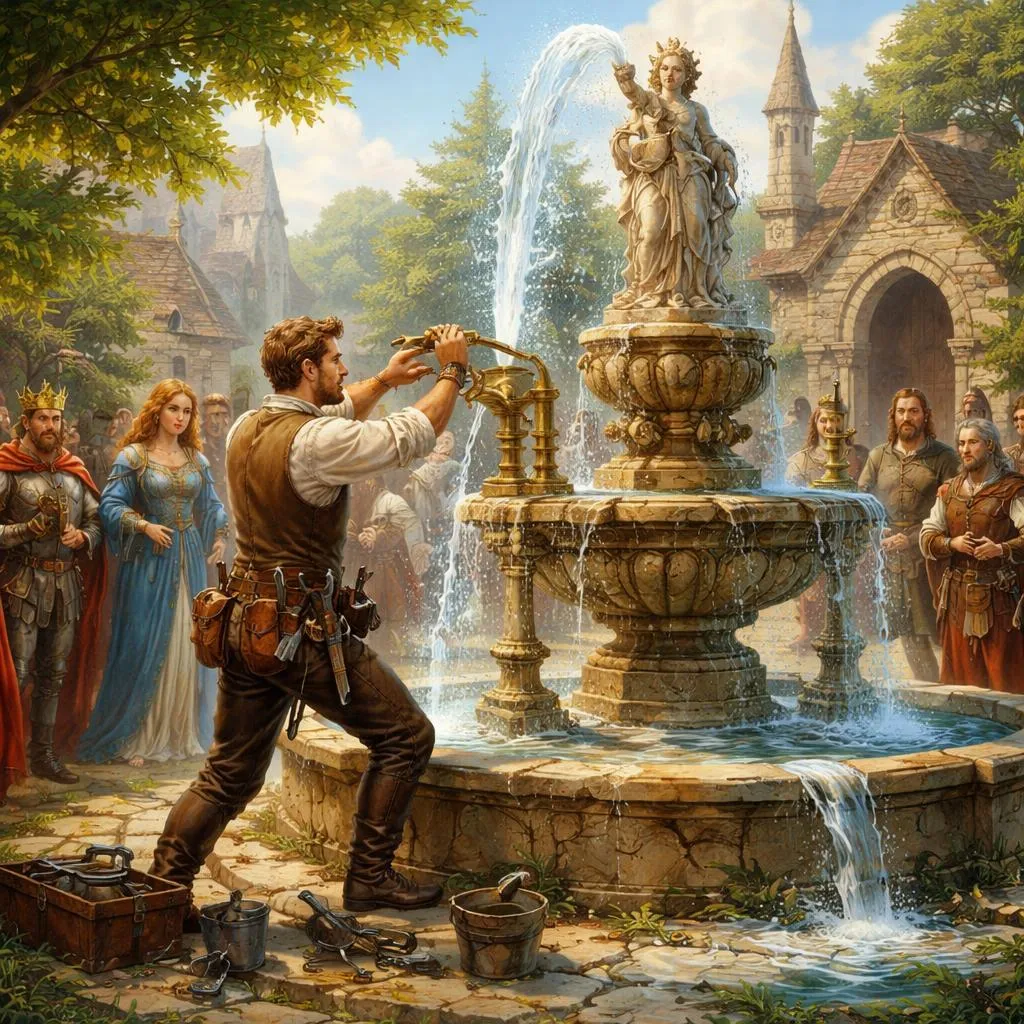

Saturday noon I went to the well and looked on a while. Merlin was still burning smoke-powders, and pawing the air, and muttering gibberish as hard as ever, but looking pretty down-hearted, for of course he had not started even a perspiration in that well yet. Finally I said:
“How does the thing promise by this time, partner?”
“Behold, I am even now busied with trial of the powerfulest enchantment known to the princes of the occult arts in the lands of the East; an it fail me, naught can avail. Peace, until I finish.”
He raised a smoke this time that darkened all the region, and must have made matters uncomfortable for the hermits, for the wind was their way, and it rolled down over their dens in a dense and billowy fog. He poured out volumes of speech to match, and contorted his body and sawed the air with his hands in a most extraordinary way. At the end of twenty minutes he dropped down panting, and about exhausted. Now arrived the abbot and several hundred monks and nuns, and behind them a multitude of pilgrims and a couple of acres of foundlings, all drawn by the prodigious smoke, and all in a grand state of excitement. The abbot inquired anxiously for results. Merlin said:
“If any labor of mortal might break the spell that binds these waters, this which I have but just essayed had done it. It has failed; whereby I do now know that that which I had feared is a truth established; the sign of this failure is, that the most potent spirit known to the magicians of the East, and whose name none may utter and live, has laid his spell upon this well. The mortal does not breathe, nor ever will, who can penetrate the secret of that spell, and without that secret none can break it. The water will flow no more forever, good Father. I have done what man could. Suffer me to go.”
Of course this threw the abbot into a good deal of a consternation. He turned to me with the signs of it in his face, and said:
“Ye have heard him. Is it true?”
“Part of it is.”
“Not all, then, not all! What part is true?”
“That that spirit with the Russian name has put his spell upon the well.”
“God’s wounds, then are we ruined!”
“Possibly.”
“But not certainly? Ye mean, not certainly?”
“That is it.”
“Wherefore, ye also mean that when he saith none can break the spell—”
“Yes, when he says that, he says what isn’t necessarily true. There are conditions under which an effort to break it may have some chance—that is, some small, some trifling chance—of success.”
“The conditions—”
“Oh, they are nothing difficult. Only these: I want the well and the surroundings for the space of half a mile, entirely to myself from sunset to-day until I remove the ban—and nobody allowed to cross the ground but by my authority.”
“Are these all?”
“Yes.”
“And you have no fear to try?”
“Oh, none. One may fail, of course; and one may also succeed. One can try, and I am ready to chance it. I have my conditions?”
“These and all others ye may name. I will issue commandment to that effect.”
“Wait,” said Merlin, with an evil smile. “Ye wit that he that would break this spell must know that spirit’s name?”
“Yes, I know his name.”
“And wit you also that to know it skills not of itself, but ye must likewise pronounce it? Ha-ha! Knew ye that?”
“Yes, I knew that, too.”
“You had that knowledge! Art a fool? Are ye minded to utter that name and die?”
“Utter it? Why certainly. I would utter it if it was Welsh.”
“Ye are even a dead man, then; and I go to tell Arthur.”
“That’s all right. Take your gripsack and get along. The thing for you to do is to go home and work the weather, John W. Merlin.”
It was a home shot, and it made him wince; for he was the worst weather-failure in the kingdom. Whenever he ordered up the danger-signals along the coast there was a week’s dead calm, sure, and every time he prophesied fair weather it rained brickbats. But I kept him in the weather bureau right along, to undermine his reputation. However, that shot raised his bile, and instead of starting home to report my death, he said he would remain and enjoy it.
My two experts arrived in the evening, and pretty well fagged, for they had traveled double tides. They had pack-mules along, and had brought everything I needed—tools, pump, lead pipe, Greek fire, sheaves of big rockets, roman candles, colored fire sprays, electric apparatus, and a lot of sundries—everything necessary for the stateliest kind of a miracle. They got their supper and a nap, and about midnight we sallied out through a solitude so wholly vacant and complete that it quite overpassed the required conditions. We took possession of the well and its surroundings. My boys were experts in all sorts of things, from the stoning up of a well to the constructing of a mathematical instrument. An hour before sunrise we had that leak mended in ship-shape fashion, and the water began to rise. Then we stowed our fireworks in the chapel, locked up the place, and went home to bed.
Before the noon mass was over, we were at the well again; for there was a deal to do yet, and I was determined to spring the miracle before midnight, for business reasons: for whereas a miracle worked for the Church on a week-day is worth a good deal, it is worth six times as much if you get it in on a Sunday. In nine hours the water had risen to its customary level—that is to say, it was within twenty-three feet of the top. We put in a little iron pump, one of the first turned out by my works near the capital; we bored into a stone reservoir which stood against the outer wall of the well-chamber and inserted a section of lead pipe that was long enough to reach to the door of the chapel and project beyond the threshold, where the gushing water would be visible to the two hundred and fifty acres of people I was intending should be present on the flat plain in front of this little holy hillock at the proper time.
We knocked the head out of an empty hogshead and hoisted this hogshead to the flat roof of the chapel, where we clamped it down fast, poured in gunpowder till it lay loosely an inch deep on the bottom, then we stood up rockets in the hogshead as thick as they could loosely stand, all the different breeds of rockets there are; and they made a portly and imposing sheaf, I can tell you. We grounded the wire of a pocket electrical battery in that powder, we placed a whole magazine of Greek fire on each corner of the roof—blue on one corner, green on another, red on another, and purple on the last—and grounded a wire in each.
About two hundred yards off, in the flat, we built a pen of scantlings, about four feet high, and laid planks on it, and so made a platform. We covered it with swell tapestries borrowed for the occasion, and topped it off with the abbot’s own throne. When you are going to do a miracle for an ignorant race, you want to get in every detail that will count; you want to make all the properties impressive to the public eye; you want to make matters comfortable for your head guest; then you can turn yourself loose and play your effects for all they are worth. I know the value of these things, for I know human nature. You can’t throw too much style into a miracle. It costs trouble, and work, and sometimes money; but it pays in the end. Well, we brought the wires to the ground at the chapel, and then brought them under the ground to the platform, and hid the batteries there. We put a rope fence a hundred feet square around the platform to keep off the common multitude, and that finished the work. My idea was, doors open at 10:30, performance to begin at 11:25 sharp. I wished I could charge admission, but of course that wouldn’t answer. I instructed my boys to be in the chapel as early as 10, before anybody was around, and be ready to man the pumps at the proper time, and make the fur fly. Then we went home to supper.
The news of the disaster to the well had traveled far by this time; and now for two or three days a steady avalanche of people had been pouring into the valley. The lower end of the valley was become one huge camp; we should have a good house, no question about that. Criers went the rounds early in the evening and announced the coming attempt, which put every pulse up to fever heat. They gave notice that the abbot and his official suite would move in state and occupy the platform at 10:30, up to which time all the region which was under my ban must be clear; the bells would then cease from tolling, and this sign should be permission to the multitudes to close in and take their places.
I was at the platform and all ready to do the honors when the abbot’s solemn procession hove in sight—which it did not do till it was nearly to the rope fence, because it was a starless black night and no torches permitted. With it came Merlin, and took a front seat on the platform; he was as good as his word for once. One could not see the multitudes banked together beyond the ban, but they were there, just the same. The moment the bells stopped, those banked masses broke and poured over the line like a vast black wave, and for as much as a half hour it continued to flow, and then it solidified itself, and you could have walked upon a pavement of human heads to—well, miles.
We had a solemn stage-wait, now, for about twenty minutes—a thing I had counted on for effect; it is always good to let your audience have a chance to work up its expectancy. At length, out of the silence a noble Latin chant—men’s voices—broke and swelled up and rolled away into the night, a majestic tide of melody. I had put that up, too, and it was one of the best effects I ever invented. When it was finished I stood up on the platform and extended my hands abroad, for two minutes, with my face uplifted—that always produces a dead hush—and then slowly pronounced this ghastly word with a kind of awfulness which caused hundreds to tremble, and many women to faint:
“Constantinopolitanischerdudelsackspfeifenmachersgesellschafft!”
Just as I was moaning out the closing hunks of that word, I touched off one of my electric connections and all that murky world of people stood revealed in a hideous blue glare! It was immense —that effect! Lots of people shrieked, women curled up and quit in every direction, foundlings collapsed by platoons. The abbot and the monks crossed themselves nimbly and their lips fluttered with agitated prayers. Merlin held his grip, but he was astonished clear down to his corns; he had never seen anything to begin with that, before. Now was the time to pile in the effects. I lifted my hands and groaned out this word—as it were in agony:
“Nihilistendynamittheaterkaestchenssprengungsattentaetsversuchungen!”
—and turned on the red fire! You should have heard that Atlantic of people moan and howl when that crimson hell joined the blue! After sixty seconds I shouted:
“Transvaaltruppentropentransporttrampelthiertreibertrauungsthraenen- tragoedie!”
—and lit up the green fire! After waiting only forty seconds this time, I spread my arms abroad and thundered out the devastating syllables of this word of words:
“Mekkamuselmannenmassenmenchenmoerdermohrenmuttermarmormonumentenmacher!”
—and whirled on the purple glare! There they were, all going at once, red, blue, green, purple!—four furious volcanoes pouring vast clouds of radiant smoke aloft, and spreading a blinding rainbowed noonday to the furthest confines of that valley. In the distance one could see that fellow on the pillar standing rigid against the background of sky, his seesaw stopped for the first time in twenty years. I knew the boys were at the pump now and ready. So I said to the abbot:
“The time is come, Father. I am about to pronounce the dread name and command the spell to dissolve. You want to brace up, and take hold of something.” Then I shouted to the people: “Behold, in another minute the spell will be broken, or no mortal can break it. If it break, all will know it, for you will see the sacred water gush from the chapel door!”
I stood a few moments, to let the hearers have a chance to spread my announcement to those who couldn’t hear, and so convey it to the furthest ranks, then I made a grand exhibition of extra posturing and gesturing, and shouted:
“Lo, I command the fell spirit that possesses the holy fountain to now disgorge into the skies all the infernal fires that still remain in him, and straightway dissolve his spell and flee hence to the pit, there to lie bound a thousand years. By his own dread name I command it—BGWJJILLIGKKK!”
Then I touched off the hogshead of rockets, and a vast fountain of dazzling lances of fire vomited itself toward the zenith with a hissing rush, and burst in mid-sky into a storm of flashing jewels! One mighty groan of terror started up from the massed people —then suddenly broke into a wild hosannah of joy—for there, fair and plain in the uncanny glare, they saw the freed water leaping forth! The old abbot could not speak a word, for tears and the chokings in his throat; without utterance of any sort, he folded me in his arms and mashed me. It was more eloquent than speech. And harder to get over, too, in a country where there were really no doctors that were worth a damaged nickel.
You should have seen those acres of people throw themselves down in that water and kiss it; kiss it, and pet it, and fondle it, and talk to it as if it were alive, and welcome it back with the dear names they gave their darlings, just as if it had been a friend who was long gone away and lost, and was come home again. Yes, it was pretty to see, and made me think more of them than I had done before.
I sent Merlin home on a shutter. He had caved in and gone down like a landslide when I pronounced that fearful name, and had never come to since. He never had heard that name before,—neither had I—but to him it was the right one. Any jumble would have been the right one. He admitted, afterward, that that spirit’s own mother could not have pronounced that name better than I did. He never could understand how I survived it, and I didn’t tell him. It is only young magicians that give away a secret like that. Merlin spent three months working enchantments to try to find out the deep trick of how to pronounce that name and outlive it. But he didn’t arrive.
When I started to the chapel, the populace uncovered and fell back reverently to make a wide way for me, as if I had been some kind of a superior being—and I was. I was aware of that. I took along a night shift of monks, and taught them the mystery of the pump, and set them to work, for it was plain that a good part of the people out there were going to sit up with the water all night, consequently it was but right that they should have all they wanted of it. To those monks that pump was a good deal of a miracle itself, and they were full of wonder over it; and of admiration, too, of the exceeding effectiveness of its performance.
It was a great night, an immense night. There was reputation in it. I could hardly get to sleep for glorying over it.
Hintergrund und Einführung des Autors
Diese Geschichte ist ein Auszug aus "Der Wasserzauberer", einer Erzählung von Mark Twain, einem der berühmtesten amerikanischen Autoren, der für seinen Witz, Humor und seine scharfen Beobachtungen der Gesellschaft bekannt ist. Twain, dessen bürgerlicher Name Samuel Clemens war, lebte im 19. Jahrhundert und ist berühmt für Klassiker wie "Die Abenteuer von Tom Sawyer" und "Abenteuer von Huckleberry Finn". Seine Geschichten verbinden oft Humor mit scharfer Gesellschaftskritik und erforschen die menschliche Natur auf lebendige, einprägsame Weise.
In "Der Wasserzauberer" vermischt Twain Elemente der Fantasie, Satire und des Abenteuers, um eine Geschichte über Magie, Glauben und menschlichen Einfallsreichtum zu erzählen. Die Geschichte dreht sich um einen mysteriösen Brunnen, der von einem mächtigen Geist verflucht wurde, wodurch es unmöglich wurde, dass Wasser fließt. Der Erzähler unternimmt zusammen mit seinen Gefährten einen kühnen und theatralischen Versuch, den Bann zu brechen und das Wasser wiederherzustellen, wobei er eine Mischung aus Wissenschaft, Showmanship und Mut einsetzt.
Detaillierte Interpretation und Bedeutung
Im Kern erforscht die Geschichte Themen wie Glaube, Skepsis und die Kraft der menschlichen Kreativität. Der Brunnen symbolisiert ein Problem oder eine Herausforderung, die unüberwindlich erscheint, gebunden an Aberglauben und Angst. Merlin, der Zauberer, repräsentiert traditionelle Magie und alte Überzeugungen, die letztendlich scheitern, das Problem zu lösen. Der Erzähler hingegen verwendet moderne Werkzeuge, Technologie und geschickte Inszenierung, um ein "Wunder" zu vollbringen, das der Gemeinschaft Hoffnung und Leben zurückgibt.
Twain kritisiert geschickt den blinden Glauben an Aberglauben und die Faszination des Spektakels, während er gleichzeitig menschliche Entschlossenheit und Innovation feiert. Das dramatische Feuerwerk, die skandierende Menge und die aufwändige Inszenierung verdeutlichen, wie Menschen von Wundern und Geheimnissen angezogen werden, doch die wahre "Magie" liegt in Wissen und Anstrengung.
Lektionen und Erkenntnisse für Schüler
-
Kritisches Denken und Innovation: Der Erfolg des Erzählers beruht nicht auf Magie, sondern auf der Anwendung von Wissen, Planung und Technologie. Die Schüler können den Wert von kritischem Denken und Kreativität bei der Lösung von Problemen lernen, anstatt sich auf Aberglauben zu verlassen oder aufzugeben.
-
Mut, den Status Quo in Frage zu stellen: Die Geschichte ermutigt dazu, akzeptierte Überzeugungen zu hinterfragen und mutig genug zu sein, neue Ansätze auszuprobieren, auch wenn andere an einem zweifeln.
-
Die Macht der Präsentation: Der Erzähler versteht die menschliche Natur und nutzt Showmanship, um Menschen zu inspirieren und zu vereinen. Dies lehrt die Bedeutung von Kommunikationsfähigkeiten und wie Präsentation andere beeinflussen kann.
-
Teamwork und Vorbereitung: Der Erfolg des Erzählers hängt von einem Expertenteam und sorgfältiger Vorbereitung ab, was die Bedeutung von Zusammenarbeit und Planung hervorhebt.
-
Respekt vor den Überzeugungen anderer: Während die Geschichte Aberglauben kritisiert, zeigt sie auch Empathie für die Hoffnungen und Ängste der Menschen und erinnert die Schüler daran, unterschiedliche Perspektiven zu respektieren und gleichzeitig die Vernunft zu fördern.
Anwendung des Geistes der Geschichte im täglichen Leben
-
Im Lernen: Gehen Sie Herausforderungen mit Neugier und der Bereitschaft zum Experimentieren an. Nutzen Sie das Wissen aktiv und scheuen Sie sich nicht vor Fehlern; es ist Teil der Entdeckung.
-
In sozialen Situationen: Verstehen Sie die Macht von Worten und Taten. Wie die sorgfältige Inszenierung des Erzählers können die Schüler lernen, sich klar auszudrücken und andere positiv zu inspirieren.
-
In der persönlichen Entwicklung: Seien Sie offen für neue Ideen und bereit, alte Annahmen zu hinterfragen. Kultivieren Sie Widerstandsfähigkeit und Kreativität, um Hindernisse zu überwinden.
-
Im Teamwork: Schätzen Sie die Stärken anderer und arbeiten Sie gemeinsam auf gemeinsame Ziele hin. Vorbereitung und Zusammenarbeit führen oft zum Erfolg.
Positive Eigenschaften aus der Geschichte kultivieren
-
Einfallsreichtum: Fördern Sie Fähigkeiten zur Problemlösung und erfinderisches Denken.
-
Selbstvertrauen: Glauben Sie an Ihre Fähigkeit, etwas zu bewirken, auch wenn Sie mit Zweifeln konfrontiert sind.
-
Empathie: Erkennen Sie die Gefühle und Überzeugungen anderer und bringen Sie Respekt und Vernunft in Einklang.
-
Führungsqualitäten: Lernen Sie, andere durch Vorbild und effektive Kommunikation zu inspirieren und zu führen.
-
Ausdauer: Verstehen Sie, dass Erfolg oft Geduld, Anstrengung und Ausdauer erfordert.
Schlussfolgerung
Mark Twains "Der Wasserzauberer" ist mehr als eine Geschichte über Magie und Wunder; es ist eine Geschichte über den menschlichen Geist, den Intellekt und den Triumph von Vernunft und Mut über Angst und Aberglauben. Für Schüler und junge Leser bietet sie reichhaltige Lektionen, wie man sich Herausforderungen stellt, kritisch denkt und andere inspiriert. Indem junge Menschen die positiven Werte der Geschichte annehmen, können sie sich zu nachdenklichen, kreativen und mitfühlenden Individuen entwickeln, die bereit sind, ihre eigene Art von Magie in der Welt zu wirken.
