
It was October again when Anne was ready to go back to school—a glorious October, all red and gold, with mellow mornings when the valleys were filled with delicate mists as if the spirit of autumn had poured them in for the sun to drain—amethyst, pearl, silver, rose, and smoke-blue. The dews were so heavy that the fields glistened like cloth of silver and there were such heaps of rustling leaves in the hollows of many-stemmed woods to run crisply through. The Birch Path was a canopy of yellow and the ferns were sear and brown all along it. There was a tang in the very air that inspired the hearts of small maidens tripping, unlike snails, swiftly and willingly to school; and it WAS jolly to be back again at the little brown desk beside Diana, with Ruby Gillis nodding across the aisle and Carrie Sloane sending up notes and Julia Bell passing a “chew” of gum down from the back seat. Anne drew a long breath of happiness as she sharpened her pencil and arranged her picture cards in her desk. Life was certainly very interesting.
In the new teacher she found another true and helpful friend. Miss Stacy was a bright, sympathetic young woman with the happy gift of winning and holding the affections of her pupils and bringing out the best that was in them mentally and morally. Anne expanded like a flower under this wholesome influence and carried home to the admiring Matthew and the critical Marilla glowing accounts of schoolwork and aims.
“I love Miss Stacy with my whole heart, Marilla. She is so ladylike and she has such a sweet voice. When she pronounces my name I feel INSTINCTIVELY that she’s spelling it with an E. We had recitations this afternoon. I just wish you could have been there to hear me recite ‘Mary, Queen of Scots.’ I just put my whole soul into it. Ruby Gillis told me coming home that the way I said the line, ‘Now for my father’s arm,’ she said, ‘my woman’s heart farewell,’ just made her blood run cold.”
“Well now, you might recite it for me some of these days, out in the barn,” suggested Matthew.
“Of course I will,” said Anne meditatively, “but I won’t be able to do it so well, I know. It won’t be so exciting as it is when you have a whole schoolful before you hanging breathlessly on your words. I know I won’t be able to make your blood run cold.”
“Mrs. Lynde says it made HER blood run cold to see the boys climbing to the very tops of those big trees on Bell’s hill after crows’ nests last Friday,” said Marilla. “I wonder at Miss Stacy for encouraging it.”
“But we wanted a crow’s nest for nature study,” explained Anne. “That was on our field afternoon. Field afternoons are splendid, Marilla. And Miss Stacy explains everything so beautifully. We have to write compositions on our field afternoons and I write the best ones.”
“It’s very vain of you to say so then. You’d better let your teacher say it.”
“But she DID say it, Marilla. And indeed I’m not vain about it. How can I be, when I’m such a dunce at geometry? Although I’m really beginning to see through it a little, too. Miss Stacy makes it so clear. Still, I’ll never be good at it and I assure you it is a humbling reflection. But I love writing compositions. Mostly Miss Stacy lets us choose our own subjects; but next week we are to write a composition on some remarkable person. It’s hard to choose among so many remarkable people who have lived. Mustn’t it be splendid to be remarkable and have compositions written about you after you’re dead? Oh, I would dearly love to be remarkable. I think when I grow up I’ll be a trained nurse and go with the Red Crosses to the field of battle as a messenger of mercy. That is, if I don’t go out as a foreign missionary. That would be very romantic, but one would have to be very good to be a missionary, and that would be a stumbling block. We have physical culture exercises every day, too. They make you graceful and promote digestion.”
“Promote fiddlesticks!” said Marilla, who honestly thought it was all nonsense.
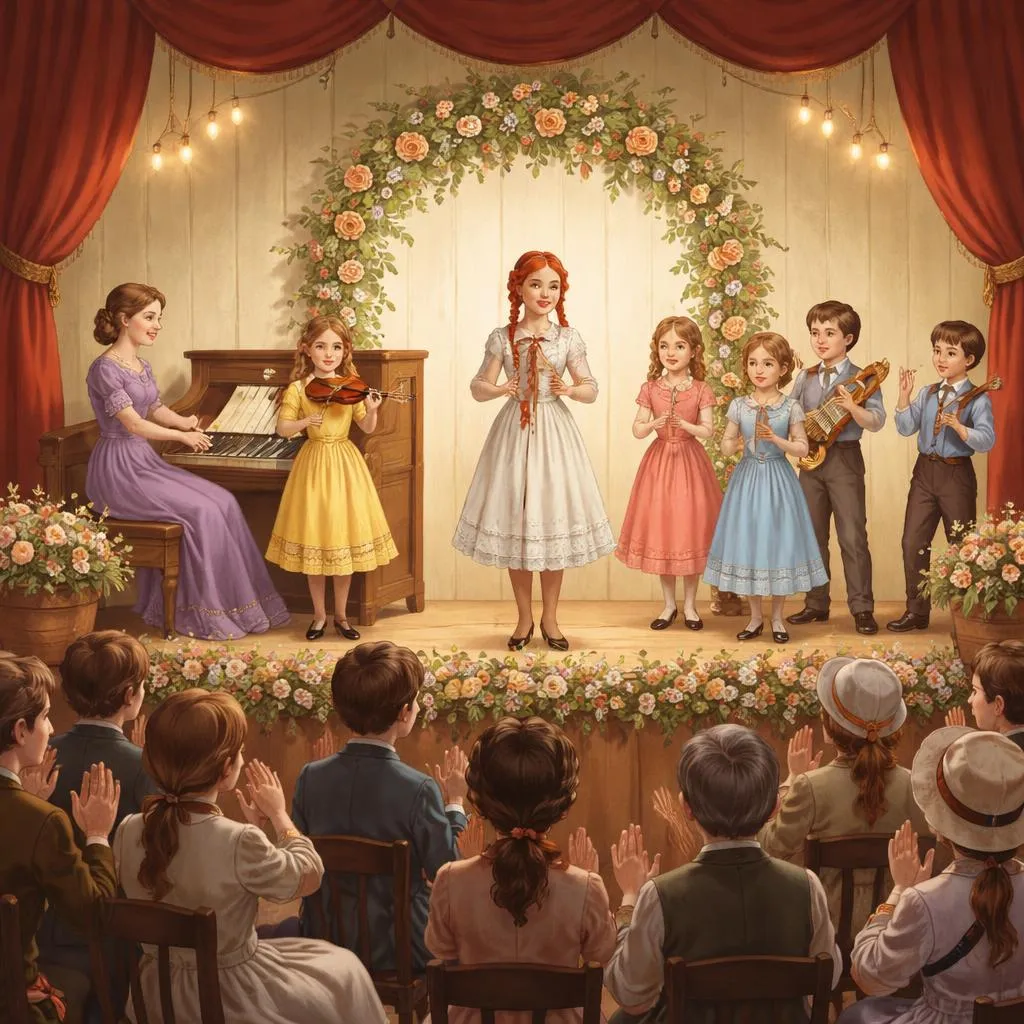
But all the field afternoons and recitation Fridays and physical culture contortions paled before a project which Miss Stacy brought forward in November. This was that the scholars of Avonlea school should get up a concert and hold it in the hall on Christmas Night, for the laudable purpose of helping to pay for a schoolhouse flag. The pupils one and all taking graciously to this plan, the preparations for a program were begun at once. And of all the excited performers-elect none was so excited as Anne Shirley, who threw herself into the undertaking heart and soul, hampered as she was by Marilla’s disapproval. Marilla thought it all rank foolishness.
“It’s just filling your heads up with nonsense and taking time that ought to be put on your lessons,” she grumbled. “I don’t approve of children’s getting up concerts and racing about to practices. It makes them vain and forward and fond of gadding.”
“But think of the worthy object,” pleaded Anne. “A flag will cultivate a spirit of patriotism, Marilla.”
“Fudge! There’s precious little patriotism in the thoughts of any of you. All you want is a good time.”
“Well, when you can combine patriotism and fun, isn’t it all right? Of course it’s real nice to be getting up a concert. We’re going to have six choruses and Diana is to sing a solo. I’m in two dialogues—’The Society for the Suppression of Gossip’ and ‘The Fairy Queen.’ The boys are going to have a dialogue too. And I’m to have two recitations, Marilla. I just tremble when I think of it, but it’s a nice thrilly kind of tremble. And we’re to have a tableau at the last—’Faith, Hope and Charity.’ Diana and Ruby and I are to be in it, all draped in white with flowing hair. I’m to be Hope, with my hands clasped—so—and my eyes uplifted. I’m going to practice my recitations in the garret. Don’t be alarmed if you hear me groaning. I have to groan heartrendingly in one of them, and it’s really hard to get up a good artistic groan, Marilla. Josie Pye is sulky because she didn’t get the part she wanted in the dialogue. She wanted to be the fairy queen. That would have been ridiculous, for who ever heard of a fairy queen as fat as Josie? Fairy queens must be slender. Jane Andrews is to be the queen and I am to be one of her maids of honor. Josie says she thinks a red-haired fairy is just as ridiculous as a fat one, but I do not let myself mind what Josie says. I’m to have a wreath of white roses on my hair and Ruby Gillis is going to lend me her slippers because I haven’t any of my own. It’s necessary for fairies to have slippers, you know. You couldn’t imagine a fairy wearing boots, could you? Especially with copper toes? We are going to decorate the hall with creeping spruce and fir mottoes with pink tissue-paper roses in them. And we are all to march in two by two after the audience is seated, while Emma White plays a march on the organ. Oh, Marilla, I know you are not so enthusiastic about it as I am, but don’t you hope your little Anne will distinguish herself?”
“All I hope is that you’ll behave yourself. I’ll be heartily glad when all this fuss is over and you’ll be able to settle down. You are simply good for nothing just now with your head stuffed full of dialogues and groans and tableaus. As for your tongue, it’s a marvel it’s not clean worn out.”
Anne sighed and betook herself to the back yard, over which a young new moon was shining through the leafless poplar boughs from an apple-green western sky, and where Matthew was splitting wood. Anne perched herself on a block and talked the concert over with him, sure of an appreciative and sympathetic listener in this instance at least.
“Well now, I reckon it’s going to be a pretty good concert. And I expect you’ll do your part fine,” he said, smiling down into her eager, vivacious little face. Anne smiled back at him. Those two were the best of friends and Matthew thanked his stars many a time and oft that he had nothing to do with bringing her up. That was Marilla’s exclusive duty; if it had been his he would have been worried over frequent conflicts between inclination and said duty. As it was, he was free to, “spoil Anne”—Marilla’s phrasing—as much as he liked. But it was not such a bad arrangement after all; a little “appreciation” sometimes does quite as much good as all the conscientious “bringing up” in the world.
Hintergrund und Einführung der Autorin
Dieser Auszug stammt aus Anne auf Green Gables, einem klassischen Roman der kanadischen Autorin Lucy Maud Montgomery. Erschienen im Jahr 1908, erzählt er die Geschichte von Anne Shirley, einem fantasievollen und temperamentvollen Waisenmädchen, das fälschlicherweise zu Marilla und Matthew Cuthbert geschickt wird, einem Bruder und einer Schwester, die beabsichtigt hatten, einen Jungen zu adoptieren, um ihnen auf ihrer Farm in Avonlea, Prince Edward Island, zu helfen. Der Roman wird weltweit für seine lebendigen Beschreibungen des Landlebens, seine bezaubernden Charaktere und seine Themen wie Zugehörigkeit, Identität und persönliches Wachstum geliebt. Montgomery, inspiriert von ihren eigenen Kindheitserfahrungen und der Schönheit von Prince Edward Island, schuf eine zeitlose Geschichte, die Fantasie, Widerstandsfähigkeit und die Freuden und Herausforderungen des Erwachsenwerdens feiert.
Detaillierte Interpretation und Bedeutung
Diese Passage fängt Annes Aufregung über die Rückkehr zur Schule und ihre Bewunderung für ihre neue Lehrerin, Miss Stacy, ein, die ihre intellektuelle und moralische Entwicklung fördert. Die lebendigen Beschreibungen des Herbstes und der Schulumgebung unterstreichen Annes tiefe Verbundenheit mit der Natur und ihren freudigen Geist. Das Schulkonzertprojekt symbolisiert Gemeinschaftsgeist, Kreativität und die Bedeutung der Zusammenarbeit für ein gemeinsames Ziel. Annes Begeisterung steht im Gegensatz zu Marillas praktischen Bedenken und veranschaulicht die Spannung zwischen Fantasie und Realismus – ein zentrales Thema in dem Roman.
Annes Bestrebungen, bemerkenswert zu sein, und ihre Träume, Krankenschwester oder Missionarin zu werden, offenbaren ihren Wunsch, einen sinnvollen Einfluss auf die Welt auszuüben, was die Ermutigung des Romans zu Ehrgeiz und Ziel widerspiegelt. Die Geschichte berührt auch Themen wie Freundschaft, Selbstausdruck und den Wert der Bildung und zeigt, wie positive Einflüsse wie Miss Stacy das Potenzial eines Kindes fördern können.
Lektionen und Inspirationen für Schüler
Schüler, die diese Geschichte lesen, können mehrere wertvolle Lektionen lernen:
-
Die Kraft der Fantasie und des Optimismus: Annes lebhafte Fantasie und ihre positive Einstellung helfen ihr, Herausforderungen zu meistern und Freude im Alltag zu finden. Schüler können dazu inspiriert werden, die Welt kreativ zu sehen und ihre einzigartigen Eigenschaften anzunehmen.
-
Die Bedeutung von Bildung und Mentoring: Miss Stacys Rolle als unterstützende Lehrerin zeigt, wie Pädagogen Selbstvertrauen und Wachstum fördern können. Die Schüler sollten den Wert des Lernens schätzen und sich von Mentoren beraten lassen.
-
Träume mit der Realität in Einklang bringen: Annes Träume sind großartig, aber sie erkennt auch ihre Grenzen, wie z. B. ihre Schwierigkeiten mit der Geometrie. Dies lehrt die Schüler die Bedeutung von Ausdauer und Demut.
-
Gemeinschaft und Zusammenarbeit: Das Schulkonzertprojekt zeigt, wie die Zusammenarbeit sinnvolle Ziele erreichen und ein Gefühl der Zugehörigkeit aufbauen kann.
-
Unterschiedliche Perspektiven respektieren: Die unterschiedlichen Ansichten von Anne und Marilla ermutigen die Leser, verschiedene Meinungen zu verstehen und zu respektieren und Begeisterung mit Praktikabilität in Einklang zu bringen.
Anwendungen im Leben, Lernen und in sozialen Situationen
- In der Schule: Die Schüler können Annes Begeisterung für das Lernen anwenden, indem sie sich aktiv am Unterricht beteiligen, an außerschulischen Aktivitäten teilnehmen und Herausforderungen mit Mut annehmen.
- Im sozialen Leben: Annes Freundlichkeit und ihre Bereitschaft, andere einzubeziehen, können die Schüler dazu inspirieren, Freundschaften auf der Grundlage von Empathie und Unterstützung aufzubauen.
- In der persönlichen Entwicklung: Annes Geschichte fördert den Selbstausdruck und das Verfolgen der eigenen Leidenschaften, während man gleichzeitig aus konstruktiver Kritik lernt und danach strebt, sich zu verbessern.
- Im gesellschaftlichen Engagement: Wie das Konzertprojekt können sich die Schüler an Gemeinschaftsveranstaltungen beteiligen und Teamwork und die Freude am Beitrag zu einer Sache erlernen.
Positive Eigenschaften aus der Geschichte kultivieren
- Neugier und Liebe zum Lernen: Folgen Sie Annes Beispiel, indem Sie Fragen stellen, neue Themen erforschen und den Entdeckungsprozess genießen.
- Resilienz und Optimismus: Stellen Sie sich Schwierigkeiten mit einer hoffnungsvollen Einstellung, indem Sie Rückschläge als Chancen sehen, stärker zu werden.
- Kreativität und Fantasie: Nutzen Sie kreatives Denken, um Probleme zu lösen und sich durch Schreiben, Kunst oder Performance auszudrücken.
- Respekt und Freundlichkeit: Behandeln Sie andere mit Respekt, auch wenn die Meinungen abweichen, und bieten Sie Freunden und Klassenkameraden Unterstützung an.
- Verantwortung und Engagement: Nehmen Sie Ihre Pflichten ernst, sei es bei Schulprojekten oder Familienaufgaben, und bringen Sie Spaß mit Konzentration in Einklang.
Anne auf Green Gables ist nach wie vor eine kraftvolle Geschichte für junge Leser, die sie ermutigt, ihre Individualität anzunehmen, ihre Talente zu fördern und positiv zu ihren Gemeinschaften beizutragen. Durch Annes Augen lernen die Schüler, dass das Leben voller Wunder ist und dass sie mit Mut und Freundlichkeit ihre eigenen bemerkenswerten Spuren in der Welt hinterlassen können.
