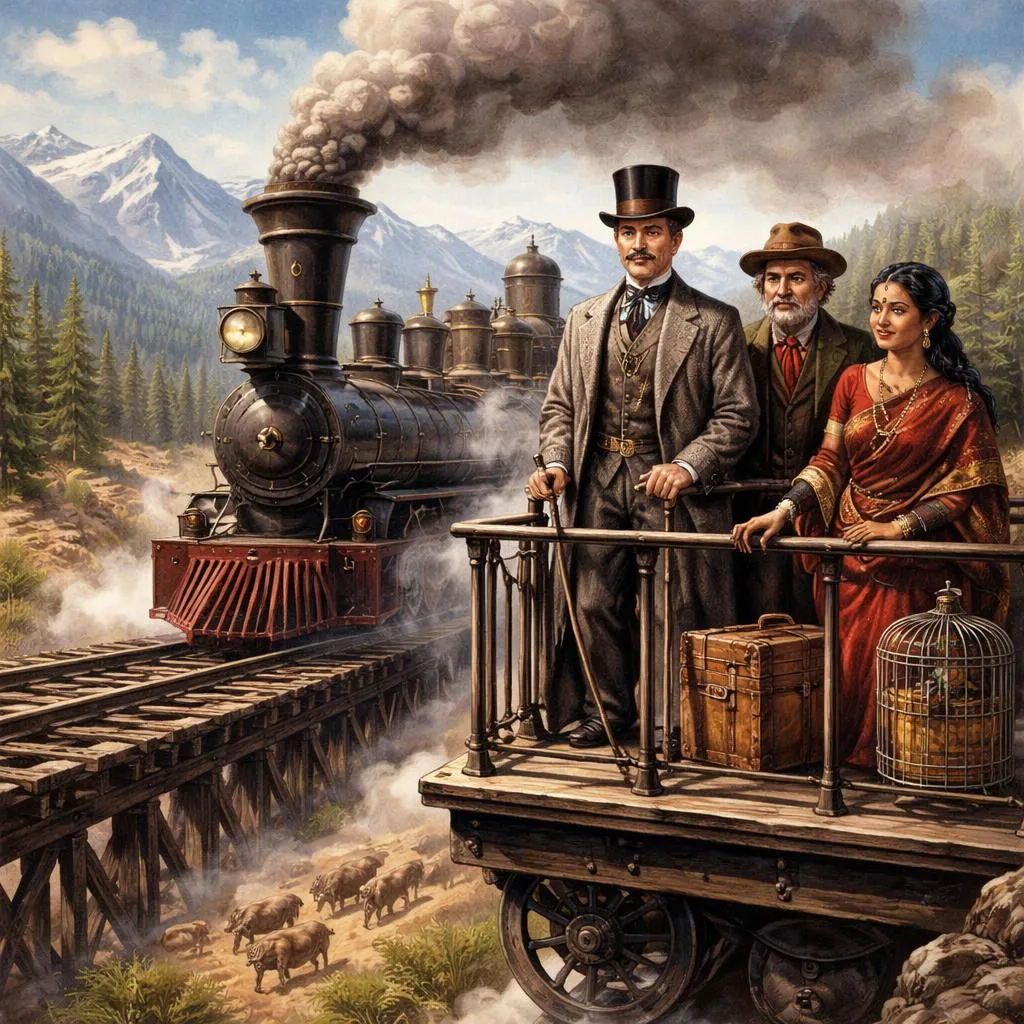

"From ocean to ocean"—so say the Americans; and these four words compose the general designation of the "great trunk line" which crosses the entire width of the United States. The Pacific Railroad is, however, really divided into two distinct lines: the Central Pacific, between San Francisco and Ogden, and the Union Pacific, between Ogden and Omaha. Five main lines connect Omaha with New York.
New York and San Francisco are thus united by an uninterrupted metal ribbon, which measures no less than three thousand seven hundred and eighty–six miles. Between Omaha and the Pacific the railway crosses a territory which is still infested by Indians and wild beasts, and a large tract which the Mormons, after they were driven from Illinois in 1845, began to colonise.
The journey from New York to San Francisco consumed, formerly, under the most favourable conditions, at least six months. It is now accomplished in seven days.
It was in 1862 that, in spite of the Southern Members of Congress, who wished a more southerly route, it was decided to lay the road between the forty–first and forty–second parallels. President Lincoln himself fixed the end of the line at Omaha, in Nebraska. The work was at once commenced, and pursued with true American energy; nor did the rapidity with which it went on injuriously affect its good execution. The road grew, on the prairies, a mile and a half a day. A locomotive, running on the rails laid down the evening before, brought the rails to be laid on the morrow, and advanced upon them as fast as they were put in position.
The Pacific Railroad is joined by several branches in Iowa, Kansas, Colorado, and Oregon. On leaving Omaha, it passes along the left bank of the Platte River as far as the junction of its northern branch, follows its southern branch, crosses the Laramie territory and the Wahsatch Mountains, turns the Great Salt Lake, and reaches Salt Lake City, the Mormon capital, plunges into the Tuilla Valley, across the American Desert, Cedar and Humboldt Mountains, the Sierra Nevada, and descends, via Sacramento, to the Pacific—its grade, even on the Rocky Mountains, never exceeding one hundred and twelve feet to the mile.
Such was the road to be traversed in seven days, which would enable Phileas Fogg—at least, so he hoped—to take the Atlantic steamer at New York on the 11th for Liverpool.
The car which he occupied was a sort of long omnibus on eight wheels, and with no compartments in the interior. It was supplied with two rows of seats, perpendicular to the direction of the train on either side of an aisle which conducted to the front and rear platforms. These platforms were found throughout the train, and the passengers were able to pass from one end of the train to the other. It was supplied with saloon cars, balcony cars, restaurants, and smoking–cars; theatre cars alone were wanting, and they will have these some day.
Book and news dealers, sellers of edibles, drinkables, and cigars, who seemed to have plenty of customers, were continually circulating in the aisles.
The train left Oakland station at six o'clock. It was already night, cold and cheerless, the heavens being overcast with clouds which seemed to threaten snow. The train did not proceed rapidly; counting the stoppages, it did not run more than twenty miles an hour, which was a sufficient speed, however, to enable it to reach Omaha within its designated time.
There was but little conversation in the car, and soon many of the passengers were overcome with sleep. Passepartout found himself beside the detective; but he did not talk to him. After recent events, their relations with each other had grown somewhat cold; there could no longer be mutual sympathy or intimacy between them. Fix's manner had not changed; but Passepartout was very reserved, and ready to strangle his former friend on the slightest provocation.
Snow began to fall an hour after they started, a fine snow, however, which happily could not obstruct the train; nothing could be seen from the windows but a vast, white sheet, against which the smoke of the locomotive had a greyish aspect.
At eight o'clock a steward entered the car and announced that the time for going to bed had arrived; and in a few minutes the car was transformed into a dormitory. The backs of the seats were thrown back, bedsteads carefully packed were rolled out by an ingenious system, berths were suddenly improvised, and each traveller had soon at his disposition a comfortable bed, protected from curious eyes by thick curtains. The sheets were clean and the pillows soft. It only remained to go to bed and sleep which everybody did—while the train sped on across the State of California.
The country between San Francisco and Sacramento is not very hilly. The Central Pacific, taking Sacramento for its starting–point, extends eastward to meet the road from Omaha. The line from San Francisco to Sacramento runs in a north–easterly direction, along the American River, which empties into San Pablo Bay. The one hundred and twenty miles between these cities were accomplished in six hours, and towards midnight, while fast asleep, the travellers passed through Sacramento; so that they saw nothing of that important place, the seat of the State government, with its fine quays, its broad streets, its noble hotels, squares, and churches.
The train, on leaving Sacramento, and passing the junction, Roclin, Auburn, and Colfax, entered the range of the Sierra Nevada. 'Cisco was reached at seven in the morning; and an hour later the dormitory was transformed into an ordinary car, and the travellers could observe the picturesque beauties of the mountain region through which they were steaming. The railway track wound in and out among the passes, now approaching the mountain–sides, now suspended over precipices, avoiding abrupt angles by bold curves, plunging into narrow defiles, which seemed to have no outlet. The locomotive, its great funnel emitting a weird light, with its sharp bell, and its cow–catcher extended like a spur, mingled its shrieks and bellowings with the noise of torrents and cascades, and twined its smoke among the branches of the gigantic pines.
There were few or no bridges or tunnels on the route. The railway turned around the sides of the mountains, and did not attempt to violate nature by taking the shortest cut from one point to another.
The train entered the State of Nevada through the Carson Valley about nine o'clock, going always northeasterly; and at midday reached Reno, where there was a delay of twenty minutes for breakfast.
From this point the road, running along Humboldt River, passed northward for several miles by its banks; then it turned eastward, and kept by the river until it reached the Humboldt Range, nearly at the extreme eastern limit of Nevada.
Having breakfasted, Mr. Fogg and his companions resumed their places in the car, and observed the varied landscape which unfolded itself as they passed along the vast prairies, the mountains lining the horizon, and the creeks, with their frothy, foaming streams. Sometimes a great herd of buffaloes, massing together in the distance, seemed like a moveable dam. These innumerable multitudes of ruminating beasts often form an insurmountable obstacle to the passage of the trains; thousands of them have been seen passing over the track for hours together, in compact ranks. The locomotive is then forced to stop and wait till the road is once more clear.
This happened, indeed, to the train in which Mr. Fogg was travelling. About twelve o'clock a troop of ten or twelve thousand head of buffalo encumbered the track. The locomotive, slackening its speed, tried to clear the way with its cow–catcher; but the mass of animals was too great. The buffaloes marched along with a tranquil gait, uttering now and then deafening bellowings. There was no use of interrupting them, for, having taken a particular direction, nothing can moderate and change their course; it is a torrent of living flesh which no dam could contain.
The travellers gazed on this curious spectacle from the platforms; but Phileas Fogg, who had the most reason of all to be in a hurry, remained in his seat, and waited philosophically until it should please the buffaloes to get out of the way.
Passepartout was furious at the delay they occasioned, and longed to discharge his arsenal of revolvers upon them.
"What a country!" cried he. "Mere cattle stop the trains, and go by in a procession, just as if they were not impeding travel! Parbleu! I should like to know if Mr. Fogg foresaw this mishap in his programme! And here's an engineer who doesn't dare to run the locomotive into this herd of beasts!"
The engineer did not try to overcome the obstacle, and he was wise. He would have crushed the first buffaloes, no doubt, with the cow–catcher; but the locomotive, however powerful, would soon have been checked, the train would inevitably have been thrown off the track, and would then have been helpless.
The best course was to wait patiently, and regain the lost time by greater speed when the obstacle was removed. The procession of buffaloes lasted three full hours, and it was night before the track was clear. The last ranks of the herd were now passing over the rails, while the first had already disappeared below the southern horizon.
It was eight o'clock when the train passed through the defiles of the Humboldt Range, and half–past nine when it penetrated Utah, the region of the Great Salt Lake, the singular colony of the Mormons.
Hintergrund und Einführung des Autors
Dieser Abschnitt stammt aus dem klassischen Abenteuerroman In 80 Tagen um die Welt von Jules Verne, einem französischen Autor, der für seine fantasievollen und bahnbrechenden Science-Fiction- und Abenteuergeschichten bekannt ist. Der 1873 geschriebene Roman fängt den Geist der Faszination des 19. Jahrhunderts für Entdeckungen, Technologie und die schrumpfende Welt ein, die durch Innovationen wie die transkontinentale Eisenbahn und Dampfschiffe hervorgerufen wurde. Vernes Werke verbinden oft detailliertes wissenschaftliches Wissen mit spannenden Erzählungen und inspirieren Generationen von Lesern, groß zu träumen und Neugier und Ausdauer zu schätzen.
Detaillierte Interpretation und Bedeutung der Geschichte
Der Auszug beschreibt einen entscheidenden Abschnitt der Reise des Protagonisten Phileas Fogg, als er mit der neu fertiggestellten Pacific Railroad durch die Vereinigten Staaten reist. Diese Eisenbahn, die die Ost- und Westküste verbindet, symbolisiert Fortschritt, menschlichen Einfallsreichtum und die Kraft der Entschlossenheit. Die Erzählung schildert anschaulich die Herausforderungen bei der Überquerung riesiger, wilder Landschaften, die Begegnung mit Hindernissen der Natur wie der riesigen Büffelherde und das Staunen über die technologische Leistung bei der Zähmung eines so riesigen Kontinents.
Phileas Foggs ruhige und philosophische Haltung während der Büffelverzögerung steht im Gegensatz zur Ungeduld seines Dieners Passepartout und unterstreicht die Themen Geduld, Anpassungsfähigkeit und Respekt vor der Natur und den Umständen, die außerhalb der menschlichen Kontrolle liegen. Die Passage deutet auch auf die kulturelle und geografische Vielfalt Amerikas in dieser Zeit hin und erwähnt die Mormonen und die zerklüfteten Bergketten, wodurch der historische und soziale Kontext der Geschichte bereichert wird.
Lektionen und Inspirationen für Schüler
-
Ausdauer und Geduld: Foggs Reise lehrt die Schüler, wie wichtig es ist, ruhig und geduldig zu bleiben, wenn sie unerwarteten Hindernissen begegnen. Im Leben geht nicht alles nach Plan, und zu lernen, zu warten und sich anzupassen, ist eine wertvolle Fähigkeit.
-
Respekt vor der Natur: Die Geschichte zeigt, dass die Natur nicht immer kontrolliert oder überstürzt werden kann. Das Verständnis und der Respekt vor der natürlichen Welt sind von entscheidender Bedeutung, insbesondere im heutigen Kontext des Umweltbewusstseins.
-
Neugier und Lernen: Vernes detaillierte Beschreibungen wecken die Neugier auf Geografie, Geschichte und Technologie. Schüler können dazu inspiriert werden, mehr über die Orte und Erfindungen zu erfahren, die unsere Welt prägen.
-
Kulturelles Bewusstsein: Die Erwähnung verschiedener Gruppen, wie der Mormonen, und die weite amerikanische Landschaft führen die Leser in verschiedene Kulturen und Umgebungen ein und fördern Aufgeschlossenheit und globales Bewusstsein.
Anwendungen im täglichen Leben
- Im Lernen: So wie Fogg seine Reise methodisch plant, können Schüler lernen, ihre Studien und Projekte zu organisieren, Herausforderungen zu antizipieren und Lösungen vorzubereiten.
- In sozialen Situationen: Geduld und Ruhe, wie sie von Fogg gezeigt werden, helfen bei der Bewältigung von Konflikten oder Verzögerungen in Freundschaften und Teamarbeit.
- In der persönlichen Entwicklung: Herausforderungen als Teil der Lebensreise anzunehmen, fördert Widerstandsfähigkeit und eine positive Denkweise.
Positive Eigenschaften aus der Geschichte kultivieren
- Anpassungsfähigkeit: Wenn sich Pläne unerwartet ändern, wie die Büffelherde, die den Zug blockiert, hilft es, flexibel und aufgeschlossen zu sein, Schwierigkeiten zu überwinden.
- Respekt und Empathie: Das Verständnis der Perspektiven anderer, sei es die vorsichtige Vorgehensweise des Ingenieurs oder das natürliche Verhalten der Tiere, fördert Empathie.
- Mut und Entschlossenheit: Foggs unerschütterliches Engagement für sein Ziel inspiriert die Schüler, ihre Träume mit Mut und Ausdauer zu verfolgen.
Indem sie In 80 Tagen um die Welt lesen und darüber nachdenken, genießen die Schüler nicht nur ein aufregendes Abenteuer, sondern gewinnen auch Einblicke in die Geschichte, Geografie, den menschlichen Charakter und die Werte, die für ihre Entwicklung zu nachdenklichen und widerstandsfähigen Individuen unerlässlich sind.
