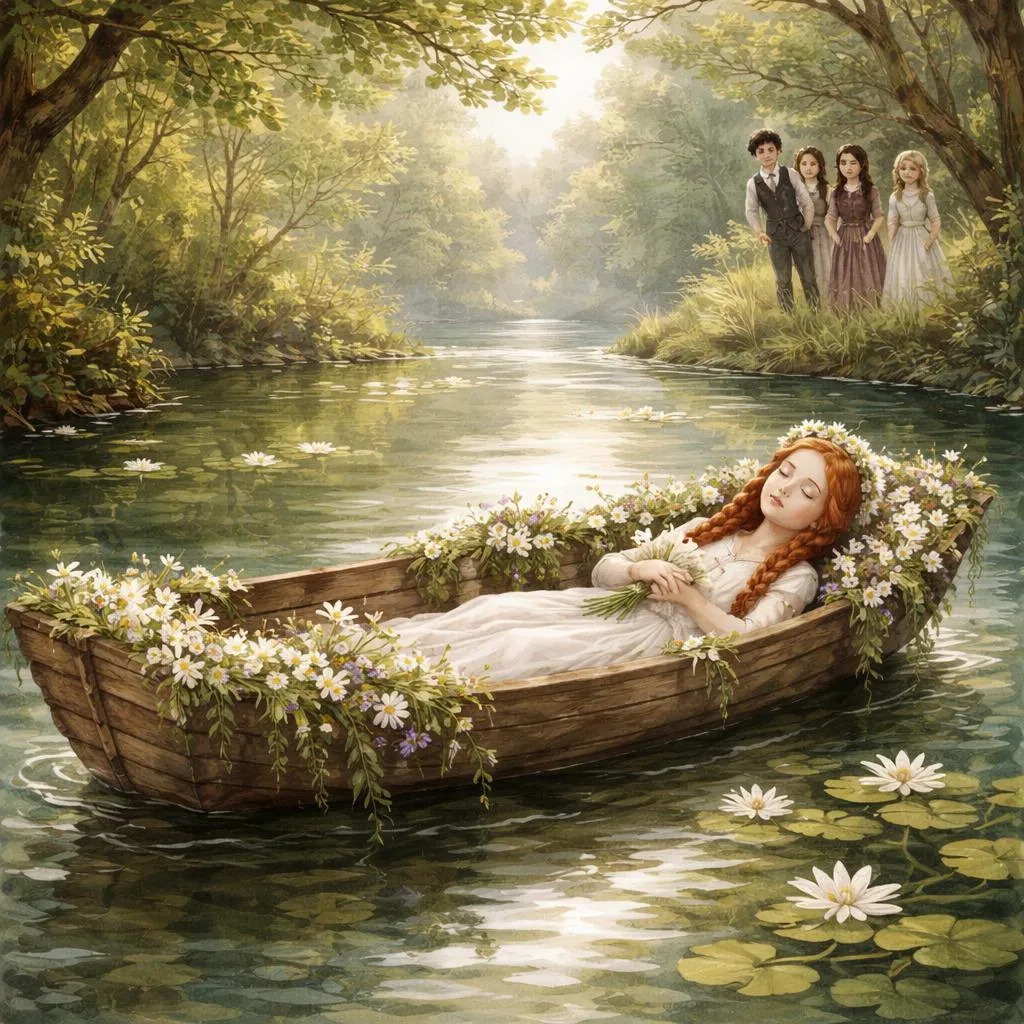

“OF course you must be Elaine, Anne,” said Diana. “I could never have the courage to float down there.”
“Nor I,” said Ruby Gillis, with a shiver. “I don’t mind floating down when there’s two or three of us in the flat and we can sit up. It’s fun then. But to lie down and pretend I was dead—I just couldn’t. I’d die really of fright.”
“Of course it would be romantic,” conceded Jane Andrews, “but I know I couldn’t keep still. I’d be popping up every minute or so to see where I was and if I wasn’t drifting too far out. And you know, Anne, that would spoil the effect.”
“But it’s so ridiculous to have a redheaded Elaine,” mourned Anne. “I’m not afraid to float down and I’d love to be Elaine. But it’s ridiculous just the same. Ruby ought to be Elaine because she is so fair and has such lovely long golden hair—Elaine had ‘all her bright hair streaming down,’ you know. And Elaine was the lily maid. Now, a red-haired person cannot be a lily maid.”
“Your complexion is just as fair as Ruby’s,” said Diana earnestly, “and your hair is ever so much darker than it used to be before you cut it.”
“Oh, do you really think so?” exclaimed Anne, flushing sensitively with delight. “I’ve sometimes thought it was myself—but I never dared to ask anyone for fear she would tell me it wasn’t. Do you think it could be called auburn now, Diana?”
“Yes, and I think it is real pretty,” said Diana, looking admiringly at the short, silky curls that clustered over Anne’s head and were held in place by a very jaunty black velvet ribbon and bow.
They were standing on the bank of the pond, below Orchard Slope, where a little headland fringed with birches ran out from the bank; at its tip was a small wooden platform built out into the water for the convenience of fishermen and duck hunters. Ruby and Jane were spending the midsummer afternoon with Diana, and Anne had come over to play with them.
Anne and Diana had spent most of their playtime that summer on and about the pond. Idlewild was a thing of the past, Mr. Bell having ruthlessly cut down the little circle of trees in his back pasture in the spring. Anne had sat among the stumps and wept, not without an eye to the romance of it; but she was speedily consoled, for, after all, as she and Diana said, big girls of thirteen, going on fourteen, were too old for such childish amusements as playhouses, and there were more fascinating sports to be found about the pond. It was splendid to fish for trout over the bridge and the two girls learned to row themselves about in the little flat-bottomed dory Mr. Barry kept for duck shooting.
It was Anne’s idea that they dramatize Elaine. They had studied Tennyson’s poem in school the preceding winter, the Superintendent of Education having prescribed it in the English course for the Prince Edward Island schools. They had analyzed and parsed it and torn it to pieces in general until it was a wonder there was any meaning at all left in it for them, but at least the fair lily maid and Lancelot and Guinevere and King Arthur had become very real people to them, and Anne was devoured by secret regret that she had not been born in Camelot. Those days, she said, were so much more romantic than the present.
Anne’s plan was hailed with enthusiasm. The girls had discovered that if the flat were pushed off from the landing place it would drift down with the current under the bridge and finally strand itself on another headland lower down which ran out at a curve in the pond. They had often gone down like this and nothing could be more convenient for playing Elaine.
“Well, I’ll be Elaine,” said Anne, yielding reluctantly, for, although she would have been delighted to play the principal character, yet her artistic sense demanded fitness for it and this, she felt, her limitations made impossible. “Ruby, you must be King Arthur and Jane will be Guinevere and Diana must be Lancelot. But first you must be the brothers and the father. We can’t have the old dumb servitor because there isn’t room for two in the flat when one is lying down. We must pall the barge all its length in blackest samite. That old black shawl of your mother’s will be just the thing, Diana.”
The black shawl having been procured, Anne spread it over the flat and then lay down on the bottom, with closed eyes and hands folded over her breast.
“Oh, she does look really dead,” whispered Ruby Gillis nervously, watching the still, white little face under the flickering shadows of the birches. “It makes me feel frightened, girls. Do you suppose it’s really right to act like this? Mrs. Lynde says that all play-acting is abominably wicked.”
“Ruby, you shouldn’t talk about Mrs. Lynde,” said Anne severely. “It spoils the effect because this is hundreds of years before Mrs. Lynde was born. Jane, you arrange this. It’s silly for Elaine to be talking when she’s dead.”
Jane rose to the occasion. Cloth of gold for coverlet there was none, but an old piano scarf of yellow Japanese crepe was an excellent substitute. A white lily was not obtainable just then, but the effect of a tall blue iris placed in one of Anne’s folded hands was all that could be desired.
“Now, she’s all ready,” said Jane. “We must kiss her quiet brows and, Diana, you say, ‘Sister, farewell forever,’ and Ruby, you say, ‘Farewell, sweet sister,’ both of you as sorrowfully as you possibly can. Anne, for goodness sake smile a little. You know Elaine ‘lay as though she smiled.’ That’s better. Now push the flat off.”
The flat was accordingly pushed off, scraping roughly over an old embedded stake in the process. Diana and Jane and Ruby only waited long enough to see it caught in the current and headed for the bridge before scampering up through the woods, across the road, and down to the lower headland where, as Lancelot and Guinevere and the King, they were to be in readiness to receive the lily maid.
For a few minutes Anne, drifting slowly down, enjoyed the romance of her situation to the full. Then something happened not at all romantic. The flat began to leak. In a very few moments it was necessary for Elaine to scramble to her feet, pick up her cloth of gold coverlet and pall of blackest samite and gaze blankly at a big crack in the bottom of her barge through which the water was literally pouring. That sharp stake at the landing had torn off the strip of batting nailed on the flat. Anne did not know this, but it did not take her long to realize that she was in a dangerous plight. At this rate the flat would fill and sink long before it could drift to the lower headland. Where were the oars? Left behind at the landing!
Anne gave one gasping little scream which nobody ever heard; she was white to the lips, but she did not lose her self-possession. There was one chance—just one.
“I was horribly frightened,” she told Mrs. Allan the next day, “and it seemed like years while the flat was drifting down to the bridge and the water rising in it every moment. I prayed, Mrs. Allan, most earnestly, but I didn’t shut my eyes to pray, for I knew the only way God could save me was to let the flat float close enough to one of the bridge piles for me to climb up on it. You know the piles are just old tree trunks and there are lots of knots and old branch stubs on them. It was proper to pray, but I had to do my part by watching out and right well I knew it. I just said, ‘Dear God, please take the flat close to a pile and I’ll do the rest,’ over and over again. Under such circumstances you don’t think much about making a flowery prayer. But mine was answered, for the flat bumped right into a pile for a minute and I flung the scarf and the shawl over my shoulder and scrambled up on a big providential stub. And there I was, Mrs. Allan, clinging to that slippery old pile with no way of getting up or down. It was a very unromantic position, but I didn’t think about that at the time. You don’t think much about romance when you have just escaped from a watery grave. I said a grateful prayer at once and then I gave all my attention to holding on tight, for I knew I should probably have to depend on human aid to get back to dry land.”
The flat drifted under the bridge and then promptly sank in midstream. Ruby, Jane, and Diana, already awaiting it on the lower headland, saw it disappear before their very eyes and had not a doubt but that Anne had gone down with it. For a moment they stood still, white as sheets, frozen with horror at the tragedy; then, shrieking at the tops of their voices, they started on a frantic run up through the woods, never pausing as they crossed the main road to glance the way of the bridge. Anne, clinging desperately to her precarious foothold, saw their flying forms and heard their shrieks. Help would soon come, but meanwhile her position was a very uncomfortable one.
The minutes passed by, each seeming an hour to the unfortunate lily maid. Why didn’t somebody come? Where had the girls gone? Suppose they had fainted, one and all! Suppose nobody ever came! Suppose she grew so tired and cramped that she could hold on no longer! Anne looked at the wicked green depths below her, wavering with long, oily shadows, and shivered. Her imagination began to suggest all manner of gruesome possibilities to her.
Then, just as she thought she really could not endure the ache in her arms and wrists another moment, Gilbert Blythe came rowing under the bridge in Harmon Andrews’s dory!
Gilbert glanced up and, much to his amazement, beheld a little white scornful face looking down upon him with big, frightened but also scornful gray eyes.
“Anne Shirley! How on earth did you get there?” he exclaimed.
Without waiting for an answer he pulled close to the pile and extended his hand. There was no help for it; Anne, clinging to Gilbert Blythe’s hand, scrambled down into the dory, where she sat, drabbled and furious, in the stern with her arms full of dripping shawl and wet crepe. It was certainly extremely difficult to be dignified under the circumstances!
“What has happened, Anne?” asked Gilbert, taking up his oars. “We were playing Elaine” explained Anne frigidly, without even looking at her rescuer, “and I had to drift down to Camelot in the barge—I mean the flat. The flat began to leak and I climbed out on the pile. The girls went for help. Will you be kind enough to row me to the landing?”
Gilbert obligingly rowed to the landing and Anne, disdaining assistance, sprang nimbly on shore.
“I’m very much obliged to you,” she said haughtily as she turned away. But Gilbert had also sprung from the boat and now laid a detaining hand on her arm.
“Anne,” he said hurriedly, “look here. Can’t we be good friends? I’m awfully sorry I made fun of your hair that time. I didn’t mean to vex you and I only meant it for a joke. Besides, it’s so long ago. I think your hair is awfully pretty now—honest I do. Let’s be friends.”
For a moment Anne hesitated. She had an odd, newly awakened consciousness under all her outraged dignity that the half-shy, half-eager expression in Gilbert’s hazel eyes was something that was very good to see. Her heart gave a quick, queer little beat. But the bitterness of her old grievance promptly stiffened up her wavering determination. That scene of two years before flashed back into her recollection as vividly as if it had taken place yesterday. Gilbert had called her “carrots” and had brought about her disgrace before the whole school. Her resentment, which to other and older people might be as laughable as its cause, was in no whit allayed and softened by time seemingly. She hated Gilbert Blythe! She would never forgive him!
“No,” she said coldly, “I shall never be friends with you, Gilbert Blythe; and I don’t want to be!”
“All right!” Gilbert sprang into his skiff with an angry color in his cheeks. “I’ll never ask you to be friends again, Anne Shirley. And I don’t care either!”
He pulled away with swift defiant strokes, and Anne went up the steep, ferny little path under the maples. She held her head very high, but she was conscious of an odd feeling of regret. She almost wished she had answered Gilbert differently. Of course, he had insulted her terribly, but still—! Altogether, Anne rather thought it would be a relief to sit down and have a good cry. She was really quite unstrung, for the reaction from her fright and cramped clinging was making itself felt.
Halfway up the path she met Jane and Diana rushing back to the pond in a state narrowly removed from positive frenzy. They had found nobody at Orchard Slope, both Mr. and Mrs. Barry being away. Here Ruby Gillis had succumbed to hysterics, and was left to recover from them as best she might, while Jane and Diana flew through the Haunted Wood and across the brook to Green Gables. There they had found nobody either, for Marilla had gone to Carmody and Matthew was making hay in the back field.
“Oh, Anne,” gasped Diana, fairly falling on the former’s neck and weeping with relief and delight, “oh, Anne—we thought—you were—drowned—and we felt like murderers—because we had made—you be—Elaine. And Ruby is in hysterics—oh, Anne, how did you escape?”
“I climbed up on one of the piles,” explained Anne wearily, “and Gilbert Blythe came along in Mr. Andrews’s dory and brought me to land.”
“Oh, Anne, how splendid of him! Why, it’s so romantic!” said Jane, finding breath enough for utterance at last. “Of course you’ll speak to him after this.”
“Of course I won’t,” flashed Anne, with a momentary return of her old spirit. “And I don’t want ever to hear the word ‘romantic’ again, Jane Andrews. I’m awfully sorry you were so frightened, girls. It is all my fault. I feel sure I was born under an unlucky star. Everything I do gets me or my dearest friends into a scrape. We’ve gone and lost your father’s flat, Diana, and I have a presentiment that we’ll not be allowed to row on the pond any more.”
Anne’s presentiment proved more trustworthy than presentiments are apt to do. Great was the consternation in the Barry and Cuthbert households when the events of the afternoon became known.
“Will you ever have any sense, Anne?” groaned Marilla.
“Oh, yes, I think I will, Marilla,” returned Anne optimistically. A good cry, indulged in the grateful solitude of the east gable, had soothed her nerves and restored her to her wonted cheerfulness. “I think my prospects of becoming sensible are brighter now than ever.”
“I don’t see how,” said Marilla.
“Well,” explained Anne, “I’ve learned a new and valuable lesson today. Ever since I came to Green Gables I’ve been making mistakes, and each mistake has helped to cure me of some great shortcoming. The affair of the amethyst brooch cured me of meddling with things that didn’t belong to me. The Haunted Wood mistake cured me of letting my imagination run away with me. The liniment cake mistake cured me of carelessness in cooking. Dyeing my hair cured me of vanity. I never think about my hair and nose now—at least, very seldom. And today’s mistake is going to cure me of being too romantic. I have come to the conclusion that it is no use trying to be romantic in Avonlea. It was probably easy enough in towered Camelot hundreds of years ago, but romance is not appreciated now. I feel quite sure that you will soon see a great improvement in me in this respect, Marilla.”
“I’m sure I hope so,” said Marilla skeptically.
But Matthew, who had been sitting mutely in his corner, laid a hand on Anne’s shoulder when Marilla had gone out.
“Don’t give up all your romance, Anne,” he whispered shyly, “a little of it is a good thing—not too much, of course—but keep a little of it, Anne, keep a little of it.”
Hintergrund und Einführung in die Autorin
Dieser Auszug stammt aus Anne auf Green Gables, einem beliebten klassischen Roman der kanadischen Autorin Lucy Maud Montgomery, der erstmals 1908 veröffentlicht wurde. Die Geschichte spielt im fiktiven Dorf Avonlea auf Prince Edward Island und folgt den Abenteuern von Anne Shirley, einem fantasievollen und temperamentvollen Waisenmädchen, das fälschlicherweise zu Marilla und Matthew Cuthbert geschickt wird, einem Bruder und einer Schwester, die eigentlich einen Jungen adoptieren wollten, um ihnen auf ihrer Farm zu helfen. Montgomerys lebendige Beschreibungen des Landlebens, ihr tiefes Verständnis der menschlichen Natur und ihre Darstellung des Wachstums und der Selbstfindung eines jungen Mädchens haben diesen Roman zu einem zeitlosen Favoriten bei Kindern und Erwachsenen gemacht.
Detaillierte Interpretation und Bedeutung der Geschichte
In dieser Passage dramatisieren Anne und ihre Freundinnen das Gedicht „Elaine“ von Alfred, Lord Tennyson, was Annes romantische Vorstellungskraft und ihre Sehnsucht nach einer magischeren, mittelalterlichen Welt widerspiegelt. Die Szene fängt Annes Abenteuergeist, ihre Kreativität und ihre Bereitschaft ein, Herausforderungen trotz Angst anzunehmen. Der Vorfall mit dem undichten Kahn und Annes anschließende Rettung durch Gilbert Blythe führen wichtige Themen wie Mut, Freundschaft und Vergebung ein.
Die Geschichte beleuchtet Annes komplexen Charakter: ihr feuriges Temperament, ihren Stolz und ihre Verletzlichkeit. Ihre Weigerung, Gilbert sofort zu vergeben, zeigt ihren ausgeprägten Gerechtigkeitssinn und ihre Verletztheit, aber auch ihr Entwicklungspotenzial. Der Rat von Matthew, etwas Romantik in ihrem Leben zu bewahren, deutet auf ein Gleichgewicht zwischen Vorstellungskraft und Realität hin, eine zentrale Botschaft des Romans.
Lektionen und Erkenntnisse für Schüler
-
Die Kraft der Vorstellungskraft: Annes Liebe zur Dramatisierung und zu romantischen Geschichten ermutigt junge Leser, ihre Kreativität zu schätzen. Vorstellungskraft kann das Leben bereichern und Trost und Freude spenden, selbst in schwierigen Zeiten.
-
Mut und Widerstandsfähigkeit: Annes Gelassenheit in einer gefährlichen Situation lehrt die Bedeutung, ruhig zu bleiben und klar zu denken, wenn man vor Herausforderungen steht. Ihr Gebet und ihre praktischen Handlungen zeigen, wie Glaube und Anstrengung gemeinsam helfen können, Widrigkeiten zu überwinden.
-
Freundschaft und Vergebung: Die Spannung und die anschließende Versöhnung zwischen Anne und Gilbert veranschaulichen, dass Missverständnisse und verletzte Gefühle Teil von Beziehungen sind, aber Freundlichkeit und Offenheit Wunden heilen können.
-
Aus Fehlern lernen: Annes Überlegungen zu ihren vergangenen Fehlern zeigen, wie Fehler wertvolle Lernerfahrungen sind, die uns helfen, weiser und reifer zu werden.
-
Ausgleich von Romantik und Realität: Der Roman deutet an, dass die Vorstellungskraft zwar wunderbar ist, es aber auch wichtig ist, praktisch zu leben und die Welt so zu akzeptieren, wie sie ist, und Freude sowohl an der Fantasie als auch am Alltag zu finden.
Anwendung dieser Lektionen im Leben
-
In der Schule: Schüler können sich von Annes Neugier und ihrer Liebe zum Lernen inspirieren lassen. Kreativität in Schreiben, Drama und Kunst zu fördern, kann das Lernen unterhaltsamer und sinnvoller machen.
-
In sozialen Situationen: Annes Geschichte ermutigt zur Ehrlichkeit über Gefühle und zum Mut, für sich selbst einzustehen, während man gleichzeitig offen für Vergebung und Freundschaft ist.
-
In der persönlichen Entwicklung: Fehler als Möglichkeiten zur Verbesserung zu erkennen, hilft, Widerstandsfähigkeit und Selbstbewusstsein aufzubauen. Wie Anne können Schüler Geduld entwickeln und lernen, Träume mit der Realität in Einklang zu bringen.
Förderung positiver Eigenschaften aus der Geschichte
-
Vorstellungskraft: Fördern Sie kreatives Spielen, Geschichtenerzählen und Lesen, um die Vorstellungskraft zu fördern.
-
Mut: Üben Sie, sich Schritt für Schritt Ihren Ängsten zu stellen und in schwierigen Momenten ruhig zu bleiben.
-
Empathie und Vergebung: Reflektieren Sie die Perspektiven anderer und versuchen Sie, Konflikte mit Freundlichkeit zu lösen.
-
Selbstreflexion: Führen Sie ein Tagebuch oder sprechen Sie über Erfahrungen, um das persönliche Wachstum zu verstehen.
-
Ausgewogenheit: Lernen Sie, sowohl Träume als auch praktische Verantwortlichkeiten zu schätzen.
Anne auf Green Gables ist nach wie vor eine reiche Inspirationsquelle für junge Leser und lädt sie ein, die Schönheit der Vorstellungskraft, die Stärke des Charakters und die Wärme menschlicher Beziehungen zu erkunden.
