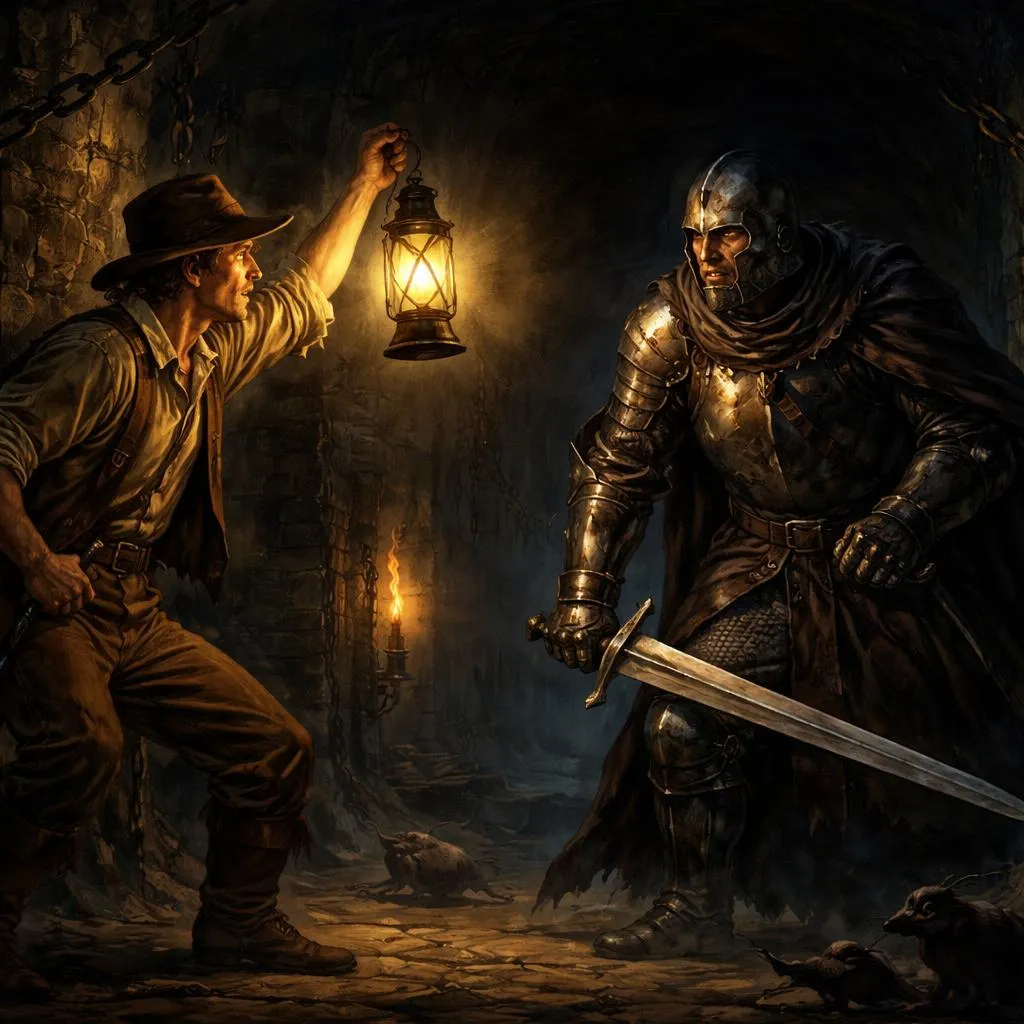

London—to a slave—was a sufficiently interesting place. It was merely a great big village; and mainly mud and thatch. The streets were muddy, crooked, unpaved. The populace was an ever flocking and drifting swarm of rags, and splendors, of nodding plumes and shining armor. The king had a palace there; he saw the outside of it. It made him sigh; yes, and swear a little, in a poor juvenile sixth century way. We saw knights and grandees whom we knew, but they didn’t know us in our rags and dirt and raw welts and bruises, and wouldn’t have recognized us if we had hailed them, nor stopped to answer, either, it being unlawful to speak with slaves on a chain. Sandy passed within ten yards of me on a mule—hunting for me, I imagined. But the thing which clean broke my heart was something which happened in front of our old barrack in a square, while we were enduring the spectacle of a man being boiled to death in oil for counterfeiting pennies. It was the sight of a newsboy—and I couldn’t get at him! Still, I had one comfort—here was proof that Clarence was still alive and banging away. I meant to be with him before long; the thought was full of cheer.
I had one little glimpse of another thing, one day, which gave me a great uplift. It was a wire stretching from housetop to housetop. Telegraph or telephone, sure. I did very much wish I had a little piece of it. It was just what I needed, in order to carry out my project of escape. My idea was to get loose some night, along with the king, then gag and bind our master, change clothes with him, batter him into the aspect of a stranger, hitch him to the slave-chain, assume possession of the property, march to Camelot, and—
But you get my idea; you see what a stunning dramatic surprise I would wind up with at the palace. It was all feasible, if I could only get hold of a slender piece of iron which I could shape into a lock-pick. I could then undo the lumbering padlocks with which our chains were fastened, whenever I might choose. But I never had any luck; no such thing ever happened to fall in my way. However, my chance came at last. A gentleman who had come twice before to dicker for me, without result, or indeed any approach to a result, came again. I was far from expecting ever to belong to him, for the price asked for me from the time I was first enslaved was exorbitant, and always provoked either anger or derision, yet my master stuck stubbornly to it—twenty-two dollars. He wouldn’t bate a cent. The king was greatly admired, because of his grand physique, but his kingly style was against him, and he wasn’t salable; nobody wanted that kind of a slave. I considered myself safe from parting from him because of my extravagant price. No, I was not expecting to ever belong to this gentleman whom I have spoken of, but he had something which I expected would belong to me eventually, if he would but visit us often enough. It was a steel thing with a long pin to it, with which his long cloth outside garment was fastened together in front. There were three of them. He had disappointed me twice, because he did not come quite close enough to me to make my project entirely safe; but this time I succeeded; I captured the lower clasp of the three, and when he missed it he thought he had lost it on the way.
I had a chance to be glad about a minute, then straightway a chance to be sad again. For when the purchase was about to fail, as usual, the master suddenly spoke up and said what would be worded thus —in modern English:
“I’ll tell you what I’ll do. I’m tired supporting these two for no good. Give me twenty-two dollars for this one, and I’ll throw the other one in.”
The king couldn’t get his breath, he was in such a fury. He began to choke and gag, and meantime the master and the gentleman moved away discussing.
“An ye will keep the offer open—”
“’Tis open till the morrow at this hour.”
“Then I will answer you at that time,” said the gentleman, and disappeared, the master following him.
I had a time of it to cool the king down, but I managed it. I whispered in his ear, to this effect:
“Your grace will go for nothing, but after another fashion. And so shall I. To-night we shall both be free.”
“Ah! How is that?”
“With this thing which I have stolen, I will unlock these locks and cast off these chains to-night. When he comes about nine-thirty to inspect us for the night, we will seize him, gag him, batter him, and early in the morning we will march out of this town, proprietors of this caravan of slaves.”
That was as far as I went, but the king was charmed and satisfied. That evening we waited patiently for our fellow-slaves to get to sleep and signify it by the usual sign, for you must not take many chances on those poor fellows if you can avoid it. It is best to keep your own secrets. No doubt they fidgeted only about as usual, but it didn’t seem so to me. It seemed to me that they were going to be forever getting down to their regular snoring. As the time dragged on I got nervously afraid we shouldn’t have enough of it left for our needs; so I made several premature attempts, and merely delayed things by it; for I couldn’t seem to touch a padlock, there in the dark, without starting a rattle out of it which interrupted somebody’s sleep and made him turn over and wake some more of the gang.
But finally I did get my last iron off, and was a free man once more. I took a good breath of relief, and reached for the king’s irons. Too late! in comes the master, with a light in one hand and his heavy walking-staff in the other. I snuggled close among the wallow of snorers, to conceal as nearly as possible that I was naked of irons; and I kept a sharp lookout and prepared to spring for my man the moment he should bend over me.
But he didn’t approach. He stopped, gazed absently toward our dusky mass a minute, evidently thinking about something else; then set down his light, moved musingly toward the door, and before a body could imagine what he was going to do, he was out of the door and had closed it behind him.
“Quick!” said the king. “Fetch him back!”
Of course, it was the thing to do, and I was up and out in a moment. But, dear me, there were no lamps in those days, and it was a dark night. But I glimpsed a dim figure a few steps away. I darted for it, threw myself upon it, and then there was a state of things and lively! We fought and scuffled and struggled, and drew a crowd in no time. They took an immense interest in the fight and encouraged us all they could, and, in fact, couldn’t have been pleasanter or more cordial if it had been their own fight. Then a tremendous row broke out behind us, and as much as half of our audience left us, with a rush, to invest some sympathy in that. Lanterns began to swing in all directions; it was the watch gathering from far and near. Presently a halberd fell across my back, as a reminder, and I knew what it meant. I was in custody. So was my adversary. We were marched off toward prison, one on each side of the watchman. Here was disaster, here was a fine scheme gone to sudden destruction! I tried to imagine what would happen when the master should discover that it was I who had been fighting him; and what would happen if they jailed us together in the general apartment for brawlers and petty law-breakers, as was the custom; and what might—
Just then my antagonist turned his face around in my direction, the freckled light from the watchman’s tin lantern fell on it, and, by George, he was the wrong man!
Hintergrund und Einführung des Autors
Diese Geschichte spielt in einem lebendigen, historischen London, gesehen durch die Augen eines Sklaven. Sie fängt die harten Realitäten und Kämpfe des Lebens unter der Knechtschaft in einer mittelalterlichen Umgebung ein und verbindet Elemente von Abenteuer, Hoffnung und Widerstandsfähigkeit. Der Erzählstil deutet darauf hin, dass sie aus einem klassischen oder historischen Roman für jüngere Leser oder solche, die sich für Geschichten über Mut und Flucht interessieren, stammen könnte.
Der Autor, obwohl hier ungenannt, schreibt mit einem scharfen Blick für Details und einem tiefen Verständnis menschlicher Emotionen, insbesondere der Sehnsucht nach Freiheit und Würde. Die Stimme der Geschichte ist sowohl reflektierend als auch hoffnungsvoll und lädt die Leser ein, sich in das Leid des Protagonisten einzufühlen und seine Befreiung zu unterstützen.
Detaillierte Interpretation und Bedeutung
Im Kern erforscht diese Geschichte Themen wie Unterdrückung und den unbezwingbaren menschlichen Geist. Der Protagonist, ein Sklave, navigiert mit Intelligenz und Mut durch die düstere Welt der Gefangenschaft. Sein Fluchtplan, der die clevere Verwendung einer gestohlenen Schließe und eine gewagte Verkleidung beinhaltet, symbolisiert die Macht der Hoffnung und des Einfallsreichtums selbst unter den dunkelsten Umständen.
Der Schauplatz – schlammige Straßen, die Anwesenheit von Rittern und Königen und die brutale Bestrafung eines Mannes wegen Falschmünzerei – zeichnet ein Bild einer rauen Gesellschaft, in der die Gerechtigkeit hart ist und die Freiheit ein ferner Traum ist. Doch die Entschlossenheit des Protagonisten, sich selbst und den König, der ebenfalls versklavt ist, zu befreien, unterstreicht den universellen Wunsch nach Freiheit und Selbstbestimmung.
Die Geschichte berührt auch die Solidarität unter den Sklaven, die Risiken der Rebellion und die Bedeutung von Geheimhaltung und Geduld. Der innere Dialog und die Interaktionen des Protagonisten offenbaren seine Führungsqualitäten und sein strategisches Denken, wertvolle Eigenschaften zur Überwindung von Widrigkeiten.
Lektionen und Erkenntnisse für Schüler
-
Mut und Widerstandsfähigkeit: Der Protagonist gibt trotz der brutalen Bedingungen und Rückschläge nie auf. Dies lehrt die Schüler die Bedeutung von Ausdauer, wenn sie sich im Leben oder im Studium Herausforderungen stellen.
-
Einfallsreichtum und Problemlösung: Sein Fluchtplan mit einer einfachen Schließe als Dietrich fördert kreatives Denken und Einfallsreichtum, Fähigkeiten, die für das Lernen und die Problemlösung in der realen Welt unerlässlich sind.
-
Empathie und Verständnis: Indem die Schüler die Welt aus der Perspektive des Sklaven betrachten, lernen sie Empathie für diejenigen, die Ungerechtigkeit erleiden, und den Wert, sich gegen Unterdrückung zu stellen.
-
Hoffnung und Optimismus: Selbst in schlimmen Situationen kann das Festhalten an der Hoffnung zum Handeln und zur Veränderung anregen. Diese positive Einstellung ist entscheidend für das persönliche Wachstum und das Erreichen von Zielen.
Anwendung im täglichen Leben und Lernen
-
In der Schule: Die Schüler können die Entschlossenheit des Protagonisten anwenden, indem sie schwierige Fächer mit Geduld und kreativen Strategien angehen, so wie er seine Flucht sorgfältig plant.
-
In sozialen Situationen: Die Geschichte ermutigt dazu, sich für Fairness einzusetzen und anderen zu helfen, die möglicherweise ausgegrenzt oder ungerecht behandelt werden, und fördert Freundlichkeit und Führungsqualitäten.
-
Im persönlichen Wachstum: Das Nachahmen der Hoffnung und Widerstandsfähigkeit des Protagonisten hilft den Schülern, mentale Stärke und Selbstvertrauen zu entwickeln, um sich den Unsicherheiten des Lebens zu stellen.
Förderung positiver Eigenschaften aus der Geschichte
-
Geduld: Auf den richtigen Zeitpunkt zu warten, um zu handeln, ist eine wichtige Lektion, die den Schülern beibringt, sich nicht zu beeilen, sondern sich gründlich vorzubereiten.
-
Strategisches Denken: Sorgfältige Planung vor dem Handeln ist unerlässlich, sei es in der Akademik, im Sport oder bei sozialen Herausforderungen.
-
Mut zum Handeln: Wenn die Zeit gekommen ist, ist Mut notwendig, um Freiheit oder Erfolg zu erlangen, und inspiriert die Schüler, in ihren Ambitionen mutig zu sein.
Schlussfolgerung
Diese Geschichte ist mehr als nur eine Fluchtgeschichte; sie ist eine kraftvolle Lektion in menschlicher Würde, Mut und Hoffnung. Durch das Studium können die Schüler Einblicke in die Geschichte gewinnen, Empathie entwickeln und wertvolle Lebenskompetenzen erlernen, die über die Seiten des Buches hinausgehen. Sie ermutigt junge Leser, groß zu träumen, schlau zu denken und in ihrem eigenen Leben mutig zu handeln.
