
“Matthew—Matthew—what is the matter? Matthew, are you sick?”
It was Marilla who spoke, alarm in every jerky word. Anne came through the hall, her hands full of white narcissus,—it was long before Anne could love the sight or odor of white narcissus again,—in time to hear her and to see Matthew standing in the porch doorway, a folded paper in his hand, and his face strangely drawn and gray. Anne dropped her flowers and sprang across the kitchen to him at the same moment as Marilla. They were both too late; before they could reach him Matthew had fallen across the threshold.
“He’s fainted,” gasped Marilla. “Anne, run for Martin—quick, quick! He’s at the barn.”
Martin, the hired man, who had just driven home from the post office, started at once for the doctor, calling at Orchard Slope on his way to send Mr. and Mrs. Barry over. Mrs. Lynde, who was there on an errand, came too. They found Anne and Marilla distractedly trying to restore Matthew to consciousness.
Mrs. Lynde pushed them gently aside, tried his pulse, and then laid her ear over his heart. She looked at their anxious faces sorrowfully and the tears came into her eyes.
“Oh, Marilla,” she said gravely. “I don’t think—we can do anything for him.”
“Mrs. Lynde, you don’t think—you can’t think Matthew is—is—” Anne could not say the dreadful word; she turned sick and pallid.
“Child, yes, I’m afraid of it. Look at his face. When you’ve seen that look as often as I have you’ll know what it means.”
Anne looked at the still face and there beheld the seal of the Great Presence.
When the doctor came he said that death had been instantaneous and probably painless, caused in all likelihood by some sudden shock. The secret of the shock was discovered to be in the paper Matthew had held and which Martin had brought from the office that morning. It contained an account of the failure of the Abbey Bank.
The news spread quickly through Avonlea, and all day friends and neighbors thronged Green Gables and came and went on errands of kindness for the dead and living. For the first time shy, quiet Matthew Cuthbert was a person of central importance; the white majesty of death had fallen on him and set him apart as one crowned.
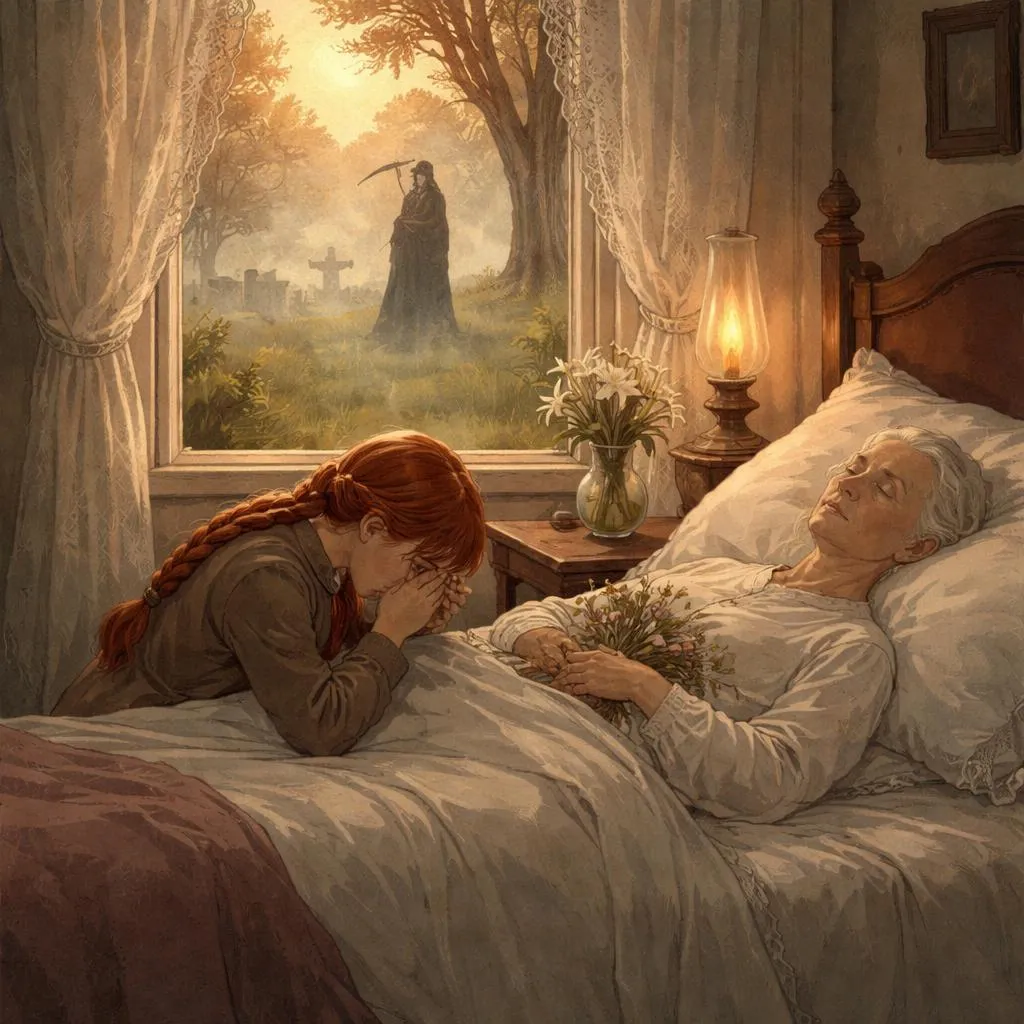
When the calm night came softly down over Green Gables the old house was hushed and tranquil. In the parlor lay Matthew Cuthbert in his coffin, his long gray hair framing his placid face on which there was a little kindly smile as if he but slept, dreaming pleasant dreams. There were flowers about him—sweet old-fashioned flowers which his mother had planted in the homestead garden in her bridal days and for which Matthew had always had a secret, wordless love. Anne had gathered them and brought them to him, her anguished, tearless eyes burning in her white face. It was the last thing she could do for him.
The Barrys and Mrs. Lynde stayed with them that night. Diana, going to the east gable, where Anne was standing at her window, said gently:
“Anne dear, would you like to have me sleep with you tonight?”
“Thank you, Diana.” Anne looked earnestly into her friend’s face. “I think you won’t misunderstand me when I say I want to be alone. I’m not afraid. I haven’t been alone one minute since it happened—and I want to be. I want to be quite silent and quiet and try to realize it. I can’t realize it. Half the time it seems to me that Matthew can’t be dead; and the other half it seems as if he must have been dead for a long time and I’ve had this horrible dull ache ever since.”
Diana did not quite understand. Marilla’s impassioned grief, breaking all the bounds of natural reserve and lifelong habit in its stormy rush, she could comprehend better than Anne’s tearless agony. But she went away kindly, leaving Anne alone to keep her first vigil with sorrow.
Anne hoped that the tears would come in solitude. It seemed to her a terrible thing that she could not shed a tear for Matthew, whom she had loved so much and who had been so kind to her, Matthew who had walked with her last evening at sunset and was now lying in the dim room below with that awful peace on his brow. But no tears came at first, even when she knelt by her window in the darkness and prayed, looking up to the stars beyond the hills—no tears, only the same horrible dull ache of misery that kept on aching until she fell asleep, worn out with the day’s pain and excitement.
In the night she awakened, with the stillness and the darkness about her, and the recollection of the day came over her like a wave of sorrow. She could see Matthew’s face smiling at her as he had smiled when they parted at the gate that last evening—she could hear his voice saying, “My girl—my girl that I’m proud of.” Then the tears came and Anne wept her heart out. Marilla heard her and crept in to comfort her.
“There—there—don’t cry so, dearie. It can’t bring him back. It—it—isn’t right to cry so. I knew that today, but I couldn’t help it then. He’d always been such a good, kind brother to me—but God knows best.”
“Oh, just let me cry, Marilla,” sobbed Anne. “The tears don’t hurt me like that ache did. Stay here for a little while with me and keep your arm round me—so. I couldn’t have Diana stay, she’s good and kind and sweet—but it’s not her sorrow—she’s outside of it and she couldn’t come close enough to my heart to help me. It’s our sorrow—yours and mine. Oh, Marilla, what will we do without him?”
“We’ve got each other, Anne. I don’t know what I’d do if you weren’t here—if you’d never come. Oh, Anne, I know I’ve been kind of strict and harsh with you maybe—but you mustn’t think I didn’t love you as well as Matthew did, for all that. I want to tell you now when I can. It’s never been easy for me to say things out of my heart, but at times like this it’s easier. I love you as dear as if you were my own flesh and blood and you’ve been my joy and comfort ever since you came to Green Gables.”
Two days afterwards they carried Matthew Cuthbert over his homestead threshold and away from the fields he had tilled and the orchards he had loved and the trees he had planted; and then Avonlea settled back to its usual placidity and even at Green Gables affairs slipped into their old groove and work was done and duties fulfilled with regularity as before, although always with the aching sense of “loss in all familiar things.” Anne, new to grief, thought it almost sad that it could be so—that they COULD go on in the old way without Matthew. She felt something like shame and remorse when she discovered that the sunrises behind the firs and the pale pink buds opening in the garden gave her the old inrush of gladness when she saw them—that Diana’s visits were pleasant to her and that Diana’s merry words and ways moved her to laughter and smiles—that, in brief, the beautiful world of blossom and love and friendship had lost none of its power to please her fancy and thrill her heart, that life still called to her with many insistent voices.
“It seems like disloyalty to Matthew, somehow, to find pleasure in these things now that he has gone,” she said wistfully to Mrs. Allan one evening when they were together in the manse garden. “I miss him so much—all the time—and yet, Mrs. Allan, the world and life seem very beautiful and interesting to me for all. Today Diana said something funny and I found myself laughing. I thought when it happened I could never laugh again. And it somehow seems as if I oughtn’t to.”
“When Matthew was here he liked to hear you laugh and he liked to know that you found pleasure in the pleasant things around you,” said Mrs. Allan gently. “He is just away now; and he likes to know it just the same. I am sure we should not shut our hearts against the healing influences that nature offers us. But I can understand your feeling. I think we all experience the same thing. We resent the thought that anything can please us when someone we love is no longer here to share the pleasure with us, and we almost feel as if we were unfaithful to our sorrow when we find our interest in life returning to us.”
“I was down to the graveyard to plant a rosebush on Matthew’s grave this afternoon,” said Anne dreamily. “I took a slip of the little white Scotch rosebush his mother brought out from Scotland long ago; Matthew always liked those roses the best—they were so small and sweet on their thorny stems. It made me feel glad that I could plant it by his grave—as if I were doing something that must please him in taking it there to be near him. I hope he has roses like them in heaven. Perhaps the souls of all those little white roses that he has loved so many summers were all there to meet him. I must go home now. Marilla is all alone and she gets lonely at twilight.”
“She will be lonelier still, I fear, when you go away again to college,” said Mrs. Allan.
Anne did not reply; she said good night and went slowly back to green Gables. Marilla was sitting on the front door-steps and Anne sat down beside her. The door was open behind them, held back by a big pink conch shell with hints of sea sunsets in its smooth inner convolutions.
Anne gathered some sprays of pale-yellow honeysuckle and put them in her hair. She liked the delicious hint of fragrance, as some aerial benediction, above her every time she moved.
“Doctor Spencer was here while you were away,” Marilla said. “He says that the specialist will be in town tomorrow and he insists that I must go in and have my eyes examined. I suppose I’d better go and have it over. I’ll be more than thankful if the man can give me the right kind of glasses to suit my eyes. You won’t mind staying here alone while I’m away, will you? Martin will have to drive me in and there’s ironing and baking to do.”
“I shall be all right. Diana will come over for company for me. I shall attend to the ironing and baking beautifully—you needn’t fear that I’ll starch the handkerchiefs or flavor the cake with liniment.”
Marilla laughed.
“What a girl you were for making mistakes in them days, Anne. You were always getting into scrapes. I did use to think you were possessed. Do you mind the time you dyed your hair?”
“Yes, indeed. I shall never forget it,” smiled Anne, touching the heavy braid of hair that was wound about her shapely head. “I laugh a little now sometimes when I think what a worry my hair used to be to me—but I don’t laugh MUCH, because it was a very real trouble then. I did suffer terribly over my hair and my freckles. My freckles are really gone; and people are nice enough to tell me my hair is auburn now—all but Josie Pye. She informed me yesterday that she really thought it was redder than ever, or at least my black dress made it look redder, and she asked me if people who had red hair ever got used to having it. Marilla, I’ve almost decided to give up trying to like Josie Pye. I’ve made what I would once have called a heroic effort to like her, but Josie Pye won’t BE liked.”
“Josie is a Pye,” said Marilla sharply, “so she can’t help being disagreeable. I suppose people of that kind serve some useful purpose in society, but I must say I don’t know what it is any more than I know the use of thistles. Is Josie going to teach?”
“No, she is going back to Queen’s next year. So are Moody Spurgeon and Charlie Sloane. Jane and Ruby are going to teach and they have both got schools—Jane at Newbridge and Ruby at some place up west.”
“Gilbert Blythe is going to teach too, isn’t he?”
“Yes”—briefly.
“What a nice-looking fellow he is,” said Marilla absently. “I saw him in church last Sunday and he seemed so tall and manly. He looks a lot like his father did at the same age. John Blythe was a nice boy. We used to be real good friends, he and I. People called him my beau.”
Anne looked up with swift interest.
“Oh, Marilla—and what happened?—why didn’t you—”
“We had a quarrel. I wouldn’t forgive him when he asked me to. I meant to, after awhile—but I was sulky and angry and I wanted to punish him first. He never came back—the Blythes were all mighty independent. But I always felt—rather sorry. I’ve always kind of wished I’d forgiven him when I had the chance.”
“So you’ve had a bit of romance in your life, too,” said Anne softly.
“Yes, I suppose you might call it that. You wouldn’t think so to look at me, would you? But you never can tell about people from their outsides. Everybody has forgot about me and John. I’d forgotten myself. But it all came back to me when I saw Gilbert last Sunday.”
Hintergrund und Einführung der Autorin
Dieser Abschnitt stammt aus Anne auf Green Gables, einem beliebten Klassiker, der von der kanadischen Autorin Lucy Maud Montgomery geschrieben wurde. Die 1908 veröffentlichte Geschichte folgt Anne Shirley, einem fantasievollen und temperamentvollen Waisenmädchen, das fälschlicherweise zu Marilla und Matthew Cuthbert geschickt wird, Geschwistern, die beabsichtigt hatten, einen Jungen zu adoptieren, um ihnen auf ihrer Farm im fiktiven Dorf Avonlea auf Prince Edward Island zu helfen. Der Roman ist bekannt für seine lebendige Darstellung des ländlichen Lebens, die Wärme menschlicher Beziehungen und das Heranwachsen eines jungen Mädchens zu einer reifen jungen Frau.
Lucy Maud Montgomery ließ sich von ihrer eigenen Kindheit und den Landschaften von Prince Edward Island inspirieren. Ihr Schreibstil kombiniert Humor, emotionale Tiefe und ein starkes Gefühl für den Ort, was Anne auf Green Gables zu einer zeitlosen Geschichte gemacht hat, die von Lesern weltweit geschätzt wird.
Detaillierte Interpretation und Bedeutung
Dieser Auszug zeigt einen entscheidenden und zutiefst emotionalen Moment in der Geschichte: den plötzlichen Tod von Matthew Cuthbert, Annes geliebtem Vormund und einem sanften, gutherzigen Mann, der Annes Träume und Wachstum stillschweigend unterstützt hatte. Sein Tod schockiert die Gemeinschaft und hinterlässt Anne und Marilla in tiefer Trauer. Der Abschnitt untersucht die Themen Verlust, Trauer und den Heilungsprozess.
Matthews Tod ist plötzlich und wird durch einen Schock verursacht – die Nachricht vom Bankrott, die die Zerbrechlichkeit des Lebens und die Unerwartetheit der Tragödie symbolisiert. Annes anfängliche Unfähigkeit zu weinen und ihr anschließender emotionaler Ausbruch verdeutlichen die komplexen Arten und Weisen, wie Menschen Trauer erleben. Die Geschichte berührt auch die Bedeutung von Kameradschaft und Verständnis während der Trauer, wie in den Interaktionen zwischen Anne, Marilla, Diana und Mrs. Lynde gezeigt wird.
Trotz des Schmerzes geht das Leben weiter, und Anne lernt, dass Freude und Lachen wiederzufinden keine Untreue gegenüber den Verstorbenen ist, sondern ein natürlicher Teil der Heilung. Diese Erkenntnis ist eine kraftvolle Botschaft über Widerstandsfähigkeit und Hoffnung.
Lektionen und Erkenntnisse für Schüler
-
Trauer verstehen: Der Abschnitt lehrt, dass Trauer eine persönliche und oft komplizierte Erfahrung ist. Sie beinhaltet möglicherweise nicht sofort Tränen; manchmal fühlt sie sich wie ein dumpfer Schmerz an. Dies zu erkennen, hilft den Schülern, ihre eigenen Emotionen und die anderer zu verstehen, wenn sie mit Verlust konfrontiert werden.
-
Der Wert von Mitgefühl: Marillas und Mrs. Lyndes Unterstützung für Anne zeigt, wie Freundlichkeit und Präsenz diejenigen trösten können, die verletzt sind. Die Schüler können die Bedeutung von Empathie lernen und in schwierigen Zeiten für Freunde und Familie da sein.
-
Widerstandsfähigkeit und Weiterentwicklung: Annes Weg von Schock zur Akzeptanz veranschaulicht die Widerstandsfähigkeit. Es ermutigt junge Leser, in sich selbst Kraft zu finden, um sich Herausforderungen zu stellen und weiterhin in vollen Zügen zu leben, indem sie die Erinnerung an geliebte Menschen ehren, indem sie die Schönheit des Lebens annehmen.
-
Wertschätzung der Natur und einfacher Freuden: Annes Liebe zu Blumen und Natur, selbst in Trauer, erinnert die Schüler daran, Trost und Inspiration in der natürlichen Welt und in alltäglichen Momenten zu finden.
-
Ehrlichkeit und emotionaler Ausdruck: Der Dialog zwischen Anne und Marilla betont, wie wichtig es ist, Gefühle offen und ehrlich auszudrücken, anstatt sie zu unterdrücken.
Anwendung dieser Lektionen im täglichen Leben
-
In der Schule: Die Schüler können Klassenkameraden unterstützen, die möglicherweise schwierige Zeiten durchmachen, indem sie ein offenes Ohr oder einfache Freundlichkeiten anbieten. Sie können auch über ihre eigenen Gefühle nachdenken und sich Hilfe suchen, wenn sie überfordert sind.
-
In Freundschaften: Zu verstehen, dass jeder anders trauert, hilft, Geduld und Mitgefühl in Freundschaften zu bewahren. Anwesend zu sein und die Emotionen anderer zu respektieren, stärkt die Bindungen.
-
In der Familie: Gefühle mit Familienmitgliedern zu teilen, wie Anne und Marilla es tun, baut Vertrauen und gegenseitige Unterstützung auf, was in schwierigen Zeiten unerlässlich ist.
-
Persönliches Wachstum: Widerstandsfähigkeit zu umarmen bedeutet, aus Schwierigkeiten zu lernen und weiterhin Ziele mit Hoffnung und Mut zu verfolgen, genau wie Anne es tut.
Positive Werte aus der Geschichte kultivieren
- Freundlichkeit: Matthews sanfte Natur und Annes Dankbarkeit unterstreichen die Kraft der Freundlichkeit bei der Schaffung bedeutungsvoller Beziehungen.
- Mut: Verlust zu bewältigen und weiterhin in vollen Zügen zu leben, erfordert Mut, eine wichtige Eigenschaft, die junge Menschen entwickeln müssen.
- Hoffnung: Annes anschließendes Lachen und ihre Freude symbolisieren die Rolle der Hoffnung bei der Heilung.
- Freundschaft: Die Unterstützung von Diana und anderen zeigt, dass Freunde sowohl in glücklichen als auch in traurigen Zeiten unerlässlich sind.
- Selbstreflexion: Annes Selbstbeobachtung über ihre Gefühle und Erfahrungen ermutigt die Schüler, tief über ihr eigenes Leben und ihre Emotionen nachzudenken.
Schlussfolgerung
Dieser Abschnitt aus Anne auf Green Gables bietet eine umfassende Auseinandersetzung mit Trauer, Liebe und Widerstandsfähigkeit. Er lädt die Schüler ein, die Komplexität menschlicher Emotionen und die Bedeutung von Mitgefühl, Hoffnung und Freundschaft zu verstehen. Indem sie aus Annes Erfahrung lernen, können junge Leser emotionale Intelligenz und positive Werte entwickeln, die ihnen helfen, ihr eigenes Leben mit Stärke und Freundlichkeit zu meistern.
