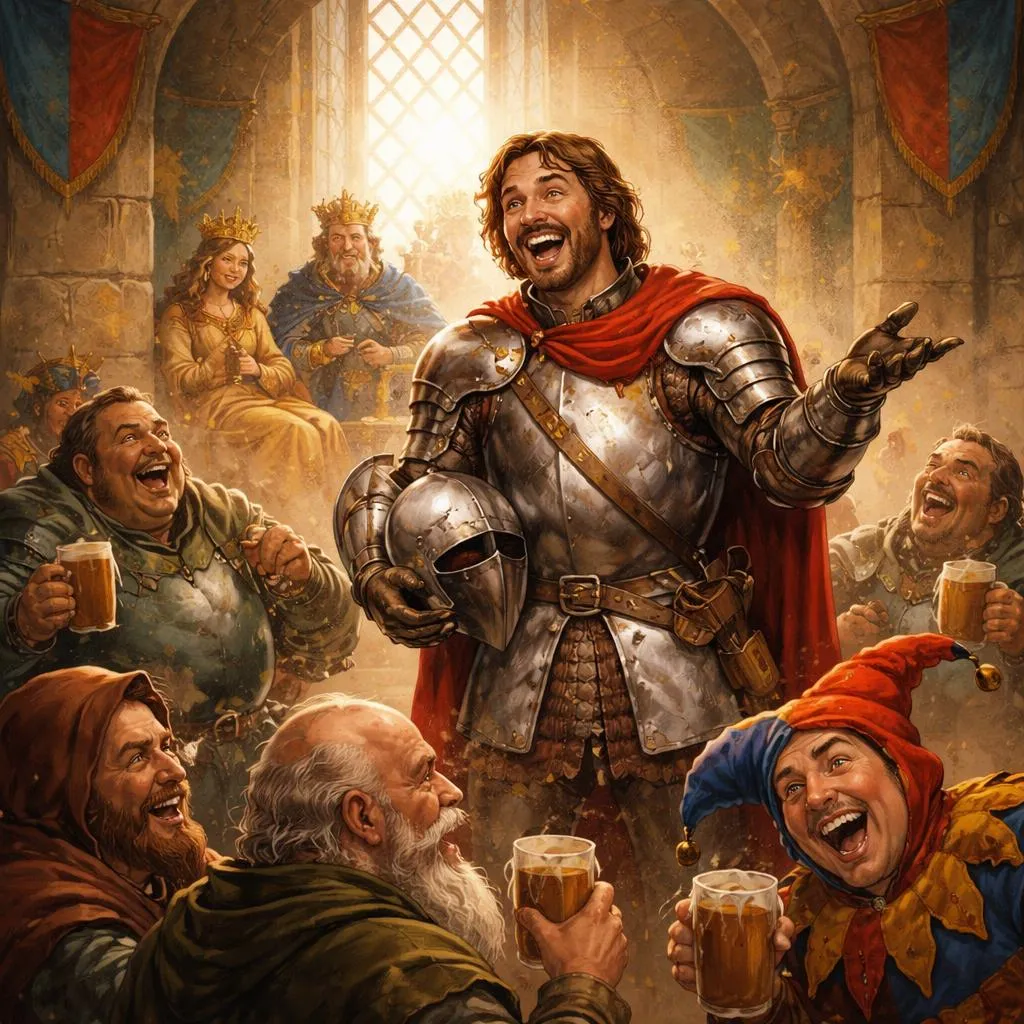

It seemed to me that this quaint lie was most simply and beautifully told; but then I had heard it only once, and that makes a difference; it was pleasant to the others when it was fresh, no doubt.
Sir Dinadan the Humorist was the first to awake, and he soon roused the rest with a practical joke of a sufficiently poor quality. He tied some metal mugs to a dog’s tail and turned him loose, and he tore around and around the place in a frenzy of fright, with all the other dogs bellowing after him and battering and crashing against everything that came in their way and making altogether a chaos of confusion and a most deafening din and turmoil; at which every man and woman of the multitude laughed till the tears flowed, and some fell out of their chairs and wallowed on the floor in ecstasy. It was just like so many children. Sir Dinadan was so proud of his exploit that he could not keep from telling over and over again, to weariness, how the immortal idea happened to occur to him; and as is the way with humorists of his breed, he was still laughing at it after everybody else had got through. He was so set up that he concluded to make a speech —of course a humorous speech. I think I never heard so many old played-out jokes strung together in my life. He was worse than the minstrels, worse than the clown in the circus. It seemed peculiarly sad to sit here, thirteen hundred years before I was born, and listen again to poor, flat, worm-eaten jokes that had given me the dry gripes when I was a boy thirteen hundred years afterwards. It about convinced me that there isn’t any such thing as a new joke possible. Everybody laughed at these antiquities —but then they always do; I had noticed that, centuries later. However, of course the scoffer didn’t laugh—I mean the boy. No, he scoffed; there wasn’t anything he wouldn’t scoff at. He said the most of Sir Dinadan’s jokes were rotten and the rest were petrified. I said “petrified” was good; as I believed, myself, that the only right way to classify the majestic ages of some of those jokes was by geologic periods. But that neat idea hit the boy in a blank place, for geology hadn’t been invented yet. However, I made a note of the remark, and calculated to educate the commonwealth up to it if I pulled through. It is no use to throw a good thing away merely because the market isn’t ripe yet.
Now Sir Kay arose and began to fire up on his history-mill with me for fuel. It was time for me to feel serious, and I did. Sir Kay told how he had encountered me in a far land of barbarians, who all wore the same ridiculous garb that I did—a garb that was a work of enchantment, and intended to make the wearer secure from hurt by human hands. However he had nullified the force of the enchantment by prayer, and had killed my thirteen knights in a three hours’ battle, and taken me prisoner, sparing my life in order that so strange a curiosity as I was might be exhibited to the wonder and admiration of the king and the court. He spoke of me all the time, in the blandest way, as “this prodigious giant,” and “this horrible sky-towering monster,” and “this tusked and taloned man-devouring ogre”, and everybody took in all this bosh in the naivest way, and never smiled or seemed to notice that there was any discrepancy between these watered statistics and me. He said that in trying to escape from him I sprang into the top of a tree two hundred cubits high at a single bound, but he dislodged me with a stone the size of a cow, which “all-to brast” the most of my bones, and then swore me to appear at Arthur’s court for sentence. He ended by condemning me to die at noon on the 21st; and was so little concerned about it that he stopped to yawn before he named the date.
I was in a dismal state by this time; indeed, I was hardly enough in my right mind to keep the run of a dispute that sprung up as to how I had better be killed, the possibility of the killing being doubted by some, because of the enchantment in my clothes. And yet it was nothing but an ordinary suit of fifteen-dollar slop-shops. Still, I was sane enough to notice this detail, to wit: many of the terms used in the most matter-of-fact way by this great assemblage of the first ladies and gentlemen in the land would have made a Comanche blush. Indelicacy is too mild a term to convey the idea. However, I had read “Tom Jones,” and “Roderick Random,” and other books of that kind, and knew that the highest and first ladies and gentlemen in England had remained little or no cleaner in their talk, and in the morals and conduct which such talk implies, clear up to a hundred years ago; in fact clear into our own nineteenth century—in which century, broadly speaking, the earliest samples of the real lady and real gentleman discoverable in English history—or in European history, for that matter—may be said to have made their appearance. Suppose Sir Walter, instead of putting the conversations into the mouths of his characters, had allowed the characters to speak for themselves? We should have had talk from Rebecca and Ivanhoe and the soft lady Rowena which would embarrass a tramp in our day. However, to the unconsciously indelicate all things are delicate. King Arthur’s people were not aware that they were indecent and I had presence of mind enough not to mention it.
They were so troubled about my enchanted clothes that they were mightily relieved, at last, when old Merlin swept the difficulty away for them with a common-sense hint. He asked them why they were so dull—why didn’t it occur to them to strip me. In half a minute I was as naked as a pair of tongs! And dear, dear, to think of it: I was the only embarrassed person there. Everybody discussed me; and did it as unconcernedly as if I had been a cabbage. Queen Guenever was as naively interested as the rest, and said she had never seen anybody with legs just like mine before. It was the only compliment I got—if it was a compliment.
Finally I was carried off in one direction, and my perilous clothes in another. I was shoved into a dark and narrow cell in a dungeon, with some scant remnants for dinner, some moldy straw for a bed, and no end of rats for company.
Hintergrund und Einführung des Autors
Dieser Abschnitt stammt aus Mark Twains Roman Ein Yankee am Hofe des König Artus, der erstmals 1889 veröffentlicht wurde. Twain, einer der größten Humoristen und Gesellschaftskritiker Amerikas, nutzt diese Geschichte, um Fantasie, Satire und historische Fiktion zu verbinden. Der Roman erzählt die Geschichte eines amerikanischen Ingenieurs aus dem 19. Jahrhundert, der auf mysteriöse Weise in die Zeit von König Artus zurückversetzt wird. Twain nutzt diese fantasievolle Ausgangssituation, um Themen wie Fortschritt, Technologie, soziale Gerechtigkeit und die menschliche Natur zu erforschen.
Detaillierte Interpretation und Bedeutung
Der Auszug fängt den humorvollen und oft absurden Zusammenstoß zwischen moderner und mittelalterlicher Welt ein. Der Protagonist, ein Mann aus der Zukunft, beobachtet die Ritter und Adligen der Artus-Sage mit einer Mischung aus Ironie und Unglauben. Der praktische Scherz von Sir Dinadan und die übertriebenen Geschichten von Sir Kay unterstreichen den Kontrast zwischen den ritterlichen Idealen und der oft lächerlichen Realität dahinter.
Twains Erzählstil kombiniert einen spielerischen Ton mit scharfer Gesellschaftskritik. Die „skurrile Lüge“ und die „alten, abgenutzten Witze“ symbolisieren, wie Geschichten und Traditionen im Laufe der Zeit verzerrt werden oder an Bedeutung verlieren können. Die Reflexionen des Protagonisten über die Sprache und die Manieren der Vergangenheit offenbaren Twains Kritik an gesellschaftlichen Ansprüchen und Heuchelei, sowohl im mittelalterlichen Umfeld als auch in seiner eigenen Zeit.
Die verzauberte Kleidung und die Gefangenschaft des Protagonisten veranschaulichen die Spannung zwischen Aberglauben und Vernunft, ein wiederkehrendes Thema in dem Roman. Merlins praktischer Rat, den Protagonisten nackt auszuziehen, um den Zauber zu brechen, steht für den Triumph des gesunden Menschenverstands über blinden Glauben.
Lektionen und Erkenntnisse für Schüler
-
Kritisches Denken und Skepsis: Die Geschichte ermutigt die Leser, akzeptierte Wahrheiten und Traditionen zu hinterfragen. So wie der Protagonist die Geschichten der Ritter und die Macht der Verzauberungen anzweifelt, sollten die Schüler lernen, Informationen kritisch zu hinterfragen und nicht alles für bare Münze zu nehmen.
-
Humor als Werkzeug zur Reflexion: Twains Humor hilft, menschliche Torheiten und soziale Fehler aufzudecken. Die Schüler können erkennen, wie Lachen und Satire mächtige Mittel sein können, um die Welt um sie herum zu verstehen und zu kritisieren.
-
Verständnis des historischen Kontexts: Der Roman verbindet historische Legenden mit modernen Ideen und zeigt, wie sich Perspektiven im Laufe der Zeit verändern. Dies ermutigt die Schüler, die Geschichte mit offenem Geist zu erforschen und den Einfluss von Kultur und Zeit auf Geschichten und Überzeugungen zu erkennen.
-
Respekt vor Wissen und Fortschritt: Der Hintergrund des Protagonisten als Ingenieur symbolisiert die Bedeutung von Wissenschaft und Technologie für den Fortschritt der Gesellschaft. Die Schüler können dazu inspiriert werden, Bildung und Innovation zu schätzen und gleichzeitig die Lehren der Vergangenheit zu respektieren.
-
Empathie und Aufgeschlossenheit: Die Erfahrung des Protagonisten als Außenseiter in einer fremden Welt lehrt die Bedeutung von Empathie und Anpassungsfähigkeit. Die Schüler können lernen, verschiedene Kulturen und Sichtweisen zu schätzen, was in der heutigen vielfältigen Gesellschaft von entscheidender Bedeutung ist.
Anwendung des Geistes der Geschichte im täglichen Leben
-
Im Lernen: Nehmen Sie Neugier an und hinterfragen Sie Annahmen. Gehen Sie Studien mit einem Gleichgewicht aus Skepsis und Offenheit an, ähnlich wie der Protagonist, der sich in einer unbekannten Welt bewegt.
-
In sozialen Interaktionen: Verwenden Sie Humor freundlich, um Spannungen abzubauen und Verbindungen aufzubauen, aber achten Sie auf die Gefühle anderer. Wie die Witze von Sir Dinadan kann Humor Menschen vereinen, wenn er mit Bedacht eingesetzt wird.
-
Bei der Bewältigung von Herausforderungen: Wenden Sie Vernunft und gesunden Menschenverstand an, um Probleme zu lösen, wie Merlin es rät. Scheuen Sie sich nicht, unnötige Komplikationen zu beseitigen, um klare Lösungen zu finden.
-
Bei der Charakterentwicklung: Kultivieren Sie Widerstandsfähigkeit und Anpassungsfähigkeit. Die Reise des Protagonisten zeigt, dass unerwartete Situationen Mut und Flexibilität erfordern.
Förderung positiver Werte
Die Schüler können aus der Erfahrung des Protagonisten Tugenden wie Ehrlichkeit, Mut und Demut lernen. Das Erkennen der Fehler anderer und der eigenen Person mit Humor und Anmut hilft, einen starken Charakter aufzubauen. Der Roman fördert auch den Wert, für das Richtige einzustehen, Ungerechtigkeit zu hinterfragen und Wissen verantwortungsvoll einzusetzen.
Durch das Lesen und Nachdenken über Ein Yankee am Hofe des König Artus erhalten junge Leser nicht nur Unterhaltung, sondern auch ein tieferes Verständnis von Geschichte, Gesellschaft und menschlicher Natur. Sie sind eingeladen, unabhängig zu denken, die Macht des Geschichtenerzählens zu schätzen und den Geist der Neugier und Freundlichkeit in ihrem eigenen Leben weiterzutragen.
