
However, my attention was suddenly snatched from such matters; our child began to lose ground again, and we had to go to sitting up with her, her case became so serious. We couldn’t bear to allow anybody to help in this service, so we two stood watch-and-watch, day in and day out. Ah, Sandy, what a right heart she had, how simple, and genuine, and good she was! She was a flawless wife and mother; and yet I had married her for no other particular reasons, except that by the customs of chivalry she was my property until some knight should win her from me in the field. She had hunted Britain over for me; had found me at the hanging-bout outside of London, and had straightway resumed her old place at my side in the placidest way and as of right. I was a New Englander, and in my opinion this sort of partnership would compromise her, sooner or later. She couldn’t see how, but I cut argument short and we had a wedding.
Now I didn’t know I was drawing a prize, yet that was what I did draw. Within the twelvemonth I became her worshiper; and ours was the dearest and perfectest comradeship that ever was. People talk about beautiful friendships between two persons of the same sex. What is the best of that sort, as compared with the friendship of man and wife, where the best impulses and highest ideals of both are the same? There is no place for comparison between the two friendships; the one is earthly, the other divine.
In my dreams, along at first, I still wandered thirteen centuries away, and my unsatisfied spirit went calling and harking all up and down the unreplying vacancies of a vanished world. Many a time Sandy heard that imploring cry come from my lips in my sleep. With a grand magnanimity she saddled that cry of mine upon our child, conceiving it to be the name of some lost darling of mine. It touched me to tears, and it also nearly knocked me off my feet, too, when she smiled up in my face for an earned reward, and played her quaint and pretty surprise upon me:
“The name of one who was dear to thee is here preserved, here made holy, and the music of it will abide alway in our ears. Now thou’lt kiss me, as knowing the name I have given the child.”
But I didn’t know it, all the same. I hadn’t an idea in the world; but it would have been cruel to confess it and spoil her pretty game; so I never let on, but said:
“Yes, I know, sweetheart—how dear and good it is of you, too! But I want to hear these lips of yours, which are also mine, utter it first—then its music will be perfect.”
Pleased to the marrow, she murmured:
“HELLO-CENTRAL!”
I didn’t laugh—I am always thankful for that—but the strain ruptured every cartilage in me, and for weeks afterward I could hear my bones clack when I walked. She never found out her mistake. The first time she heard that form of salute used at the telephone she was surprised, and not pleased; but I told her I had given order for it: that henceforth and forever the telephone must always be invoked with that reverent formality, in perpetual honor and remembrance of my lost friend and her small namesake. This was not true. But it answered.
Well, during two weeks and a half we watched by the crib, and in our deep solicitude we were unconscious of any world outside of that sick-room. Then our reward came: the center of the universe turned the corner and began to mend. Grateful? It isn’t the term. There isn’t any term for it. You know that yourself, if you’ve watched your child through the Valley of the Shadow and seen it come back to life and sweep night out of the earth with one all-illuminating smile that you could cover with your hand.
Why, we were back in this world in one instant! Then we looked the same startled thought into each other’s eyes at the same moment; more than two weeks gone, and that ship not back yet!
In another minute I appeared in the presence of my train. They had been steeped in troubled bodings all this time—their faces showed it. I called an escort and we galloped five miles to a hilltop overlooking the sea. Where was my great commerce that so lately had made these glistening expanses populous and beautiful with its white-winged flocks? Vanished, every one! Not a sail, from verge to verge, not a smoke-bank—just a dead and empty solitude, in place of all that brisk and breezy life.
I went swiftly back, saying not a word to anybody. I told Sandy this ghastly news. We could imagine no explanation that would begin to explain. Had there been an invasion? an earthquake? a pestilence? Had the nation been swept out of existence? But guessing was profitless. I must go—at once. I borrowed the king’s navy—a “ship” no bigger than a steam launch—and was soon ready.
The parting—ah, yes, that was hard. As I was devouring the child with last kisses, it brisked up and jabbered out its vocabulary! —the first time in more than two weeks, and it made fools of us for joy. The darling mispronunciations of childhood!—dear me, there’s no music that can touch it; and how one grieves when it wastes away and dissolves into correctness, knowing it will never visit his bereaved ear again. Well, how good it was to be able to carry that gracious memory away with me!
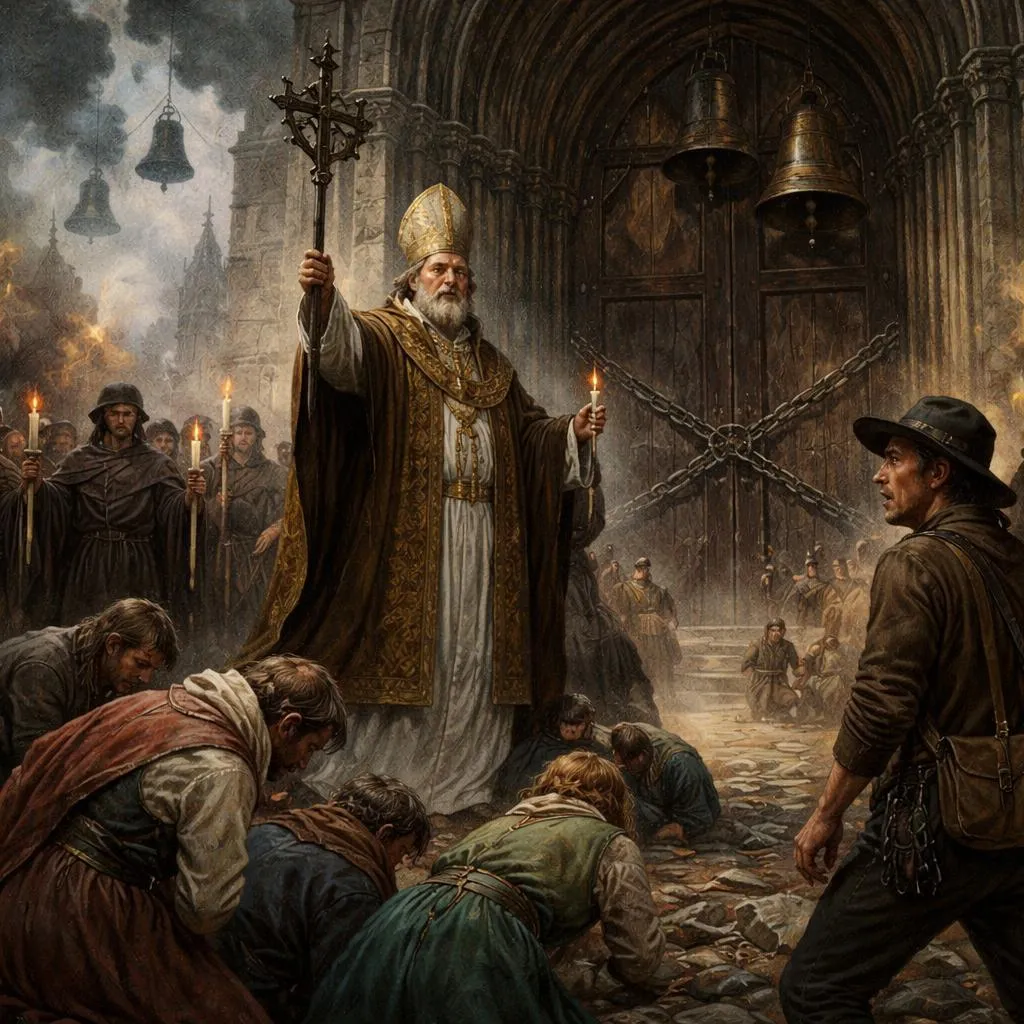
I approached England the next morning, with the wide highway of salt water all to myself. There were ships in the harbor, at Dover, but they were naked as to sails, and there was no sign of life about them. It was Sunday; yet at Canterbury the streets were empty; strangest of all, there was not even a priest in sight, and no stroke of a bell fell upon my ear. The mournfulness of death was everywhere. I couldn’t understand it. At last, in the further edge of that town I saw a small funeral procession —just a family and a few friends following a coffin—no priest; a funeral without bell, book, or candle; there was a church there close at hand, but they passed it by weeping, and did not enter it; I glanced up at the belfry, and there hung the bell, shrouded in black, and its tongue tied back. Now I knew! Now I understood the stupendous calamity that had overtaken England. Invasion? Invasion is a triviality to it. It was the INTERDICT!
I asked no questions; I didn’t need to ask any. The Church had struck; the thing for me to do was to get into a disguise, and go warily. One of my servants gave me a suit of clothes, and when we were safe beyond the town I put them on, and from that time I traveled alone; I could not risk the embarrassment of company.
A miserable journey. A desolate silence everywhere. Even in London itself. Traffic had ceased; men did not talk or laugh, or go in groups, or even in couples; they moved aimlessly about, each man by himself, with his head down, and woe and terror at his heart. The Tower showed recent war-scars. Verily, much had been happening.
Of course, I meant to take the train for Camelot. Train! Why, the station was as vacant as a cavern. I moved on. The journey to Camelot was a repetition of what I had already seen. The Monday and the Tuesday differed in no way from the Sunday. I arrived far in the night. From being the best electric-lighted town in the kingdom and the most like a recumbent sun of anything you ever saw, it was become simply a blot—a blot upon darkness—that is to say, it was darker and solider than the rest of the darkness, and so you could see it a little better; it made me feel as if maybe it was symbolical—a sort of sign that the Church was going to keep the upper hand now, and snuff out all my beautiful civilization just like that. I found no life stirring in the somber streets. I groped my way with a heavy heart. The vast castle loomed black upon the hilltop, not a spark visible about it. The drawbridge was down, the great gate stood wide, I entered without challenge, my own heels making the only sound I heard—and it was sepulchral enough, in those huge vacant courts.
Hintergrund und Einführung des Autors
Dieser Abschnitt stammt aus einem Werk, das historische und fantastische Elemente vermischt und die Atmosphäre des mittelalterlichen Englands mit einem modernen Empfinden hervorruft. Der Autor, der oft dafür bekannt ist, komplizierte Geschichten über Ritterlichkeit, Loyalität und den menschlichen Geist zu weben, verwendet lebendige Bilder und emotionale Tiefe, um Themen wie Liebe, Verlust und Widerstandsfähigkeit zu erforschen. Die Geschichte gehört wahrscheinlich zum Genre der historischen Fantasy oder der von der Artus-Sage inspirierten Fiktion, in der der Protagonist sowohl persönlichen als auch gesellschaftlichen Umwälzungen begegnet.
Detaillierte Interpretation und Bedeutung
Die Erzählung konzentriert sich auf die tiefe Bindung zwischen dem Erzähler und seiner Frau Sandy und hebt die Stärke hervor, die in echter Kameradschaft und Liebe gefunden wird. Ihre gemeinsame Wache über ihrem kranken Kind symbolisiert Hingabe und die menschliche Fähigkeit, Widrigkeiten zu ertragen. Die Geschichte berührt auch Themen wie Identität und Zugehörigkeit, da der Erzähler mit seinen New England-Wurzeln und den ritterlichen Bräuchen, die seine Ehe prägten, zu kämpfen hat.
Das mysteriöse Verschwinden der Schiffe und die unheimliche Stille in England deuten auf eine größere Krise hin – ein vom Klerus verhängtes Interdikt, ein mächtiges und düsteres Ereignis, das die Gesellschaft stört und den Protagonisten zu Verkleidung und Einsamkeit zwingt. Dies spiegelt die Spannung zwischen individuellen Wünschen und institutioneller Autorität wider, ein häufiges Thema in der Literatur, die mittelalterliche Umgebungen erforscht.
Lektionen und Erkenntnisse für Schüler
-
Die Macht der Liebe und des Engagements: Die Geschichte lehrt die Bedeutung der Beständigkeit in Beziehungen und zeigt, wie gegenseitige Unterstützung helfen kann, die dunkelsten Momente des Lebens zu überwinden. Die Schüler können lernen, Empathie, Geduld und Engagement in ihren eigenen Freundschaften und Familienbeziehungen zu schätzen.
-
Mut in Widrigkeiten: Die Reise des Erzählers durch ein stilles, beunruhigtes Land ermutigt die Leser, der Ungewissheit mit Mut und Einfallsreichtum zu begegnen. Dies kann junge Menschen dazu inspirieren, Widerstandsfähigkeit zu entwickeln, wenn sie sich Herausforderungen in der Schule oder im Privatleben stellen.
-
Verständnis von Geschichte und Kultur: Die Umgebung bietet einen Einblick in mittelalterliche Bräuche, die Rolle der Kirche und soziale Strukturen. Die Schüler können schätzen, wie die Geschichte menschliche Erfahrungen prägt und wie die Literatur das kulturelle Gedächtnis bewahrt.
-
Die Bedeutung von Fantasie und Träumen: Die Träume des Erzählers von einer verschwundenen Welt und die symbolische Namensgebung des Kindes zeigen, wie Fantasie Trost und Sinn stiften kann, eine wertvolle Lektion für die Förderung der Kreativität.
Anwendung dieser Lektionen im täglichen Leben
- Im Lernen: Ahmen Sie die Beharrlichkeit des Erzählers nach, indem Sie sich Ihren Studien widmen, auch wenn die Themen schwierig erscheinen oder der Fortschritt langsam ist.
- In sozialen Interaktionen: Üben Sie Empathie und Freundlichkeit und erkennen Sie, dass jeder mit unsichtbaren Kämpfen zu kämpfen hat, ähnlich wie die Charaktere, die sich um ihr krankes Kind kümmern.
- Im persönlichen Wachstum: Kultivieren Sie den Mut, neue Ideen zu erforschen und Ängste zu überwinden, inspiriert von der kühnen Reise des Protagonisten durch ein stilles, gefährliches Land.
- In der Kreativität: Nutzen Sie das Erzählen von Geschichten, Träume und Fantasie als Werkzeuge für den Selbstausdruck und die Problemlösung.
Förderung positiver Werte aus der Geschichte
- Loyalität und Partnerschaft: Fördern Sie Teamarbeit und gegenseitigen Respekt in Gruppenprojekten und Freundschaften.
- Geduld und Fürsorge: Entwickeln Sie Gewohnheiten der Aufmerksamkeit und Unterstützung für andere, besonders in Zeiten der Not.
- Anpassungsfähigkeit: Lernen Sie, sich mit Anmut an veränderte Umstände anzupassen, so wie der Erzähler es tut, wenn die Gesellschaft verstummt.
- Respekt vor der Geschichte: Beschäftigen Sie sich mit historischen Geschichten, um die Wurzeln moderner Werte und Gesellschaften zu verstehen.
Indem die Schüler über diese Geschichte nachdenken, bereichern sie nicht nur ihr literarisches Wissen, sondern gewinnen auch praktische Weisheit, um ihr eigenes Leben mit Mut, Mitgefühl und Fantasie zu meistern.
