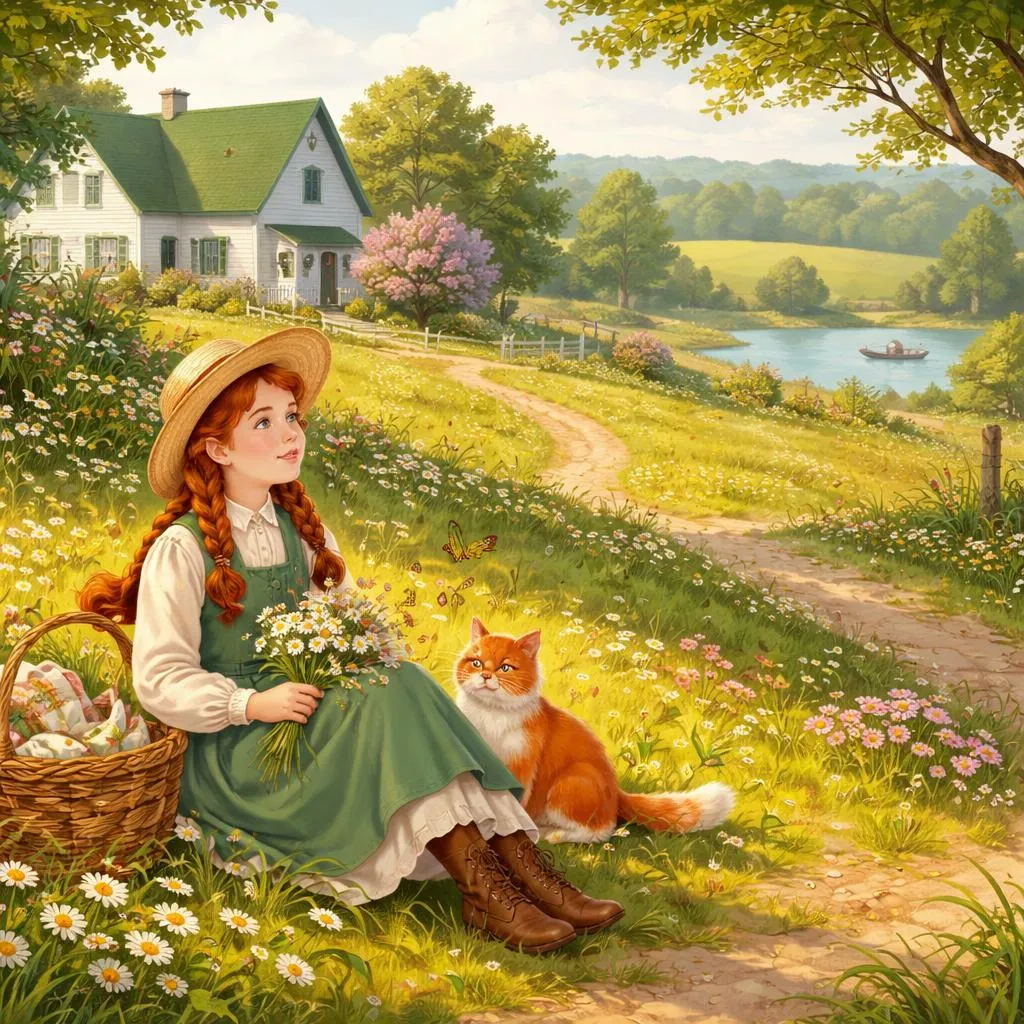

“Do you know,” said Anne confidentially, “I’ve made up my mind to enjoy this drive. It’s been my experience that you can nearly always enjoy things if you make up your mind firmly that you will. Of course, you must make it up FIRMLY. I am not going to think about going back to the asylum while we’re having our drive. I’m just going to think about the drive. Oh, look, there’s one little early wild rose out! Isn’t it lovely? Don’t you think it must be glad to be a rose? Wouldn’t it be nice if roses could talk? I’m sure they could tell us such lovely things. And isn’t pink the most bewitching color in the world? I love it, but I can’t wear it. Redheaded people can’t wear pink, not even in imagination. Did you ever know of anybody whose hair was red when she was young, but got to be another color when she grew up?”
“No, I don’t know as I ever did,” said Marilla mercilessly, “and I shouldn’t think it likely to happen in your case either.”
Anne sighed.
“Well, that is another hope gone. ‘My life is a perfect graveyard of buried hopes.’ That’s a sentence I read in a book once, and I say it over to comfort myself whenever I’m disappointed in anything.”
“I don’t see where the comforting comes in myself,” said Marilla.
“Why, because it sounds so nice and romantic, just as if I were a heroine in a book, you know. I am so fond of romantic things, and a graveyard full of buried hopes is about as romantic a thing as one can imagine isn’t it? I’m rather glad I have one. Are we going across the Lake of Shining Waters today?”
“We’re not going over Barry’s pond, if that’s what you mean by your Lake of Shining Waters. We’re going by the shore road.”
“Shore road sounds nice,” said Anne dreamily. “Is it as nice as it sounds? Just when you said ‘shore road’ I saw it in a picture in my mind, as quick as that! And White Sands is a pretty name, too; but I don’t like it as well as Avonlea. Avonlea is a lovely name. It just sounds like music. How far is it to White Sands?”
“It’s five miles; and as you’re evidently bent on talking you might as well talk to some purpose by telling me what you know about yourself.”
“Oh, what I KNOW about myself isn’t really worth telling,” said Anne eagerly. “If you’ll only let me tell you what I IMAGINE about myself you’ll think it ever so much more interesting.”
“No, I don’t want any of your imaginings. Just you stick to bald facts. Begin at the beginning. Where were you born and how old are you?”
“I was eleven last March,” said Anne, resigning herself to bald facts with a little sigh. “And I was born in Bolingbroke, Nova Scotia. My father’s name was Walter Shirley, and he was a teacher in the Bolingbroke High School. My mother’s name was Bertha Shirley. Aren’t Walter and Bertha lovely names? I’m so glad my parents had nice names. It would be a real disgrace to have a father named—well, say Jedediah, wouldn’t it?”
“I guess it doesn’t matter what a person’s name is as long as he behaves himself,” said Marilla, feeling herself called upon to inculcate a good and useful moral.
“Well, I don’t know.” Anne looked thoughtful. “I read in a book once that a rose by any other name would smell as sweet, but I’ve never been able to believe it. I don’t believe a rose WOULD be as nice if it was called a thistle or a skunk cabbage. I suppose my father could have been a good man even if he had been called Jedediah; but I’m sure it would have been a cross. Well, my mother was a teacher in the High school, too, but when she married father she gave up teaching, of course. A husband was enough responsibility. Mrs. Thomas said that they were a pair of babies and as poor as church mice. They went to live in a weeny-teeny little yellow house in Bolingbroke. I’ve never seen that house, but I’ve imagined it thousands of times. I think it must have had honeysuckle over the parlor window and lilacs in the front yard and lilies of the valley just inside the gate. Yes, and muslin curtains in all the windows. Muslin curtains give a house such an air. I was born in that house. Mrs. Thomas said I was the homeliest baby she ever saw, I was so scrawny and tiny and nothing but eyes, but that mother thought I was perfectly beautiful. I should think a mother would be a better judge than a poor woman who came in to scrub, wouldn’t you? I’m glad she was satisfied with me anyhow, I would feel so sad if I thought I was a disappointment to her—because she didn’t live very long after that, you see. She died of fever when I was just three months old. I do wish she’d lived long enough for me to remember calling her mother. I think it would be so sweet to say ‘mother,’ don’t you? And father died four days afterwards from fever too. That left me an orphan and folks were at their wits’ end, so Mrs. Thomas said, what to do with me. You see, nobody wanted me even then. It seems to be my fate. Father and mother had both come from places far away and it was well known they hadn’t any relatives living. Finally Mrs. Thomas said she’d take me, though she was poor and had a drunken husband. She brought me up by hand. Do you know if there is anything in being brought up by hand that ought to make people who are brought up that way better than other people? Because whenever I was naughty Mrs. Thomas would ask me how I could be such a bad girl when she had brought me up by hand—reproachful-like.
“Mr. and Mrs. Thomas moved away from Bolingbroke to Marysville, and I lived with them until I was eight years old. I helped look after the Thomas children—there were four of them younger than me—and I can tell you they took a lot of looking after. Then Mr. Thomas was killed falling under a train and his mother offered to take Mrs. Thomas and the children, but she didn’t want me. Mrs. Thomas was at HER wits’ end, so she said, what to do with me. Then Mrs. Hammond from up the river came down and said she’d take me, seeing I was handy with children, and I went up the river to live with her in a little clearing among the stumps. It was a very lonesome place. I’m sure I could never have lived there if I hadn’t had an imagination. Mr. Hammond worked a little sawmill up there, and Mrs. Hammond had eight children. She had twins three times. I like babies in moderation, but twins three times in succession is TOO MUCH. I told Mrs. Hammond so firmly, when the last pair came. I used to get so dreadfully tired carrying them about.
“I lived up river with Mrs. Hammond over two years, and then Mr. Hammond died and Mrs. Hammond broke up housekeeping. She divided her children among her relatives and went to the States. I had to go to the asylum at Hopeton, because nobody would take me. They didn’t want me at the asylum, either; they said they were over-crowded as it was. But they had to take me and I was there four months until Mrs. Spencer came.”
Anne finished up with another sigh, of relief this time. Evidently she did not like talking about her experiences in a world that had not wanted her.
“Did you ever go to school?” demanded Marilla, turning the sorrel mare down the shore road.
“Not a great deal. I went a little the last year I stayed with Mrs. Thomas. When I went up river we were so far from a school that I couldn’t walk it in winter and there was a vacation in summer, so I could only go in the spring and fall. But of course I went while I was at the asylum. I can read pretty well and I know ever so many pieces of poetry off by heart—’The Battle of Hohenlinden’ and ‘Edinburgh after Flodden,’ and ‘Bingen of the Rhine,’ and most of the ‘Lady of the Lake’ and most of ‘The Seasons’ by James Thompson. Don’t you just love poetry that gives you a crinkly feeling up and down your back? There is a piece in the Fifth Reader—’The Downfall of Poland’—that is just full of thrills. Of course, I wasn’t in the Fifth Reader—I was only in the Fourth—but the big girls used to lend me theirs to read.”
“Were those women—Mrs. Thomas and Mrs. Hammond—good to you?” asked Marilla, looking at Anne out of the corner of her eye.
“O-o-o-h,” faltered Anne. Her sensitive little face suddenly flushed scarlet and embarrassment sat on her brow. “Oh, they MEANT to be—I know they meant to be just as good and kind as possible. And when people mean to be good to you, you don’t mind very much when they’re not quite—always. They had a good deal to worry them, you know. It’s very trying to have a drunken husband, you see; and it must be very trying to have twins three times in succession, don’t you think? But I feel sure they meant to be good to me.”
Marilla asked no more questions. Anne gave herself up to a silent rapture over the shore road and Marilla guided the sorrel abstractedly while she pondered deeply. Pity was suddenly stirring in her heart for the child. What a starved, unloved life she had had—a life of drudgery and poverty and neglect; for Marilla was shrewd enough to read between the lines of Anne’s history and divine the truth. No wonder she had been so delighted at the prospect of a real home. It was a pity she had to be sent back. What if she, Marilla, should indulge Matthew’s unaccountable whim and let her stay? He was set on it; and the child seemed a nice, teachable little thing.
“She’s got too much to say,” thought Marilla, “but she might be trained out of that. And there’s nothing rude or slangy in what she does say. She’s ladylike. It’s likely her people were nice folks.”
The shore road was “woodsy and wild and lonesome.” On the right hand, scrub firs, their spirits quite unbroken by long years of tussle with the gulf winds, grew thickly. On the left were the steep red sandstone cliffs, so near the track in places that a mare of less steadiness than the sorrel might have tried the nerves of the people behind her. Down at the base of the cliffs were heaps of surf-worn rocks or little sandy coves inlaid with pebbles as with ocean jewels; beyond lay the sea, shimmering and blue, and over it soared the gulls, their pinions flashing silvery in the sunlight.
“Isn’t the sea wonderful?” said Anne, rousing from a long, wide-eyed silence. “Once, when I lived in Marysville, Mr. Thomas hired an express wagon and took us all to spend the day at the shore ten miles away. I enjoyed every moment of that day, even if I had to look after the children all the time. I lived it over in happy dreams for years. But this shore is nicer than the Marysville shore. Aren’t those gulls splendid? Would you like to be a gull? I think I would—that is, if I couldn’t be a human girl. Don’t you think it would be nice to wake up at sunrise and swoop down over the water and away out over that lovely blue all day; and then at night to fly back to one’s nest? Oh, I can just imagine myself doing it. What big house is that just ahead, please?”
“That’s the White Sands Hotel. Mr. Kirke runs it, but the season hasn’t begun yet. There are heaps of Americans come there for the summer. They think this shore is just about right.”
“I was afraid it might be Mrs. Spencer’s place,” said Anne mournfully. “I don’t want to get there. Somehow, it will seem like the end of everything.”
Hintergrund und Einführung in die Autorin
Dieser Abschnitt stammt aus Anne auf Green Gables, einem beliebten klassischen Roman der kanadischen Autorin Lucy Maud Montgomery. Die Geschichte, die erstmals 1908 veröffentlicht wurde, handelt von Anne Shirley, einem fantasievollen und temperamentvollen Waisenmädchen, das fälschlicherweise zu Marilla und Matthew Cuthbert geschickt wird, einem Bruder und einer Schwester, die beabsichtigt hatten, einen Jungen zu adoptieren, um ihnen auf ihrer Farm in Avonlea, Prince Edward Island, zu helfen.
Lucy Maud Montgomery wurde von den wunderschönen Landschaften von Prince Edward Island inspiriert, und ihre lebendigen Beschreibungen der Natur und des Landlebens haben die Leser seit über einem Jahrhundert verzaubert. Ihre Darstellung von Annes Charakter – eine Mischung aus Unschuld, Witz und Widerstandsfähigkeit – hat den Roman zu einem zeitlosen Favoriten bei Kindern, Jugendlichen und Erwachsenen gemacht.
Detaillierte Interpretation und Bedeutung
Dieser Auszug offenbart Annes hoffnungsvolle und fantasievolle Natur trotz ihrer schwierigen Vergangenheit. Sie entscheidet sich, sich auf die Schönheit des gegenwärtigen Moments zu konzentrieren – die wilde Rose, die Uferstraße, das Meer – anstatt über die schmerzhaften Erinnerungen an ihre Waisenzeit und die Zeit im Asyl nachzudenken. Annes romantische Sicht auf die Welt, ihre Liebe zur Poesie und ihre lebhafte Fantasie sind zentral für ihren Charakter und den Charme des Romans.
Marillas eher praktische und strenge Haltung steht im Gegensatz zu Annes verträumter Persönlichkeit und schafft eine Dynamik, die einen Großteil der emotionalen Tiefe und des Humors der Geschichte ausmacht. Der Dialog berührt auch Themen wie Zugehörigkeit, Identität und die Sehnsucht nach einem Zuhause – einem Ort, an dem Anne geliebt und akzeptiert werden kann.
Lektionen und Erkenntnisse für Schüler
-
Die Kraft des positiven Denkens: Annes Entscheidung, „sich vorzunehmen, diese Fahrt zu genießen“, lehrt uns, dass die Einstellung unsere Erfahrung prägt. Sich auf das Gute zu konzentrieren, auch in schwierigen Situationen, kann Freude und Widerstandsfähigkeit bringen.
-
Fantasie als Stärke: Annes reiche Fantasie hilft ihr, mit Einsamkeit und Not umzugehen. Für Schüler kann die Förderung der Kreativität eine Quelle des Trostes und der Inspiration sein.
-
Empathie und Verständnis: Marillas wachsendes Mitgefühl für Anne zeigt, wie wichtig es ist, über das oberflächliche Verhalten hinauszuschauen, um den Hintergrund und die Gefühle einer Person zu verstehen.
-
Wertschätzung der Natur: Die detaillierten Beschreibungen ermutigen die Leser, die natürliche Welt zu beobachten und zu schätzen, Achtsamkeit und ein Gefühl des Staunens zu fördern.
Anwendung dieser Lektionen im Leben und Lernen
-
In der Schule: Die Schüler können lernen, Herausforderungen mit einer positiven Einstellung anzugehen, so wie Anne es tut. Wenn man sich schwierigen Fächern oder sozialen Situationen stellt, hilft es, sich auf das zu konzentrieren, was man genießen oder lernen kann, um Stress abzubauen.
-
In sozialen Umgebungen: Annes Geschichte erinnert uns daran, freundlich und geduldig mit anderen umzugehen und zu erkennen, dass jeder eine einzigartige Geschichte hat. Empathie zu üben, kann stärkere Freundschaften und Gemeinschaften aufbauen.
-
In der persönlichen Entwicklung: Die Kultivierung von Fantasie und Kreativität durch Lesen, Schreiben oder Kunst bereichert das Leben und bietet gesunde Ventile für Emotionen.
Förderung positiver Eigenschaften aus der Geschichte
-
Widerstandsfähigkeit: Wie Anne können die Schüler lernen, sich von Rückschlägen zu erholen, indem sie sich auf Hoffnung und Möglichkeiten konzentrieren.
-
Neugier: Annes Eifer, mehr über sich selbst und die Welt zu erfahren, fördert die lebenslange Neugier.
-
Dankbarkeit: Die Wertschätzung kleiner Schönheiten – wie eine wilde Rose oder eine Uferstraße – kann Dankbarkeit und Glück fördern.
-
Selbstreflexion: Annes ehrliches Teilen über ihre Vergangenheit lädt die Leser ein, über ihre eigenen Erfahrungen und Gefühle nachzudenken und fördert die emotionale Intelligenz.
Schlussfolgerung
Anne auf Green Gables ist mehr als nur eine Geschichte über ein Waisenmädchen; es ist eine Feier der Fantasie, der Hoffnung und der Fähigkeit des menschlichen Geistes, Freude im Unglück zu finden. Für Schüler und junge Leser bietet Annes Reise wertvolle Lektionen in Bezug auf Widerstandsfähigkeit, Empathie und die Kraft einer positiven Einstellung – Eigenschaften, die ihnen in der Schule, in Freundschaften und im Leben außerhalb des Klassenzimmers gute Dienste leisten werden.
