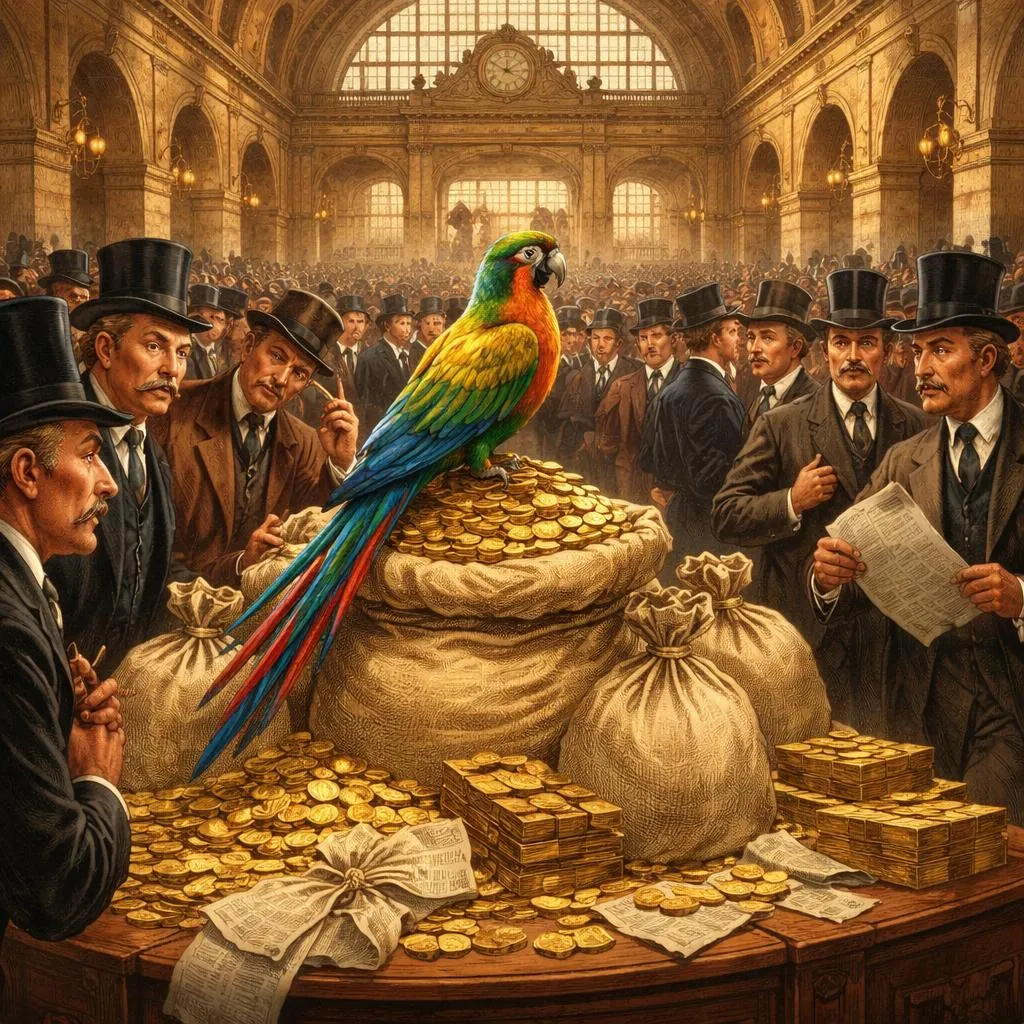

Phileas Fogg rightly suspected that his departure from London would create a lively sensation at the West End. The news of the bet spread through the Reform Club, and afforded an exciting topic of conversation to its members. From the club it soon got into the papers throughout England. The boasted "tour of the world" was talked about, disputed, argued with as much warmth as if the subject were another Alabama claim. Some took sides with Phileas Fogg, but the large majority shook their heads and declared against him; it was absurd, impossible, they declared, that the tour of the world could be made, except theoretically and on paper, in this minimum of time, and with the existing means of travelling. The Times, Standard, Morning Post, and Daily News, and twenty other highly respectable newspapers scouted Mr. Fogg's project as madness; the Daily Telegraph alone hesitatingly supported him. People in general thought him a lunatic, and blamed his Reform Club friends for having accepted a wager which betrayed the mental aberration of its proposer.
Articles no less passionate than logical appeared on the question, for geography is one of the pet subjects of the English; and the columns devoted to Phileas Fogg's venture were eagerly devoured by all classes of readers. At first some rash individuals, principally of the gentler sex, espoused his cause, which became still more popular when the Illustrated London News came out with his portrait, copied from a photograph in the Reform Club. A few readers of the Daily Telegraph even dared to say, "Why not, after all? Stranger things have come to pass."
At last a long article appeared, on the 7th of October, in the bulletin of the Royal Geographical Society, which treated the question from every point of view, and demonstrated the utter folly of the enterprise.
Everything, it said, was against the travellers, every obstacle imposed alike by man and by nature. A miraculous agreement of the times of departure and arrival, which was impossible, was absolutely necessary to his success. He might, perhaps, reckon on the arrival of trains at the designated hours, in Europe, where the distances were relatively moderate; but when he calculated upon crossing India in three days, and the United States in seven, could he rely beyond misgiving upon accomplishing his task? There were accidents to machinery, the liability of trains to run off the line, collisions, bad weather, the blocking up by snow—were not all these against Phileas Fogg? Would he not find himself, when travelling by steamer in winter, at the mercy of the winds and fogs? Is it uncommon for the best ocean steamers to be two or three days behind time? But a single delay would suffice to fatally break the chain of communication; should Phileas Fogg once miss, even by an hour; a steamer, he would have to wait for the next, and that would irrevocably render his attempt vain.
This article made a great deal of noise, and, being copied into all the papers, seriously depressed the advocates of the rash tourist.
Everybody knows that England is the world of betting men, who are of a higher class than mere gamblers; to bet is in the English temperament. Not only the members of the Reform, but the general public, made heavy wagers for or against Phileas Fogg, who was set down in the betting books as if he were a race–horse. Bonds were issued, and made their appearance on 'Change; "Phileas Fogg bonds" were offered at par or at a premium, and a great business was done in them. But five days after the article in the bulletin of the Geographical Society appeared, the demand began to subside: "Phileas Fogg" declined. They were offered by packages, at first of five, then of ten, until at last nobody would take less than twenty, fifty, a hundred!
Lord Albemarle, an elderly paralytic gentleman, was now the only advocate of Phileas Fogg left. This noble lord, who was fastened to his chair, would have given his fortune to be able to make the tour of the world, if it took ten years; and he bet five thousand pounds on Phileas Fogg. When the folly as well as the uselessness of the adventure was pointed out to him, he contented himself with replying, "If the thing is feasible, the first to do it ought to be an Englishman."
The Fogg party dwindled more and more, everybody was going against him, and the bets stood a hundred and fifty and two hundred to one; and a week after his departure an incident occurred which deprived him of backers at any price.
The commissioner of police was sitting in his office at nine o'clock one evening, when the following telegraphic dispatch was put into his hands:
Suez to London.
Rowan, Commissioner of Police, Scotland Yard:
I've found the bank robber, Phileas Fogg. Send with out delay warrant of arrest to Bombay.
Fix, Detective.
The effect of this dispatch was instantaneous. The polished gentleman disappeared to give place to the bank robber. His photograph, which was hung with those of the rest of the members at the Reform Club, was minutely examined, and it betrayed, feature by feature, the description of the robber which had been provided to the police. The mysterious habits of Phileas Fogg were recalled; his solitary ways, his sudden departure; and it seemed clear that, in undertaking a tour round the world on the pretext of a wager, he had had no other end in view than to elude the detectives, and throw them off his track.
Hintergrund und Einführung des Autors
Dieser Auszug stammt aus dem klassischen Roman In 80 Tagen um die Welt von Jules Verne, einem französischen Autor, der für seine wegweisenden Werke in der Science-Fiction- und Abenteuerliteratur bekannt ist. Die 1873 verfasste Geschichte fängt den Geist des 19. Jahrhunderts ein, der von der Faszination für Entdeckungen, Technologie und der Verkleinerung der Welt durch Fortschritte im Transportwesen geprägt war. Vernes lebhafte Vorstellungskraft und detaillierte Recherche machten seine Romane sowohl unterhaltsam als auch lehrreich und inspirierten Generationen von Lesern, von fernen Orten und gewagten Abenteuern zu träumen.
Überblick über die Geschichte und ihre Bedeutung
Die Geschichte folgt Phileas Fogg, einem präzisen und wohlhabenden englischen Gentleman, der darauf wettet, dass er die Welt in nur achtzig Tagen umrunden kann. Diese kühne Wette bildet die Grundlage für eine aufregende Reise voller Herausforderungen, kultureller Begegnungen und Momente der Spannung. Die Passage beschreibt die anfängliche öffentliche Reaktion auf Foggs Plan und hebt Skepsis und Unglauben von Zeitungen und der Öffentlichkeit sowie die soziale Dynamik rund um Wetten und Ruf im viktorianischen England hervor.
Foggs Reise ist nicht nur ein physisches Abenteuer, sondern auch eine Prüfung der menschlichen Entschlossenheit, des Einfallsreichtums und der Macht der modernen Technologie. Die Geschichte erforscht Themen wie Zeit, Fortschritt und den Zusammenstoß zwischen Tradition und Innovation. Sie reflektiert auch die menschliche Natur – wie die Gesellschaft auf das Unkonventionelle und Unbekannte reagiert, oft mit Zweifeln oder Angst.
Lektionen und Erkenntnisse für Schüler
-
Mut und Entschlossenheit: Phileas Foggs Bereitschaft, sich einer fast unmöglichen Herausforderung zu stellen, lehrt die Schüler den Wert von Mut und Ausdauer. Auch wenn man mit weit verbreiteten Zweifeln und Hindernissen konfrontiert wird, ist es entscheidend, sich seinen Zielen zu verschreiben.
-
Kritisches Denken und Skepsis: Die Reaktion der Öffentlichkeit zeigt, wie Menschen Ideen oft aufgrund ihrer eigenen Erfahrungen und Vorurteile beurteilen. Die Schüler können lernen, neue Ideen sorgfältig zu bewerten, aber auch offen für Möglichkeiten zu bleiben, die über die aktuellen Grenzen hinausgehen.
-
Die Bedeutung von Planung und Anpassungsfähigkeit: Foggs Reise hängt von präzisem Timing und Koordination ab, aber unerwartete Ereignisse gefährden seinen Erfolg. Dies unterstreicht die Notwendigkeit einer sorgfältigen Planung und der Fähigkeit, sich anzupassen, wenn die Dinge nicht wie erwartet verlaufen.
-
Kulturelles Bewusstsein: Auf seiner Reise um die Welt begegnet Fogg verschiedenen Kulturen und Umgebungen. Dies ermutigt die Schüler, die globale Vielfalt zu schätzen und Empathie und Neugier für andere Lebensweisen zu entwickeln.
-
Die Rolle der Technologie: Die Geschichte zeigt, wie technologische Fortschritte (wie Eisenbahnen und Dampfschiffe) die Gesellschaft verändern können. Die Schüler können darüber nachdenken, wie sich Innovation auf das tägliche Leben auswirkt und wie wichtig es ist, Veränderungen anzunehmen.
Anwendung dieser Lektionen im Leben und Lernen
-
In der Schule: Die Schüler können Foggs Beispiel anwenden, indem sie sich anspruchsvolle, aber erreichbare Ziele setzen, ihre Zeit gut einteilen und Schwierigkeiten in ihrem Studium überwinden.
-
In sozialen Situationen: Foggs ruhiges und respektvolles Auftreten, trotz Kritik, lehrt die Bedeutung von Selbstvertrauen und Integrität, wenn man Gruppenzwang oder Skepsis ausgesetzt ist.
-
In der persönlichen Entwicklung: Das Annehmen neuer Erfahrungen und das Lernen von verschiedenen Kulturen kann den eigenen Horizont erweitern und Aufgeschlossenheit fördern.
Förderung positiver Eigenschaften aus der Geschichte
-
Resilienz: Wie Fogg sollten die Schüler lernen, sich von Rückschlägen zu erholen und weiterzumachen.
-
Neugier und Erkundung: Die Förderung eines Abenteuergeistes beim Lernen – sei es durch Lesen, Reisen oder neue Hobbys – kann das Leben bereichern.
-
Respekt vor anderen: Das Verstehen und Wertschätzen von Vielfalt, wie Fogg es auf seinen Reisen tut, hilft, bessere Beziehungen aufzubauen.
Reflexion und Wertschätzung
Das Lesen von In 80 Tagen um die Welt lädt die Schüler ein, sich den Nervenkitzel des Abenteuers vorzustellen und gleichzeitig kritisch über die Herausforderungen von Wandel und Fortschritt nachzudenken. Es ist eine Geschichte, die den menschlichen Einfallsreichtum und den Wunsch, Grenzen zu überschreiten, feiert und die Leser dazu inspiriert, groß zu träumen und mutig zu handeln. Durch Foggs Reise gewinnen junge Leser nicht nur Unterhaltung, sondern auch wertvolle Lektionen, die sie ermutigen, in ihrem eigenen Leben mutig, nachdenklich und offenherzig zu sein.
